Event Type: Station‑Scale Tech Fey Outage / Botnib Cascade Scenario
The Twelve‑Minute Blackout at Kestral Spindle is the textbook example of what happens when botnibs stop being cute UI glitches and start riding your power grid.
Kestral Spindle Station was a mid‑Resurgence logistics node hanging off a busy Inner/Outer transfer route, its overworked reactors feeding dockside yards, slipways, and a tangle of tenant habitats. Years of incremental upgrades, deferred maintenance, and creative “temporary” patches left its power web full of hot spots and jury‑rigged taps. On GD‑30.6.03 Parallax 44, those weaknesses met the wrong kind of Rift echo.
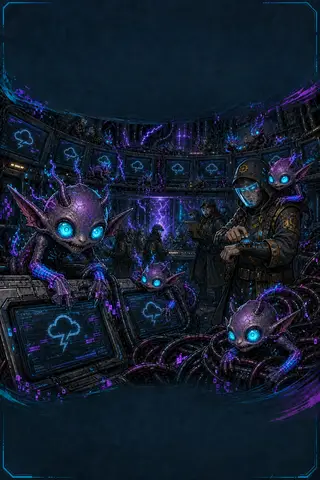
At 03:17 station time, a local load‑balancing routine failed to resolve a spike in tug‑dock demand and instead began oscillating power between two reactor spines. The jitter created high‑frequency glitch signatures in one overtaxed tap—exactly the kind of “static” Undersong‑born tech fey, already known from survey incidents, liked to use as seed crystals for their bodies. Within seconds, a botnib troupe had coalesced in the tap’s maintenance void, weaving themselves out of flickering fields and scorched circuit paths, then following the station’s own load‑balancing software as a highway into adjacent nodes.
What followed is logged in every engineering guild curriculum as the Twelve‑Minute Blackout of Kestral Spindle. Across the station, every status panel, wall repeater, and public holosurface blinked to the same display: looping cartoon storms over a capering gremlin silhouette, accompanied by bursts of static laughter. Lighting dropped to emergency strips, mag‑locks cycled unpredictably, and life‑support handling shifted into a fail‑safe hibernation mode. For exactly twelve minutes, Kestral Spindle functioned as a haunted maze—gravity hiccups, door misfires, tram collisions avoided by seconds, and dozens of minor injuries as people stumbled through a station that refused to behave.
Then, as suddenly as it began, full power and normal HUDs snapped back. Post‑incident forensics by Chronologist observers and guild engineers traced the cascade to the colonized reactor tap: botnibs had used glitching components as anchor points, then piggy‑backed on load‑balancing code to propagate timing faults and localized brownouts station‑wide. Cleanup teams recovered melted boards and charmingly obscene gremlin graffiti inside shielded junctions, but no intact botnib cores—only a new category in station risk registers and PI‑scented nightmares in power crews.
Treat a botnib cascade as an environmental hazard that, each round/turn, randomly disables or misbehaves one subsystem: doors, weapons, grav, sensors, life‑support, etc. Damage is minor, but positioning, timing, and plans get shredded.
Introduce “Kestral‑grade” engineering upgrades that grant bonuses to resist such cascades (extra redundancy, analog overrides, or charm‑like ward routines) at the cost of Yoms and mass.
Use a Twelve‑Minute Clock in tense scenes: once it fills, the anomaly burns out—whether or not the PCs solved the underlying problem. Success is measured by how much permanent damage, data loss, or political fallout they prevented before the clock expired.
Primary Functions in Campaigns:
A canonical template for short, intense station‑wide crises driven by tech fey rather than sabotage or straight malfunction.
A reason every serious yard, dock, and Metronome‑hosting facility has “gremlin‑safe” power‑routing diagrams, watchdog daemons, and emergency analog hand‑offs baked into design.
A ready‑made flashback or simulation scenario used in guild training briefs that PCs can be dropped into—either as historical reenactment or as a new echo of the same pattern.
Botnib Cascade Failure Pattern
Unlike single‑system gremlin infestations, the Kestral event showed that botnibs can weaponize infrastructure logic itself—riding automatic balancing and redundancy routines to produce synchronized chaos rather than random glitches. Twelve minutes of outages across hundreds of subsystems with zero confirmed kills but a long tail of “unexplained faults” became the textbook “botnib cascade failure” signature.
Time‑Boxed Anomaly
The blackout’s precise twelve‑minute duration attracted Chronologist interest. Later analyses suggest the troupe’s stability window matched a specific Undersong micro‑cycle; once that cycle lapsed, the power signature they depended on collapsed and the botnibs either dispersed back into the Rift’s ambient noise or fell dormant in hardware that later had to be scrapped. The incident becomes a case study in short‑lived but intense temporal‑Devotional overlaps.
Cartoon Storms as Warning Glyph
The looping storm‑and‑gremlin display evolved into a semi‑formal hazard icon across Starfall. Engineers and Navigators now use stylized “Kestral storms” on dashboards and manuals to flag botnib‑susceptible circuits, gremlin quarantine modes, or software that has history with Undersong interference.
Significance
Guild Training Sim: PCs could be contracted by an engineering guild to stress‑test a new anti‑botnib protocol, running live drills on a working station modeled on Kestral Spindle. The focus is on procedure, triage decisions, and keeping civilians calm while systems misbehave.
Forensic Reconstruction: Chronologists hire PCs to re‑audit the Kestral incident logs, suspecting that during the blackout someone used the chaos to slip contraband or fugitives through—hidden behind botnib‑induced telemetry noise. The mission is mostly investigation, log analysis, and interviews with aging witnesses.
Legal & Insurance Mediation: Arbitration teams (or Arbiter‑adjacent PCs) mediate liability claims between the station, its power guild, insurers, and injured tenants, using the Kestral case law as precedent for classifying botnib cascades as “act of Rift” vs. preventable negligence.
Aftermath
After Kestral Spindle, engineering guilds, Chronologists, and station architects folded “botnib cascade” scenarios into standard doctrine. New builds and major refits include:
Gremlin‑rated reactor taps: smoother load curves, sacrificial glitch sinks, and physically isolated control paths so micro‑cyclones have fewer anchor points.
Cartoon‑storm test suites: firmware packages that deliberately simulate Kestral‑style gremlin overlays during dry runs to see which subsystems fail gracefully and which spiral into chaos.
Permanent “Unexplained Faults” Lines: budged‑in allowances for a certain number of irreconcilable anomalies per cycle, no longer waved away but tracked as a metric—stations that exceed their botnib‑class faults get flagged for Chronologist and Viridian review.
For everyday spacers, “we had a Kestral Twelve” becomes shorthand for short, terrifying, but ultimately survivable bursts of chaos—good bar stories, bad maintenance reports. Some stations run tongue‑in‑cheek “Blackout Festivals” each cycle to mock the event, while power crews quietly double‑check their gremlin baffles the night before.
The Twelve‑Minute Blackout of Kestral Spindle turned a station’s worst twelve minutes into a permanent change in how the galaxy thinks about power grids, tech fey, and the thin line between “harmless glitch” and Rift‑born disaster.
GD‑30.6.03 Parallax 44