Trench Warfare
"Over the last four hundred years of conflict in Nullius Terram, the Legion of Justice has advanced its front line by perhaps twenty feet." — from the chapter on Shavarath in Exploring Eberron, describing the plane of war's largest layer
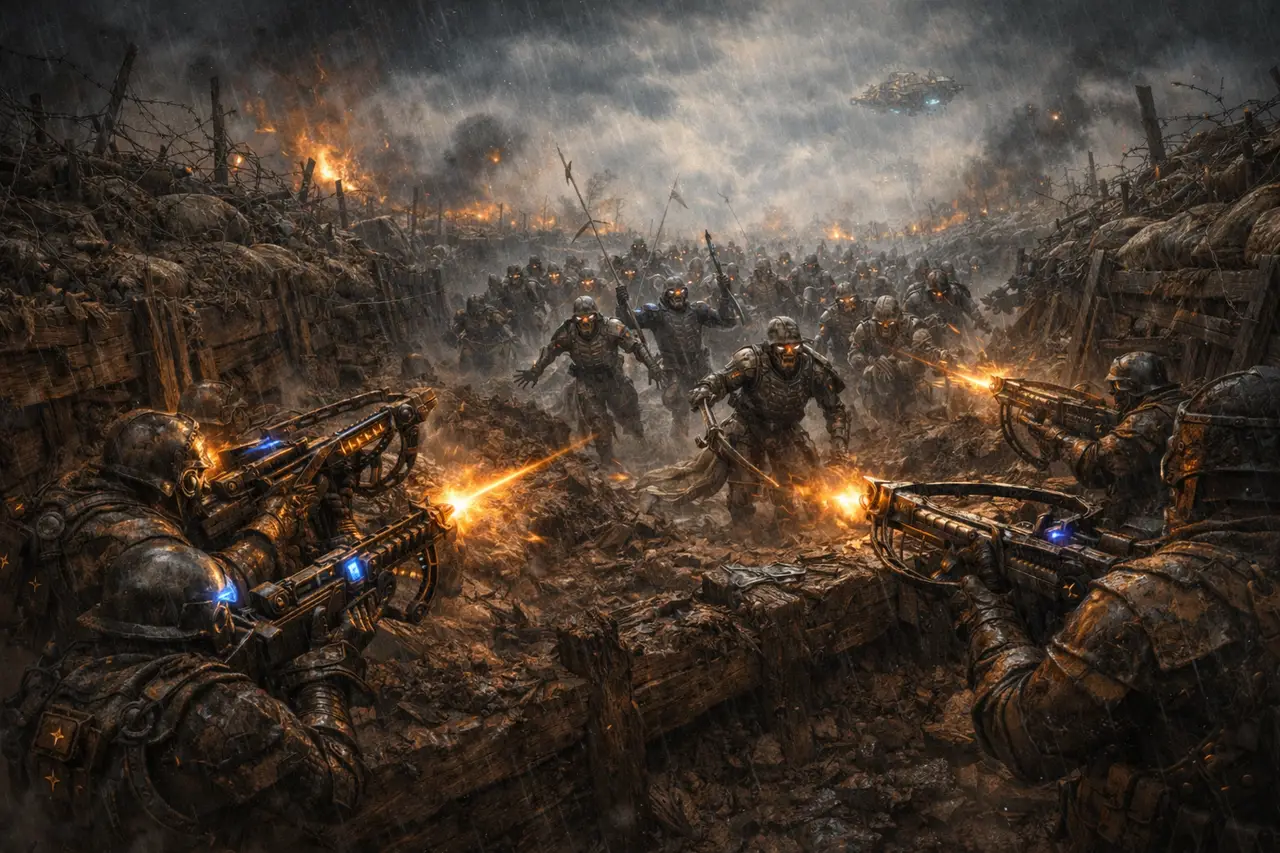
Trench warfare emerged in the middle decades of the Last War not as a strategy but as a confession. It was what happened when armies stopped trying to win and started trying to survive. When siege staffs could bombard a formation from over a thousand feet, when blast disks turned the approaches on every fortified position into invisible killing grounds, when the cost of crossing open ground to a prepared enemy line exceeded anything a general could justify — soldiers went underground. They dug, and they kept digging, and eventually the trenches became the war.
The fronts that hardened into earth and stone in the war's long middle period had names. Veterans spoke of them the way civilians spoke of cities — the Thrane line, the Karrnathi salient, the Breland break. Soldiers who had served multiple postings could read the differences at a glance: Karrnathi trenches were broader and deeper, built to accommodate both living soldiers and the undead that rotated through their ranks without needing sleep, food, or light; Thrane lines clustered around fortified stone chapels that served as bunker and barricade both, the Flamic architectural style — soaring arches and high ceilings — repurposed for a grimmer kind of devotion; Aundairian positions were threaded with ward anchors and counterspell stations, the ground above them crackling faintly with prepared defences against siege staff barrages. Each nation dug according to its character. The mud was the same everywhere.
Exposure
Our brains ache, in the merciless damp trench-winds that knive us . . . Wearied we keep awake because the night is silent . . . Low drooping ward-flares confuse our memory of the salient . . . Worried by silence, sentries whisper, curious, nervous, But nothing happens.
Watching, we hear the mad gusts tugging on the wire, Like twitching agonies of men among its brambles. Northward, incessantly, the distant spellfire rumbles, Far off, like a dull rumour of some other war. What are we doing here?
The poignant misery of dawn begins to grow . . . We only know war lasts, rain soaks, and clouds sag stormy. Dawn massing in the east her melancholy army Attacks once more in ranks on shivering ranks of grey, But nothing happens.
Sudden successive flights of bolts streak the silence. Less deadly than the air that shudders thick with ash, With sidelong flowing drifts that flock, pause, and renew, We watch them wandering up and down the wind's nonchalance, But nothing happens.
Pale grit with fingering stealth comes feeling for our faces— We cringe in holes, back on forgotten dreams, and stare, trench-dazed, Deep into broken earthworks. So we drowse, spell-dozed, Littered with embers trickling where no birds remain. —Is it that we are dying?
Slowly our ghosts drag home: glimpsing the sunk fires, glozed With crusted dark-red jewels; faint charms hum there; For hours the innocent rats rejoice: the trench is theirs; Doors and hearths all closed: on us the doors are closed,— We turn back to our dying.
Since we believe not otherwise can kind fires burn; Nor ever suns smile true on child, or field, or fruit. For gods long silent, our love is made afraid; Therefore, not loath, we lie out here; therefore were born, For faith itself seems dying.
Tonight, this cold will fasten on this mud and us, Shrivelling many hands, and puckering foreheads crisp. The recovery detail, picks and shovels in shaking grasp, Pause over half-known faces. All their eyes are dull, But nothing happens.
Contributed by Wilfard ir'Owen, Lieutenant of Cyre, 3rd Crownwatch Battalion, written during trench service on the Karrnathi front (Deceased on the Day of Mourning)
The Ground Between
Between any two hardened trench lines lay what soldiers simply called the ground — an expanse of contested earth that both sides had spent months and years making as lethal as possible to cross.
Blast disks were the defining feature of that ground. Nine inches of layered metal inlaid with dragonshards, buried ankle-deep in mud, armed with proximity triggers that detonated when a creature entered a set radius or when contact was made and then broken — they were invisible, patient, and essentially permanent until their dragonshards shattered on detonation. All nations planted them. All nations lost soldiers to their own forgotten fields. The standard model detonated in a twenty-foot burst of force or fire, but the nation-specific variants made every stretch of contested ground a different kind of terrible. Aundairian dragonhawk squads had seeded the approaches with cloudkill disks dropped from altitude. Thrane had planted radiant-damage disks designed to scour any Karrnathi undead that crossed the line, and toward the end of the war was developing dawn disks whose full capabilities were never deployed. And the Karrnathi variant — developed during the ascendancy of the Blood of Vol — was something worse than any of them: it dealt necrotic damage to living targets first, then triggered a danse macabre effect, animating the killed as hostiles that turned on the survivors. A single Karrnathi disk could turn three dead soldiers into three enemies. Recovery operations into disk-heavy ground were not merely dangerous — they were potentially self-defeating, as the dead you went to retrieve could rise as the thing you were trying to stop.
Finding a buried disk required an Intelligence (Investigation) check equal to the DC of whatever skill the planter had used to conceal it — Wisdom (Nature) for disks hidden among roots and undergrowth, Dexterity (Sleight of Hand) for those buried in loose soil. Disarming one required proficiency in Arcana and thieves' tools, with a Dexterity check against the disk's save DC. If the check failed by five or more, the disk detonated. Successfully disarming a disk expended its charge, rendering it inert — cold comfort, but better than the alternative.
Untriggered blast disks remain in the ground across former front lines to this day. Under the Code of Galifar, blast disks are illegal for civilians to own or carry, and House Cannith will not sell them to civilians openly — but the ground does not care about the Code of Galifar. Farmers who try to reclaim land near old borders turn them up with plows. Travellers who leave the road in contested regions sometimes never return. The clearing work is slow and expensive, and most nations cannot afford to do it at scale. Most former front lines have simply been abandoned.
Beyond the disks, the approaches were seeded with mundane wire, sharpened stakes, and ritual warding glyphs that denied movement to anyone not carrying the right counter-charm. Siege staffs on both sides maintained intermittent bombardment — not to achieve anything specific, but to keep the other side afraid to show their heads. A blast staff could hit a formation in a wide burst from over a thousand feet away; a focus staff could amplify a fire bolt to 600 feet of effective range, and 1,200 at long range. Against soldiers in trenches who were, by design, stationary and exposed, this was not a battle. It was erosion. The blast craters left behind became their own tactical features: soldiers learned to move from crater to crater, using the depressions for cover, curling into the bodies of the last assault when there was nothing else to hide behind.
The ground between was also where the dead accumulated. Most armies had some recovery capacity, but the mathematics of trench warfare made sustained recovery impossible. The bodies stayed, and the rats — and in Karrnathi zones, the colour-coded skeletal labourers detailed to logistical work by the Ministry of the Dead's bone wranglers — moved among them without concern.
FROM A LETTER HOME — unsigned, found in the effects of a deceased Brelish corporal, Vathirond garrison: "They told us the disks were cleared. They were not cleared. Hallam stepped on one at dusk. We found most of him. The rest of him found us — the Karrns had seeded the field with the kind that brings them back. We lost Hallam twice in one night."
Nullius Terram
Arcane scholars and clerics who study Shavarath — the Eternal Battleground, the plane of war that has existed since the moment of creation — have noted that its largest layer bears a particular resemblance to the trench fronts of the Last War's middle decades.
Nullius Terram is a battlefield the size of a small nation. It is divided by several deep, heavily fortified trench lines that twist and curve throughout the region, separated by blasted scorched earth, blast craters, and bones. Strategic outposts lie in the lands between the trenches. The layer is marked by constant barrages and terrible tools of mass destruction — widescale cloudkill, curses that transform conscripts into killers, and worse. Three legions — Tyranny, Cruelty, and Justice — contest this ground. Justice holds a difficult position but has been slowly gaining strength. Periodically, the commanders send troops to clash in the fields between the lines, in simple skirmishes or full offensives that go nowhere. Ultimately, the theme of Nullius Terram is slow, agonising stalemate, and the suffering that war inflicts on both the land and the soldiers who fight it.
Nullius Terram's time flows differently from the Material Plane: for every ten minutes that pass in the layer, only one minute passes on Eberron. A soldier could spend months in those trenches and find that less than three days had elapsed at home. The war in Shavarath began at the moment of creation and will continue to the end of time. Its primary combatants are immortal, and fallen soldiers return within a day or so. Over the last four hundred years of conflict in Nullius Terram, the Legion of Justice has advanced its front line by perhaps twenty feet.
Whether the Last War shaped Shavarath — whether a century of trench horror on Khorvaire left some impression on the plane of war itself, reinforcing or deepening the image of Nullius Terram — is a question that theologians decline to answer on the grounds that they find the implications upsetting. The canonical understanding of the planes holds that each layer reflects an idea of war, not a specific historical conflict. But the resemblance between what soldiers endured on the Aundair-Thrane border and what the immortal conscripts of Nullius Terram endure for eternity is too precise for scholars to dismiss comfortably. The resemblance is noted. No conclusion has been reached.
What the Trenches Did
The psychological literature of the Last War has not caught up to what the trenches actually produced in the soldiers who survived them. The official vocabulary available — cowardice, fatigue, moral weakness — was developed for a different kind of war and does not describe what trench service did to a person's relationship with time, with progress, with the question of whether anything they were doing had any connection to any outcome anyone could still articulate.
Spell-daze — the dissociative state produced by prolonged exposure to ambient magical discharge, ward interference, and the low-grade arcane contamination of heavily worked battlefields — was not formally recognised as a condition until well into the war. Even then, it was treated as a discipline problem more often than a medical one. Soldiers who could not maintain composure after months of trench rotation were documented as unfit, reassigned, or in some commands simply returned to the line on the theory that there was no better cure for fear of the trenches than more trenches. The House Jorasco healers stationed behind the lines were equipped to mend wounds and cure diseases, but the condition that trench service produced was neither a wound nor a disease — it was something the existing frameworks of both medicine and military discipline had no language for.
Karrnathi commands faced a version of this problem with an additional dimension that made it uniquely corrosive: their living soldiers served alongside undead raised through the Odakyr Rites. The Karrnathi undead needed no sleep, felt no fear, required no rotation, and could stand motionless at a post for days with no effect on their operational capability. They did not suffer from spell-daze. They did not complain. They did not need to be told why they were fighting. For months at a stretch, living Karrns watched their dead comrades perform with an endurance no living soldier could match, and understood implicitly what the army thought of human limitation. Every skeleton that held its position without flinching was a silent rebuke to the living soldier beside it who could not.
MEDICAL NOTATION — House Jorasco field station, Thrane border, 971 YK: "Pvt. Sorn Kellam, 12th Brelish Infantry. Third presentation in six weeks. Soldier reports inability to sleep without ward-flare illumination. States that silence is 'worse than bombardment' and that periods without incoming fire produce greater distress than active shelling. Physical examination unremarkable. Recommend return to duty. [Handwritten addendum in different ink:] Fourth presentation. Patient found standing motionless at the latrine block at 0300, facing the trench wall. Did not respond to verbal commands for several minutes. When he spoke, he asked whether the war was still happening. Recommend reassignment to rear echelon. Request denied by battalion command."
The Crying Fields
The Aundair-Thrane border produced the war's most documented example of how trench fronts transformed landscape into something that outlasts the soldiers who made it.
The farms along that border — once among the most productive in central Khorvaire, the fertile land that fed both nations before the war set them against each other — were held, contested, shelled, burned, recaptured, shelled again, and finally abandoned. The countryside that emerged is known today as the Crying Fields.
The Crying Fields are permanently scarred by magic and haunted by restless spirits. Aundairian mages who have surveyed the region report that the soil itself seems to resist recovery — arcane contamination from years of siege staff bombardment, blast disk detonations, and sustained ward magic has altered something fundamental about the land. Aundairian war magic created a blasted wasteland between the two nations; to the east, the conflict with Karrnath left farms and cities like Shadukar devastated and home only to lingering undead. Nothing grows cleanly in the Crying Fields. The contamination is not a curse that can be lifted — it is the cumulative residue of a decade of magical warfare soaked into the earth, and no one knows how to draw it out.
The spirits are not aggressive in the manner of Mabaran-raised undead; they are Dolurrhi, caught in the incomplete way that violent sudden death produces, still living the final moment of whatever assault or defence killed them, unable to process that the war is over. Travellers who spend the night near the Crying Fields report hearing whispered orders, distant commands, the sound of something moving through mud. In the morning, the fields are quiet.
No one has reclaimed the Crying Fields. The land is technically part of Aundair. Aundair shows no urgency to rebuild there. This is not because of the ghosts — ghosts can be dealt with. It is because of the blast disks still buried in the mud, the glyphs still active in the walls of collapsed dugouts, and the ward anchors still humming at intervals through positions no one mapped before the command structure collapsed. Clearing it would take years and significant arcane resources that the post-war treasury cannot allocate to farmland that might not be salvageable anyway. The Crying Fields will continue to cry for some time yet.
OVERHEARD IN A FAIRHAVEN TAVERN — attributed to a Reacher druid, visiting the capital: "You people pour magic into the soil like poison and then wonder why the land won't feed you. The land isn't broken. You broke it. The land is doing exactly what damaged land does — it's telling you what you did. You just don't want to listen."
The Warforged Line
The warforged altered trench doctrine in ways that commanders found useful and that historians find disturbing.
A warforged soldier does not suffer from spell-daze. It does not need to rotate off the line for sleep. It does not fear the dark, the mud, the cold, the waiting, or the blast disk fields it walks through on assignment. It does not need to eat, to drink, to be told why it is fighting, or to be convinced that the war is worth fighting. The Treaty of Thronehold granted the warforged the rights of sentient beings, but during the war they were treated as matériel — ordered, deployed, billed for at standard Cannith rates, and replaced when destroyed by the next allocation from the supply chain. A warforged imprints on its commanders and follows general instructions with adequate tactical judgment — "hold this position," "patrol this section," "advance when the bombardment lifts" — and executes those instructions until it is destroyed or countermanded.
What the warforged cannot do is tell you when a situation has changed in a way that makes the original order no longer coherent. A warforged ordered to hold a position will hold it past the point where any living commander would have recognised that the position was lost and ordered a withdrawal. The typical warforged shows little emotion; many embrace a concrete purpose and pursue it as they once pursued war. That purpose, in the trenches, was to hold. And they held.
The trench commands that deployed warforged at high operational tempo understood they were purchasing endurance at a specific price — the loss of the judgment that tells a soldier when to stop. Most accepted this trade. The warforged held their sections. They absorbed the casualty rates that would have broken a living unit. They were replaced, when they fell, by the next allocation from Cannith's forgeholds, because the creation forges that produced them ran continuously until the Treaty ordered them destroyed.
The warforged who survived the war carry that service with them into peacetime. Many were still in their assigned trench positions on the day the Treaty was signed, waiting for orders that took weeks to arrive because the command structures that should have recalled them had been destroyed in the final offensives. They held ground that no longer mattered, in a war that was technically over, because no one had told them otherwise. Now they walk through a world at peace, freed by a treaty they had no voice in signing, searching for a new purpose — and carrying, in whatever serves them for memory, the knowledge of what it was to stand in a trench and hold the line while the living soldiers beside them rotated away and the dead ones did not.
RECOVERED WARFORGED OPERATIONAL LOG — designation unknown, found in an abandoned trench position near Vathirond, 997 YK: "Day 847. Position held. No contact. No orders received. Bombardment ceased on Day 641. Last command: hold. Holding. Query: is the war still happening? No response channel active. Holding."
Legacy
Former trench lines are visible across Khorvaire wherever the war hardened into stalemate — which is to say, across much of the interior. Some have been partially reclaimed. Most have simply been avoided, their ground too contaminated, too dangerous, and too full of unresolved things to make reclamation practical.
What the trenches left behind is not primarily physical. It is a generation of survivors who know, with a certainty no peacetime civilian can share, what it feels like when nothing happens for long enough that the question are we dying? stops feeling rhetorical. They know what it is to move through a field of buried blast disks, testing each step, aware that the ground itself is armed. They know what it is to watch, at two in the morning, the ward-flares sink and gutter at the edge of the salient, and to understand in that moment that nothing separating you from the enemy is trustworthy — not the dark, not the silence, not the temporary ceasefire that someone's command arranged for prisoner exchanges and has theoretically been in effect for six days.
The Crying Fields still cry. The disks are still buried. And men and women who survived the trenches walk through cities that have no particular interest in what they learned there, past memorials that summarise in three lines what took three years to live, toward a peace that everyone says will hold and that those veterans, who have developed a specific and well-founded relationship with optimism, do not entirely believe.
MEMORIAL INSCRIPTION — Fairhaven War Memorial, unveiled 997 YK: "To those who held the line."
GRAFFITI — scratched beneath it, date unknown: "Which one?"