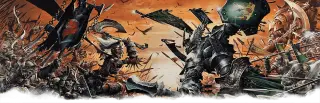
Early War and Late War
"There are two histories of the Last War. One is the history of battles and treaties and the rise and fall of kings. The other is the history of when people stopped believing the war had a purpose and kept fighting anyway. The second history is the one that matters, and almost nobody writes it down." — Provost Tara Haldren, Morgrave University, lecture on periodisation
When people talk about "the Last War," they often speak of it as a single thing — a conflict with a beginning, a middle, and an end. That framing is understandable and almost entirely wrong. The Last War lasted a hundred and two years. What began in 894 YK on the steps of Galifar's succession was a dynastic quarrel between royal heirs who had grown up in the same palace, trained at the same academies, and served in the same kingdom. What ended in 996 YK with the Treaty of Thronehold was something categorically different: a continental system of military, political, and economic institutions that had become self-sustaining, that had produced its own internal logic and its own momentum, and which no single decision or victory could have resolved even if one had been achieved.
Understanding the difference between the early war and the late war is not an academic exercise. It is the difference between a world that remembers what it was fighting for and a world that does not. The people who live in post-Treaty Khorvaire are products of the late war, not the early one, and the assumptions they carry — about the houses, about the nations, about what peace means and how long it will last — are assumptions shaped by the war's exhausted final decades, not by the principled disputes that started it.
The War That Could Have Been Short
The conflict began as a question with a legal answer. King Jarot died on 12 Therendor 894 YK, and Galifar's succession law was unambiguous: Mishann, his eldest child and governor of Cyre, was the rightful heir. The question was not disputed as a matter of law. It was disputed as a matter of will.
Kaius of Karrnath had conspired with his older brother Thalin of Thrane to deny Mishann the throne — Khorvairian scholars now broadly agree that Kaius supported Thalin's claim chiefly because it was the only route by which Kaius himself could eventually reach power. Alongside declaring Karrnath's independence, Kaius instituted a new system of laws known as the Code of Kaius, mandated military service, and immediately marched on both Aundair and Cyre. Wroann of Breland declared her own claim independently. Only Wrogar of Aundair backed his sister. The alliance between Karrnath, Thrane, and Breland held in the opening years, largely because geography prevented them from fighting each other directly. They had not yet become enemies. They were still, in some sense, rivals to the same disputed inheritance.
Cyre entered the war with genuine confidence. Mishann had centuries of precedent behind her claim. The nation controlled the treasury of Galifar, had the finest artificers in the kingdom — the seat of House Cannith and House Phiarlan, second only to Aundair in arcane sophistication — and believed, correctly in principle, that it had the best of everything. The early Cyran literary scene imagined a brief war followed by reunification and wrote works speculating about the technological and artistic advances that would bloom in a restored Galifar. The art of early-war Cyre was broad, sweeping, and optimistic. Filigree designs pushed the limits of material engineering while precious gems and dragonshards added glimmering light to spectacular creations. These works were full of hope.
The Karrnathi war machine had its own early confidence, and its own early shock. Chronic plagues and famine struck Karrnath almost from the opening of hostilities, undermining the swift campaign Kaius I had planned. For all his work strengthening Karrnath's armies, he could not march them through Aundair and Cyre as he had envisioned if they were starving faster than they could fight. By 896 YK he had accepted a desperate bargain: Lady Illmarrow of Farlnen approached Kaius with a deal — she would bring an end to the famines and plagues so long as Kaius made the Blood of Vol the state religion and established the Order of the Emerald Claw as a knightly order. Kaius took the deal. The alliance with necromancy would define Karrnath for the rest of the war and beyond.
That framing — the dynastic dispute, the legal question, the recognisable siege warfare of professional royal armies with noble officers and flags and family crests and the vocabulary of legitimacy — would not survive the decade.
FROM A CYRAN LITERARY JOURNAL — published Metrol, 897 YK: "When the present misunderstanding is resolved — and it will be resolved, for law and tradition and the weight of history all favour us — the citizens of a restored Galifar will look back on these months as the brief fever that preceded a greater flowering. The question is not whether Mishann will prevail. The question is what wonders we will build when she does."
The Pivots
The first decade and a half of the war produced the transformations that foreclosed any quick resolution.
The arrival of the war had an immediate economic impact on Cyre, which had been the kingdom's cultural and commercial heart. The mithral needed for the filigree art Cyre was famous for, as well as many gemstones, had been imported from eastern Karrnath — now the Mror Holds. Dragonshards, the lifeblood of both art and artifice, were the first resource drafted to the war effort and were no longer available for artistic purposes. With limited resources, the Cyran art scene was forced to evolve in both material and tone. Some artists persevered in hoping for a quick resolution. The Cyran literature scene especially liked to ponder on the magical, scientific, and technological advances in a utopian post-war Galifar.
In 906 YK, the arrival of Tairnadal mercenaries, hired by Cyre to bolster its forces, created a surge of interest in elven foreign lands and culture — interest that would sour catastrophically when those same mercenaries betrayed their employers fifty years later.
In 908 YK, Queen Mishann was assassinated. The canonical Cyran hope — that the war was temporary, that the rightful queen would prevail, that the best of Galifar would be preserved — died with her. Almost all artists gave up on the dream of a quick and easy victory. State-sponsored music replaced utopian fiction, urging citizens to band together through shortages as material was diverted to the war effort. The nobles continued commissioning retrospective work celebrating glory days that were receding fast. The optimism of 894 had already become a kind of mourning.
In 910 YK, Kaius I died under mysterious circumstances — later alleged to be a consequence of his resistance to Lady Illmarrow, who had murdered his wife in retribution when he attempted to impose his own controls on the Order of the Emerald Claw. His heir and successor, Kaius II, inherited both the war and the necromantic bargain that came with it.
In 914 YK, two things happened in the same year that together mark the clearest line between the early war and the war it became. The Mror Holds declared independence from Karrnath, forming the first Iron Council — a nation wracked by plague and famine could not marshal the force to reclaim the mountains, and the crown was forced to diplomatically recognise the dwarven government, losing both tribute revenues and a significant portion of Karrnath's strategic depth. And in Thrane, King Thalin died. The Church of the Silver Flame assumed direct governance of the nation. Thrane became a theocracy. The dynastic war — which had at least nominally been about which royal heir would rule Galifar — now involved a nation that had simply abolished the role of monarch.
These events did not cause the war to change. They confirmed that it had already changed, and that no one had noticed when.
FROM A KARRNATHI BROADSIDE — Korth, 915 YK: "The dwarves have betrayed their oaths. The priests of Thrane have stolen a crown. And the treasury of Galifar feeds the armies of a dead queen's pretenders. Citizens of Karrnath: the war you were promised is over. The war you must now fight is harder, longer, and more necessary than anything your king described. Prepare yourselves. This is not the struggle of a season. This is the struggle of your lives."
What the Middle War Looked Like
By the middle decades, the nations fighting the Last War bore little resemblance to the heirs who had started it.
Professional armies had replaced feudal levies. Karrnath's Code of Kaius mandated military service for all citizens — all citizens were required to serve a minimum of two years, a tradition that predated the war but was formalised and intensified by it, with deployment commitments sometimes extended to eight years during the worst periods. Karrnath's professional officer corps had been shaped over a generation at Rekkenmark Academy. Aundair had built its wandslinger doctrine into a formal military institution, with the Arcane Congress subordinated to war research. Thrane's templars, originally tasked with defending the innocent from supernatural evil, had become the functional army of a theocratic state — its three orders of ministers, friars, and templars repurposed for a war that had nothing to do with binding fiends. Breland's industrial capacity produced standardised equipment at scale, its floating fortress Argonth patrolled threatened borders, and its King's Citadel — particularly the Dark Lanterns — had become one of the finest intelligence agencies on the continent. Cyre's military, rebuilt around the Vermishard Guard and sustained by the absolute conviction that Cyre alone was in the right, fought on every front simultaneously with a versatility that no other nation could match and an endurance that no treasury could sustain.
Each nation had rebuilt its military in its own image — and that image reflected the war's demands more than any peacetime national character.
The dragonmarked houses had adapted to this landscape and profited handsomely from it. Officially neutral, they sold services and weapons to all sides — healing to both the army that burned your village and the army defending it, at the same rate. The Korth Edicts, which had once given united Galifar meaningful leverage over the houses — barring them from owning land, holding noble titles, or maintaining standing armies — had become a formality that no fragmented nation could enforce. By the war's midpoint, every belligerent was dependent on house services in ways that made the edicts irrelevant in practice if not in name. The war had transferred power from the nations that were fighting it to the institutions that were supplying it.
The map had changed beyond recognition. In 956 YK, Tairnadal mercenaries who had been fighting for Cyre annexed eastern Cyre and declared the sovereignty of Valenar — the cultural interest the Cyrans had developed in their elven allies since 906 YK curdled into fury and dehumanising art, brooding melodies with heavy drums and strings dominating the Cyran soundscape while the visual arts took demeaning slants in their depiction of the elves who had once been employed allies. In 958 YK, the farmers of western Aundair seceded to join the druids of the Eldeen Reaches, stripping Aundair of crucial farmlands at a stroke. In 969 YK, Lhesh Haruuc Sharaat'kor led a hobgoblin rebellion and seized southern Cyre to found Darguun — goblinoid mercenaries who had been brokered by House Deneith since 878 YK turning on the nations that had armed and deployed them.
Cyre's response to these successive losses, documented in its cultural output, is the clearest record of what the middle war did to a nation's soul. The optimism had died with Mishann. The anger had burned through the Valenar and Darguun betrayals. By the late middle decades, Cyran artists had largely abandoned both hope and rage. The art had become a form of processing loss, not imagining victory. Queen Dannel — elevated to the throne at seventeen, presiding over Cyre's greatest losses over a reign of more than half a century — was lampooned in popular work as too prideful to forsake her claim, a claim that, the satirists implied, had cost the nation more than it was worth. When the ministries tried to suppress this art, they succeeded mainly in confirming what everyone suspected: that the leadership knew the situation was bad and did not want to say so. By the end of the war, the Cyran people had fallen into a deep depression, and their art reflected it — works of grief rather than defiance, elegies for a kingdom that most of its citizens had never actually lived in.
FROM THE KORRANBERG CHRONICLE — Arts Section, 982 YK: "The Cyran painter Teska Mela's latest exhibition, 'Five Empty Thrones,' has been seized by the Metrol civic authorities for 'undermining public confidence.' The works depicted each of the Five Nations' thrones as empty, crumbling, and overgrown — a commentary that, whatever its artistic merits, the crown has determined is unsuitable for public display in wartime. Ms. Mela's whereabouts are currently unknown."
The Late War
By the final decades of the Last War, the question of who would inherit Galifar's throne had become so remote from the actual conduct of the conflict that most soldiers could not have articulated what winning would mean.
Victory had been redefined — not by declaration, but by attrition. Each nation had developed a strategy not for concluding the war but for surviving it. Breland leaned on its intelligence networks and industrial capacity, fighting a war it could sustain rather than one it could win. Karrnath's undead legions — the Odakyr Rites soldiers produced at Fort Bones and the catacombs beneath Atur, raised in the powerful Mabaran manifest zones of Odakyr county — gave it reserves that required no food, no sleep, and no morale management, offsetting the losses of living troops in ways that conventional armies could not match. Aundair invested in the Arcane Congress's war research, perfecting the wandslinger doctrine and ultimately producing the wand of magic missiles barely twelve years before the war's end. Thrane's communities of faith produced soldiers who fought with conviction that discipline and gold could not replicate — archers who had been putting arrows through targets since childhood as a devotional practice, and templars who genuinely believed that dying in service to the Silver Flame was not a defeat. Cyre poured the last of Galifar's treasury into House Cannith's coffers, purchasing warforged titans in 959 YK, then modern warforged in 965 YK, then colossi in the war's final weeks — always buying what it could not grow organically, always paying premium rates to a house that remained officially neutral and sold the same weapons to Cyre's enemies.
The warforged themselves are the cleanest symbol of what the late war had become. They were created in 965 YK specifically to fight the Last War — sentient beings manufactured for a purpose, deployed into a conflict that by the time they achieved full awareness was already entering its final and most exhausted phase. They did not choose the war. They were produced by it and for it. The Treaty of Thronehold freed them, destroyed the creation forges, and granted them the rights of sentient beings. No one had given any thought to what they were supposed to do next.
The Korth Edicts, meanwhile, had effectively ceased to function. United Galifar had imposed them to keep dragonmarked houses from accumulating power that might rival the crown — no land, no titles, no armies. The divided nations of the Last War's later decades needed the houses too much to enforce those restrictions. No single monarch could afford to break ties with any of them. What will happen if one of the houses goes too far in its pursuit of profit — or if two houses go to war with each other — is one of the defining unanswered questions of the post-war era.
FRAGMENT OF A SOLDIER'S JOURNAL — recovered from a Brelish barracks, Vathirond, undated: "Sergeant Hask asked the lieutenant today what we were fighting for. The lieutenant said 'Breland.' Hask said he knew that, he meant what specifically. The lieutenant looked at him for a long time and then said 'I'll let you know when I find out.' Nobody laughed. Nobody was supposed to."
What Changed, and What Did Not
The children who were born after 894 YK and are now adults have never lived in a united Khorvaire. They have never sent a letter from Fairhaven to Korth on a lightning rail that crossed Cyre without military escorts. They grew up learning that every city has siege defences as part of its civic architecture, that food stores are maintained against the possibility of supply disruption, that the dragonmarked house enclave in your city is as important an institution as the government offices, and that the nations are not friends. A century of bitter war has divided the people of the Five Nations, but they remain bound by a common inheritance — the laws, customs, language, and shared cultural reference points of Galifar. Many look back on the united kingdom as a golden age and would willingly go to war again for a chance to reclaim it.
This is not merely a cultural inheritance. The war built institutions and those institutions persist. The Arcane Congress continues its weapons research under Queen Aurala's Arcane Initiative. Cannith East in Korth blends Karrnathi necromancy with traditional artifice under Zorlan d'Cannith's direction. The Ministry of the Dead maintains its vaults beneath Atur. The Dark Lanterns have not disbanded. The templar order has not returned to purely spiritual duties. The people who operate these institutions — the military planners, the intelligence services, the weapons researchers — have spent their careers in a world defined by the war, and are preparing, with professional diligence and without any particular malice, for the next one.
The treaty froze the war. It did not resolve it. The Mourning is the only thing that keeps it frozen. If someone proves the Mourning cannot happen again — or finds a way to reproduce it — the cold war that has replaced the hot one will thaw immediately. Everyone in a position to know this already knows it. Most of them are not saying so in public.
The early war was a dynastic dispute. The late war was a continental system that had outlived any achievable objective. The peace is an interval between those two things and whatever comes next. What changes between early war and late war, in the end, is not tactics or technology or the map. It is the answer to the question of what the nations are actually fighting for. By the end, the answer was: this. Just this. The continuation of what already exists, against the possibility of something worse.
Whether that was worth a hundred years is a question the survivors are still working out.
OVERHEARD IN A SHARN TAVERN — attributed to a Cyran refugee, 997 YK: "My grandmother was alive when the war started. She remembered Mishann. She remembered what it was about. She died in 972, still believing we would would win. My mother was alive when the Mourning came. She didn't remember Mishann. She didn't remember what it was about. She just remembered the war. There was nothing else to remember. That's what a hundred years does. It doesn't change what you're fighting for. It makes you forget there was ever anything else."