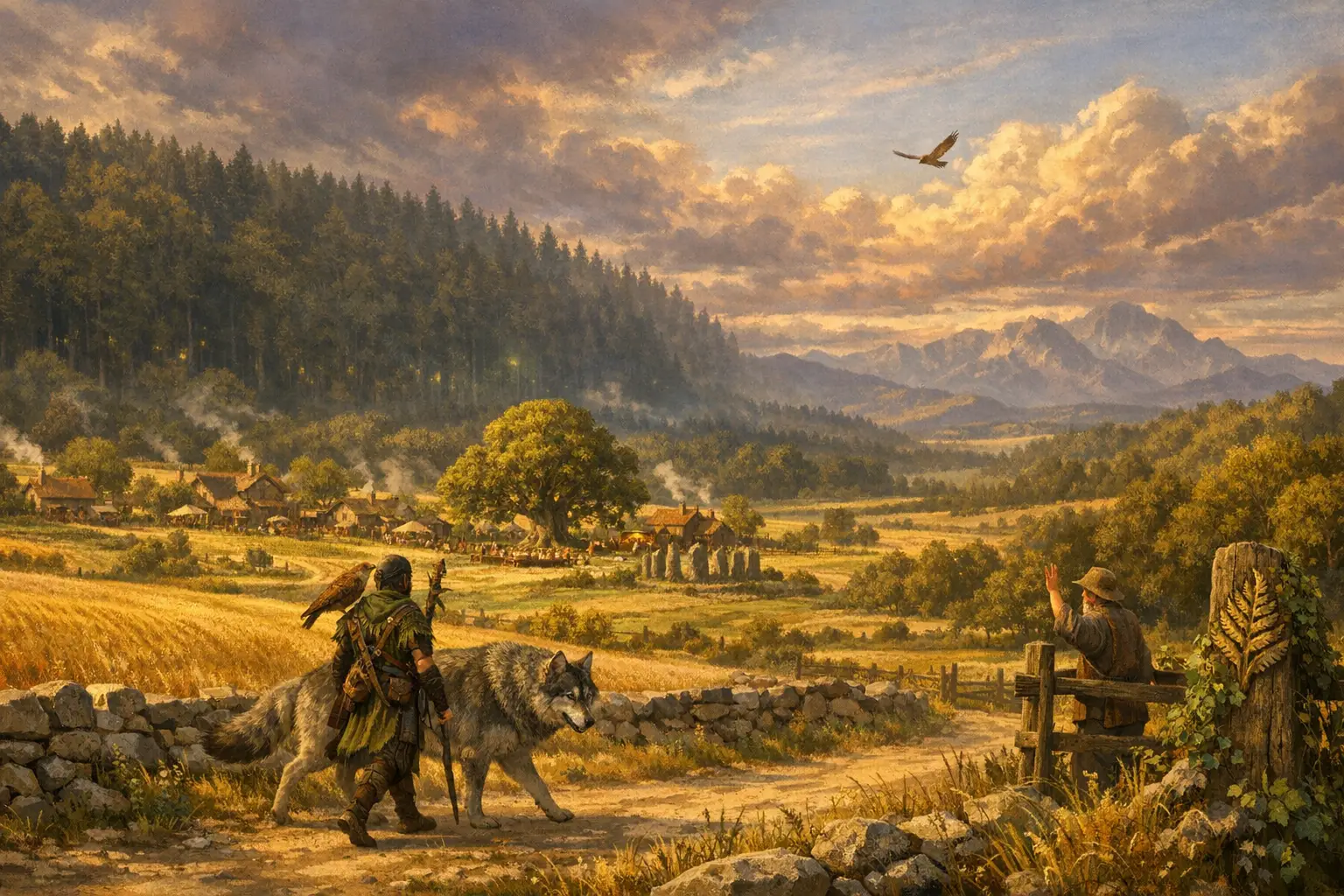
Art & Culture of the Eldeen Reaches
"An Aundairian bard came to our village and asked where the concert hall was. We took him to the meadow behind the guiding tree. He played for two hundred people, three awakened foxes, and the tree itself. Afterward, the tree told him it was the best performance it had heard in sixty years. He wept. I think he meant to stay for one night. He stayed for the rest of his days." — Reacher farmer, name unrecorded, from the field notes of a Korranberg Chronicle correspondent
Where the Art Lives
The tree said the performance was the best it had heard in sixty years. Not the best it had seen — the best it had heard, because the guiding tree is blind and has been listening to music in this meadow since before anyone in the village was born. This is the detail that tells you everything about culture in the Eldeen Reaches. The audience includes the tree. The tree has opinions. The tree remembers what the village forgets. And nobody in the meadow thinks any of this is remarkable.
Art in the Reaches is not something you go to see. It happens around you, constantly, as part of the texture of daily life — the planting song a farmer sings over the spring furrows, the trail ballad a ranger carries from village to village with the week's news encoded in its verses, the awakened raven who holds court at the inn three nights a week and whose stand-up routine about Aundairian fashion has been getting laughs for longer than most of the audience has been alive. The Reaches have no theaters, no concert halls, no galleries. They have meadows and common rooms and night fires and trees that have been listening since the world was young. If you need a building to appreciate beauty, the Reachers would say, you are not paying attention to the right things.
The Land Between Two Traditions
Forty years is not very long. The people of the eastern farmlands were Aundairian for nearly a thousand years — they speak Aundairian dialect, cook Aundairian food, celebrate Boldrei's Feast and the other Sovereign Host holidays their grandparents celebrated — and the druidic traditions that now shape their governance have not erased any of that. What has happened is a grafting: new growth on old wood. A village in the eastern Reaches might celebrate Boldrei's Feast with a communal meal at the long table and then walk to the guiding tree to give thanks before the autumn equinox rites begin. The two traditions are still learning to grow together, and the seams are visible — but seams, the Wardens would tell you, are where new growth happens.
The Towering Wood is another world entirely. Settled Warden communities build structures of earth and wood, or platforms in the ancient trees, surrounded by small groves maintained for seasonal rites. Nomadic shifter tribes following the Moonspeaker tradition live as their ancestors have for millennia — hunter-gatherers attuned to the beast within, their champions druids, rangers, and barbarians who chant stories of Grandmother Wolf and Grandfather Rat around night fires, the rhythms synced to drumming and the clapping of hands. Greensinger enclaves near the Twilight Demesne blur the line between the material world and Thelanis so thoroughly that visitors may not be sure which plane they are standing in — a Greensinger bard's performance does not merely entertain; it coaxes flowers from bare wood, draws fireflies from the dark, and makes listeners feel emotions so vivid they forget which feelings were theirs and which belonged to the song.
And the Ashbound, deep in the northern Wood, eschew all woven cloth and worked metal, wearing undyed hides and furs and decorating themselves with the remains of everything they have destroyed in nature's name — demon horns, wizard staves, aberration teeth, fashioned into cloaks and headgear of terrifying intricacy. A senior Ashbound druid wears the history of their campaigns on their body. The effect is somewhere between costume and reliquary, and it is not meant to be comfortable for the viewer.
"In Fairhaven, they wear the season. In the Reaches, we dress like the season dresses — or, if we've earned it, like the things that didn't survive the season." — Ashbound elder, at a grand conclave
The Year Turns
The calendar of the Reaches is marked by four great seasonal ceremonies on the solstices and equinoxes — daylong observances from sunup to the following dawn, filled with songs, prayers, and feasts of food appropriate to the turning: young shoots, lamb, and early wines in spring. Berries, fish, and corn in summer. Nuts, apples, venison, and squash in fall. Ale, root vegetables, and smoked meats in winter. Every village participates. Every family contributes. The druid counselor blesses every dish.
The most important rite of the year is the Ceremony of Thanks to Oalian, held at the autumn feast. Druids from across the Reaches bring a barrel of honey wine, each speaking words of blessing over the mixture and adding a pinch of soil from their home region. The celebrants carry the barrel to Oalian's grove in Greenheart and carefully pour it over the ground near the Great Druid's feeder roots, singing songs of thanks and asking wisdom for the coming year. The draft is only mildly alcoholic, which does not damage the greatpine. It does make Oalian noticeably drowsier for the next few days — a detail the druids share with the affectionate exasperation of people describing a beloved grandparent who has had one cup too many.
In the spring, senior druids visit the villages to bless the land and assess whether any young people feel the call to druidic service. Those who do are taken to Greenheart for initiation. Initiates wear robes of deep green; at the height of the ceremony they throw back the robes to reveal bright red tunics — symbolizing the harmony of animal and vegetative life. Each receives a sprig of young bracken, its tightly rolled shoot representing the growth that lies ahead. The bracken fern is everywhere in the Reaches — carved into doors, woven into cloth, carved into the bark of guiding trees. Its spreading fronds represent welcome. Its humble status as undergrowth represents the humility the Wardens prize. It is the closest thing the Reaches have to a national symbol, and it is a weed, and the Wardens consider this appropriate.
SONG — traditional, sung at the autumn equinox feast; many regional variants exist
The root drinks deep, the branch grows high,
The wind remembers what the winter forgets.
We plant the seed that feeds the child
Who plants the seed that feeds us yet.
Voices on the Wind
Music in the Reaches is communal, seasonal, and inseparable from work. Farmers sing planting songs in spring and harvest songs in fall — melodies so old that the words have shifted dialect three times and the rhythm still matches the motion of a scythe. Rangers carry trail ballads from village to village, long narrative songs that encode practical navigation information inside verses about landmarks, dangers, and notable trees — a tradition that serves the same purpose as Sivis message stations and costs nothing but a good memory and a strong voice.
The most distinctive performers in the Reaches are not human. Oalian's Voice — the network of awakened animal messengers who carry news across the nation — includes creatures who are far more than couriers. An awakened raven might arrive at a village, share news of a distant harvest, tell the tale of a ranger's encounter with a troll, deliver a new song learned from a Greensinger enclave, and then perform a ten-minute routine about the absurdity of Aundairian court fashion — all in the same visit. Awakened animals are full citizens of the Reaches. Some who have retired from messenger service have taken up permanent residence in taverns, where they hold court as storytellers, gossips, comedians, and occasional hecklers. The most popular performer in a Reacher inn may well be a crow with impeccable comic timing and a three-night-a-week residency. The crow's material is its own. The crow does not take requests. The crow has been doing this longer than you have been alive, and it knows what's funny.
What the Land Provides
Eastern Reacher cooking is Aundairian at its roots — hearty stews, fresh bread, roasted root vegetables, orchard fruits, soft cheeses, smoked meats — adapted to the rhythm of the farm and served on communal tables long enough to seat the entire village. The style is rustic and generous, and the seasonal ingredients dictate the menu with an authority that no chef would dare override: spring lamb with wild garlic, summer fish grilled over coals with herbs, autumn venison with apples and squash, winter stews thickened with roots and served with dense bread that could double as a building material if the need arose.
Goodberry wine is the Reaches' signature — pressed from druidically cultivated goodberries and carrying a faint magical warmth that provides minor restorative properties in its first pressing. The wine does not travel well; fermentation destroys the healing properties, making it a purely local treasure and a strong incentive for visitors to drink where they are rather than try to carry a bottle home. Every village produces its own variant, and Reachers debate the relative merits of their home vintage with the same passion that Aundairians devote to their arcane wines. The correct answer is always the one you are currently drinking, in the village that made it, with the people who grew the berries. Context is the final ingredient.
Deeper in the Wood, the cuisine diverges. Shifter tribes favor raw and lightly prepared game, dried fish, and gathered plants — food that can be made over a fire or eaten without one. Greensinger enclaves near the Twilight Demesne are rumored to serve foods that taste of memories or seasons that haven't arrived yet — fey-touched delicacies that are not always safe for mortal digestion. The Ashbound eat only what they hunt, fish, or gather, and they consider cultivation itself a wound to the earth. Their meals are spare, practical, and eaten without ceremony, because the ceremony was the hunt.
MENU — Autumn Equinox Feast, village of Erlaskar, 997 YK
Roast venison with crabapple glaze. River trout in clay. Squash and leek soup with rosemary cream. Three-grain bread with honey butter. Smoked pheasant. Pickled beets. Apple and walnut cake. Goodberry wine (first pressing, Erlaskar blend — healing properties active through the second cup, after that you're on your own).
The guiding tree requests that no one carve their initials into the table again.
Dressed for the Land
Warden fashion favors comfort and practicality — leather, skins, and cloth woven from plant and animal fibers, in greens and browns suited to the woodland. For the great seasonal ceremonies, Wardens adopt brightly colored robes attuned to the season: yellow for spring, blue for summer, flame orange for autumn, white with silver thread for winter. Many wear a stylized pine tree somewhere on their garb in honor of Oalian. Orcs and half-orcs with Gatekeeper ties often bear a tree-shaped scar.
In the deep Wood, the shifter tribes produce artistry in hide, bone, and primal-worked wood — carvings of totem spirits, decorated weapons, and body art that records a shifter's deeds and connection to the beast within. Tattooing and scarification are widespread across all cultures of the Wood, though the styles and meanings vary by sect and tribe. A Moonspeaker shifter's tattoos tell a different story than a Gatekeeper half-orc's ritual scars, and reading either requires knowledge that outsiders rarely possess — though asking, respectfully, is almost always welcomed. The Reachers are not secretive about their traditions. They are simply patient with people who are learning.
"A Brelish merchant asked me who enforces the law here. I told him to ask the oak tree by the bridge. He thought I was joking." — overheard in a tavern near Delethorn