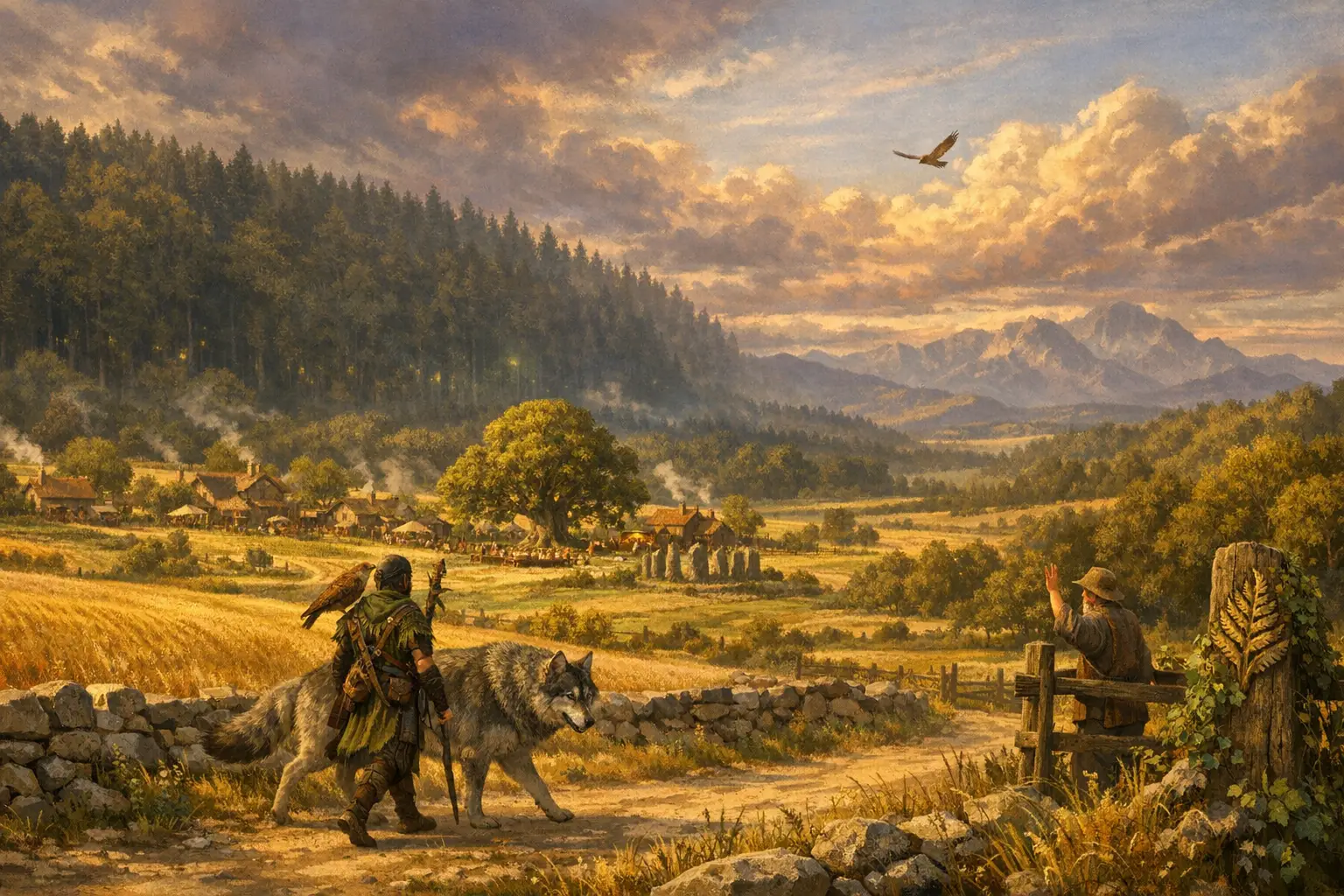
Economy & Industry of the Eldeen Reaches
"An Aundairian merchant asked me how we heat our forges without coal or bound elementals. I told him we ask the fire nicely. He didn't believe me. The fire didn't care." — Tella Greenspark, smith, Delethorn
A Primal Economy
The Eldeen Reaches are the breadbasket of Khorvaire and one of the least industrialized nations on the continent — two facts that are not contradictions but complements. Where Breland builds machines and Aundair conjures with arcane elegance, the Reaches grow things. The eastern farmlands produce grain, livestock, fruits, herbs, and cultivated goods in volumes that feed not only the Reaches but a significant portion of the continent, and they do it with druidic methods that the Five Nations find bewildering and slightly unnerving. The Reaches are not primitive — they are a primal civilization, one that has spent forty years learning to replace arcane industry with the tools that nature and druidic magic provide.
The distinction matters. Metal comes from the soil, and the people of the fields have not abandoned metalworking, carpentry, or the basic comforts of settled life. There is no inherent taboo against industry — only against industry that wounds the land without giving anything back. The Wardens of the Wood seek to reduce the environmental impact of production, not to eliminate production itself. In practice, this means primal magic does much of the heavy lifting: druids use spells to locate ore deposits, shape earth and stone, and heat metal at the forge. Where a Cannith foundry is built around an manifest zone or binds a fire elemental, a Reacher smith works with a druid who heats the iron by laying hands on it — the same primal force that produces flaming sphere in battle, channeled slowly and with care. The scope may be smaller than a Sharn foundry, but the quality is no less.
The Farmlands
Agriculture is the foundation of the Eldeen economy and its chief export. The eastern plains — rolling fields of grain, orchards, pastures, and market gardens — are among the most productive farmlands in Khorvaire. This fertility is not accidental. Every village has a druid counselor or gleaner — the primal equivalent of a magewright — who assists with planting schedules, pest management, weather forecasting, and soil enrichment. Druidic rituals encourage growth over broad areas and long periods, giving Reacher farmers a substantial advantage over their counterparts in the Five Nations. Where Karrnath suffers periodic famines and Aundair mourns the loss of its western breadbasket, the Reaches produce reliably, year after year, because the people who tend the fields have been working with druids for longer than most nations have existed.
Reacher agriculture emphasizes sustainability over volume. Free-range grazing, crop rotation guided by druidic observation, and low-impact cultivation techniques are standard practice. The Wardens discourage monoculture and large-scale industrial farming of the kind favored in some Brelish estates, preferring diversified production that keeps the soil healthy and the land in balance. Communities coordinate their planting through their druid counselors, who in turn share information through Oalian's Voice — the network of awakened animal messengers that connects the Reaches in lieu of Sivis message stations.
The products that flow out of the Reaches include grain (wheat, barley, oats), livestock (cattle, sheep, goats, poultry), herbs and medicinal plants, honey, wool, hides, timber from the managed edge of the Towering Wood, and the distinctive goodberry wine that substitutes for Jorasco healing in rural communities. Reacher merchants travel from across the farmlands to sell their goods at the markets of Varna, the gateway for commerce with the outside world.
NOTICE — posted at the Varna Merchants' Hall, Eyre 998 YK
The following goods are cleared for seasonal export through House Orien and House Lyrandar licensed carriers: grain (all varieties, hulled and unhulled), cured hides, raw wool, beeswax, tallow, tanned leather, dried herbs (medicinal and culinary), rendered fats, and Vadalis-certified livestock.
Unprocessed timber must bear a Warden sustainability seal. Goodberry wine is not approved for export — fermentation renders the healing properties inert beyond the first pressing, and frankly, they need it more than you do.
Varna and the Dragonmarked Houses
Varna is the largest city in the Reaches and the only settlement that would be recognizable as a city to a visitor from the Five Nations. It is the ancestral seat of House Vadalis, whose largest enclave — Foalswood, just outside the city — operates the house's most important breeding and training facilities. All the dragonmarked houses maintain outposts in Varna's markets, making it the sole point where the Reaches connect to the continental house network.
House Vadalis dominates Varna's economy. The Mark of Handling gives its bearers a primal connection to beasts, and Vadalis has leveraged this for centuries — breeding and training horses, hounds, cattle, hippogriffs, griffons, and more exotic creatures for clients across Khorvaire. The house's magebreeding program produces superior animals: stronger, faster, smarter, and sometimes possessing abilities their natural forebears lacked. Magebred cattle from Vadalis ranches are among the finest livestock available on the continent, and Vadalis-trained hippogriffs serve as the standard flying mount for most nations' aerial forces. The house's current patriarch, Dalin d'Vadalis, disdains titles and has no aspirations to political greatness — he and his barons are more interested in discovering new monstrosities than in playing the games of Fairhaven or Wroat.
House Orien maintains the primary overland trade route connecting Varna to the rest of Khorvaire. A secret resource — discovered but not widely publicized — links Orien's enclaves in Varna and Passage through a tiny, safe demiplane in Khyber's shadow, allowing near-instantaneous transit between the two cities. For now, this remains an internal house asset rather than a commercial service. More visibly, Orien caravans run regular circuits between Varna and the eastern trade roads, though no lightning rail line reaches the Reaches.
The other houses maintain a cautious presence: Sivis operates a handful of message stations, Ghallanda runs an inn or two, Jorasco keeps a small healing station, and Kundarak provides basic banking services. But beyond Varna, the dragonmarked presence thins rapidly. Most Reacher communities have no contact with the houses at all, relying instead on druidic alternatives — animal messengers for communications, goodberry wine for healing, community storehouses for banking.
The Primal Workshop
The Towering Wood is not an economy in any conventional sense, but it produces materials that the eastern farmlands and the wider world value highly. Eldeen lumber — harvested sustainably from the managed edge of the forest under Warden supervision — is prized for construction and shipbuilding. Deeper in the Wood, the druid sects and shifter tribes work with materials that have no equivalent in arcane industry.
Bronzewood and darkleaf are primal materials that can be shaped and strengthened to match or exceed the performance of metal armor and weapons. Wood, hide, stone, and bone — particularly the hides of horrid animals, whose unnatural toughness makes them ideal for armor, and the bones and teeth of the deep Wood's megafauna — are worked by primal techniques into equipment that a Brelish smith would struggle to replicate. These goods rarely appear in the markets of Varna, but a visitor who earns the trust of a Warden circle or a shifter tribe may find craftsmanship unlike anything available in the Five Nations.
The Wood also produces herbs, rare plants, and alchemical reagents that druidic communities gather and trade among themselves. Lamannian manifest zones within the forest strengthen plants and animals in their vicinity, producing materials with unusual properties — wood that resists fire, hides that turn blades, fruits that provide minor magical effects. These are not mass-produced; they are gathered by people who know where to look and how to ask permission.
"You want Eldeen steel? We make it. You want Eldeen bronzewood? You have to earn it." — overheard in the Varna market
Trade and Transit
The Reaches' position on the western edge of Khorvaire limits their trade connections. No lightning rail reaches the nation — the nearest station is in Passage, across the Aundairian border. Overland trade flows primarily through House Orien caravans running east from Varna, and by river and lake routes connecting to the Aundairian waterway network. Some goods move by sea via the Bitter Sea to Karrnath, continuing a trade relationship that began during the Last War when Karrnathi warships protected Eldeen food shipments in exchange for the grain that sustained Karrnath through its famines. Today, Karrnath remains the Reaches' most significant trade partner — Karrnathi glass, finished goods, and metalwork flow west while Eldeen grain and livestock flow east.
The lack of conventional infrastructure is both a vulnerability and a deliberate choice. The Wardens have not pursued lightning rail expansion, and the dragonmarked houses have not pushed the issue — the Reaches' suspicion of concentrated economic power keeps the houses at arm's length outside Varna. Internal trade between Reacher communities relies on Orien caravans where available and on local networks of farmers, merchants, and awakened animal couriers where it is not. The system is slower than what the Five Nations enjoy, but it is resilient — it does not depend on conductor stones that can be disrupted or house networks that can be withdrawn.
The Informal Economy
The Reaches have no central taxation, no national treasury, and no formalized currency system beyond the standard Galifar coinage that flows through Varna. Most communities operate on a blend of barter, communal labor, and voluntary offerings. Villages make small contributions of food and goods to the druids at Greenheart — not as taxes but as acknowledgment of the services the Wardens provide. Greenheart has no market of its own and depends entirely on these offerings and on local hunters and gatherers.
In the deep Wood, the economy — such as it is — runs on gift exchange, reciprocal obligation, and the ancient customs of the shifter tribes. A Warden ranger does not charge for patrolling the roads; a druid counselor does not invoice the village for weather forecasting. The system works because the communities are small, the relationships are personal, and the Wardens' authority rests on trust rather than contract. Whether this model can scale to handle the pressures of continental trade and postwar recovery is one of the open questions of the Eldeen experiment.
From the diary of Selen Haldas, Aundairian trade surveyor, stationed at the Cree border post, Olarune 998 YK:
I have spent three months attempting to compile a trade balance for the Eldeen Reaches. I can tell you how much grain leaves Varna. I can tell you how many Vadalis horses were sold to Karrnath last season. Beyond that, I have numbers for nothing. The villages do not keep ledgers. The druids do not file reports. The awakened raven who delivers the post between Delethorn and Cree refused to discuss freight volumes and instead told me a very long joke about a gnome and a dire badger.
I am beginning to suspect that the economy of the Eldeen Reaches is not so much unregulated as it is invisible.