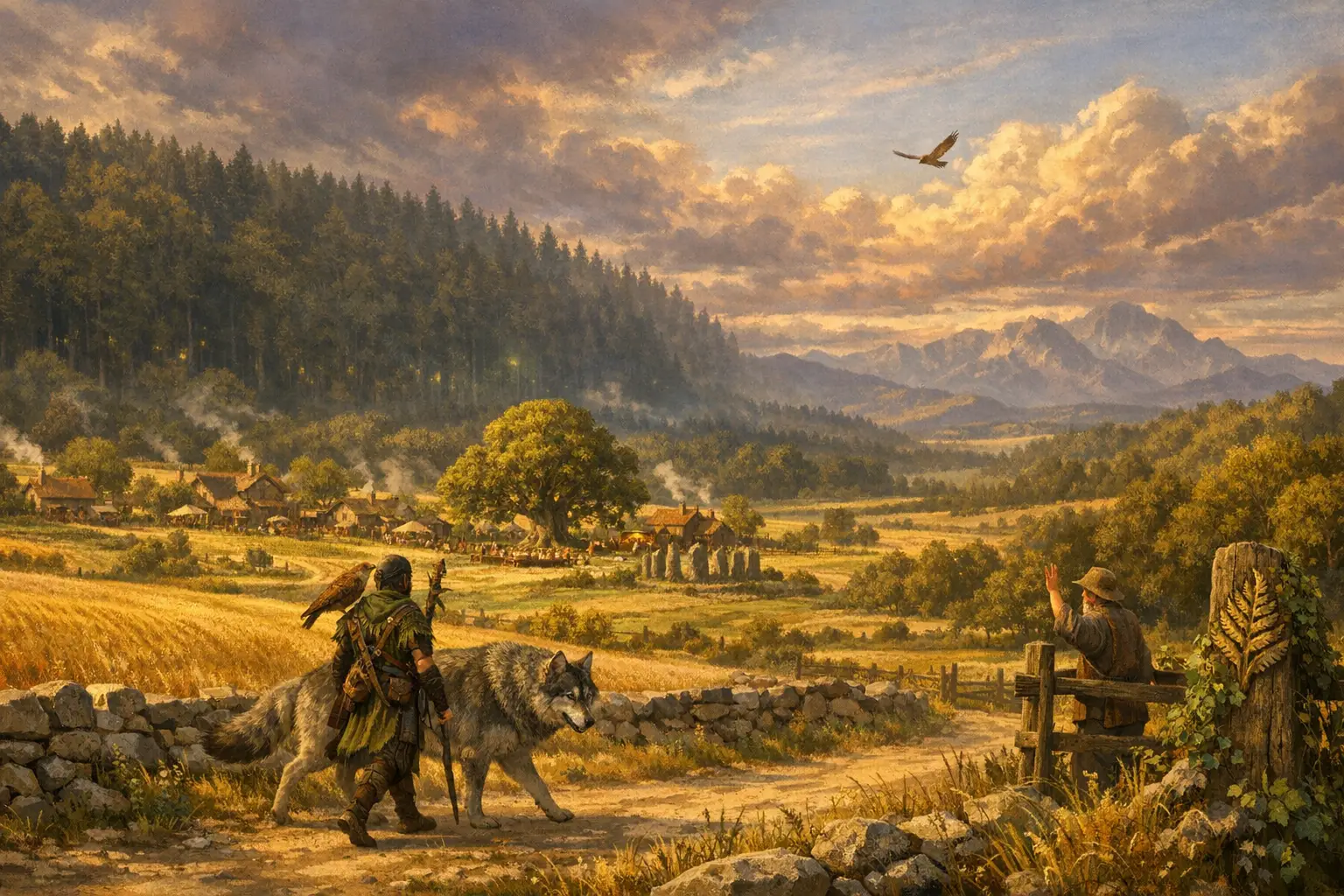
Politics of the Eldeen Reaches
From the field notes of Haldas ir'Ceran, Aundairian cultural attaché, seconded to the Eldeen border post at Cree, Barrakas 997 YK:
I have been in the Reaches for six months. In that time I have not met a single official who holds a title I would recognize. The village has a council — five farming families who meet under a willow tree — and a druid who advises them. When I asked who the druid reports to, she said "the land." When I asked who appointed the council, they said "nobody." When I asked who collects taxes, they laughed.
I am beginning to suspect this assignment is a punishment.
The Governing Structure
The Eldeen Reaches has no king, no parliament, no constitution, and no codified body of law. It is governed — to the extent it is governed at all — through a loose alliance between village councils and the Wardens of the Wood, guided by the spiritual authority of the Great Druid Oalian. This arrangement was not designed by political theorists; it grew out of necessity during the Last War, when the Wardens stepped in to provide the protection and governance that Aundair's lords had abandoned. The Treaty of Thronehold recognized the Reaches as a sovereign nation in 996 YK, but the nation is still figuring out what sovereignty means in practice. The Reaches are, more than anything else, an experiment — one that is very much still in progress.
The system works because of two reinforcing factors: the villages are self-governing by long tradition, and the Wardens provide the connective tissue between them. When those factors align, the Reaches function with a quiet efficiency that puts more elaborate governments to shame. When they don't, people settle their problems the old-fashioned way — which, in a land full of druid circles and shifter tribes, can get complicated fast.
Oalian
The Great Druid Oalian — an ancient greatpine rooted in the grove of Greenheart, deep in the Towering Wood — is the spiritual leader of the Eldeen Reaches and the closest thing the nation has to a head of state. Every druid sect in the Reaches acknowledges Oalian as the ultimate spiritual authority, and the Great Druid's rare pronouncements carry enormous weight. But Oalian is a tree — ancient, immensely wise, and largely sedentary. The Great Druid usually dreams in the deep grove, stirring to welcome visitors, preside over seasonal conclaves, and speak to new initiates. Oalian does not issue executive orders, does not command armies, and does not concern itself with grain prices in Varna.
In practice, the humanoid leader of the nation is Faena Graymorn, a half-elf druid who handles the day-to-day management of the Wardens of the Wood. Faena played a critical role in the secession, led the Reaches' delegation at the Treaty of Thronehold negotiations, and is effectively the person foreign dignitaries must deal with when they need someone with hands and legs to sign a document. She is assisted by a conclave of elder druids at Greenheart, whose number fluctuates — six to twelve administrators during quiet periods, many more during the great seasonal conclaves when thousands converge on the grove.
"Our head of state is a tree. In Fairhaven they say this as an insult. In the Reaches we say it with pride — it means our leader has been thinking about the same problems for four thousand years and has never once been tempted by gold, flattery, or ambition." — attributed to Faena Graymorn
The Village Councils
Every farming community in the eastern Reaches is governed by a council made up of representatives from each farming family in the settlement. These councils handle the business of daily life — land disputes, water rights, planting schedules, market days, criminal complaints, and the allocation of communal labor. Decisions are made by consensus when possible and by majority when necessary. There is no formal hierarchy between villages; each community is effectively self-governing, bound to the others by shared tradition, trade, and the presence of the Wardens rather than by law or administrative structure.
Each village also has a druid counselor — assigned by the Wardens of the Wood — who provides magical assistance, spiritual guidance, and advice to the council. The counselor does not command the council, but the counselor's word carries the weight of the Wardens behind it, and few councils ignore their advice lightly. Some communities also have a guiding tree — an awakened tree that serves as a permanent spiritual advisor, always present when the druid might be away.
The Galifar Code of Justice provides a general framework that most eastern communities follow out of inherited habit — things considered crimes in Sharn are usually considered crimes in Varna. But there is no central enforcement mechanism, and communities aligned with different druid sects may interpret justice very differently. A village guided by the Children of Winter may have alarming ideas about what constitutes a proper trial. Justice in the Reaches is swift, local, and shaped by the community's relationship with the natural world — closer to frontier law than to the codified systems of the Five Nations.
The Wardens as Government
The Wardens of the Wood are not a government in any conventional sense, but they perform most of the functions a government would. Warden rangers patrol the roads and forests, responding to threats — bandits, aberrations, monstrous incursions from the deep Wood, hostile forces from Droaam. They carry news between communities, investigate crimes, and serve as mediators in disputes that village councils cannot resolve. Their network of awakened animals — Oalian's Voice — functions as a combined postal service, intelligence network, and traveling press corps. The Wardens don't collect taxes; instead, communities make voluntary offerings of food and goods to Greenheart, which has no market of its own and depends on these contributions.
This system is not a theocracy — Greenheart does not dictate the laws of individual communities, and the Wardens are careful to frame their role as guidance rather than command. But the distinction between advice backed by spiritual authority and advice backed by a government with soldiers is, in practice, thinner than the Wardens might like to admit. When a Warden ranger tells a village council what needs to happen, the council generally does it — not because they fear punishment, but because the Wardens have earned a trust that no Aundairian lord ever managed to.
The Deep Wood
The Towering Wood operates by different rules. Shifter tribes follow their own customs, with leaders chosen by age, spiritual wisdom, or proven strength. Most tribes respect Oalian and the Wardens, but only a few have chosen to fully participate in the Reacher experiment; the majority maintain the same traditions they have followed for centuries, largely ignoring the world beyond the Wood. The other druid sects — the Gatekeepers, Ashbound, Children of Winter, and Greensingers — each exercise authority within their own territories, and the Wardens' ability to influence them ranges from strong (the Gatekeepers cooperate readily) to effectively nonexistent (the Greensingers do what they please and always have).
The Ashbound in particular present a governance challenge. Eastern farming communities regard the more radical Ashbound as enemies of their people, issuing warnings and treating even moderate adherents as wanted criminals. Aundair classifies the Ashbound as a terrorist organization outright. The Wardens view the Ashbound's zealotry with sadness and attempt to dissuade their more extreme actions, but the two sects' goals align often enough that open confrontation is rare. The result is an unresolved tension at the heart of the Reaches: the same national framework that protects the Ashbound's right to exist in the deep Wood also fails to protect the eastern farmers from Ashbound raids on their fields and workshops.
Overheard in Varna's market square: "The Wardens keep the peace. The Ashbound keep us honest. The Children of Winter keep us nervous. And the Greensingers — well, nobody keeps the Greensingers."
The Varna Question
Varna is the largest city in the Reaches, the ancestral seat of House Vadalis, and the gateway for commerce with the outside world. All the dragonmarked houses maintain outposts there. It is also the settlement with the strongest ties to Aundair — culturally, economically, and in the sympathies of a significant minority of its citizens. House Vadalis maintains close connections to Aundair and would not be unhappy to see Varna return to Aundairian sovereignty.
Varna is the most likely place for a pro-Aundairian political movement to take root, and the Wardens know it. The city represents the permanent tension at the heart of the Eldeen experiment: the Reaches need Varna's commerce, its infrastructure, and its connection to continental trade, but Varna's interests do not always align with the values of the druids who guide the rest of the nation. A visitor to Varna will find the most conventional-looking settlement in the Reaches — a city with proper markets, dragonmarked house enclaves, and citizens who dress more like Aundairians than like Wardens. Whether Varna's loyalty holds through the next crisis is one of the open questions of Reacher politics.
Foreign Relations
The Eldeen Reaches largely ignore the politics of the east and are ignored in return. They have no consulate in Sharn, have rebuffed diplomatic contact with Aundair, and have made clear they will defend the nation against military threats while having no interest in further discussions regarding borders, treaties, or resource rights. But the Treaty of Thronehold is only two years old, and the Reaches are still learning what it means to be a nation on a continent full of them.
The Wardens have established a minimal diplomatic presence — people in Wroat, Fairhaven, and Flamekeep, because the bordering nations of Breland, Aundair, and Thrane are too important to ignore entirely. But the Reaches have not yet sent representatives to Regalport, Korth, or any of the other treaty nations. Karrnath is the closest thing to an external ally — a relationship built on mutual trade and shared suspicion of Aundairian ambition. Relations with Breland are minimal but civil. Relations with Aundair are defined by a wound that has not healed: most Aundairians view the secession as an unforgivable betrayal, and Queen Aurala has never publicly accepted it as permanent.
The Reaches' isolationism is a luxury that may not survive the postwar period. As the dragonmarked houses expand, as Droaam grows more ambitious, and as Aundair's internal politics shift, the Reaches may find they need allies — and allies require embassies, trade agreements, and the kind of engagement that the Wardens have thus far avoided. Adventurers with ties to the Reaches could find themselves on the front lines of this transition, helping to establish or protect the first true Eldeen embassies.
Political Tensions
The Reaches' political disagreements do not organize around parties or factions in the way that Brelish or Aundairian politics do. They orbit a set of structural contradictions that the current balance of power holds in uneasy equilibrium.
The Aundairian threat is the unifying force in Reacher politics — the shared conviction that Aundair will eventually try to reclaim the territory, whether through diplomacy, sabotage, or force. Every village maintains a militia. The Wardens watch the eastern border. But this shared fear also creates a climate in which any criticism of the current system can be reframed as disloyalty, and in which suspicion of outsiders shades easily into xenophobia.
The sect tensions are a constant undercurrent. The Wardens are the governing force, but they do not command the other sects, and the Ashbound, Children of Winter, and Greensingers each pursue agendas that sometimes directly contradict the Wardens' vision of balanced coexistence. A village aligned with the Children of Winter operates by different principles than one guided by the Wardens, and neither has formal authority over the other.
The Varna question — whether the largest city in the Reaches will remain loyal to the new nation or gradually drift back toward Aundair — is a slow-burning tension that the Wardens monitor without an obvious solution.
The dragonmarked houses maintain a cautious presence concentrated in Varna, but their growing influence across Khorvaire pushes against the Reaches' preference for local self-sufficiency and primal industry. House Vadalis in particular occupies an awkward position — headquartered in the Reaches but commercially tied to the east.
And the experiment itself — the question of whether a nation governed by druids, village councils, and an ancient tree can survive on a continent of monarchies, parliaments, and dragonmarked corporations — remains open. The Reaches have existed for forty years as a self-declared nation and two years as a recognized one. Whether the system can endure a generation of peace, let alone another war, is the question no one in Greenheart can answer yet.
From a letter intercepted by the Aundairian Royal Eyes, origin unknown, Zarantyr 998 YK:
"The tree dreams. The druids argue. The farmers plant. And Varna watches the road east, waiting to see which way the wind blows. We have time. Patience is the one resource the Reaches will never run short of — and it is the one resource Fairhaven has never possessed."