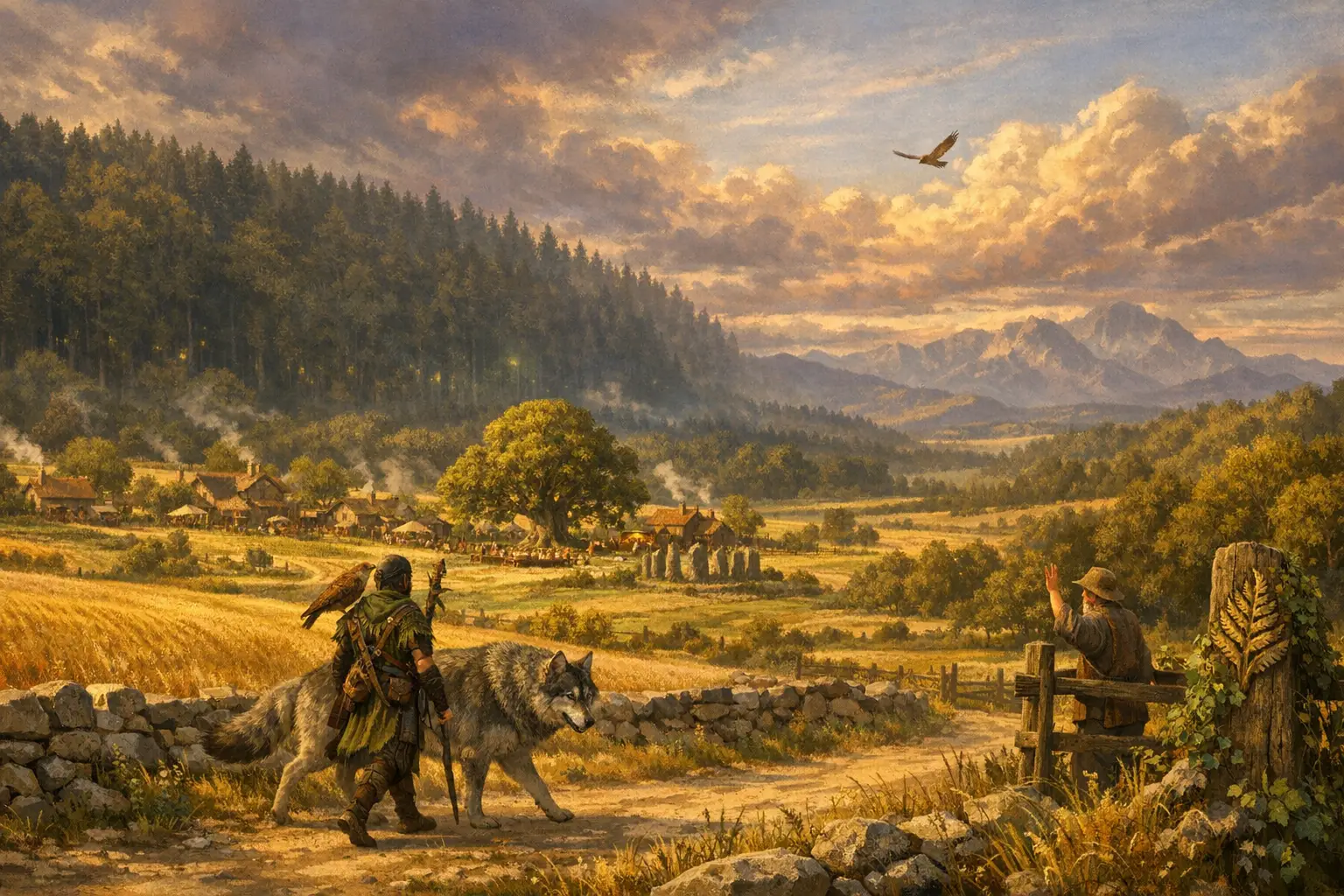
History of the Eldeen Reaches
"The Towering Wood is as old as the world. Some say the greatpines were the first trees Eberron created, that the Wood was the first forest." — from the chants of the Moonspeaker druids
Ancient Origins
The history of the Eldeen Reaches begins long before the territory had a name, long before humans set foot on Khorvaire, and arguably long before any creature alive today could have witnessed it. The Towering Wood — the vast primeval forest that dominates the western half of the nation — is among the oldest living environments on the continent, and its roots run deeper than any scholar can trace with certainty.
The earliest oral traditions, preserved by the Moonspeaker druids of the shifter tribes, speak of the Ur-Oc — the species known today as orcs — as the first humanoid inhabitants of the Wood. The archaeological record supports this in outline: orcs were once found across the entire west coast of Khorvaire, from the Shadow Marches to the Demon Wastes, and the Towering Wood was the heartland of their civilization. These were not the scattered tribes of the present age but an established people, living in harmony with the forest for millennia before the Dhakaani goblins raised their empire on the open plains to the south and east.
Over fifteen thousand years ago, the green dragon Vvaraak — a rogue seer who had read disaster in the Draconic Prophecy — left Argonnessen and came to the Shadow Marches. The Conclave of dragons had refused to act on her visions; Vvaraak chose to act alone. She taught the orcs of the western coast the secret language of the natural world, showed them how to work with stone and soil, and trained them to read the future in the Ring of Siberys. These were the first Gatekeepers — the oldest druidic tradition on Khorvaire, and the wellspring from which all the druid sects of the Reaches would eventually flow.
The Daelkyr War (circa –9,000 YK)
Thousands of years after Vvaraak's departure, the threat she had foreseen arrived. The daelkyr — lords of the alien plane of Xoriat — tore open portals and poured their horrors into the material world. Mind flayers, beholders, dolgaunts, and other aberrations boiled out of the rifts. The Dhakaani Empire, the greatest goblinoid civilization Khorvaire had ever known, bore the brunt of the assault and was ultimately shattered beyond recovery.
In the Towering Wood, the daelkyr Avassh — the Twister of Roots — sank its tendrils deep into the forest, corrupting trees and beasts and warping the land itself. But the Gatekeepers had been preparing for this moment for millennia. Orc druids from the Shadow Marches traveled north to share their knowledge with their cousins in the Wood, and together — druidic orc and Dhakaani goblin — they drove the lords of Xoriat back and sealed them in the depths of Khyber.
The seals took many forms. Some say the seals had to match the nature of the daelkyr they bound. The Twister of Roots could not be held by stone or steel — Avassh could only be imprisoned by a living seal of root and leaf. And so the druids created the Eldeen Ada — Druidic for "the first trees" — imbuing a handful of great trees with sentience and primal power. The greatest of these became the Guardian of the Greenheart: the entity the world now knows as Oalian. The daelkyr were imprisoned, but the war left terrible scars. Within a generation of the sealing, something catastrophic occurred in the Towering Wood — an event that utterly obliterated the orcish civilization within the forest and the goblinoid cities beyond its borders. The historical record goes silent. When it resumes, the Wood is home to scattered shifter tribes and feral gnolls, and the orcs are gone. The Moonspeaker druids speak of a time of chaos and terror, when shifters were feral beasts — until the moon Olarune taught the first among them to master the beast within.
"In the darkest night of the Dragon Below, storm and dragon are reunited, and they break together upon the legions of the Blasphemer." — ancient prophecy, translated by Thausil Kennar, Library of Korranberg
The Rise of the Druid Sects
In the millennia that followed, the druidic traditions spread and diversified. New interpretations of Vvaraak's teachings — filtered through the experiences of shifters, humans, and the land itself — gave birth to new druidic sects. The Wardens of the Wood emerged as guardians of the balance between civilization and the wild, guided by the wisdom of Oalian. The Greensingers arose in the Twilight Demesne, where the influence of Thelanis and the Faerie Court shaped a path devoted to the fey. The Ashbound took root in the northern reaches, fierce defenders of the wild against all incursion. The Children of Winter gathered in the shadow of the Gloaming, the Mabaran manifest zone that festers in the deep Wood, and embraced the grim conviction that death and decay are necessary parts of the natural cycle. And the Gatekeepers themselves endured — diminished, scattered, but still maintaining the ancient seals.
These sects were not political organizations and did not seek to govern. For thousands of years, the Towering Wood remained a world apart — visited by the daring, avoided by the wise, and largely ignored by the powers of eastern Khorvaire.
Under Galifar (1–894 YK)
When Galifar I unified the Five Nations around 1 YK, the western farmlands bordering the Towering Wood were incorporated into Aundair — the province named for his daughter, who sought to instill her love of education, civilization, and arcane magic in the region. The people closest to Fairhaven embraced these values; those in the far west held to older traditions. The Towering Wood itself was never truly claimed. The sage Dalen Book wrote in his Chronicle of Thaliost that "the world ends at the Towering Wood," and after a few failed attempts to settle the forest, the Aundairians largely agreed.
The people of the western farmlands lived as Aundairian subjects for nearly a thousand years, paying taxes, sending their children east for education, and worshipping the Sovereign Host alongside quieter druidic customs inherited from the land. The Wardens of the Wood maintained ties to these communities throughout the Galifar period, but rarely ventured into the open farmlands. House Vadalis established its seat in Varna, breeding and training animals for clients across the kingdom, and Varna grew into the largest settlement in the region — a center of commerce with the deepest ties to the east.
The critical thing to understand is that the divide between the western farmlands and Fairhaven was not born during the Last War. It had been brewing for centuries — a cultural fault line between the arcane, cosmopolitan values of Aundair's ruling class and the older, land-rooted traditions of the west. The Last War did not create the fracture. It simply gave the people of the west a reason to stop pretending it wasn't there.
The Silver Crusade (830–882 YK)
In 830 YK, a dark power surged through the Towering Wood, amplifying the curse of lycanthropy to terrifying levels. The curse became more virulent — victims fell prey more quickly, driven by some force beyond the common evil of the affliction. Werewolves, wererats, and other lycanthropes spilled out of the Wood into the western Aundairian farmlands, and entire communities were infiltrated or devastated.
In 832 YK, Keeper of the Flame Jolan Sol launched the Silver Crusade — an army of templars dispatched to Aundair to exterminate the lycanthropic threat. The battle was long and brutal. Within the Towering Wood, shifter tribes fought their own corrupted kin alongside the templars. But the inquisitors had never studied good-aligned lycanthropes, assumed the curse was incurable, and — driven in part by Keeper Sol's ambition to expand the Silver Flame's influence in Aundair — proclaimed that lycanthropy corrupted the soul itself.
As the campaign ground on, lycanthropes hid among human and shifter communities. Overzealous templars slaughtered innocents in their desperation to root out the shapeshifters. Wererats on both sides deliberately sowed distrust between shifters and templars, ensuring that potential allies became bitter enemies instead. The scars of this period — the slaughter of innocent shifters, the terror of the purge — have never healed. To this day, many shifters regard the Church of the Silver Flame with deep suspicion, and the extremist Pure Flame sect still claims that all shifters are servants of darkness.
Ultimately, House Medani produced a dragonshard focus that could reliably detect lycanthropes, allowing the templars to target the true enemy. By 880 YK, the church withdrew its forces and declared the curse eliminated. Keeper Jovor Daran formally ended the Crusade in 882 YK. The templars went home. The dead stayed where they had fallen.
KORRANBERG CHRONICLE — excerpt, Therendor 883 YK
"The Church of the Silver Flame has declared the western lycanthrope threat extinguished. Citizens of the western provinces may return to their homes in safety. The Church extends its gratitude to the people of Aundair for their patience during what has been, by all accounts, a difficult half-century."
The editors note that the "people of Aundair" in question were not consulted regarding this gratitude.
The Last War and the Secession (894–958 YK)
When King Jarot died in 894 YK and the Last War erupted, the western farmlands were expected to contribute grain, livestock, and conscripts to Aundair's war effort. In return they received nothing — no protection from the bandits that ravaged the roads, no soldiers to guard the villages, no relief from the increasing tax burden. For decades, the lords of Aundair poured their resources into the war against Thrane and Karrnath while their own western subjects starved and bled.
The Wardens of the Wood, who had rarely left the forest during the Galifar period, stepped forward. Warden rangers patrolled the roads, druid counselors helped struggling communities plan their planting, and the sects provided what the crown would not — protection, healing, and governance. The idea of secession was already being discussed by the mid-950s; it simply took a show of strength by the Wardens to convince the holdouts.
In 958 YK, the western farmlands formally declared their alliance with the Great Druid Oalian and asserted their independence as the Eldeen Reaches. All five druid sects united behind the cause — Ashbound, Children of Winter, Greensingers, Gatekeepers, and Wardens fighting together for the only time in living memory. Aundair could not afford to fight a war on an additional front and was forced to accept the loss, though it never stopped contesting it. Karrnath quietly supported the secession — Karrnathi warships protected Eldeen food shipments across the Bitter Sea, and Karrnathi arms flowed westward in exchange for the grain that sustained Karrnath through its devastating famines.
"We rode to Erlaskar expecting to requisition winter grain and found the granaries flying green banners. The village reeve said, 'We feed our own now.' There was a Warden ranger standing behind him, and a hawk on the ranger's shoulder that I swear was watching me take notes." — from the recovered satchel of Lt. Corren Haldas, 4th Fairhaven Reconnaissance, Aryth 958 YK
The Treaty of Thronehold (996 YK)
The Treaty of Thronehold formally recognized the Eldeen Reaches as a sovereign nation. Aundair was forced to accept the sovereignty of the Reaches under the treaty's terms, but the wounds have not healed. Most Aundairians view the secession as an unforgivable act of treason committed during a time of national weakness. The Reachers say their actions were precipitated by decades of neglect and corruption from nobles who took their grain and gave nothing back.
The treaty did not resolve the deeper questions. Aundair lost its western breadbasket — the most fertile farmlands in the province — and many in Fairhaven have never stopped planning to get them back. Queen Aurala, who assumed the throne in 980 YK, has never publicly accepted the secession as permanent.
Postwar Reaches (996 YK–Present)
The Eldeen Reaches in the postwar period is a nation still defining itself — an experiment in druidic governance that has no precedent in Khorvaire's history. The Wardens have spread from the Wood into the farmlands, establishing druid counselors in every village and Warden ranger patrols on every road. Village councils govern local affairs. Oalian presides from Greenheart, stirring from deep contemplation to welcome visitors and preside over the great seasonal conclaves.
But the Reaches face pressures from every direction. Aundair watches the eastern border with undisguised intent — every village maintains a militia, and the Wardens watch for Aundairian agents in Varna, the city most sympathetic to the old regime. Droaam presses against the southern mountains, and monstrous raids cross the Shadowcrags with increasing boldness. The Gloaming expands. The Gatekeeper seals require constant maintenance. The Ashbound grow more radical under aggressive leadership, raiding farms in the eastern Reaches and arcane academies across the border in Aundair. The Children of Winter have turned their attention to the Mournland, some convinced the Mourning is a sign of the apocalypse they have always predicted.
And within the Wood itself, swathes of forest remain entirely untouched — harboring ruins from the Age of Demons, relics of the daelkyr, giant beasts never catalogued, and secrets that not even the trees remember. The Towering Wood has never been safe. The Wardens exist because someone has to stand between the wild and the people who live beside it. That job is not finished, and it will not be finished in anyone's lifetime.
Scratched into a marker stone on the Aundair-Eldeen border, painted over by Aundairian soldiers, scratched again:
THE WOOD REMEMBERS WHAT THE CROWN FORGOT.