Military & Security of the Shadow Marches
From a briefing prepared for a Brelish military attaché, Wroat, Sypheros 997 YK:
"You are asking whether the Shadow Marches could be invaded. The answer is: by whom, and to what end? The region has no cities worth seizing except Zarash'ak, which is built on stilts over a swamp. It has no treasury. It has no strategic infrastructure. It has no roads for an army to march on and no ground firm enough to pitch a camp. The terrain is trackless bog extending in every direction, populated by people who have been living in it for nine thousand years and who can disappear into it faster than your scouts can follow.
The Dhakaani Empire did not bother to conquer the Marches. Galifar did not bother. Breland didn't even make it as far as Droaam. These were not oversights. The Marches are unconquerable because there is nothing to conquer and no way to hold it if you did. The swamp is the fortress. The people are the garrison. And the things that live beneath the mud are a threat that makes any conventional military assessment irrelevant.
Recommendation: maintain trade relations through House Tharashk. Do not send soldiers."
No Army, No Walls, No Need
The Shadow Marches have no military. There is no standing army, no militia system, no officer corps, no chain of command, no fortification network, and no institution responsible for the collective defense of the region. The Marches were not recognized as a nation by the Treaty of Thronehold, and even if they had been, there would be no mechanism for raising, equipping, or directing a unified fighting force. There is no one to give the order.
This does not mean the Marches are defenseless. It means the defense operates on principles that no Rekkenmark strategist would recognize as military doctrine but that have successfully deterred every organized power in Khorvaire for the entirety of recorded history.
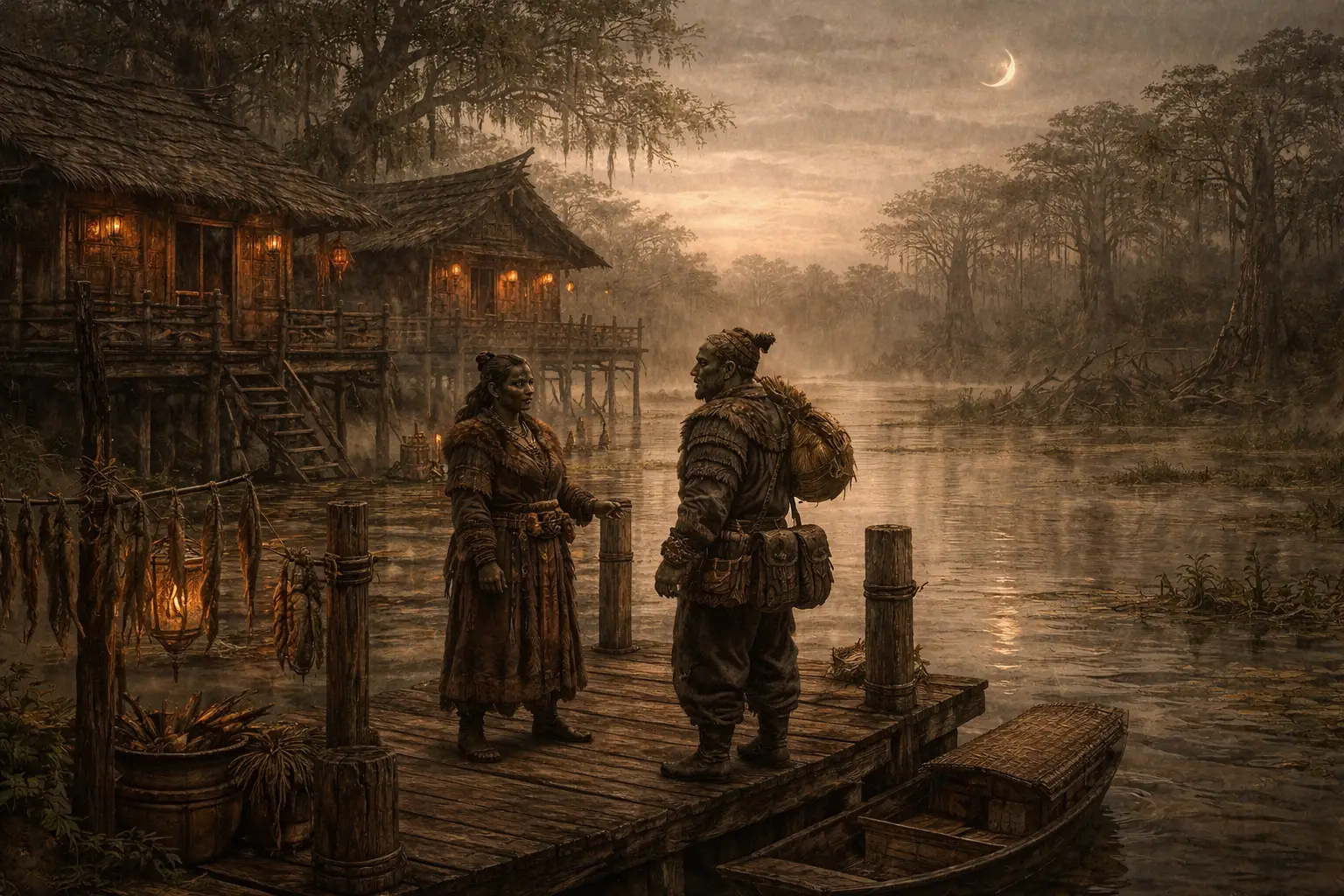
The first defense is the swamp itself. The Shadow Marches are, from a military standpoint, the worst terrain on the continent. There are no roads, no bridges, no chokepoints to seize and no high ground to hold. The ground shifts underfoot. The water is everywhere — not deep enough to navigate by ship in most places, not shallow enough to march through in formation. Visibility is poor. Supply lines are impossible to maintain over any distance. The climate ranges from miserably damp to actively pathogenic. An army that enters the Marches without local guides will be lost within a day, sick within a week, and dead or demoralized within a month — not from enemy action, but from the environment alone.
The second defense is the people. Marcher orcs, half-orcs, and humans have been surviving in this terrain for millennia, and the skills required for that survival are indistinguishable from the skills required for guerrilla warfare. Every tribal hunter is a tracker, a fighter, and an expert in concealment. Every clan community maintains its own capacity for violence — not organized as a militia, but present as a simple fact of life in a region where the wildlife is dangerous, the neighbors may be hostile, and the deep swamp produces things that want to kill you on a regular basis. A Marcher who has spent their life hunting aberrations in manifest-zone territory is not a soldier in any formal sense, but they are a combatant whose practical experience exceeds that of most professional infantry.
The third defense is the thing the briefing mentioned and could not elaborate on: what lives beneath the mud. The daelkyr are imprisoned in Khyber. Their servants and spawn are not. Aberrations breed in the deep swamp and have done so for nine thousand years. Any invading force that pushed deep enough into the Marches would eventually encounter things that no conventional army is equipped to fight — and that is before considering the possibility that sustained violence in the region could damage the Gatekeeper seals and release something that would make an invading army the least of everyone's problems.
"The Aashta say the swamp fights for itself. They're not being poetic. They mean the leeches, the mud, the fever, the things with too many eyes that come up from the deep pools at night. An army that camps in the Marches without knowing what it's camping over will not be an army by morning." — Tharashk scout, speaking to a Deneith Blademark officer
The Gatekeeper Hunting Groups
The closest thing the Shadow Marches have to an organized military force is something that would not be recognized as one by any conventional standard: the hunting groups of the Gatekeepers.
A typical Gatekeeper hunting group consists of three or four combatants — rangers, barbarians, scouts — led by an aspirant, a low-level druid trained in the Gatekeeper traditions. Their mission is not territorial defense or law enforcement. It is the destruction of aberrations and extraplanar horrors, the monitoring of manifest zones, and the protection of the Gatekeeper seals. They patrol the deep swamp, track creatures that have crept up from the dark places, and kill what they find. The work is lonely, dangerous, and almost entirely invisible to anyone who does not live in the communities the hunting groups protect.
In more dangerous areas, or when a specific threat demands it, groups can be called together — a dozen combatants or more, led by two aspirants and an initiate or even a true gatekeeper. Such concentrations of force are rare, deployed only against threats that would overwhelm a single group. A hunting group operating out of the Green Spire — a Gatekeeper bastion in the Marches — might include combatants of considerable power, and the most experienced groups carry weapons and equipment that reflect thousands of years of accumulated knowledge about how to fight the unnatural.
The Gatekeeper hunting groups are not numerous. The entire sect numbers fewer than a thousand members across the Marches and the Eldeen Reaches combined — perhaps two hundred aspirants, three dozen initiates, and only a handful of true gatekeepers with the power to conduct seal-renewal rituals. This is the force that maintains the wards holding the daelkyr in Khyber. It is also the force that patrols millions of acres of deep swamp for aberrations that breed faster than the druids can hunt them. The math is not encouraging, and the Gatekeepers know it.
The Finder's Guild cooperates with the Gatekeepers in the Marches, helping the druids locate stray aberrations and open portals between planes. This cooperation is one of the few points of genuine alliance between Tharashk's commercial operations and the Gatekeeper mission — a practical relationship built on the fact that aberrations are bad for business as well as bad for the world.
Clan and Tribal Self-Defense
Beyond the Gatekeepers, every community in the Marches provides its own security. There is no external force coming to help. There is no Watch to call, no garrison to summon, and no Sentinel Marshal who will cross a thousand miles of swamp to investigate a missing person. If trouble arrives at a Marcher settlement, the people who live there deal with it themselves or they do not deal with it at all.
Clan communities are better equipped for this than the tribes — they have steel weapons, permanent fortifications (such as they are — stilt-houses are defensible against the swamp, not against an organized assault), and a population accustomed to working together. A clan settlement under threat can put every able-bodied adult into a defensive line within hours, armed with spears, axes, crossbows, and whatever else the local smith has produced. The quality of the fighters varies enormously — a prosperous Tharashk-affiliated clan near Zarash'ak will have members with combat training and decent equipment, while a remote clan three days' paddle upriver may fight with tools and desperation.
The tribes rely on different advantages. They are mobile, they know the terrain with an intimacy that borders on the supernatural, and their hunters are individually among the most dangerous combatants in the region. A tribal warband moving through familiar swamp is nearly impossible to track, impossible to ambush, and capable of inflicting devastating casualties on an opponent who does not understand the ground. The tribes do not fight in formations. They fight the way the swamp fights — by attrition, by ambush, by being everywhere and nowhere, and by waiting for the environment to do half the work.
Tribal weapons are made from bone, stone, hide, and the dense swamp-wood of the region — materials that outsiders dismiss as primitive until they encounter a tribal spear driven by an orc hunter who has been killing things in the dark since before the spear's target learned to walk. The tribes do not work metals, but this is a cultural choice, not a technological limitation — the clans have offered steel in trade for centuries, and the tribes have consistently declined, preferring the materials their ancestors used.
"A Karrnathi officer told me his soldiers could pacify the Marches in a season. I asked him if his soldiers could hold their breath underwater for three minutes. He said no. I said then they can't pacify the Marches, because that's how long a tribal hunter can wait beneath the surface of a bog before coming up behind you." — Marcher half-orc, speaking at a Tharashk hiring hall
Tharashk's Security Operations
House Tharashk maintains guards and enforcers in Zarash'ak and at its wayposts and prospecting stations throughout the Marches. These are not soldiers in the military sense — they are house employees whose primary job is protecting Tharashk property, maintaining order in Tharashk-controlled spaces, and ensuring that the dragonshard trade operates without disruption. They are competent fighters, equipped with steel weapons and often bearing the Mark of Finding, but they are not an army and they do not pretend to exercise authority beyond the house's commercial operations.
In the Last War, Tharashk recruited Marcher orcs and half-orcs as mercenaries for service across Khorvaire. The Dragonne's Roar extended this into the brokering of monstrous mercenaries from Droaam — ogre shock troops, gnoll soldiers, and troll phalanxes supplied to clients through Tharashk intermediaries. The house also drew on more exotic Marcher assets: Clan Aashta brokered the services of grung amphibious commandos from the Mrrga Pod — frog-like beings native to the Marches whose skill with poisons, ambush tactics, and swamp warfare made them devastating in the right conditions. The Holondon harengons — rabbit-folk from a burrow-hall on the Marches' eastern border — fielded a celebrated squad of scouts called the Sar'taashi, the Swift Razors, as part of the Dragonne's Roar in the war's final years. These units were small, specialized, and spectacularly effective in the kinds of environments that conventional soldiers hated most.
In the postwar period, Tharashk's security footprint in the Marches has expanded along with its commercial operations. More wayposts, more guards, more prospectors who need protection in dangerous territory. This expansion puts the house in an awkward position: it needs security to protect its investments, but projecting force into the deep Marches risks antagonizing the tribes, the Gatekeepers, and the swamp itself — none of which respond well to outsiders who arrive armed and start giving orders.
The Droaam Border
The eastern edge of the Shadow Marches abuts what is now Droaam — a boundary that has never been formally defined, is not marked on any official map, and is defended by precisely nothing. The terrain between the Marches and the western edge of Droaam is not a clean line but a gradual transition — swamp becoming moor becoming the plains and broken hills that the Daughters of Sora Kell claimed in 986 YK.
Clan Aashta has held the eastern borderlands for generations, and the Aashta's long history of skirmishing with ogres, trolls, worgs, and Gaa'aram orcs from the Watching Woods is one of the reasons the clan produces the fiercest warriors in the Marches. Before Droaam existed as a political entity, this was simply frontier violence — raiders crossing into the swamp, Aashta war parties crossing back, and neither side thinking of it in terms of borders or nations. Since the Daughters' arrival, the relationship has become more complex. Tharashk's role as Droaam's sole commercial intermediary gives the house — and through it, the Aashta — a strategic interest in keeping the border peaceful. The Daughters, for their part, have no particular reason to invade a swamp that has nothing they need, and doing so would shatter their relationship with the house that connects them to continental commerce.
The Holondon harengons, whose burrow-hall sits on this unmarked border, have recently been offered the chance to join Droaam under the oni warlord Drul Kantar. The harengons have no love for Drul Kantar but fear that refusing could mark them as enemies. They have been drawing out the discussions for as long as possible — a strategy that works until it doesn't.