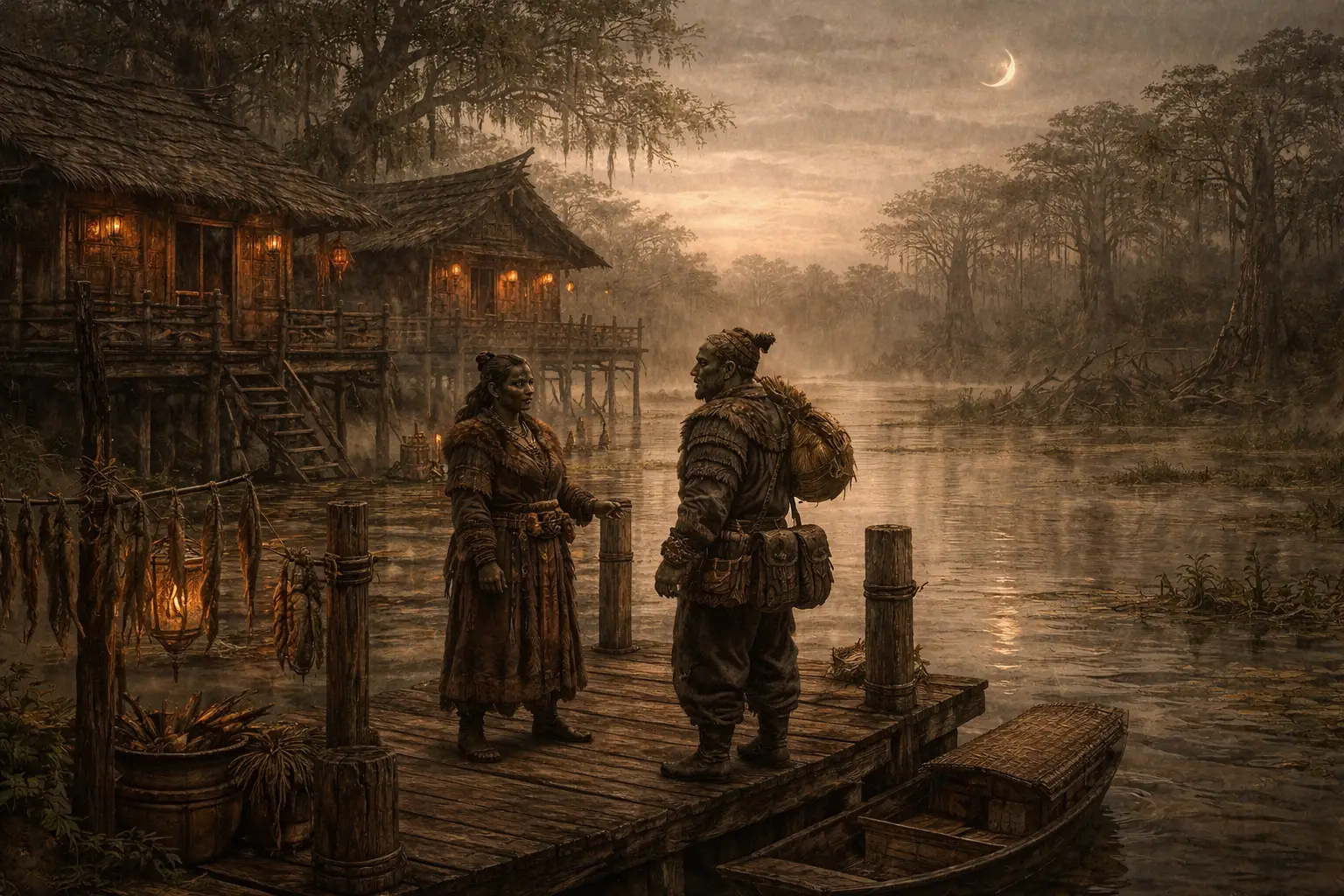
Art & Culture of the Shadow Marches
"A Korranberg scholar came to study our culture. She brought a notebook and a charcoal pencil and a list of questions about our art. She wanted to see our paintings. We don't paint. She wanted to hear our epic poetry. We don't recite. She wanted to examine our architecture. We live in huts on stilts. After three days she was frustrated. After three weeks she stopped asking questions and started listening to the frogs. After three months she told me she understood more about the Marches than she had learned in a year of reading about them. I told her the frogs had been saying the same thing the whole time. She just hadn't known how to hear it." — unnamed Torrn elder, speaking to a Tharashk factor
Listening to the Mud
Marcher culture is not performed. It is lived — woven into the rhythms of daily existence so tightly that separating "culture" from "life" is like separating the water from the swamp. The songs are work songs. The stories are warnings. The rituals are maintenance routines for wards that keep the world from ending. The decorative carvings on a stilt-house crossbeam are also clan markers, territorial claims, and prayers against the things that come up from the deep at night. Nothing exists for its own sake. Everything serves a purpose and carries a meaning, and the beauty — when it is present, and it is present more often than outsiders expect — is in the precision of the function, not in any ornament applied after the fact.
This is a culture shaped by two overwhelming forces: nine thousand years of continuous oral tradition reaching back to the dragon Vvaraak, and a landscape so dangerous and strange that the people who live in it have learned to treat every sensory detail as information. A Marcher does not look at the swamp the way a Brelish farmer looks at a field. A Marcher reads the swamp — the color of the water, the direction of the wind, the pattern of the frog-song, the quality of the silence where the frog-song stops. This attentiveness is the foundation of Marcher aesthetics. The most beautiful thing in the Marches is the thing that tells you the truth about where you are and what is coming.
The Two Traditions
Marcher culture splits along the same line that divides the population: clans and tribes, blended and ancient, steel and bone.
The clan tradition is the more visible of the two — the one outsiders encounter in Zarash'ak and in the Tharashk-affiliated communities along the navigable rivers. It blends human and orcish customs into a hybrid that has been evolving for sixteen centuries, since the first Sarlonan refugees settled among the orcs and the two peoples began the slow process of becoming one. Clan culture works with steel, builds permanent settlements, trades with the outside world, and produces the musicians, cooks, and craftspeople whose work has made Zarash'ak famous. The Azhani language — a blend of Goblin, Riedran, and traces of the ancient Orc tongue — is the common speech of the clans, and its cadences carry the flavor of every culture that has contributed to Marcher life. The clans are where Marcher culture is most accessible to visitors. They are not where it is deepest.
The tribal tradition is older by thousands of years and largely invisible to anyone who has not been invited to see it. The tribes maintain the customs of the orcs as they existed before human contact — semi-nomadic, unmetallized, organized around kinship and territory, and steeped in spiritual practices that predate the founding of Galifar by more than a dozen millennia. Tribal art is carved from bone, woven from marshgrass, painted on hide with pigments drawn from the swamp. It is not decorative in the way eastern art is decorative. It is instructional, commemorative, and — in the case of the Gatekeeper traditions — functional. A pattern carved into a bone amulet may be a clan marker, a prayer, and a minor ward against aberrant influence, all at once. A tribal orc who carves such an amulet would not call it art. They would call it necessary.
OVERHEARD IN ZARASH'AK — two Marchers arguing at a dockside tavern, Therendor 998 YK
"You can't play that song on a drum." "Why not?" "Because it's a river song. It moves like water. You're hitting it like stone." "Water hits stone all the time. That's how you get a river." (The argument continued for two hours. Both parties were still drinking together at the end of it.)
The Sound of the Swamp
Music is the Marches' most recognized cultural export, and Zarash'ak is where it reaches the outside world. The tradition is built on percussion — hand drums, hollow-log drums, bone rattles, seed-pod shakers, and rhythm sticks struck against the wooden pilings of the stilt-houses themselves — layered with chanted vocal patterns that sit somewhere between singing and speaking. The rhythms are complex, polyrhythmic in a way that borrows from both orcish and Sarlonan traditions, and the effect on an unprepared listener is disorienting in a manner that visiting Brelish music critics have consistently described as "hypnotic" before running out of more precise vocabulary.
The vocal traditions divide along the clan-tribe line. Clan music favors call-and-response patterns — a lead voice sets the melody and the group answers, building layers until the whole community is producing a sound that is greater than any individual voice. The songs are work songs, river songs, market songs, seasonal songs, and drinking songs, and they serve the same function music serves in every culture: they synchronize labor, carry news, mark time, and make the hard parts of life bearable. The lyrics are in Azhani, and the best Marcher songs are untranslatable — built on wordplay, double meanings, and rhythmic structures that depend on the specific cadences of the hybrid language.
Tribal music is something else entirely. The oldest orcish traditions use the voice in ways that have no parallel in Five Nations music — deep, resonant tones sustained for extraordinary durations, overtone techniques that produce multiple pitches simultaneously, and a relationship between the human voice and the ambient sounds of the swamp that blurs the line between singing and listening. A tribal chant performed at a Gatekeeper seal-renewal ceremony is not entertainment. It is participation — the singers are adding their voices to the sound of the swamp the way a tributary adds its water to a river, and the distinction between performer and audience does not exist. Everyone present contributes. The sound carries across the water and into the deep places, and the Gatekeepers say it reinforces the seals in ways that mere ritual cannot.
In Zarash'ak's dockside taverns, the two traditions collide and produce something that belongs to neither. A clan drummer sitting down with a tribal singer creates a sound that has no name and no precedent — percussive, vocal, polyrhythmic, and strange enough that the Brelish food critics who come for the cuisine stay for the music and leave unable to describe what they heard. Cassan Bridge in Sharn — the Middle Menthis district founded by Marcher immigrants — is the only place outside the Marches where this music can be heard regularly, and the taverns there draw audiences from across the city.
"I have attended performances at the Sharn Opera House, the Kavarrah Concert Hall, and a dockside tavern in Zarash'ak where the drummer was an orc woman who played a hollow log with her bare hands while three singers produced sounds I did not know the throat could make. The tavern was the only one that changed how I hear the world." — unsigned letter to the Sharn Inquisitive, 997 YK
What the Swamp Feeds
Marcher cuisine is famous in Zarash'ak and increasingly famous in Sharn, and the reason is simple: the swamp produces flavors that exist nowhere else on Khorvaire, because the swamp is not entirely natural, and the plants that grow in manifest-zone-touched soil develop properties that cannot be replicated in any other environment.
The base of the Marcher diet is fish and gathered plants — marshfin, mud-eel, gristfish, swamp greens, starchy roots, and the dozens of herbs and spices that grow in the bog. Clan cooks prepare these with techniques inherited from both orcish and Sarlonan traditions — smoking, fermenting, pickling, and the distinctive Marcher practice of fire-charring at the table, a preparation method that outsiders find dramatic and Marchers find practical, since the char seals flavor and kills anything the boiling missed. The heat in Marcher food comes from peppers and fermented root sauces that register on a scale the Five Nations have no vocabulary for — a spectrum that runs from "warm" through "assertive" to a category the Zarash'ak market vendors label, with admirable frankness, "you will regret this."
Swamp honey — gathered from hives that produce only during specific lunar phases — is the primary sweetener, used in everything from glazed fish to the dense, aromatic cakes that appear at seasonal observances. Blackroot tea, brewed from a root that grows only in Kythri-touched soil, is the universal Marcher beverage — bitter, stimulating, and carrying a faintly astringent quality that clears the head and sharpens the senses. Marchers drink it the way the Five Nations drink tal — constantly, reflexively, and with a conviction that the day does not properly begin until the first cup is finished.
The tribal diet is simpler and wilder — game, fish, foraged roots and greens, and preparations that rely on the specific flora of whatever territory the tribe currently occupies. Tribal cooks work with ingredients that clan cooks would not recognize and that outsiders would not eat without considerable persuasion. Some of these ingredients are genuinely remarkable — manifest-zone flora with mild alchemical properties, mushrooms that induce clarity or calm, herbs that accelerate healing or suppress pain. The grung apothecaries of the Mrrga Pod are the most sophisticated practitioners of this tradition, producing poisons, antidotes, and hallucinogens from swamp materials with a skill that rivals anything a Jorasco herbalist can manage.
In Zarash'ak, the two traditions merge. The dockside taverns serve smoked marshfin, fire-charred eel, fermented root sauces, ghost pepper preparations, and dishes that combine clan technique with tribal ingredients in ways that have made the City of Stilts a destination for anyone in Khorvaire who takes food seriously. The Cassan Bridge district in Sharn has built a thriving restaurant trade on Marcher cuisine, and the most sought-after ingredient in the district — genuine manifest-zone-grown Marcher spice, imported by Tharashk traders at considerable expense — commands prices that would make a Lorghalan gnome raise an eyebrow.
MENU — chalked on a board at a Zarash'ak dockside tavern
Smoked marshfin with root glaze — 3 cp Fire-charred eel (prepared at table, stand back) — 5 cp Blackroot tea — 1 cp Ghost pepper stew (no refunds) — 4 cp Swamp honey cake — 2 cp "The Whole Bog" (chef's selection, feeds 3, you don't get to ask what's in it) — 1 sp
Carved in Bone, Woven in Grass
Material culture in the Marches is functional, local, and shaped by the available resources — which means it looks nothing like what the Five Nations consider art and is, by the standards of anyone paying attention, quietly extraordinary.
Clan artisans work in wood, leather, bone, and — since the arrival of metalworking with the Sarlonan refugees — steel. The stilt-houses of the clan settlements are the most visible expression of Marcher craft: massive pilings of murk oak driven into the swamp, supporting platforms and structures that must withstand flooding, storms, and the slow subsidence of the ground beneath them. The engineering is sophisticated and entirely unliterary — no Marcher architect has ever written a treatise, and the knowledge is passed from builder to builder through apprenticeship. The crossbeams and support posts of stilt-houses are often carved with clan markers, territorial patterns, and stylized images of the swamp's flora and fauna — decorative work that doubles as identification, prayer, and practical information about the building's purpose and the family that occupies it.
Tribal craft is older, stranger, and more haunting. Bone carving is the primary medium — amulets, ritual implements, weapon hafts, and decorative objects shaped from the bones of animals, fish, and occasionally things that are neither. Marshgrass weaving produces waterproof textiles, basket traps, and the distinctive Marcher traveling cloaks that shed water as effectively as any oilskin and weigh almost nothing. Hide painting — using pigments drawn from swamp minerals and crushed insects — produces images on stretched leather that serve as clan records, spiritual maps, and teaching tools for young Gatekeepers learning the patterns of the manifest zones.
The most extraordinary tribal craft is one that outsiders almost never see: the carved standing stones that mark Gatekeeper seal sites. These are not art in any conventional sense. They are functional objects — rune-carved stones infused with byeshk ore, placed in powerful manifest zones, and charged with the druidic magic that maintains the wards. But the carving on the oldest stones — patterns that are sixteen thousand years old, reaching back to Vvaraak's original students — achieves a precision and a beauty that has no equivalent in any tradition the Five Nations have produced. The patterns are not decorative. They are instructions, encoded in a symbolic language that only the Gatekeepers can read, and the fact that they are also beautiful is, to the druids who maintain them, beside the point. It is beautiful because it is correct. It is correct because it must be.
Faith and Superstition
The Marches are not devout in the way that Thrane is devout, but they are spiritual in a way that the Five Nations have no framework to describe. Every Marcher lives in a world where the boundary between the natural and the unnatural is a daily physical reality, and this produces a relationship with the sacred that is less about belief and more about observation.
The Gatekeeper traditions constitute the dominant spiritual framework — the Old Ways that most Marchers follow regardless of whether they are practicing druids or simply people who blindfold the dead because that is what their grandmother taught them to do. The daily rituals are small: a moment of reflection at the beginning and end of each day, a blessing over food, an acknowledgment of Vvaraak's teachings at moments of significance — birth, death, union, the completion of an important task. The major ceremonies are seasonal, tied to the movement of the moons and the Ring of Siberys, and the most sacred are the seal-renewal rituals that the Gatekeeper traveling circles conduct at each warded site. These are daylong observances in which every participant contributes spiritual energy to recharge the wards — a communal act that is simultaneously religious ceremony, magical maintenance, and the oldest continuous tradition in Khorvaire.
The Sovereign Host has adherents — Kol Korran and Balinor are invoked with some regularity, particularly among the clans — but the faith lacks the institutional depth it carries in the Five Nations. There are no temples in the Marches. The Host's observances are woven into the Gatekeeper framework rather than standing alongside it, producing a blended spiritual practice that a Thranish theologian would find heretical and a Marcher would find unremarkable.
The cults of the Dragon Below follow their own calendar, their own rituals, and their own logic. Some cult observances are indistinguishable from Gatekeeper practice to an outside observer — the same moonlit gatherings, the same chanted vocals, the same attentiveness to the sounds of the swamp. The difference is in what the practitioners believe they are listening to and what they are asking for. A Gatekeeper blesses the earth in gratitude. A cultist blesses the earth in supplication. Both are sincere. The distinction matters enormously and is, from the outside, almost impossible to detect.
Superstition saturates everything. Marchers blindfold the dead so Belashyrra cannot use their eyes. They do not speak the names of the daelkyr aloud after dark. They leave offerings of fish at the waterline for reasons they cannot articulate but would not dream of neglecting. They read omens in the pattern of frog-song, the direction of drifting mist, and the behavior of the insects that gather around the everbright lanterns of the stilt-houses. A Brelish skeptic would call this irrational. A Marcher would call it paying attention — and in a swamp where manifest zones can twist reality without warning, where aberrations breed in the deep places, and where the ground beneath your feet may be the only thing standing between you and the lord of madness, paying attention is not superstition. It is survival.
"They say we're superstitious. We say we've been right for nine thousand years and the people who laugh at us have been alive for thirty. We'll keep blindfolding the dead. They can keep their opinions." — Marcher clan elder, provenance uncertain