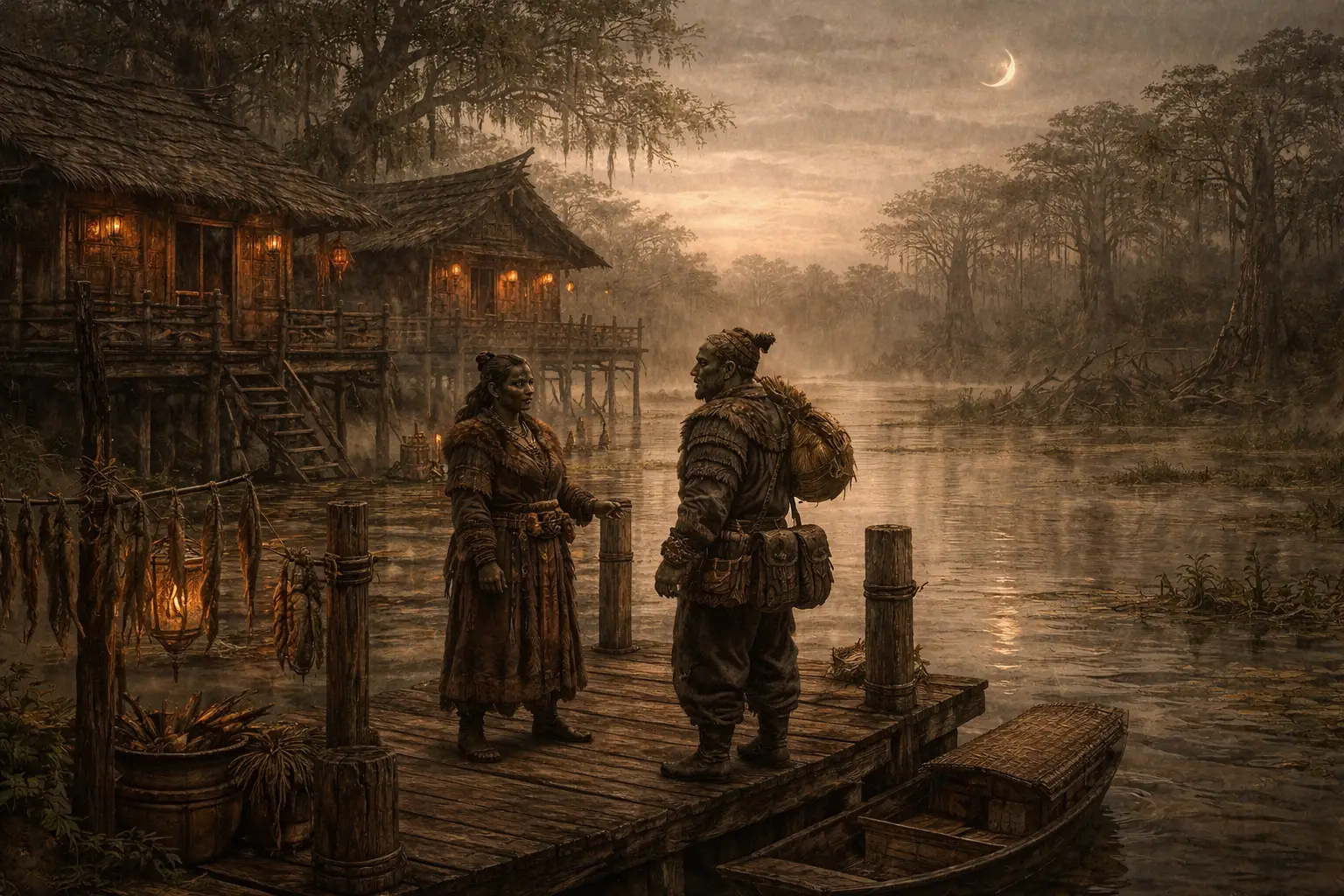
Economy & Industry of the Shadow Marches
An Economy of Mud and Patience
The Shadow Marches do not have an economy in the sense that a Brelish trade minister would recognize the word. Most of the population — the tribes and the outlying clans — operates on subsistence and barter, exchanging fish for hides, herbs for labor, and favors for favors in a system that predates the invention of coinage and has never seen a reason to adopt it. The concept of gross domestic product does not apply to a region where the majority of inhabitants have never used money.
What the Marches have instead is a single dragonmarked house sitting on top of a subsistence culture like a trading post built on a burial ground, drawing wealth from the swamp and sending it east while the swamp itself continues to operate on principles that have nothing to do with profit margins. House Tharashk is the economy — or at least the part of the economy that the outside world can see. Everything else is invisible, unrecorded, and conducted between people who have been trading with each other for generations without ever writing anything down.
This is not a poor region. The swamp provides — the Marchers say this with the same certainty that a Mror dwarf says "the mountain endures" — and providing means something different here than it does in the east. It means fish in the river and game in the bog. It means herbs that grow in manifest-zone soil and cannot be cultivated anywhere else. The wealth is real; it is simply organized around principles that no Kundarak assessor has ever been able to put in a ledger.
PRICE LIST — posted at a Zarash'ak market stall, handwritten in Azhani
Smoked marshfin (bundle of 6) — 3 cp Blackroot tincture (vial) — 8 sp Swamp honey, seasonal — 5 sp / jar Grist paste, ready-ground — 2 cp / bowl Ghost pepper mash (VERY HOT) — 1 sp / pot Marshgrass weave (waterproof, 3 ft.) — 4 sp Dragonshard dust — ask at counter. Tharashk license required. DO NOT ASK AGAIN IF REFUSED.
The Subsistence Layer
Beneath House Tharashk's commercial operations, the great majority of Marchers live on what the swamp gives them — and the swamp gives generously, if you know how to take it.
Fishing is the foundation. The rivers and bogs of the Marches teem with marshfin, mud-eel, gristfish, and a dozen other species that the eastern nations have never heard of and would not know how to prepare if they had. Marcher fishing techniques are adapted to the peculiar conditions of the swamp — shallow nets woven from marshgrass, bone-tipped spears for mudbank hunting, and a tradition of reading water currents that outsiders find indistinguishable from divination. The tribes fish for subsistence; the clans fish for subsistence and trade, selling smoked and salted catch at Zarash'ak and the smaller clan markets.
Hunting provides the other primary food source. The swamps hold a diverse and occasionally alarming population of wildlife — boar, deer adapted to boggy terrain, waterfowl in staggering variety, and predators ranging from mundane wolves and marsh cats to creatures whose relationship to the natural order is questionable. The deep swamp, where manifest zones twist the local ecology, produces animals that no naturalist from Korranberg would classify without extensive hedging. The tribes hunt these as readily as anything else, and tribal hunters are, by universal consensus, among the most skilled trackers in Khorvaire — a skill set that House Tharashk recognized and monetized when it began licensing bounty hunters for the wider world.
Gathering is the third pillar. The Marches produce an extraordinary variety of herbs, roots, fungi, and medicinal plants, many of which grow only in soil touched by manifest zones. These botanicals are the Marches' most distinctive local export apart from dragonshards. Marcher herbs command premium prices in the apothecaries and alchemical shops of the Five Nations — not because they are rare in the absolute sense, but because they cannot be cultivated outside the unique conditions of the swamp. The spices and flavorings that make Zarash'ak's cuisine famous are drawn from this same botanical wealth, and a significant community of Marcher immigrants in Sharn's Cassan Bridge district has built a thriving trade in exotic herbs and prepared foods.
The tribes and outlying clans also produce crafts — leatherwork, bone carving, woven marshgrass textiles, and wooden implements shaped from the dense swamp-wood of the region. These goods circulate through local trade networks and occasionally appear in the Zarash'ak market, where they are purchased by outsiders as curiosities or by Tharashk agents as supplies. The tribal economy is entirely unmonetized — transactions occur through barter, reciprocal obligation, and the kind of informal social accounting that functions perfectly well within a community of people who all know each other by name and breaks down completely the moment a stranger arrives with a purse full of coins.
"You can buy Marcher herbs in Sharn for ten galifars a bundle. The Marcher who picked them traded a basket of roots for a day's fishing rights and considered it a good deal. The profit margin between the swamp and the city is the entire reason House Tharashk exists." — overheard at the Cassan Bridge market, Sharn
Dragonshards: The Reason the World Cares
Eberron dragonshards are the lifeblood of the magical economy. Every creation forge, every elemental binding, every dragonmark focus item, and a substantial proportion of the enchanted goods produced across Khorvaire depend on dragonshards as a raw material. The Shadow Marches contain significant deposits of Eberron dragonshards — not as rich as those in Q'barra, but productive enough to constitute a major industry and the primary reason the wider world has any interest in the region at all.
Dragonshard prospecting is House Tharashk's founding industry and remains its most important revenue source within the Marches. Prospectors with the Mark of Finding can sense shard veins through layers of mud and stone — a talent that gives Tharashk a decisive advantage over any competitor and that made the house's fortune when House Sivis first identified the mark in 498 YK. Clan Torrn oversees the largest mining operations, blending dragonmarked tools with primal magic passed down from Gatekeeper traditions. Torrn prospectors are considered the finest in the house — stoic, methodical, and attentive to the land in ways that reflect their druidic roots.
The work is dangerous. Dragonshard deposits in the Marches tend to occur in precisely the places that are hardest to reach and most likely to kill you — deep bog, manifest-zone-touched terrain, and territory that may be claimed by tribal communities, infested with aberrations, or both. A prospector wading into the deep swamp with a shard-sense and a prayer is engaged in an activity that is roughly as safe as deep mining in the Realm Below, with the added complication that the ground under your feet might be concealing a nine-thousand-year-old ward against the lords of madness, and digging in the wrong place could breach it.
Tharashk maintains licensed prospecting operations throughout the Marches, with wayposts marking the boundaries of approved extraction zones. Independent prospectors — clan hunters with the mark who have chosen not to join the house, or outsiders who have obtained a Tharashk license — work smaller claims. The shards are sold to Tharashk factors in Zarash'ak, weighed, graded, and shipped east to the markets of the Five Nations, where they disappear into the supply chains of House Cannith, the Arcane Congress, and every artificer's workshop on the continent.
NOTICE — Tharashk Prospecting Office, Zarash'ak
CURRENT SHARD PRICES (Eyre 998 YK)
Grade I (raw, uncut) — 15 gp / oz. Grade II (cleaned, sorted) — 28 gp / oz. Grade III (cut, ready for enchantment) — negotiable, consult factor
All purchases subject to Tharashk licensing. Unlicensed sellers will be reported to port authority. We do not ask where your shards came from. We do weigh them very carefully.
The Finder's Guild: Exporting Marcher Talent
Dragonshards stay in the ground until someone finds them. Fugitives hide until someone tracks them down. Lost objects remain lost until someone with the right gifts goes looking. The Mark of Finding is the engine that drives everything House Tharashk does, and the Finder's Guild — the house's primary commercial arm — turns that talent into revenue across the continent.
The Finder's Guild licenses three categories of service: inquisitives, bounty hunters, and dragonshard prospectors. Tharashk inquisitives operate in every major city in Khorvaire — Sharn alone hosts four Tharashk-affiliated agencies, each specializing in a different kind of work. The house's reputation for discretion and competence has made Tharashk inquisitives competitive with House Medani's Warning Guild, a development that has generated considerable friction between the two houses. Tharashk bounty hunters are feared across the continent; the Mark of Finding means they almost always catch their quarry, and the orc and half-orc hunters who carry the mark bring a physicality to the job that most fugitives find persuasive. Prospectors work dragonshard claims in the Marches, Q'barra, and Xen'drik, using the mark to locate deposits that conventional surveying would miss.
What makes this relevant to the Marches' economy is that the Finder's Guild is essentially an export of Marcher human capital. The clans produced skilled hunters for thousands of years before anyone thought to call it a business. The mark sharpened abilities that already existed. The guild simply put a price on talents that the swamp had been cultivating for free, and the revenue flows back to Zarash'ak, where it funds the house's expansion and, through the house, the slow transformation of the Marches from subsistence backwater to something the rest of the world has to take seriously.
The Dragonne's Roar: Brokering Droaam
The most lucrative and most controversial arm of Tharashk's business has nothing to do with dragonshards or the Mark of Finding. Beginning in 988 YK — in the final years of the Last War — Clan Aashta devised the Dragonne's Roar, a brokerage service that supplies monstrous mercenaries from the newly declared nation of Droaam to clients across Khorvaire. Ogre laborers for construction projects. Gnoll soldiers for hire. Troll shock troops for clients who need a problem solved and do not care how much of the problem is left standing afterward. Harpy scouts, medusa negotiators, and minotaur enforcers, all contracted through Tharashk and delivered to the client under house guarantee.
The Dragonne's Roar made Tharashk rich in ways that dragonshard prospecting never could. It also made the house indispensable to Droaam — Tharashk is the sole commercial bridge between the Daughters of Sora Kell and the rest of Khorvaire, and every monstrous mercenary contract, every trade negotiation, and every diplomatic communication between Droaam and the treaty nations passes through Tharashk intermediaries. This gives the house extraordinary leverage on both sides of the arrangement, and it has made House Deneith — Khorvaire's traditional mercenary broker — furious. The rivalry between the two houses is one of the most dangerous fault lines in dragonmarked politics, and it shows no sign of cooling.
For the Marches, the Dragonne's Roar means that the region's eastern border — the unmarked, undefended frontier where the swamp becomes the plains that become Droaam — is one of the most economically significant boundaries in Khorvaire. Aashta territory on the Marches' eastern edge has always been the contact zone between the two regions, and the Aashta's longstanding familiarity with the peoples of what is now Droaam made them the natural architects of the arrangement. The Dragonne's Roar is an Aashta innovation, and the profits from it have made Clan Aashta the most aggressive voice on the Triumvirate — pushing for deeper ties with Droaam, more expansion, and a more confrontational posture with rival houses.
"House Deneith has been brokering mercenaries for centuries. House Tharashk has been doing it for a decade. The difference is that Tharashk's mercenaries can rip a door off its hinges. Sometimes the old ways are overrated." — Khandar'aashta, attributed
Zarash'ak: The Market at the Edge of the World
Zarash'ak, the City of Stilts, is the only place in the Shadow Marches where the subsistence economy and the continental trade network meet face to face. The city sits on massive murk oak pilings driven into the swamp, raised by Torrn druids using primal magic, and it functions as port, market, and cultural crossroads — the single point where the Marches open their hand and show the world what they have.
The Zarash'ak market is where dragonshards change hands, where Tharashk factors set prices and weigh product, where Lhazaar and Brelish merchantmen tie up at the docks and load cargo. It is also where the deeper Marcher economy surfaces: tribal hunters and clan gatherers bring herbs, hides, crafts, and preserved foods to sell or trade, and the market stalls carry goods that cannot be found anywhere else in Khorvaire — blackroot tinctures used by Jorasco healers, ghost pepper preparations that can clear a sinus infection or strip varnish depending on the dosage, swamp honey gathered from hives that only produce during specific lunar phases, and smoked marshfin that Sharn food critics have described in language usually reserved for Aereni wine.
The city is also known for its music — a percussive, rhythmic tradition built on drums, bone-rattle instruments, and chanted vocal patterns that visiting Brelish critics have called both hypnotic and deeply unsettling. Zarash'ak's music scene draws occasional visitors who have no interest in dragonshards whatsoever, and the dockside taverns where Marcher musicians perform are among the few places in the region where an outsider can sit down, eat something extraordinary, listen to something they have never heard before, and leave with all their limbs.
The rest of the Marches has no markets, no docks, and no interest in tourists. Zarash'ak is the aperture through which the swamp becomes visible to the continent. Everything else is dark water.
REVIEW — excerpted from an unsigned letter to the Sharn Inquisitive's food correspondent, 997 YK
"I ate something at a stilt-house in Zarash'ak that the cook called 'marshfin three ways.' The first way was smoked. The second way was raw, dressed in a fermented root sauce that made my eyes water. The third way involved setting the fish on fire at the table and eating it while the flames were still going. I have no explanation for the third way. It was the best meal I have eaten in my life."
Trade and Transit
Within the Marches, travel is by water. The Glum River and its tributaries are the primary transit network, navigated by flat-bottomed barges, punts, and canoes that the Velderan clan has operated for centuries. The Torshaa — a Velderan lesser clan — are considered the most reliable guides in the Marches, and anyone venturing beyond Zarash'ak without a Torshaa boatman is either very experienced or very optimistic. Beyond the navigable rivers, travel is on foot through terrain that ranges from difficult to lethal, and the only people who move through the deep swamp with any confidence are the tribal hunters who grew up in it.
Exports leave by ship from Zarash'ak: dragonshards, herbs, prepared foods, and the occasional crate of tribal crafts. Imports arrive the same way: finished goods, steel tools, alchemical supplies, and the various materials that Tharashk needs to maintain its operations. The trade is modest by continental standards — Zarash'ak is not Sharn — but it is growing. Tharashk's postwar expansion has increased the volume of traffic through the port, and the house has invested in docking infrastructure and warehousing to accommodate it.
The Marches also maintain a trade connection to Droaam through the eastern borderlands, though "connection" is a generous word for a series of informal paths through contested territory where the likelihood of being robbed, eaten, or both is non-trivial. The Aashta clan handles most of this traffic, and their familiarity with the peoples of Droaam gives them a practical monopoly on cross-border commerce.
Tharashk also maintains Blood Crescent, an outpost on the shores of Crescent Bay in the Demon Wastes, regularly supplied by ships from the Marcher town of Yrlag. This foothold — the house's long-dreamed-of base in the Wastes — is small, isolated, and supplied at considerable risk, but it represents Tharashk's ambition to expand its prospecting operations into one of the most dangerous and least explored regions on the continent.
SHIPPING MANIFEST — filed at Zarash'ak port, Nymm 998 YK
Outbound (Lhazaar vessel Greywater): 14 sealed crates Eberron dragonshards (Grade II), 6 barrels smoked marshfin, 2 crates assorted Marcher herbs (sealed, perishable), 1 crate tribal crafts (bone and hide, decorative). Destination: Regalport.
Inbound (Brelish merchantman Dagger's Reach): 20 barrels refined steel stock, 8 crates alchemical reagents (House Jorasco consignment), 4 crates finished tools (House Cannith stamp), 1 barrel Brelish ale (crew personal). Origin: Sharn.