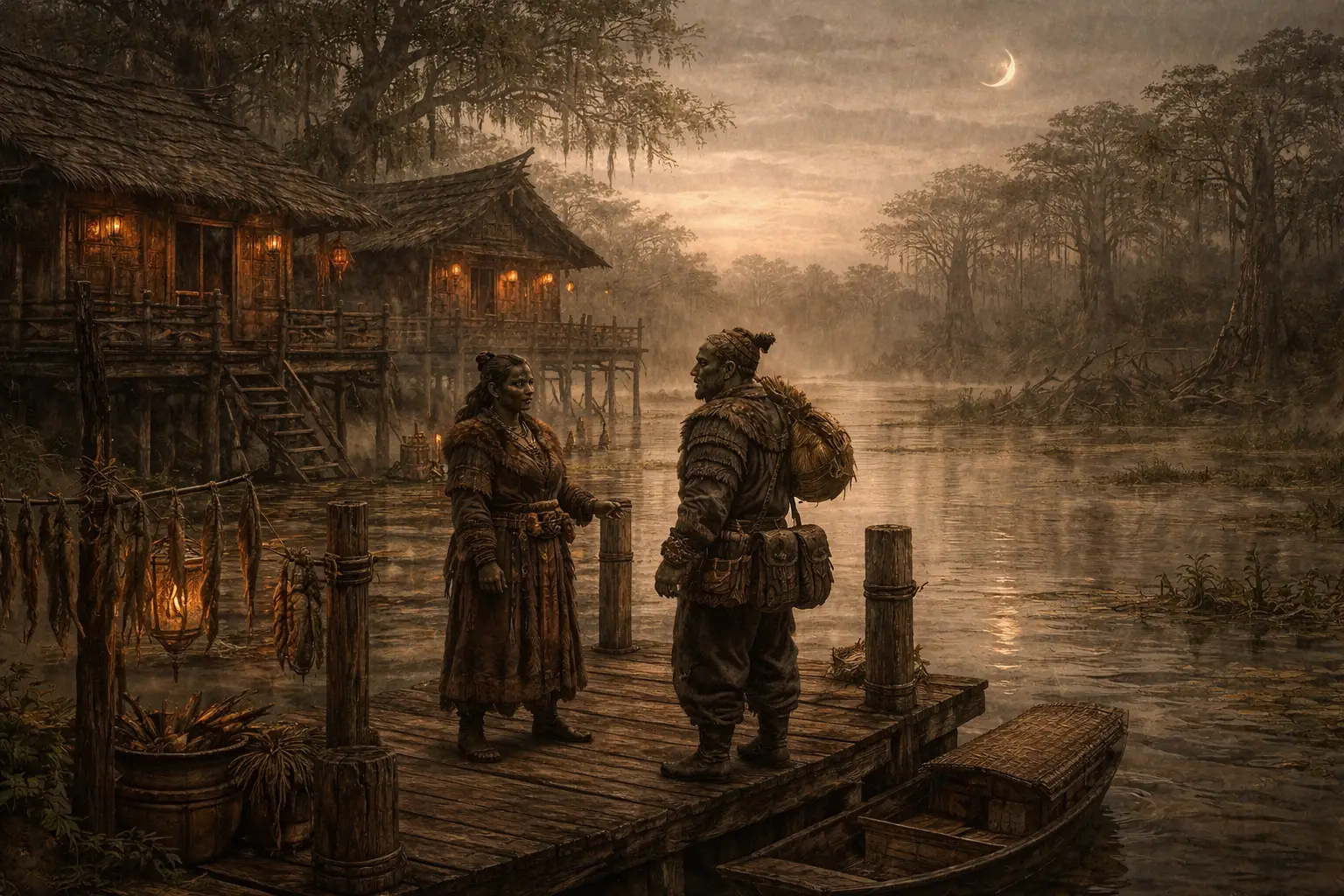
Politics of the Shadow Marches
From the field notes of Tassilar d'Sivis, attached to a Tharashk trade delegation, Barrakas 997 YK:
I have been in the Shadow Marches for eleven weeks. In that time I have asked nine separate people who governs this region. The Tharashk factor in Zarash'ak said "the Triumvirate." The clan elder outside Valshar'ak said "the ancestors." The tribal hunter I met on the Glum River said nothing and walked away. The old woman who runs the stilt-house tavern near the dragonshard flats said "nobody, and we like it that way." A Gatekeeper druid I met at a waypost said "the land."
I am beginning to suspect this region is ungovernable by design.
The Absence of Government
The Shadow Marches have no government; there is no head of state, no legislature, no constitution, no codified body of law, no unified military, no tax system, and no institution that speaks for the region as a whole. The Treaty of Thronehold did not recognize the Shadow Marches as a sovereign nation, because there was no sovereignty to recognize — no delegation arrived at the negotiations, no representative signed any document, and nobody in the Marches particularly cared.
To an outsider trained in the political traditions of the Five Nations, this looks like chaos. To the Marchers, it looks like nine thousand years of evidence that they do not need what the east is selling. The orcs of the Shadow Marches lived without centralized authority for millennia before humans arrived on Khorvaire. They defeated the daelkyr without a king. They endured the Long Silence without a parliament. They absorbed a wave of Sarlonan refugees without a border policy. And they produced a dragonmarked house without a charter of incorporation. The Marches function — not smoothly, not equitably, and not in any way a Brelish parliamentarian would recognize as functional — but they function, and they have functioned for longer than any nation currently sitting at the Thronehold table.
What exists in place of government is a layered, overlapping set of local authorities, spiritual traditions, and commercial interests that interact with each other in ways that are informal, inconsistent, and largely invisible to outsiders. Understanding who holds power in the Shadow Marches requires understanding that "power" does not mean what it means in Wroat or Korth. There is no one to petition. There is no one to bribe. There is only the elder, the druid, the factor, and the swamp — and the swamp always gets the final vote.
The Clan Structure
The clans are the closest thing the Marches have to organized governance, and even they would resist the comparison. A Marcher clan is a community of orc-kin bound by kinship, marriage, and shared territory — typically a town or cluster of villages built on stilts above the waterline. Each clan governs itself. The clan elder — sometimes a single leader, sometimes a council of senior family heads — makes decisions for the community: settling disputes, allocating resources, negotiating with neighboring clans, and determining how to respond to threats. The elder's authority derives from respect, competence, and the consent of the families, not from any external appointment. An elder who loses the confidence of the clan will be replaced, usually without violence but always without ceremony.
There is no hierarchy between clans. No clan has authority over any other. There is no council of elders, no regional assembly, and no mechanism for clans to make collective decisions — which means that when a problem affects multiple clans, the response depends entirely on whether someone takes the initiative to talk to the neighbors. Sometimes they do. Sometimes they don't. The Marches have survived for millennia on the principle that most problems are local and most local problems can be solved by the people who live there, and this principle has held up remarkably well against everything except the slow, grinding pressure of a dragonmarked house that thinks in continental terms.
Justice within a clan is the elder's business. A Marcher who wrongs a clanmate answers to the elder. A Marcher who wrongs a member of another clan has started a feud — a problem that will be resolved through direct negotiation between the families, compensation in goods, or violence, depending on the severity of the offense and the temperament of the people involved. There is no appeals process. There is no code of law. The Galifar Code of Justice has never applied in the Shadow Marches and almost nobody in the Marches has heard of it. Outsiders who get into trouble in the deep Marches will find that the concept of legal protection does not translate, and that the local elder's sense of fairness may or may not align with anything they would recognize as due process.
"You want to file a complaint? With who? The frogs? Write it down and nail it to a tree. Maybe the tree will care." — Marcher clan elder, responding to a Tharashk prospector's request for arbitration
The Tribal Structure
Beyond the clans, the tribes represent an older and more diffuse form of social organization. Predominantly orcish, the Marcher tribes are semi-nomadic groups that follow the rhythms of the swamp — hunting, fishing, gathering, and moving with the seasons through territories they have occupied for thousands of years. Tribal leadership follows ancient custom: an elder or a council of elders, chosen by age, wisdom, spiritual authority, or demonstrated competence. In many tribes, the senior Gatekeeper druid is the de facto leader, or at minimum the most influential voice in any decision. In others — particularly those aligned with the cults of the Dragon Below — the spiritual authority belongs to figures whose relationship with reality is, by outsider standards, deeply questionable.
The tribes do not recognize the authority of the clans, of House Tharashk, or of any external institution. Many tribes have no contact with the wider world and want none. Their territories are not marked on any map — they are carried in memory, known by the people who walk them, and defended when necessary by people who know every bog and ridge and treeline by feel. A tribal territory is not a legal boundary. It is an understanding, and the consequence of violating that understanding depends on who you have offended and how deep into the swamp you are when they find you.
The relationship between tribes and clans is neither hostile nor harmonious. They share a swamp and, in many cases, ancestors. Clan folk view the tribes as stubbornly backward. Tribal folk view the clans as having traded something essential about themselves for steel and coin. Trade occurs. Intermarriage occurs. Conflict occurs. There is no formal mechanism for resolving disputes between the two cultures, which means disputes are resolved the same way everything else in the Marches is resolved — locally, personally, and with results that vary enormously depending on who is involved.
House Tharashk: The Government That Isn't
House Tharashk is the single most powerful organization in the Shadow Marches, and it functions in many respects as a de facto government — controlling the region's largest city, overseeing its primary industry, maintaining its only connection to the outside world, and employing a significant portion of its population. It is also, emphatically, not a government, and the distinction matters.
The Triumvirate governs House Tharashk, not the Shadow Marches. The Triumvirate's authority extends to house members, house operations, and house property. It does not extend to independent clans, to the tribes, or to anyone who has not voluntarily entered into a relationship with the house. A Tharashk factor can tell a licensed prospector where to dig. That same factor cannot tell a tribal elder what to do with the water rights upstream. The elder may choose to cooperate. The elder may choose to ignore the factor entirely. The elder may choose to express displeasure in ways that make future cooperation difficult. Tharashk has learned, through expensive experience, that attempting to impose authority where it has not been granted tends to end badly in the deep swamp.
The Triumvirate consists of one leader from each of the three founding clans. Maagrim Torrn d'Tharashk is the eldest — stoic, patient, and deeply rooted in the Gatekeeper traditions of her clan. She is the most cautious voice on the Triumvirate and the most likely to counsel restraint when expansion threatens the ancient balances. Khandar'aashta — he does not use the d' prefix or the house name — is the fiercest, the most ambitious, and the most willing to use force to protect house interests. The Aashta clan has always thrived on conflict, and Khandar pushes the house toward aggressive expansion, deeper ties with Droaam, and a more confrontational posture with rival houses. Daric d'Velderan is the diplomat — optimistic, curious, and genuinely interested in making Tharashk a positive force in the wider world. He balances Maagrim's caution and Khandar's aggression with flexibility and charm, though the elder cabal within Clan Velderan — the Veldokaa — pursues its own subtler agenda behind his affable exterior.
In Zarash'ak, the City of Stilts, Tharashk's authority comes closest to actual governance. The house built the city, maintains its infrastructure, and oversees its markets, docks, and trade operations. Tharashk guards keep order in the commercial districts. Tharashk factors set the terms of trade. But even in Zarash'ak, independent clan communities and tribal visitors operate by their own customs. The city is a shared space — the only one in the Marches where all the region's factions can be found in one place — and Tharashk's control over it is more like a harbormaster's authority over a busy port than a lord's authority over a fief.
POSTED AT THE ZARASH'AK DOCKSIDE — undated
THARASHK TRADE RULES — ZARASH'AK PORT
All dragonshard transactions within the port must be weighed and witnessed by a licensed Tharashk factor. Cargo inspections are conducted at the discretion of port authority. Disputes between licensed operators are subject to Tharashk arbitration.
The Gatekeepers as Hidden Authority
Within the tribes that follow the Old Ways, senior Gatekeeper druids are often the most respected voices in the community — and in some tribes, the actual leaders. Their authority is spiritual rather than political, but in a culture where the spiritual and the practical are not separated the way they are in the Five Nations, this distinction is thinner than it sounds. When a Gatekeeper elder says that a particular stretch of swamp must not be disturbed, the community listens — not because the elder has legal authority to forbid it, but because the Gatekeeper traditions have kept the community alive for nine thousand years.
The Gatekeepers also exercise a form of territorial authority over the seals — the ancient wards that keep the daelkyr imprisoned in Khyber. Traveling circles of druids move continuously between sealed sites, conducting annual renewal ceremonies that are both religious observances and practical maintenance. Communities that exist near a seal are acutely aware of the debt they owe the druids, and these communities are the most common source of new Gatekeeper recruits. When a Gatekeeper says that a Tharashk mining operation must stop because it is too close to a sealed site, the result is a confrontation between two forms of authority that have no common framework for resolving the disagreement — the house's commercial interests and the druids' nine-thousand-year-old mandate. These confrontations are becoming more frequent, though they have not yet become violent.
The elder Gatekeeper of the Shadow Marches, Saala Torrn, is as close to a leader as the sect possesses. She does not command others or set policy, but those in search of wisdom seek her out. It is said she carries the last words of Vvaraak recorded in a mystic crystal passed down through generations of Gatekeepers in her clan. Fewer than a thousand Gatekeepers exist across the Marches and the Eldeen Reaches combined — perhaps two hundred aspirants, three dozen initiates, and only a handful of true gatekeepers with the power to conduct seal-renewal rituals. This tiny number maintains a vigil that protects the entire world, and almost no one outside the Marches knows they exist.
The Cults as Parallel Power
The cults of the Dragon Below do not govern. They do not aspire to govern. But in communities where cult traditions are strong — and there are many such communities in the Marches — the cult leader or the cult's spiritual practices shape daily life in ways that function as de facto authority.
A cult elder who declares that a particular day is sacred, that a particular stretch of water must not be fished, or that a particular ritual must be performed before the dark of the moon is exercising authority over the community's behavior. The authority is not political. It is spiritual, familial, and deeply embedded in traditions that may be thousands of years old. Some cult communities are perfectly functional by any external measure — people farm, fish, trade, raise children, and observe their rituals without doing anything that a visitor from the Five Nations would find objectionable, provided the visitor does not look too closely at what happens on certain nights or ask too many questions about the thing in the cellar. Others are genuinely dangerous — communities where the cult's practices have shaded into madness, where aberrations are tolerated or venerated, and where outsiders who stumble in may not stumble out.
Scratched into a waypost at the edge of Tharashk territory, in Azhani, in letters that have been recarved many times by many hands:
THE SWAMP WAS HERE BEFORE THE HOUSE. THE SWAMP WILL BE HERE AFTER.