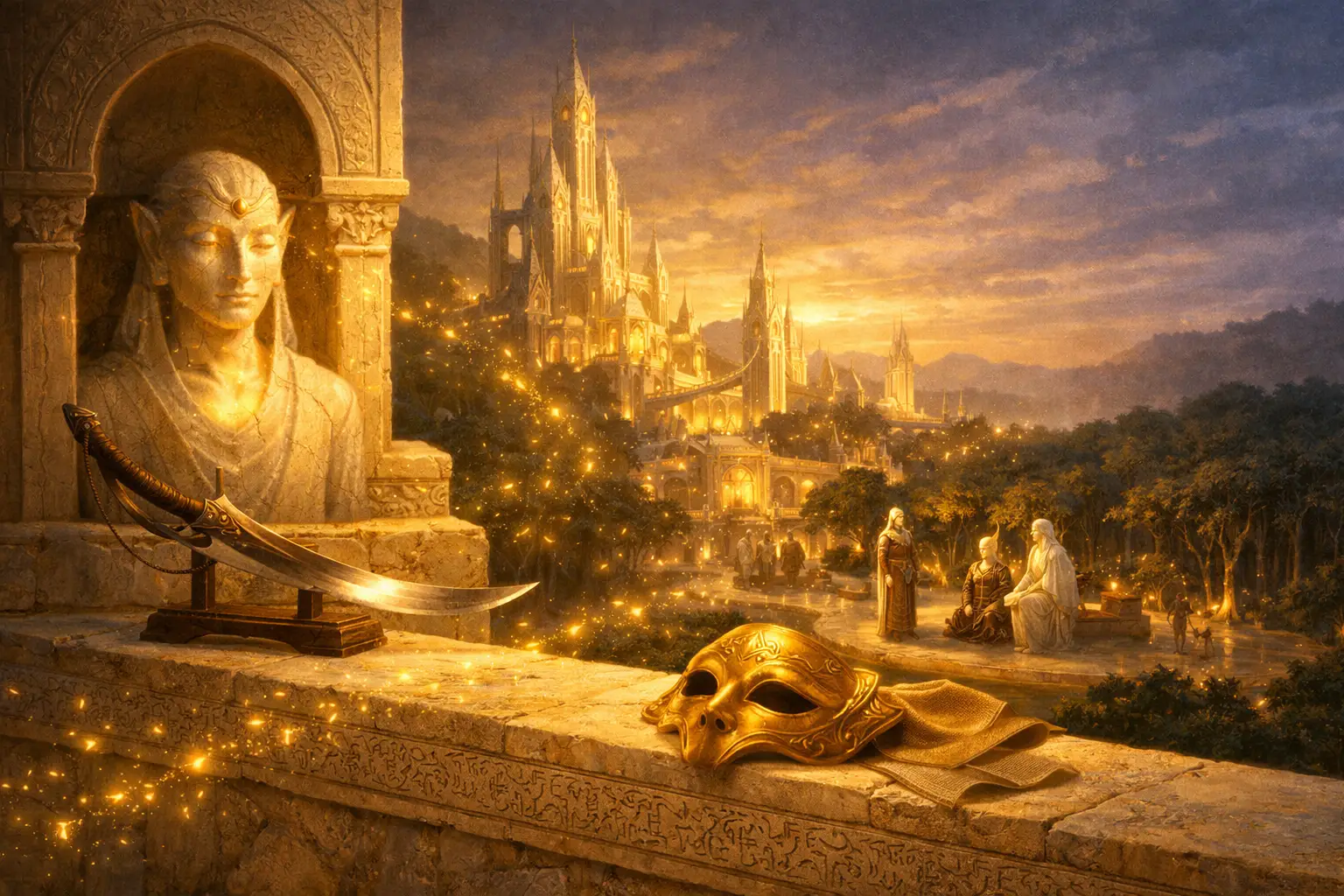
History of Aerenal
"We do not study history. We consult it. The historians are still here." — Helaeras Jhaelian, Deathguard captain, to a Morgrave researcher requesting access to the Shae Mordai archives
The history of Aerenal is measured in tens of thousands of years. This is not a figure of speech. The elves arrived on the island roughly thirty-nine thousand years before the present day. The Undying Court achieved its current power approximately ten thousand years ago. The wound that the Aereni do not speak of — the destruction of a noble line and the erasure of a dragonmark — occurred twenty-six centuries before the founding of Galifar. The Last War, which consumed the human nations for a century and reshaped the continent, barely registered on the island. An ascendant councilor who noticed the conflict might have mentioned it to the Sibling Kings. The Sibling Kings might have discussed it briefly. Then they returned to the work of perfecting a civilization that has been perfecting itself since before the first human drew breath on Khorvaire.
The challenge in telling Aereni history to outsiders is that the Aereni do not experience time the way humans do. A century is not a long time. A millennium is a notable span. The truly important events — the exodus, the first deathless, the breaking of a line — are measured against each other across gulfs of time that reduce everything the Five Nations have accomplished to a footnote. The Aereni are patient with this. They have had practice.
The Exodus (~–39,000 YK)
The elves were slaves in Xen'drik. For thousands of years, they served the giant empires — the Cul'sir Dominion, the Sul'at League, the Group of Eleven — as laborers, soldiers, and raw material for magical experimentation. The giants had learned arcane magic from the dragons and pushed it into territory the dragons would not enter. The elves learned what they could from their masters, and they remembered everything.
The rebellion, when it came, was not a single event but a long and brutal guerrilla campaign. The free elven clans in the wilds — those who had never been fully enslaved — joined with escaped slaves and the Gyrderi druids of the deep jungles. Vadallia, Queen of Swords, united the scattered clans and brought them to the same table. The Phiarlan served as messengers and spies, carrying intelligence between groups that could not safely meet. The giants responded by breeding the drow — elves magically altered to hunt their own kind in the dark. Some drow turned against their creators. The war ground on.
Emperor Cul'sir, desperate, began preparations for a weapon so devastating that it drew the attention of the dragons of Argonnessen. What happened next is not fully known — only that the dragons came, and what they did to the giants ended the war, the empire, and most of Xen'drik in a single cataclysm that still scars the continent.
The elves did not stay to watch. A visionary named Aeren had foreseen the coming destruction and united elves from a dozen different cultures — warriors, scholars, druids, and the handful of necromancers who carried knowledge inherited from the fallen Qabalrin — for an exodus across the sea. The journey was brutal. Aeren died before the fleet reached the island that would bear the name Aeren's Rest. The wizard Cardaen remained behind, driven by grief and rage over the death of Vadallia, vowing to slay Cul'sir. Neither Cardaen nor Cul'sir was ever heard from again.
The elves who followed Aeren were a ragtag alliance, not a unified people. They carried different traditions, different skills, different ideas about how to honor the dead — and the grief of what they had lost drove everything that followed.
"Aeren brought us together. Aeren died so that we could be here. Everything we have built on this island — every temple, every tradition, every soul preserved against the dark — began with that crossing, and with that loss." — from a Mendyrian memorial recitation, performed annually at Shae Cairdal
The Sundering of Paths (~–39,000 to –28,000 YK)
The refugees landed on an island saturated with planar energy. The southern reaches held powerful manifest zones tied to Irian, the Eternal Day — wellsprings of positive energy unlike anything the elves had encountered. The northern regions carried the influence of Mabar, the Endless Night — dark places where shadows thickened and death pressed close. Between them, the island's jungles offered soarwood, bronzewood, livewood, and dangers that the settlers had not anticipated.
The elves split almost immediately. Not violently — not yet — but by temperament and conviction. The warriors who had fought the giants settled the northern steppes and continued to live as they always had: in warbands, honoring their greatest champions, training for the next battle. These were the Tairnadal, and their conviction was simple — the heroes of the rebellion must never be forgotten, and the surest way to preserve a hero is to become them. The Tairnadal did not seek to defeat death. They sought to make death irrelevant through the act of emulation.
The rest — the scholars, the priests, the necromancers, the builders — settled the south and the coasts, founding the cities that would become the noble lines. Their conviction was different: death had taken Aeren, and death would take them all, and this was unacceptable. They would find a way to preserve their greatest souls, not as memory but as living presence.
Two schools of thought emerged over the millennia that followed. The Priests of Transition — the Mendyrian and Jhaelian, working with the Irian manifest zones of the south — discovered that positive energy could sustain the dead in a state that was not undeath as the world understood it. The process was agonizingly slow. It took over ten thousand years to create the first deathless. It took ten thousand more for the Undying Court to attain the collective divine power it wields today. The Aereni calendar measures these developments in cycles so long that their units have no equivalent in Common.
The Line of Vol — descended from elves who carried Qabalrin necromantic knowledge — pursued a parallel path through Mabar. Vol's founder had learned secrets from the dead psychopomps of Shae Tirias Tolai and the fallen Qabalrin arcanists, and she pledged that her people would never live in fear of death. Shae Deseir rose on the bank of the River of Night, in a Mabaran manifest zone, and the Vol developed vampirism, lichdom, and other forms of Mabaran preservation alongside their more conventional necromancy. They preserved the skulls of their dead in vast bone libraries and consulted them through speak with dead. They animated beasts for tireless labor. Their arcanists could send their own shadows on errands like familiars. Shadow puppetry became an art form.
For millennia, the two paths coexisted. There was tension — the Mendyrian and Jhaelian distrusted the Vol's reliance on Mabar — but the Melideth and Tolaen respected the Vol and maintained trade and conversation. The lines were united by Aeren's memory if nothing else, and by the shared understanding that death was the enemy and each line fought it in its own way.
The Dragonmarks (~–3,200 YK)
The Mark of Shadow appeared among the elves of Aerenal — the bloodlines that would eventually become House Phiarlan. A second dragonmark appeared among the Line of Vol. The nature and powers of this second mark are not widely known — the Aereni do not discuss it, and the few Khorvairian scholars who have tried to research it have been firmly discouraged. What is known is that the Undying Court regarded this mark with deep unease, and that the events which followed were, in part, a response to what the Vol intended to do with it.
The Breaking of a Line (~–2,600 YK)
What happened next is the deepest wound in Aereni history, and the one the Aereni are least willing to discuss.
The details are deliberately obscured — by the Undying Court, which does not explain itself; by the surviving noble lines, which have had twenty-six centuries to bury the story; and by the sheer weight of time. What is known, even to outsiders, is this: the Undying Court determined that the Line of Vol had committed an act so transgressive that it demanded annihilation. The Court acted with a speed and totality that it has never displayed before or since. The Line of Vol was destroyed. Every elf bearing the Vol bloodline who did not flee was killed. Shae Deseir was left a ruin — consumed by unchecked Mabaran influence, intensely haunted, a city where no one has lived for over two thousand years but where the dead remain.
The Great Bone Library still stands in Shae Deseir. Thousands of skulls wait to speak. No one goes to listen.
Scholars in Khorvaire have pieced together fragments: that the Vol's experiments exceeded the boundaries the Court had set for Mabaran necromancy, that outside powers may have been involved, and that the Court acted in alliance with forces it has never publicly acknowledged. Rumors persist of a dragonmark lost in the purge — a mark that has not manifested since. The Aereni do not confirm or deny these accounts. They do not discuss the Line of Vol at all, except to note that the line is broken and the region around Shae Deseir is forbidden.
Elves who had supported the Vol were exiled from Aerenal. Some fled to the Lhazaar coast, where they became the Bloodsail Principality — preserving fragments of Vol's Mabaran traditions in a harsh maritime exile. The elves of House Phiarlan, who carried the Mark of Shadow, chose to relocate to Khorvaire rather than remain on an island that had just demonstrated what the Court does to those who cross it. The Aereni do not consider the Phiarlan to be Aereni anymore. They chose exile. The Court does not forget.
"There is a jungle on Aerenal whose name is a moment of silence. Southwest of this silence, there is a city on the coast of a river. No one has lived there for over two thousand years. 'Why?' I asked. 'No one lives there,' he told me. 'But the dead remain.'" — from a Khorvairian explorer's journal, provenance uncertain
The Dragon Wars
Aerenal has been attacked by dragons from Argonnessen multiple times throughout its history — assaults on a scale that would have annihilated any human nation. The Undying Court has repelled each one. The Draleus Tairn — the smallest and deadliest of the Tairnadal armies — exist specifically because of these attacks, spending the intervals between dragonflights in constant preparation for the next.
Whether these wars are genuine conflicts or something else — some Tairnadal legends suggest the dragons may be testing the elves, sharpening them in preparation for a challenge yet to come — is a question the ascendant councilors contemplate and do not answer.
The Long Watch (~–2,600 YK to Present)
After the destruction of the Line of Vol, Aereni history becomes, from a human perspective, very quiet. The Undying Court consolidated its power. The noble lines refined their traditions. The Deathguard was established to ensure that Mabaran undead would never again take root on the island. The Cairdal Blades began operating as the Court's intelligence arm, extending Aerenal's eyes into a world the Aereni preferred not to visit. And the island turned inward.
Aerenal did not participate in the rise of Galifar. It did not intervene when the Dhakaani Empire fell. It did not respond to the arrival of humanity on Khorvaire. It traded — soarwood, bronzewood, livewood, the occasional magical artifact of extraordinary quality — through Pylas Talaear, and it allowed limited contact with the dragonmarked houses. But it did not engage. The Five Nations were a passing phenomenon, the Aereni believed, and the Court had more important work to do.
Small numbers of elves emigrated to Khorvaire over the centuries — exiles, dissidents, and a few who were simply curious about the world beyond the island. These immigrants could not replicate Aereni civilization in the Five Nations. They were severed from the manifest zones, the deathless mentors, the eldritch machines, and the infrastructure of a society that had been building its magical foundations for twenty thousand years. They became the Khorvairian elves — culturally human in most respects, carrying traces of Aereni knowledge but unable to practice it at the level their homeland maintained.
The Last War, when it came, was beneath the Court's notice. Aerenal did not fight. It did not choose sides. It watched, as it had watched the fall of Dhakaan and the rise of Galifar, with the patience of a civilization that has outlived everything it has ever observed.
The Present
Two developments have disturbed the long watch. The first is the Tairnadal seizure of Valenar in 956 YK — a bold action by High King Shaeras Vadallia that divided the Tairnadal and brought elven warriors into direct conflict with the nations of Khorvaire. The Aereni did not approve. The Tairnadal did not ask. The second is the Mourning — the destruction of Cyre in 994 YK, an event of unknown origin and catastrophic scale that the ascendant councilors have studied with an intensity they reserve for matters that touch the Draconic Prophecy. What they have concluded, they have not shared.
Aerenal remains what it has been for twenty thousand years: an island of light and shadow, guided by the dead, perfected by the living, and uninterested in the world beyond its shores except insofar as that world threatens the long, patient work of becoming worthy.
"The humans ask us what we think of the Mourning. We think it is too early to tell. We have seen the world break before. We are still here." — attributed to an ascendant councilor, through a soungral intermediary