Politics & Government of Aerenal
"A Brelish diplomat once asked me who really rules Aerenal — the Sibling Kings or the Undying Court. I told him: the Kings rule. The Court advises. He asked what happens when the Kings ignore the Court's advice. I told him: they don't." — Melideth trade factor, Pylas Talaear
The Living Rule, the Dead Advise
The government of Aerenal is, on its surface, straightforward. The Sibling Kings — two elves chosen from the same noble line, symbolically brother and sister though not blood relatives — lead the nation from Shae Cairdal. They are the temporal authority: they set policy, mediate between the noble lines, oversee foreign affairs, and command the island's military forces. The Sibling Kings are living elves, mortal and accountable to the people they govern.
The Undying Court does not rule. This distinction matters — the Aereni insist on it, and they are correct in the narrowest technical sense. The ascendant councilors of Shae Mordai do not issue decrees. They do not command armies. They do not administer justice or collect taxes. What they do is advise — and their advice carries the weight of twenty thousand years of accumulated wisdom, the divine power of a gestalt entity that has repelled dragon invasions, and the knowledge that the advisors will still be here long after the current Sibling Kings have joined them.
No Sibling King in recorded history has overruled the Undying Court on a matter the Court considered important. Whether this is because the Court's counsel is genuinely perfect or because the consequences of defiance are too terrible to contemplate is a question the Aereni do not find useful to ask.
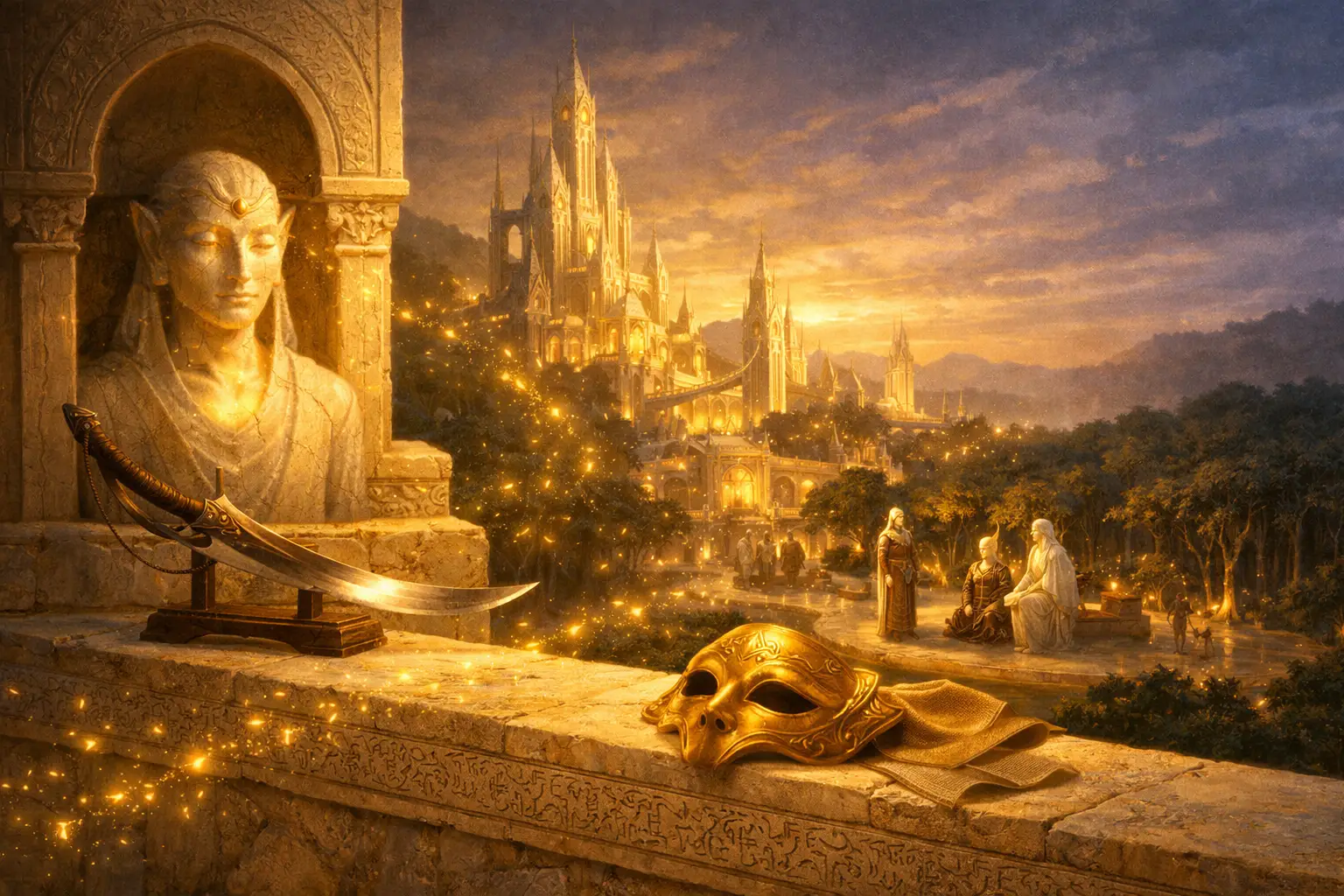
The soungraloi — the priests of the Undying Court — serve as the intermediaries between the living government and the deathless advisors. A soungral may serve as the spiritual leader of a community, an advisor to a noble lord on matters of faith, or a direct conduit for the will of a specific deathless councilor. They dress in white, paint their faces like skulls or wear death-masks, and speak with an authority that derives not from political appointment but from the fact that they speak for ancestors who are literally present and watching. The golden mask of the Undying Court, worn by soungraloi when acting in official capacity, is the most recognized symbol of religious authority on the island.
The Noble Lines
Beneath the Sibling Kings, Aerenal functions as a collection of city-states, each governed by a noble line. The lines are not dynasties — a critical distinction that outsiders consistently fail to grasp. A noble line is a meritocracy: an alliance of ancient families governed by a noble house whose members are selected from the region's most accomplished elves. You do not inherit membership in the noble house. You earn it — through demonstrated mastery of your craft, service to the line, devotion to the Undying Court, and the judgment of your peers and the deathless who remember what excellence looks like because they have been watching it for ten thousand years.
In life, an elf aspires to be appointed to the noble line. In death, they hope to be raised to the Undying Court — preserved as a spirit idol, or, if they are truly remarkable, elevated to the deathless state. The aspiration is the same motion at two different scales: prove you are worthy.
The lines govern their regions with considerable autonomy. Each line maintains its own soldiers, its own artisans, its own magical traditions, and its own relationship with the deathless of its territory. The Sibling Kings coordinate between lines and represent the nation as a whole, but the day-to-day governance of a Jhaelian monastery looks nothing like the governance of a Melideth port town or a Tolaen lumber camp. This is by design — the lines were founded by elves from different cultures who settled different regions of the island and developed different traditions over millennia. Unity does not require uniformity, and the Aereni have never confused the two.
Rivalries between lines are ancient, complex, and conducted with a patience that human politics cannot match. A feud between two noble houses might simmer for centuries before producing a visible consequence. The deathless of each line remember every slight, every debt, every act of generosity and betrayal, and this institutional memory — stretching back thousands of years — means that political relationships in Aerenal carry a depth of context that no outsider can fully navigate.
The Lines and the Political Landscape
The noble lines are not equal in influence, and the political landscape of Aerenal is shaped by alliances, rivalries, and philosophical differences that predate the founding of Galifar by tens of thousands of years.
The line of Mendyrian governs the region around Shae Cairdal and has, for most of Aereni history, provided the Sibling Kings. This makes Mendyrian the closest thing Aerenal has to a ruling dynasty — though the Aereni would reject the comparison, since the Kings are chosen by merit, not birth. Mendyrian's character is arcane scholarship: its members are devoted to magical lore, its wizards and artificers are among the finest on the island, and its aesthetic is elaborate to the point of ostentation — ornate clothing, complex hairstyles, and masks of polished metal or tooled leather that declare we have achieved things worth decorating. Mendyrian's political position is that of the natural center — the line that other lines orbit around, whether in deference or opposition. Its relationship with Jhaelian is one of mutual respect shading into rivalry, because both lines claim spiritual authority: Mendyrian through arcane mastery, Jhaelian through devotion. Its relationship with Tolaen is warmer — the practical artisans and the scholarly mages need each other more than either would admit.
The line of Jhaelian governs the region around Taer Kalindal and is the spiritual heart of Aerenal. Jhaelian produces more monks, clerics, and paladins than any other line, and it is the primary source of the Deathguard — the institution dedicated to hunting Mabaran undead. Jhaelian's character is contemplative devotion, and its members pursue divine mysteries with a single-mindedness that other lines sometimes find uncomfortable. Some Jhaelian Aereni use cosmetic transmutation to adopt a desiccated appearance — skin drawn tight, features hollow, eyes burning — emulating the deathless while still alive. Others wear masks. Both practices serve the same purpose: to declare that the boundary between the living and the dead is thinner than it appears, and that the Jhaelian walk closer to that boundary than most. Jhaelian's political influence comes not from wealth or military strength but from moral authority — when Jhaelian declares that a practice violates the will of the ancestors, the other lines listen, even when they disagree. This makes Jhaelian the Doldarun of Aerenal — the conscience that nobody asked for and nobody can afford to ignore.
The line of Melideth governs the region surrounding Pylas Talaear and is, by a considerable margin, the most outward-facing line on the island. Melideth produces the finest sailors in Aerenal, maintains the Aereni navy, and manages the trade that flows through the island's only open port. Its mercantile tradition makes Melideth Aereni more comfortable with foreigners than any of their kin — a relative term, since "comfortable" still means "politely condescending rather than coldly dismissive." Facial tattoos, often in skull or gothic motifs, are the line's distinctive mark. Melideth's political role is diplomat and gatekeeper: it controls what enters and leaves Aerenal, and it profits handsomely from the position. The most notable Melideth figure in Khorvaire is Lady Etrigani, a minor noble who married King Kaius III of Karrnath — a personal choice, not a state arrangement, and one the Sibling Kings observe with interest but have not endorsed.
The line of Tolaen governs the region around Pylas Zirinth and is the muscle of the Aereni. Tolaen drives the lumber industry — soarwood, bronzewood, livewood — and produces the finest architects and wood-masons on the island. But Tolaen is also the line that fights. Its soldiers are the best among the Aereni, its traditions emphasize physical craft over metaphysical contemplation, and it maintains closer ties to the Tairnadal than any other line. Elves who cannot adapt to the harsh life of the Tairnadal steppes are sometimes fostered among the Tolaen, and elves who feel the call of a patron ancestor sometimes leave Tolaen for the Tairnadal. The cultural exchange goes both ways. Tolaen's aesthetic is plain — simple clothing, functional design, wood masks that may be intricately carved but are never ornamental. Tolaen soldiers wear half-masks covering the lower face, a practice that carries both practical and spiritual significance. Tolaen's political position is pragmatic rather than ideological: it supplies the raw materials and the warriors, and it expects the other lines to remember that when the council votes.
The line of Valraea is all but unknown in the Five Nations. These are sea elves — their ancestors were magebred during the exodus to guard and govern the coastline — and they live beneath and along Aerenal's shores in communities that surface-dwelling Aereni rarely visit. Valraea are represented in the Undying Court and participate in island politics, but their concerns are oceanic: coastal defense, the Valraean Protectorate (a maritime buffer zone established around Aerenal's waters), and threats that come from below the waves rather than across them. Valraea dress in leather, are comfortable with casual nudity, and fashion their masks from shell and bone. Their existence is a reminder that Aerenal has depths that outsiders — and even most Aereni — do not see.
"An elf of the line of Tolaen told me his family had been in a dispute with a Mendyrian house for six hundred years. I asked him what the dispute was about. He said he didn't remember — but his grandmother's spirit idol did, and she was still angry." — notes of a Korranberg scholar, returned from Pylas Talaear
The Factions
Aereni politics appear monolithic from the outside — a nation united in devotion to the Undying Court and obedience to the Sibling Kings. From the inside, the picture is more complicated.
The mainstream of Aereni society accepts the system as it is: the living serve, the dead guide, and the work of perfecting the civilization continues. But within that mainstream, a current called the Dynastians holds that the Undying Court is not truly a unified body. In the Dynastian view, the ancestors of each noble line constitute their own separate divine entity — a familial god cooperating with other familial gods for the preservation of Aerenal, but ultimately destined to dominate them. A Dynastian works to advance the position of their own line's divine ancestry at the expense of all others. This is not a formal sect or an organized movement. It is a temperament — and it produces a quiet, centuries-long competition between lines that occasionally erupts into acts of sabotage, political maneuvering, and betrayals so subtle that only elves with millennia of institutional memory can follow them.
On the margins, the Skullborn represent a more dangerous dissatisfaction. These are elves who yearn for the deathless state but are unwilling — or believe themselves unable — to earn it through the long, demanding process the Undying Court requires. The Skullborn look for shortcuts: alternative paths to preservation, unauthorized rituals, and in extreme cases, the Mabaran necromancy the Court has forbidden since the destruction of a certain noble line. The Deathguard watches the Skullborn carefully, and any elf who shows too much interest in forbidden magic draws attention that most would prefer to avoid.
The Instruments of State
The Deathguard is the most visible instrument of state power beyond the noble lines. Formally an institution dedicated to hunting Mabaran undead wherever they are found, the Deathguard serves a dual function: military order and religious mandate. Deathguard agents operate across Aerenal, patrolling the Mabaran manifest zones, destroying vampires and liches, and enforcing the prohibition on Mabaran necromancy. Jhaelian provides a disproportionate number of its members, and the institution carries significant moral authority — to oppose the Deathguard is to oppose the will of the ancestors.
The Cairdal Blades are something the Aereni do not discuss. Named for the capital, the Blades are the Court's covert intelligence agency — spies and operatives who work across Khorvaire pursuing the interests of the Undying Court in ways the Sibling Kings can officially deny. A Blade might pose as a merchant in Pylas Talaear, a scholar at Morgrave, or an exile who has severed ties with the homeland. They gather intelligence on threats to Aerenal, monitor the activities of Mabaran undead abroad, and — when necessary — act to eliminate dangers before they reach the island. They are not numerous, but they are very good at what they do. Notably, the Blades include some elves who still carry the Mark of Shadow — descendants of the shadow-marked families who chose to remain on Aerenal when the Phiarlan departed.
POSTED IN THE SHAE CAIRDAL HALL OF LINES — in Elven, undated
By decree of the Sibling Kings: appointments to the noble lines for the current cycle are now open for review. Candidates are reminded that endorsement by a deathless councilor of the line carries weight but does not guarantee appointment. All candidates must present evidence of craft mastery, devotion, and service before the line's council of elders.
Petitions from families outside the current line boundary will be considered only with the sponsorship of an existing noble house.
The ancestors are watching. Conduct yourselves accordingly.
The Tairnadal Question
The Tairnadal of the northern steppes are allies, not subjects. The Sibling Kings have no authority over them, and the Undying Court does not guide them. The two cultures stand together when the island is threatened, and elves can move between them — Tolaen has particularly close ties — but in peacetime the relationship is one of mutual respect and mutual distance.
The Tairnadal seizure of Valenar introduced a complication. The Aereni did not approve of High King Shaeras Vadallia's decision to claim a portion of Khorvaire — it draws unwanted attention to Aerenal and divides the Tairnadal between supporters and opponents. The Sibling Kings expressed their displeasure. The Tairnadal ignored it. The alliance has endured worse, but the fracture is real, and the ascendant councilors are watching to see whether it widens.
Foreign Relations
Aerenal's foreign policy can be summarized in a single word: no.
The island trades with Khorvaire through Pylas Talaear, where the line of Melideth manages commerce with a professionalism that belies the nation's broader disinterest in the outside world. Soarwood, bronzewood, livewood, and occasional works of extraordinary magical craftsmanship flow outward; finished goods, raw materials, and intelligence flow in. The dragonmarked houses maintain outposts in Pylas Talaear and are tolerated so long as they respect Aereni customs and do not attempt to extend operations beyond the port. Foreigners are politely but firmly encouraged to conduct all business there and go no further.
The Aereni maintain no embassies in the Five Nations. They send no delegates to Thronehold. They signed no treaties during the Last War and took no sides. The elves of House Phiarlan and House Thuranni — who carry the Mark of Shadow and left Aerenal centuries ago — are not considered Aereni. They severed their ties. An elf of Phiarlan who wished to return would need to abandon the house, embrace Aereni traditions, and find a noble line willing to accept them. The Court does not extend its protections — or its promise of eternity — to those who have chosen exile.
"The humans send ambassadors to Pylas Talaear with letters of introduction, proposals for trade agreements, and invitations to diplomatic summits. The Melideth accept the letters, consider the proposals, and decline the invitations. The humans send more ambassadors. The Melideth accept those letters too. This has been going on for several centuries. Neither side appears to be tiring of the arrangement." — unsigned commentary, found in a Sivis diplomatic archive