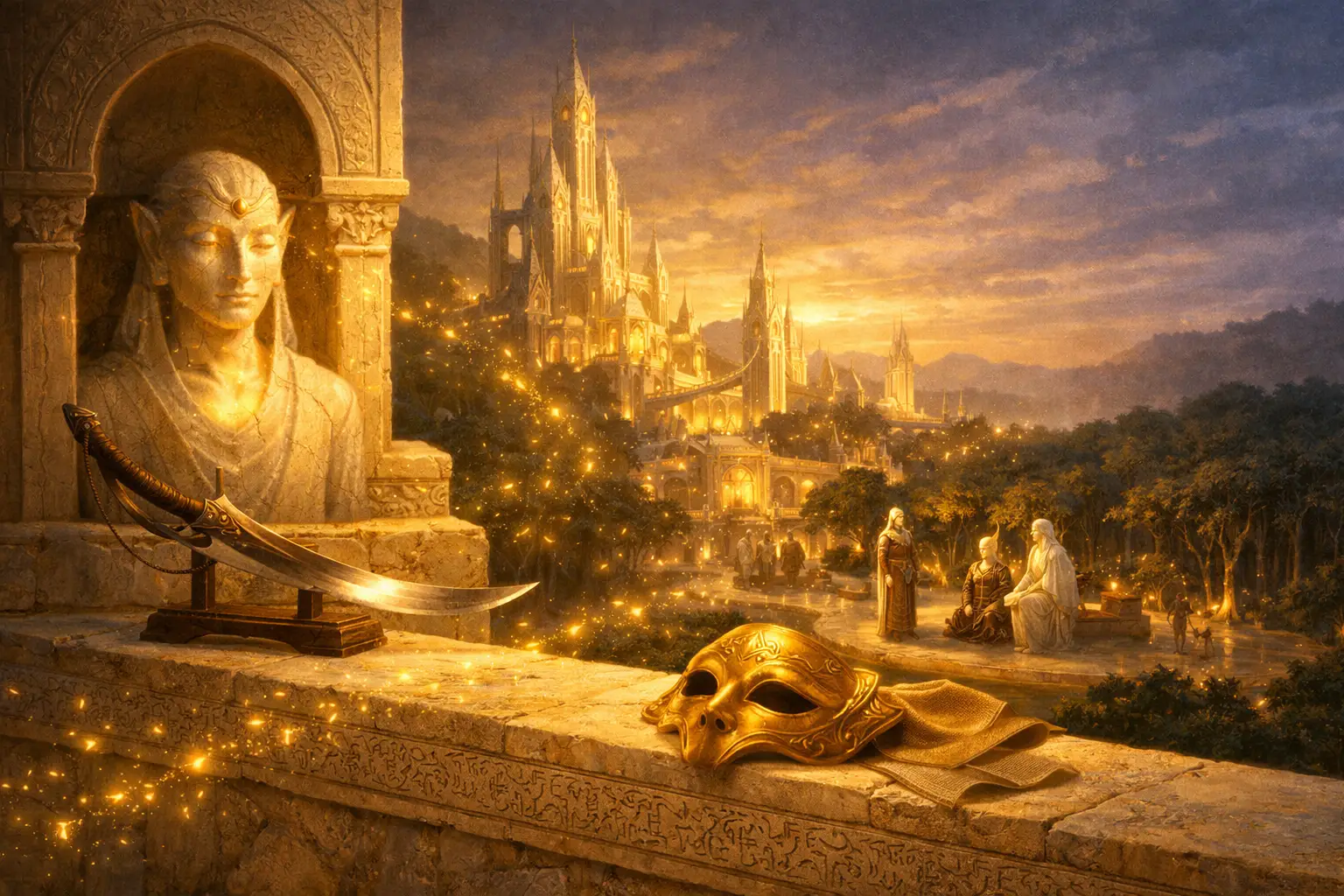
Aerenal
Capital: Shae Cairdal | Rulers: The Sibling Kings (temporal), the Undying Court (spiritual and divine) | Government: Collection of noble line city-states united under the Sibling Kings | Hallmarks: Deathless ancestors, positive energy necromancy, soarwood, bronzewood, ancient arcane mastery
"You misunderstand us. We are not preserving the past. We are living in it. The past is not behind us. It is teaching our children. It is guarding our gates. It remembers what we have forgotten, and it will be here when you are dust." — Thaera Mendyrian, speaking to a Brelish ambassador, Pylas Talaear
The island-continent of Aerenal lies southeast of Khorvaire, between the Thunder Sea and the Dragonreach. It has been the homeland of the elves for longer than humanity has existed on this world — a civilization over twenty thousand years old, built by refugees who fled the collapse of the giant empires on Xen'drik nearly forty thousand years ago, led by a visionary named Aeren whose death upon arrival gave the island its name. Aeren's Rest. The elves have been resting here ever since, and the rest of the world has been unable to disturb them.
The Undying Court — the divine council of deathless elven ancestors that guides and protects the nation — has repelled invasions by legions of dragons. It monitors the Draconic Prophecy on a timescale no mortal institution can match. It is, by most assessments, the most powerful benevolent force on Eberron. The Kingdom of Galifar, the greatest achievement of human civilization, lasted a thousand years before it tore itself apart. The Aereni watched it happen, as they had seen such countless things before.
The Dead Who Guide the Living
Aerenal is ruled by the living. The Sibling Kings — two elves chosen from the same noble line, symbolically brother and sister though not blood relatives — lead the nation from Shae Cairdal. The high priests and the lords of the noble lines are mortal elves, but the dead guide the living, and the dead are the source of Aerenal's power.
When remarkable elves die, they are preserved beyond death. Most are bound to spirit idols — stone busts holding relics of the corpse that preserve the soul from dissolution in Dolurrh. A spirit idol dwells in a dreamlike trance built from memory, but can be awakened to serve as tutor, judge, or counselor. Others are raised as deathless — undead sustained not by the negative energy of Mabar but by the positive energy of Irian and the freely given devotion of their living descendants. Deathless soldiers guard the catacombs. Deathless sages teach students who will not match their skill for centuries. And over time, the most extraordinary deathless rise further, becoming ascendant councilors — beings of pure spirit who reside in Shae Mordai, the City of the Dead. When the ascendant councilors join their spirits together, they wield power that is, by any functional measure, divine.
This is the Undying Court — not merely the ascendant councilors but the entire apparatus of deathless guardians, spirit idol counselors, and undying soldiers that protects and instructs the nation. Unlike many religions in Eberron, the Undying Court does not require faith, as there is no question whether the Court exists. But it requires devotion: the prayers and offerings of the living generate the positive energy that sustains the deathless beyond the reach of Irian's manifest zones. As an Aerenal elf, your ancestors protect you, but they also need you.
The Aereni despise Mabaran undead — vampires, liches, and anything animated by negative energy — with a revulsion that goes beyond theology into something closer to disgust. The Deathguard, an institution dedicated to hunting such abominations, is one of the most respected callings in Aereni society. To the Aereni, a vampire is not merely evil; it is a perversion of the sacred relationship between the living and the dead — a creature that feeds on life instead of being sustained by devotion.
"A visitor once asked how long a deathless wizard had been studying a particular spell. The wizard considered the question. 'Since your continent was forest,' he said. The visitor assumed he was speaking metaphorically, but he was not."
The Noble Lines
Aerenal is, in practice, a collection of city-states. Each region is governed by a noble line — but the word noble does not mean what it means in Khorvaire. An Aereni noble line is a meritocracy; the house carries the name of the line, but its members are chosen from the people of the region based on demonstrated excellence. Being born to a noble family does not guarantee you a place; proving yourself worthy of one does. In life, an elf aspires to be appointed to the noble line. In death, they hope to be raised to the Undying Court. The aspiration is the same motion at two different scales: prove you are worthy.
The line of Mendyrian governs Shae Cairdal, has historically provided the Sibling Kings, and is devoted to arcane lore — its members favor ornate clothing, elaborate hairstyles, and masks of metal or leather. The Jhaelian, based at Taer Kalindal, produce monks, clerics, paladins, and the Deathguard; they are protectors of the living. Some Jhaelian use cosmetic transmutation to adopt a desiccated appearance, emulating the deathless while still alive. The Melideth govern Pylas Talaear, maintain the Aereni navy, and are the most comfortable with foreigners; facial tattoos in skull motifs are common among them. The Tolaen, centered at Pylas Zirinth, drive the lumber industry and produce the fiercest soldiers among the Aereni, with close ties to the Tairnadal; their masks are carved from wood, and Tolaen soldiers often wear half-masks covering the lower face. The Valraea are a line of sea elves — all but unknown in the Five Nations — who guard the coastline, dress in leather, and fashion masks from shell and bone.
Each line has its face. Each face says who you serve and what you aspire to become.
Perfection, Not Innovation
The Aereni are not looking to the future. They are perfecting the present — which is to say, they are perfecting the past.
An Aereni wizard spends a decade refining the pronunciation of a single incantation, pursuing the exact technique developed by the master who created it — who is, in many cases, still available to correct their form. An Aereni artificer produces a very rare magic item that no Cannith creation forge can match, but it is a hand-crafted work of art that takes years to complete, while Cannith churns out common items by the hundred and constantly searches for new methods. Both approaches produce magic. The Aereni approach produces better magic. The Khorvairian approach produces more magic, faster, and it is accelerating. A master magewright in Khorvaire would be considered a mere apprentice in Aerenal.
The Aereni do not consider this a problem. The old ways are the best ways. The ancestors who developed those ways are still here to teach them. Why would you innovate when perfection is already available? The answer — that a species with shorter lives and less patience is catching up through sheer velocity of invention — is not one the Aereni take seriously. Their ancestors have watched empires rise and fall for twenty thousand years. Humanity is moving fast, but so does a fire.
The Shape of the Island
Aerenal straddles the planar boundary between Irian and Mabar — the Eternal Day and the Endless Night — and both planes bleed into the landscape. The southern reaches hold powerful Irian manifest zones, most notably beneath Shae Mordai, where the positive energy that sustains the ascendant councilors is strongest. The northern reaches and the deep jungles hold Mabaran zones — dark places where shadows thicken and dangerous forces creep in from the plane of endless night, kept in check by the Deathguard's eternal vigil.
Pylas Talaear is the gateway — the port city where outsiders are welcomed, the dragonmarked houses maintain outposts, and the lumber trade takes place; visitors are encouraged to enter the city, and then go no further. Aerenal's jungles provide some of the most valuable wood in Eberron: soarwood for airship hulls, bronzewood as strong as metal, and livewood that remains alive after being felled. Shae Cairdal is the capital — the seat of the Sibling Kings, the center of politics between the lines, and a city where foreigners are politely encouraged to conduct their business elsewhere. Shae Mordai is the heart — the ancient citadel atop the Irian rift where the ascendant councilors reside, where the greatest treasures of the elves are kept, and where almost no outsider has ever set foot. It is said to be far larger than it appears.
The northern steppes belong to the Tairnadal — the warrior elves who also occupy Valenar. The Tairnadal are cousins to the Aereni but a separate culture entirely. They do not worship the Undying Court. They preserve their ancestors not as deathless but by emulating their heroic deeds, believing that a living warrior who channels a patron ancestor serves as that spirit's anchor to the world. The two cultures have always been allies — they stand together when the island is threatened — but their philosophies diverge at the most fundamental level. The Aereni believe the dead should guide the living. The Tairnadal believe the living should become the dead.
NOTICE — posted at the entrance to the Pylas Talaear customs quarter, in Common and Elven
Visitors to Aerenal are welcome in Pylas Talaear and its surrounding territories. Passage beyond Pylas Talaear requires authorization from the governing line.
The following are prohibited without exception: Mabaran artifacts, negative energy foci, undead creatures or materials used in their creation, and any item bearing the symbols or sigils of the Blood of Vol.
Violators will be remanded to the Deathguard. Appeals may be filed with the soungraloi of the Melideth line. Processing times vary.
Postwar Pressures
Aerenal did not fight in the Last War. The elves had no interest in the quarrel and no stake in its outcome, but the war's aftermath has brought changes that even a twenty-thousand-year-old civilization cannot entirely ignore.
The Tairnadal seizure of Valenar has divided that culture between those who support High King Shaeras Vadallia's initiative and those who consider it reckless. The division runs through Aerenal's northern steppes, where Tairnadal noncombatants — children, artisans, and the druids who raise the remarkable warbred animals — remain while the warriors are abroad. Increased traffic through Pylas Talaear from dragonmarked houses and Five Nations diplomats pushes against Aereni isolation. And the Mourning, whatever it was, has attracted the attention of the ascendant councilors, who study the Prophecy and say nothing about what they have seen.
The dragonmarked houses of Phiarlan and Thuranni — founded by elves who left Aerenal centuries ago and severed their ties to the Undying Court — are a lingering irritation. The Aereni do not consider them Aereni. They chose exile. The Court does not forget, and neither does the Cairdal Blades — Aerenal's covert intelligence agency, which operates across Khorvaire pursuing the Court's interests in ways the Sibling Kings can officially deny.
The Aereni Character
Two qualities define the Aereni temperament, and outsiders find them difficult to distinguish from arrogance.
The first is patience so deep it looks like indifference. An Aereni elf does not rush. They do not improvise. They study a technique for a century and consider that a reasonable apprenticeship. They have been taught by mentors who have been teaching the same skill for ten thousand years, and they see no reason to deviate from what those mentors have perfected. This patience extends to their view of the world: the Aereni are aware that Khorvaire is changing, that the Five Nations are in turmoil, that the dragonmarked houses are consolidating power at a pace that would alarm anyone paying attention. They are paying attention. They have been paying attention for longer than Galifar existed. They are not alarmed. They have seen this before.
The second is a certainty so total it appears to leave no room for doubt. The Aereni know that their ancestors are real. They have spoken to them. They have been taught by them. They have watched them repel dragons. The Undying Court is not a matter of belief; it is a matter of daily, demonstrable fact, and this gives the Aereni a relationship with their own culture that no human nation can match. A Brelish patriot loves their country. An Aereni elf knows their country is correct — guided by divine ancestors who have been refining the same civilization for two hundred centuries. The confidence this produces is genuine, not performed, and it is exactly as infuriating to outsiders as you would expect.
An Aereni who leaves the island carries that certainty with them — into Sharn, into Stormreach, into whatever corner of the world their business or their quest has taken them. They are a traveler from a kingdom that was ancient when humanity was young, carrying techniques that the greatest artificers in Khorvaire cannot replicate, sustained by a faith that is not faith at all but simple knowledge of what is true. They are patient with the short-lived races. They find human urgency baffling but occasionally charming. And somewhere behind the mask — because there is always a mask — they are wondering whether this journey will be the one that proves them worthy of something that has been waiting for them since before they were born.
"I have been asked, many times, why we do not share our knowledge with Khorvaire. The question reveals the asker. You assume that what we have is knowledge. It is not. It is devotion — to the ancestors, to the traditions, to the work of becoming worthy. You cannot share devotion. You can only practice it, for as long as it takes, until the work is done." — a soungral of the Undying Court, declining a Morgrave University invitation