Art & Culture of Aerenal
"Stand on the steps of the Grand Temple in Pylas Talaear and look down upon the High Street and you will see fountains of light casting shadows across buildings that have stood for over ten thousand years. Brilliant motes dance through the air — spectral messengers carrying words across the city. Go to the Dalaen Forge and you will see the ghost of Old Dalaen advising his descendants as they work wood and steel. Visit the Eidolon Tavern and you will see poltergeists mixing drinks, and you can get advice from a spectral bartender with thousands of years of wisdom to share. Visit Maer Crossing at midnight and you will see the spirit of Lady Jhaelian dance with a grace unmatched by any living elf. Wondrous as it is, as a human visitor, I found it more than a little unnerving. There is no escaping the past in Aerenal. It lingers all around you." — from Nightlife of the Walking Dead, a Khorvairian travelogue
The Weight of Perfection
Culture in Aerenal is not a category. It is not something the Aereni do alongside the business of living, the way a Brelish citizen might attend the theater on Boldrei's Feast or a Cyran might commission a portrait to hang above the mantle. In Aerenal, culture and life are the same thing — and the standard for both is perfection.
The Aereni are obsessed with tradition — not merely mastering a skill, but performing it in the exact style of the ancient masters who developed it. An Aereni wizard does not simply learn a spell. They learn to cast it with the precise incantation, the exact somatic gestures, and the specific cadence that the elf who invented it used ten thousand years ago. An Aereni woodwright does not merely shape bronzewood. They shape it in the manner taught by the deathless master who has been teaching the same technique since the exodus, refining their approach over centuries until every cut, every join, every grain alignment is as close to the ideal as mortal hands can achieve. The deathless master watches. The deathless master remembers what perfection looks like. The deathless master will tell you when you have not reached it.
This is what it means to live in a civilization where the ancestors are literally present. In Khorvaire, tradition is a story you tell about the past. In Aerenal, tradition is a person standing in the room, watching you work, and they have been watching people work for longer than your entire nation has existed. The Aereni do not innovate because the innovators are still here, and they have already tried everything, and they have concluded that the way they do it is the best way it can be done. Challenging that conclusion is not merely bold — it is rude, because the person you are challenging is your great-great-great-grandmother, and she is right here.
The beauty of Aereni craft is inseparable from its precision. A bronzewood breastplate engraved by a Tolaen artisan is functional, protective, and exquisite — not because the artisan added decoration after the fact, but because the technique itself produces beauty as a byproduct of correctness. A spell cast by a Mendyrian wizard is not merely effective; its incantation is musical, its gestures are graceful, and the visual result — the play of light, the movement of energy — is aesthetically refined in a way that a Khorvairian mage would not even think to pursue. The Aereni do not distinguish between craft and art. If it is done correctly, it is beautiful. If it is beautiful, it was done correctly.
Hidden Faces
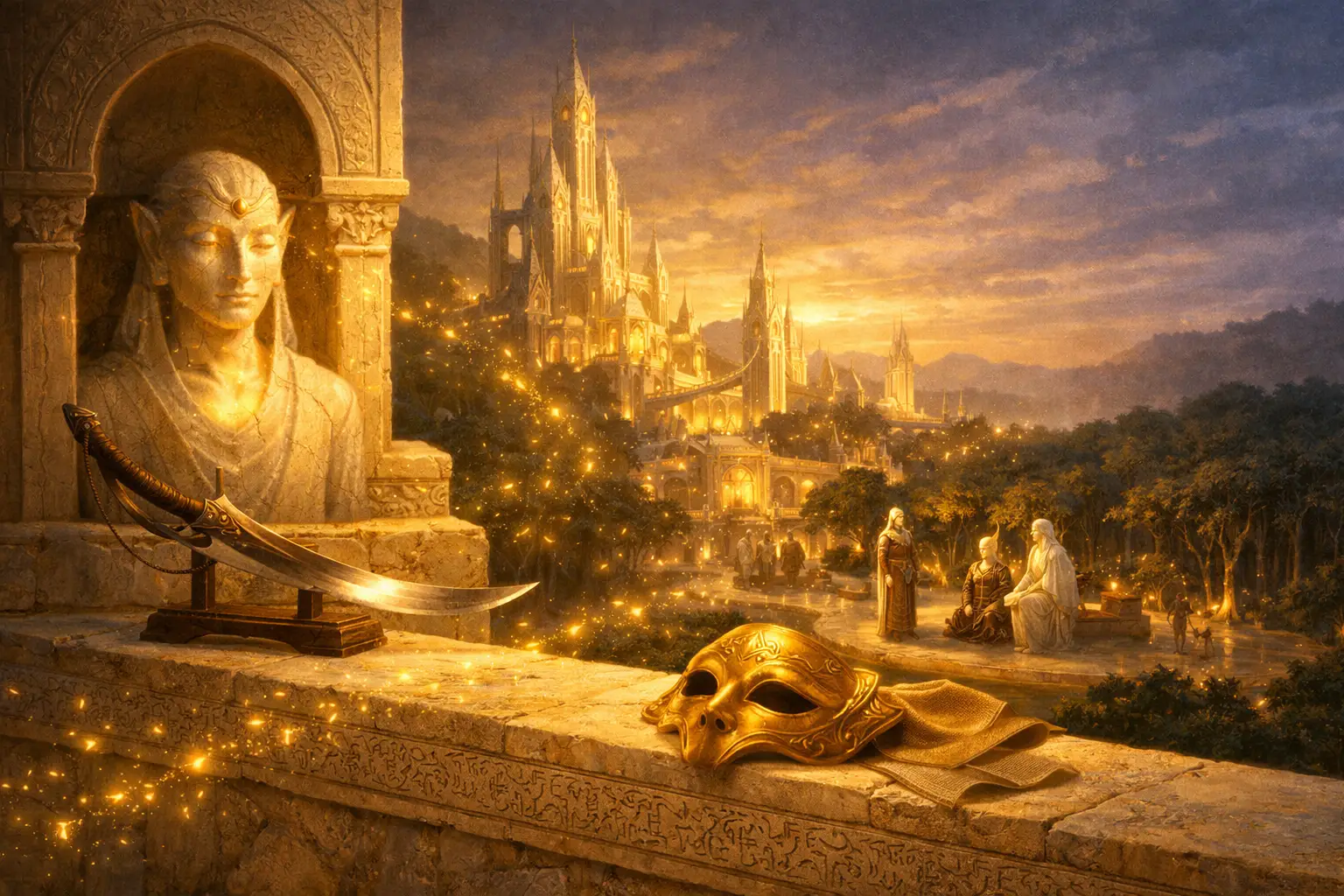
The Aereni mask is the most visible expression of this culture to outsiders — and the one most commonly misunderstood. Every noble line has its own distinctive mask tradition, worn by agents of the line when conducting official business. The masks are not disguises. They are declarations — of line, of purpose, of the face you present to the ancestors.
The Mendyrian favor masks of polished metal or tooled leather, often elaborate and ornamental, reflecting the line's devotion to arcane excellence and aesthetic refinement. The Jhaelian wear death-masks — or, more unsettlingly, use cosmetic transmutation to alter their living features to resemble the deathless themselves, their skin drawn tight, their eyes burning with devotion. The Melideth favor facial tattoos, often skull motifs or gothic imagery, worn openly as a mark of their line's identity. The Tolaen carve their masks from wood — sometimes intricately, sometimes plainly — and their soldiers wear half-masks covering the lower face. The Valraea fashion masks from shell and bone, shaped by the sea. And the soungraloi — the priests of the Undying Court — wear the golden mask of the Court when acting in official capacity, paint their faces like skulls during rites, and sometimes maintain the death-face even when they are not performing rituals, as a permanent declaration that they speak for the dead.
An Aereni who goes unmasked in a formal context is making a statement — either of intimacy, of vulnerability, or of contempt for the person they are addressing. Reading which one requires a fluency in Aereni social codes that no outsider possesses.
"A Melideth trade factor met with a delegation from House Cannith. The factor wore a skull-motif tattoo and an expression of absolute neutrality. The Cannith envoy asked if the tattoo was decorative. The factor said: 'It reminds me that everyone I am speaking with will die.' The meeting went poorly."
Faith as Architecture
Religion and daily life in Aerenal are inseparable. The Aereni believe their ancestors watch them constantly — not as a metaphor but as a statement of fact, because the ancestors are demonstrably present: as spirit idols in the alcoves, as deathless councilors in the halls, as ghosts advising at the forge, as spectral dancers at the midnight crossing. To please the ancestors and to continue their own spiritual advancement, the Aereni seek to be the best at everything they do. Artisans spend days or weeks on a single item. Lawmakers study and debate policy from every possible angle. Frivolity is not forbidden — the Aereni are not joyless — but it is regarded as a distraction from duty, and duty is the shape that devotion takes in daily life.
Nearly all structures are decorated with the holy symbols of important ancestors. Small rites and prayers punctuate the day — not lengthy ceremonies, but brief utterances addressed to specific ancestors. An Aereni does not pray to the Undying Court as a whole; they address a particular ancestor, usually one with relevant expertise. A soldier prays to a great-great-grandmother who was a warrior. A smith prays to the deathless master who taught them. The prayer is simple: a name, an honorific, a request or an expression of thanks. The ancestors carry these words to the Court — or, if they are powerful enough, answer them directly.
Every family marks the deathday of each of its members who have gone before, holding a rite at sundown to commemorate the anniversary. Depending on the size of the family, this can result in daily observances. The rites involve lit flames, sacred symbols drawn on the ground in wine or blood, and somber chants and dances whose steps are determined in advance by the leading soungral based on which ancestors are being honored. These are not performances. They are conversations — conducted in a language of movement and sound that the Aereni have been refining for twenty thousand years and that the ancestors recognize.
Death and What Follows
The Aereni relationship with death is the most misunderstood aspect of their culture. Outsiders assume the Aereni fear death. They do not. They regard death as a transition — one stage of a spiritual journey that began before birth and continues after the body fails. The physical realm is not the destination. It is the chrysalis.
The common dead are embalmed and interred in vast catacombs beneath the island, accompanied by a record of their life. Their spirits may linger, watching over their descendants, unable to continue their own spiritual journey but present nonetheless. Many Aereni live their entire lives in the company of ghosts they can feel but not always see — a great-aunt's approval, a cousin's warning, the whisper of someone who died before they were born.
Those who have proven themselves worthy are preserved in spirit idols — stone busts holding relics of the corpse that maintain the soul in an eternal trance, a dreamlike existence built from memories and personal experiences. Not all Aereni aspire to the deathless state. Many consider the spirit idol the superior path — an eternity of peace in a dream of their own making. An Aereni's greatest ambition may be to live a life rich enough in experience that the memories sustaining their eternal trance will be worth the dreaming.
The truly remarkable — those whose mastery, devotion, and service rise to the level that the Undying Court deems worthy — receive the Rite of Transition, the levan mordr-aer. This 48-hour ceremony can take place only in Shae Mordai, in the presence of the Irian energies that sustain the ascendant councilors. The mordraloi — the Priests of Transition — bathe the subject in oils and embalming fluids, lay them upon a bier, and draw holy symbols on their body in the willingly given blood of witnesses. Spells are cast. Utterances are spoken that do not belong to any known magical tradition. The process anchors the resulting deathless to the energies of Irian, creating a being sustained by positive energy and the devotion of the living. It is the highest honor in Aereni civilization — and an elf who has not received the proper rites at birth and death cannot be considered, no matter how worthy they otherwise would have been.
Those who commit truly heinous crimes — grave robbery, the practice of Mabaran necromancy, disrespect to the deathless — are denied memory. Their bodies are burned. Their ashes are scattered in the ocean. No record is kept of their lives. They are unmade, as thoroughly as the Aereni can manage, and in a civilization where being remembered is the closest thing to immortality most people can hope for, this is a fate worse than death.
The Shape of the World
Aereni architecture is old in a way that no building in Khorvaire is old. The structures of Pylas Talaear have stood for ten thousand years. The citadels of Shae Cairdal and Shae Mordai are older still. They are raised using stone shape and sustained by enchantments woven so deep into the material that the magic and the architecture have become indistinguishable — the building does not contain magic, the building is magic, in the same way that a tree is not a container for life but life itself.
The Aereni build in stone, livewood, and bronzewood — materials that endure. Their aesthetic is vertical and precise: tall, narrow structures with clean lines, intricate carvings on every surface that serve as holy symbols, clan markers, and records of the building's history. A single doorframe might carry the names of every family that has lived behind it, carved in script too small for human eyes to read without assistance. The Tolaen are the finest architects on the island, and their approach to building is the same as their approach to everything else: perfect the technique, honor the tradition, produce something that will still be standing when the last human kingdom has fallen to dust.
The interior of an Aereni home is spare by Khorvairian standards — the Aereni do not accumulate possessions the way humans do, because possessions are transient and the things that matter are not. A home contains the tools of the occupant's craft, the spirit idols of the honored dead, the masks of the line, and very little else. The beauty is in the precision of the space itself — the proportions of the room, the quality of the light, the way the enchantments sustain a constant, gentle warmth that makes the structure feel alive. An Aereni home is not furnished. It is tuned, the way an instrument is tuned, and the occupant lives inside the resonance.
The Aereni Calendar
The Aereni calendar is practically unreadable to anyone not raised with it. Time is measured in overlapping cycles: three-day tuernai form the basic unit, twenty-one tuernai form a luenir (roughly three months), and luenirai overlap to form the Aereni year. Years form ruelnai, and ruelnai form nuerlnirai — roughly analogous to a decade. Only then does the calendar restart. Specific holidays vary by family and are tied to the deathdays of ancestors, which means that the ritual calendar of one household may share almost nothing with the household next door. The result is a timekeeping system that makes perfect sense to the Aereni, who have had millennia to internalize it, and no sense at all to anyone else.
"I asked an Aereni scholar to explain their calendar. She began. I took notes for three hours. At the end, I understood less than when I started. She told me this was normal, and that I should expect to feel that way for approximately forty years." — Zil academic, in a letter to the Library of Korranberg