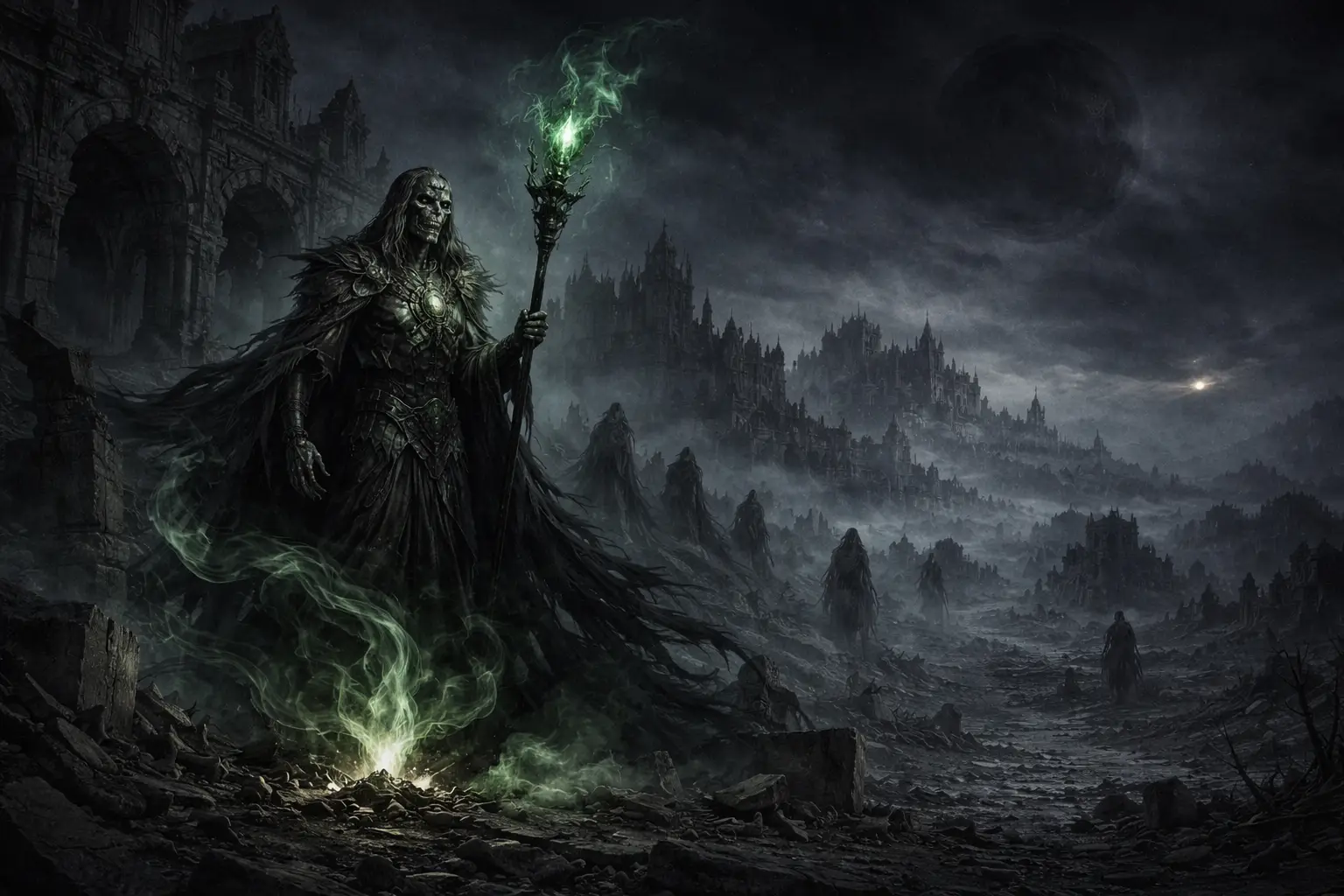
Mabar, the Endless Night
Plane — Entropy, Despair, Death & the Hunger That Consumes — Moon: Sypheros, the Shadow
Early scholars who studied reports of Mabar concluded it was the Plane of Darkness — that physical gloom was its defining concept. They were wrong. The eternal night is a symptom, not the cause. Even the brightest day eventually ends in darkness, and Mabar embodies that truth with patient, absolute certainty. It is the shadow that surrounds every island of light, waiting to consume it. It is entropy, despair, and loss — not the place where the souls of the living go after death, but the plane of death itself, the hunger that devours both light and life.
Mabar is the source of negative energy in Eberron and the origin of most undead. Its manifest zones and the undead it creates consume the life force of the world around them, draining vitality from plants, animals, and mortals alike. Some maintain that negative energy is merely a tool and that Mabar's power can be harnessed for constructive ends — the Seekers of the Blood of Vol and the necromancers of Karrnath have built entire traditions on this belief — but the plane itself does not share their optimism. Mabar hungers, and what it hungers for is everything.
The cosmic check on Mabar's appetite is Irian, the Eternal Dawn. As Mabar tears fragments from other planes and unmakes them, Irian generates new planar seeds to fill the void. Were it not for this balance — the Dawn restoring what the Night consumes — the Endless Night would eventually swallow reality entire. The planes exist in equilibrium: Irian is the beginning, Mabar is the end, and between them, the world endures.
FROM THE PARISH NOTICE BOARD, TEMPLE OF BOLDREI, SHAVALANT, BRELAND — POSTED 3 VULT 997 YK
LONG SHADOWS BEGINS IN FIVE DAYS. Families are reminded to lay in firewood and lamp oil sufficient for three full nights. All hearth-fires should be banked and maintained from dusk until dawn; do not allow any fire to go out during the Hours of Darkness. Shutters must be latched and sealed with the consecrated chalk provided at the vestry. Children should not be left unattended after sunset under any circumstances.
The Temple will remain open through all three nights for those who wish to gather in fellowship. Brother Halladan will lead the traditional recitation of the Canticle of Boldrei's Hearth. Sister Orla has volunteered to organize the Children's Story Circle; parents are encouraged to bring cheerful tales and small treats.
Remember: the darkness passes. The dawn always comes.
By order of Abbot Meren ir'Tallask
Universal Properties
Mabar is a wellspring of necrotic energy where light is swallowed by gloom and unprotected creatures die with alarming speed. The following properties apply across all of its layers.
Eternal Shadows. There is no bright light in Mabar. Any object or effect that would normally create bright light — a daylight spell, a bonfire, a sunrod — only manages to produce dim light. The darkness here is not merely an absence of illumination; it is a presence, a weight that presses against every source of warmth.
The Hunger of Mabar. Mabar consumes the life force of living things. For every minute a living creature spends in the plane without protection, it suffers necrotic damage; if this kills the creature, its body crumbles to ash. Natives of Mabar, creatures with resistance or immunity to necrotic damage, and creatures under the effects of a death ward spell are immune to this property. Everything else is food.
Standard Time. Time passes at the same pace as on the Material Plane and is consistent across all layers.
The Consuming Darkness
The planes do not usually interact with one another. The armies of Shavarath battle endlessly among themselves; they do not lay siege to Xoriat. Each plane is an isolated, perfect expression of a single concept. Mabar is the exception, because its concept is the hunger to consume. The inevitable downfall of all things is not a passive idea — it is an active force, and when the proper cosmic alignments occur, Mabar reaches out and tears fragments from other planes, pulling them into the Endless Night to be drained, corrupted, and eventually absorbed as new layers.
The process works by replacement. A captured fragment first enters the Hinterlands — the outer edge of Mabar — where night falls over the region but none of the plane's universal properties yet apply. Then, slowly, the fragment's original planar properties are replaced one by one with Mabar's own. The landscape changes to reflect this erosion: in a former fragment of Lamannia, vegetation wilts at the borders, creatures grow sickly, and the great totems of nature are replaced by terrifying shadows that kill the grass they walk on. When the fragment at last acquires the Hunger of Mabar — always the final property — it is fully assimilated, a new symbol of entropy and despair added to the Endless Night's collection.
Mortal inhabitants of a consumed fragment are typically transformed into shadows or other forms of undead. Immortals are corrupted into yugoloths or twisted into dark mockeries of their former selves. The conversion is slow and inevitable; the Dark Powers of Mabar need take no action to bring it about, though most enjoy tormenting their captives regardless.
The Drifting Citadel is a well-known example of a fully assimilated fragment. This floating tower was once a library in Syrania, maintained by angelic scholars dedicated to the pursuit of knowledge. Now it drifts through an icy void, its grand windows shattered, its books scattered across the floors. Shadows of sages clutch at volumes with insubstantial fingers, never able to turn a page. The angelic librarians have become tormented spirits who hunger for knowledge and drain the memories from any creature unfortunate enough to fall into their grasp.
The great powers of other planes have attempted to stop Mabar from claiming fragments — and failed. The darkness cannot be stopped; it is part of the machinery of reality. A fragment's inhabitants can fight against it, but the ultimate outcome is inevitable. The process can take months, years, or centuries, and there are always multiple fragments in various stages of assimilation in the Hinterlands at any given time.
Mabar typically targets other planes, but it can claim pieces of the Material Plane as well. When it does, gray fog — reminiscent of, but distinct from, the Mourning — rolls over the affected region, and all within it is lost. The affected area is typically no larger than a town or a county; Mabar has never been known to claim an entire nation. The fog usually clears within a day, leaving a barren region stripped of vegetation and structures. But Mabar's power extends beyond the physical: it also consumes memories of the place. Most mortals simply forget that the affected region ever held anything at all, and forget the people who were taken with it. When contradictory evidence surfaces — a letter from someone who lived in a town that nobody remembers, a map showing a road that leads to empty fields — people instinctively rationalize it away. This effect, rare and poorly understood, may explain many of Khorvaire's lost colonies and unsolved disappearances.
Layers and Domains
It is always night in Mabar. The shadowy moon Sypheros hangs fixed in the sky, offering only the faintest smoky illumination. The setting varies across countless layers — a desert of black sand, a ruined city, the withered remains of fertile farmland — but the story is always the same: loss, entropy, despair, and death. A layer might contain a massive battlefield filled with the intertwined bones of dragons and giants, or ossuaries and catacombs stretching beyond all reason, or crumbling memorials with names too faded to read. Barren orchards and dried riverbeds. Tombs, from tiny unmarked crypts to the death-palaces of fallen rulers — necropolises filled with traps and treasures, some of whose dead rulers still dominate their domains in undead form.
Layers are grouped into domains, each bound to one of the Dark Powers. The denizens and themes of a layer reflect the influence of its ruling Dark Power: undead dominate in the Kingdom of Bones, while yugoloths fill the layers of the Amaranthine City. Some layers are bounded by physical barriers, but most either loop back on themselves or terminate in walls of thick fog — not unlike the dead-gray mists of the Mournland — and wandering into the fog deposits the traveler elsewhere in the same layer. Within a domain, layers are often connected by physical portals: a massive iron gate, a pool of still shadows, a staircase descending into absolute darkness. Crossing between domains, however, requires either plane shift or a ritual specific to the destination domain. These rituals need not be magical; they are secrets that must simply be learned. To move from the Kingdom of Bones to the domain of the Queen of All Tears, the answer is simple: sincerely weep, and your tears will carry you there.
The Three Known Domains
The Amaranthine City
The Amaranthine City is widely considered the heart of Mabar — and experienced planar travelers recognize it as a dark reflection of Irian's own Amaranthine City. Where Irian shows that city in its first bloom of glory, prosperous and clean and full of life, Mabar's version is a haunted shadow of the same grandeur, frozen at the moment before everything fell apart. Banners are faded and torn. Walls are cracked. Fountains are dry. Shadows drift through the streets in a miserable pantomime of the crowds that once filled them, and rotting tapestries and chipped mosaics speak of a past age of wonders that will never be recovered. Yet for all the decay, the city retains immense power beneath its tragic façade — its walls are still mighty, and a mezzoloth's rusty trident kills you just as easily as a polished one.
The city's ruler is the Empress of Shadows, first and greatest of the Dark Powers. Her defining principle is hunger — the desire to consume all that is light, to expand her empire across eternity. She typically takes an elegant fiendish form, with polished horns and chitin plates engraved with arcane sigils, though she can assume the shape of any yugoloth. She presides over the decaying pomp of the Amaranthine City, closely monitors the campaigns in the Hinterlands, and occasionally descends to torment her hostages personally. Sages of Syrania believe she chooses which fragments of other planes are pulled into Mabar, and planar emissaries sometimes dwell in the city seeking to negotiate with her — though what leverage any emissary could bring to bear on the embodiment of universal entropy remains unclear.
The relationship between the Empress of Shadows and Irian's Dawn Empress is a subject of considerable scholarly debate. For every yugoloth in the Amaranthine City of Mabar, there is a corresponding angel in Irian's city — a symmetry that runs all the way to both rulers. Some sages believe this simply reflects the two planes' complementary concepts. Others have proposed something more unsettling: that Irian and Mabar may somehow be the same plane viewed from different angles, and that the Dawn Empress and the Empress of Shadows are two aspects of a single spirit — one representing a beginning, one representing the same spirit's end.
The layers tied to the Amaranthine City reflect its theme of imperial ambition ground down by time: collapsing fortresses awaiting a final assault that never quite arrives, abandoned sanitariums whose inmates are trapped and starving, outposts where the garrison has forgotten what it was ever guarding.
The Kingdom of Bones
Where the Amaranthine City feels like an empire in its final days, the Kingdom of Bones is one that has already fallen. Fortresses here are not preparing for a last battle; they are what remained after one. Gates are shattered. Bloodstains and broken weapons litter the floors. The people of this domain fought a dreadful war and lost — but this being Mabar, their bones remain, and the dead do not rest. Skeletons of peasants continue their menial labors, seemingly oblivious to the futility of it. Wights, deathlocks, and vampire spawn serve as the soldiers of cruel lords, while the lords themselves — vampires and mummy lords — still rule from their ruined keeps.
All of the kingdom's cursed nobility bow before the Bone King, who embodies death and decay in their most literal forms. A lich in rotting finery, he stands as a warning that even the mightiest lords eventually become dust and bone. He prefers to drain the life from his claimed fragments slowly — he wants his hostages to dwell on their approaching death while the land withers around them, wants the lords to turn on their own people before he finally kills them all. He is known to teach mortal wizards the foul rituals of lichdom, granting titles in his kingdom along with the knowledge that when they die, they will be forever bound to serve there. He makes few demands of these servants in life — they feed him simply by using the powers he grants to slay the living. But a warlock may be tasked to destroy a lich or vampire — or even another warlock — because the Bone King desires them to serve in his kingdom.
The Last Desert
A desert of black sand under a starless sky is one of Mabar's most iconic images, and the Last Desert is exactly that — an endless expanse of dark dunes scattered with the remnants of grand monuments from dramatically different cultures. The half-buried head of a statue, its eye cracked. A fragment of a memorial wall, engraved with names that can no longer be read. Ruins so worn that their original purpose is impossible to determine. Those with an education in planar history and arcana can recognize that these monuments span the work of celestials, giants of Xen'drik, and cultures in between — all drawn here by the plane's endless hunger.
At the center of the desert stands a massive tomb-palace in the architectural style of Aerenal, grander than even the City of the Dead. This is the fortress of the Queen of All Tears, the Dark Power of this domain. She takes the form of a mummified corpse enshrouded in a spectral image of a beautiful elf woman. Cruel specters and banshees attend her, alongside incubi and succubi who bask in the delicious misery that suffuses the region. The suffering of others is her sustenance — and her only pleasure is the slow torment of the hostages in her Hinterland fragments.
The Queen of All Tears is one of the youngest of the Dark Powers, and one of the few whose mortal origin is documented — though the details are fragmentary and her own memory is incomplete. She was once a mortal woman who dreamed of mastering life and death, and her pursuit of that goal resulted in the deaths of everyone she ever loved and everyone who shared her blood. Her kingdom was razed, and in a final act of desperation she killed her own daughter and transformed her into a lich, so that at least one piece of her legacy might survive. In the process of becoming a Dark Power, she has lost most of her own identity. She despises both elves and dragons, but has forgotten the reasons why.
The layers of her domain are largely desolate and wailing, filled with wraiths and banshees. One holds a battlefield plucked from Aerenal, where the bones of elves and dragons lie intertwined — and this may hold the key to uncovering what she once was.
Denizens
Shadows
Shadows are the most numerous inhabitants of Mabar — semi-sentient spirits that linger in places where one might expect to find people, forlornly pantomiming the roles of the absent. The shadows of children play on a darkened street corner. The shadow of a priest silently prays to an absent god in a shattered temple. In his Planar Codex, Dorius Alyre ir'Korran asserts that every mortal has a shadow in Mabar, much as every mortal has a conscript in Shavarath — a theory supported by the shadow-gardeners of the Amaranthine City. But the shadows do not speak. They are driven by impulse and instinct, and if they are tied to living creatures at all, they are only a dark sliver of each soul. They hunger for the life force of mortals, and ignore only those protected by resistance or immunity to necrotic damage, or by the shelter of a death ward spell.
Yugoloths and Other Immortals
The immortals of Mabar are spirits of darkness. Yugoloths — embodiments of hunger, despair, and death — form the citizenry of a vast empire centered on the Amaranthine City, most serving as soldiers. In the Hinterlands, yugoloths battle celestials and fiends trapped in doomed fragments until those fragments are fully drained and their immortal inhabitants converted into something more suited to the Endless Night. Where there are no immortals to fight, yugoloths simply spread despair; an oinoloth might seed a fragment of the Material Plane with plague, then spend years watching the result unfold.
Some yugoloths serve as gardeners — cultivators not of plants but of shadows. By shaping a mortal's shadow, a yugoloth gardener can fill that mortal with despair or nudge them down dark paths. When the associated mortal eventually dies, the yugoloth refines their shadow into quintessence — the solidified energy of Mabaran darkness — which yugoloth artisans then craft into tools and weapons designed to carry death and misery into the mortal world. Other yugoloths are philosophers and oracles who contemplate the nature of entropy and the way in which all things must end, while still others serve menial roles in the decaying grandeur of the Amaranthine City.
Beyond yugoloths, Mabaran incubi and succubi embody emotional pain and loss. Some prey on hostages in the Hinterlands; others live alongside the yugoloths and ply their wiles on fiends just as readily as on mortals, since the suffering of a yugoloth is as satisfying to them as that of any living creature. Still others are transformed immortals — angels and devils from consumed fragments, reshaped by the Endless Night into something new and terrible.
Undead
Mabar is the origin of most undead. Sentient undead are created when a dying creature's soul is bound to Mabar instead of passing onward to Dolurrh. The energy of Mabar sustains the creature — be it wraith, mummy, or vampire — while the creature in turn serves as a living conduit to the Endless Night. This is why so many undead directly consume the life force of others, and why even those that do not may still wither plants simply by frequenting an area; they are always pulling life through themselves and into Mabar. This connection also exerts a corrupting influence on personality. Even those who were good in life find that Mabar erodes empathy and compassion — maintaining one's humanity when existence is bound to the Endless Night is an ongoing and often losing struggle.
Many undead within Mabar itself are not the remains of mortals at all, but symbolic manifestations of the plane. The Bone King's endless skeletal armies are manifestations; the Bone King himself was almost certainly never mortal. The more desolate layers, such as the Obsidian Desert, are ruled by nightwalkers — powerful conduits of negative energy that often attack fragments in the Hinterlands, feeding on their energy and accelerating their assimilation.
It is important to distinguish Mabaran undead from those created by other sources. A zombie spontaneously raised in a Mabaran manifest zone is driven by the plane's malevolent hunger — it can sense the spark of life in nearby creatures and mindlessly seeks to extinguish it. By contrast, a zombie raised by a necromancer outside a Mabaran zone, or one created by the lingering influence of Dolurrh, may be entirely passive. The Seekers of the Blood of Vol have long used zombies and skeletons for manual labor in their communities, and these pose no inherent threat to the living. The Aereni draw a similar distinction: they believe Mabaran undead are inherently dangerous, but Dolurrhi undead are merely restless — sad, perhaps, but not predatory.
When a sentient undead — a vampire, mummy, lich, or similar creature — is physically destroyed on the Material Plane, it does not receive the release of Dolurrh. Instead, the soul becomes a wraith in Mabar, forever driven by the hunger of the Endless Night. Most are driven mad by this process. But it is possible that adventurers might encounter a vampire they thought they had defeated long ago, now a spectral lord presiding over some forgotten corner of the darkness.
The Dark Powers
The mightiest and most malevolent beings in Mabar are collectively known as the Dark Powers. Each embodies a particular aspect of the Endless Night and rules a domain of linked layers. Some have been part of Mabar since the beginning of time; others rose from the fragments the plane has consumed over the centuries. Most are equivalent in power to archfey or archfiends, though each is substantially stronger within the specific layer that serves as their seat of power. Their reach is not unlimited: the Dark Powers have only a limited ability to act beyond Mabar, and can affect the Material Plane primarily through warlocks who serve them or through undead agents operating in the world. Three are described in the domains above. There are many more in the shadows.
Planar Manifestations on Eberron
Manifest Zones
Mabaran manifest zones are infamous and almost universally shunned, for nearly all are harmful to the flora and fauna of their regions. In some zones, life simply withers and dies. In others, it is twisted: plants may develop a hunger for blood, or grow unnaturally pale and cold; rot and decay accelerate; disease thrives. Skeletons, zombies, and ghouls can spontaneously rise within Mabaran manifest zones, and more powerful undead can be created there under the proper circumstances. Mabaran zones often possess the Necrotic Power universal property, and there are epic rituals and eldritch machines that specifically require one.
There is, however, a useful and widely underappreciated synergy in such arrangements. When negative energy is regularly channeled into rituals or spells, it prevents that same energy from spreading disease or killing vegetation — in effect, the controlled use of a zone's power contains it. Scholar Jolan Hass Holan has argued that the plagues and famines Karrnath suffered in the early years of the Last War were a direct consequence of the Blood of Vol practitioners who normally maintained this balance being displaced from their zones by strategic military concerns — which, in turn, forced Karrnath to embrace necromancy on a national scale to repair the damage its own generals had caused.
The most notable Mabaran zone in Khorvaire blankets the Karrnathi city of Atur, which earned the name "the Lake of Shadows" long before the city was founded. When humans first expanded east from Korth, they found a large barren plain shrouded in eternal mist, a font of undead monsters that no one dared settle. It was exiled elves from Aerenal — allies of the line of Vol — who first channeled the zone's energies into structured necromantic magic, allowing the otherwise-desirable location to flourish. The Odakyr Rites used to create Karrnathi undead are another product of Mabaran zone necromancy at scale.
Far to the east, the island of Farlnen in the Lhazaar Principalities — home to the Bloodsail Principality's necromancers — sits within a powerful Mabaran zone. When plants grow in Mabaran zones at all, they are often poisonous; bloodvine in particular produces a range of deadly venoms. But the Bloodsail elves have mastered the art of gardening in shadow. Lord Sylian Varonaen, the oldest member of the Grim — Farlnen's ruling council of undead — spent centuries cultivating remarkable plants that feed on shadows rather than sunlight: darkwood trees, ebon sedge grass, and stranger things besides. The exotic spices and wines produced from his creations are unique exports sold by Bloodsail merchants, unlike anything found elsewhere in the world. Some of Varonaen's experiments blur the line between plant and undead entirely — assassin vines that drain life force, and shriekers that howl with the cry of a banshee.
EXCERPT — WAR AND DEATH: A HISTORY OF KARRNATHI NECROMANCY, BY JOLAN HASS HOLAN, MORGRAVE UNIVERSITY PRESS, 993 YK
The popular narrative holds that Karrnath turned to necromancy out of desperation, driven by the famines of the early war years to animate the dead because it could no longer feed the living. This is true as far as it goes, but it conceals a deeper irony. The plagues and crop failures that devastated eastern Karrnath in the first decade of the war were not random misfortune — they were the direct consequence of displacing the Seeker communities that had, for centuries, maintained the Mabaran manifest zones upon which Karrnath's eastern cities were built. When the strategists of Rekkenmark removed Blood of Vol practitioners from Atur and its surrounding zones for military reasons, they severed the rituals that channeled the zones' necrotic energy into controlled necromancy. Uncontained, that energy spread disease and killed the surrounding farmland. Karrnath's embrace of necromancy was not merely a response to famine — it was, in a very real sense, the only way to repair the damage that its own military planning had caused.
Coterminous and Remote
Traditionally, Mabar is coterminous for three nights in the month of Vult — the nights of the new moon closest to the winter solstice — a period called Long Shadows by the people of the Five Nations. During these nights, the Necrotic Power property encompasses the entire world, and the radius of all light sources is halved. Regions of deepest darkness, especially those suffused with despair or misery, can open as gateways to Mabar, releasing shadows and worse into the world. This happens only at night, ending as soon as dawn breaks. Most families spend Long Shadows indoors, keeping fires burning and telling cheerful tales — a tradition so deeply embedded in Five Nations culture that many communities treat it as a minor holiday, albeit one marked by anxiety rather than celebration.
Mabar becomes remote far less often: a period of five days around the summer solstice, and only once every five years. During remote periods, the plane's influence fades noticeably, and undead sustained by Mabaran manifest zones are correspondingly weakened.
Mabaran Artifacts
Mabaran artifacts are formed from quintessence, the solidified energy of Mabaran shadows. This matte black substance can be worked like wood, metal, or cloth, and it serves as a powerful conduit for necromancy and necrotic energy. Common quintessence items include weapons such as a staff of withering, a sword of wounding, or a sword of life stealing, as well as items that create undead or consume light. Such items carry a cost beyond their mechanical function: they drain joy and empathy from those who carry them, and long-term bearers often become cold and cruel — a reflection of the slow personality erosion that Mabar inflicts on all things bound to it.
Yugoloth artisans create more potent items specifically tailored to spread despair and misery. Some drain Hit Dice from their wielders to fuel their deadly abilities; others ensure that the bearer rises as an undead creature upon death, their soul bound forever to the Endless Night.
The most powerful Mabaran artifacts are battleloths — yugoloths who have allowed themselves to be forged into objects to serve as weapons of death and despair. These items are intelligent, carry enormous destructive potential, and are designed with one overriding purpose: to drive their wielders down dark paths. They are remarkably effective at it.