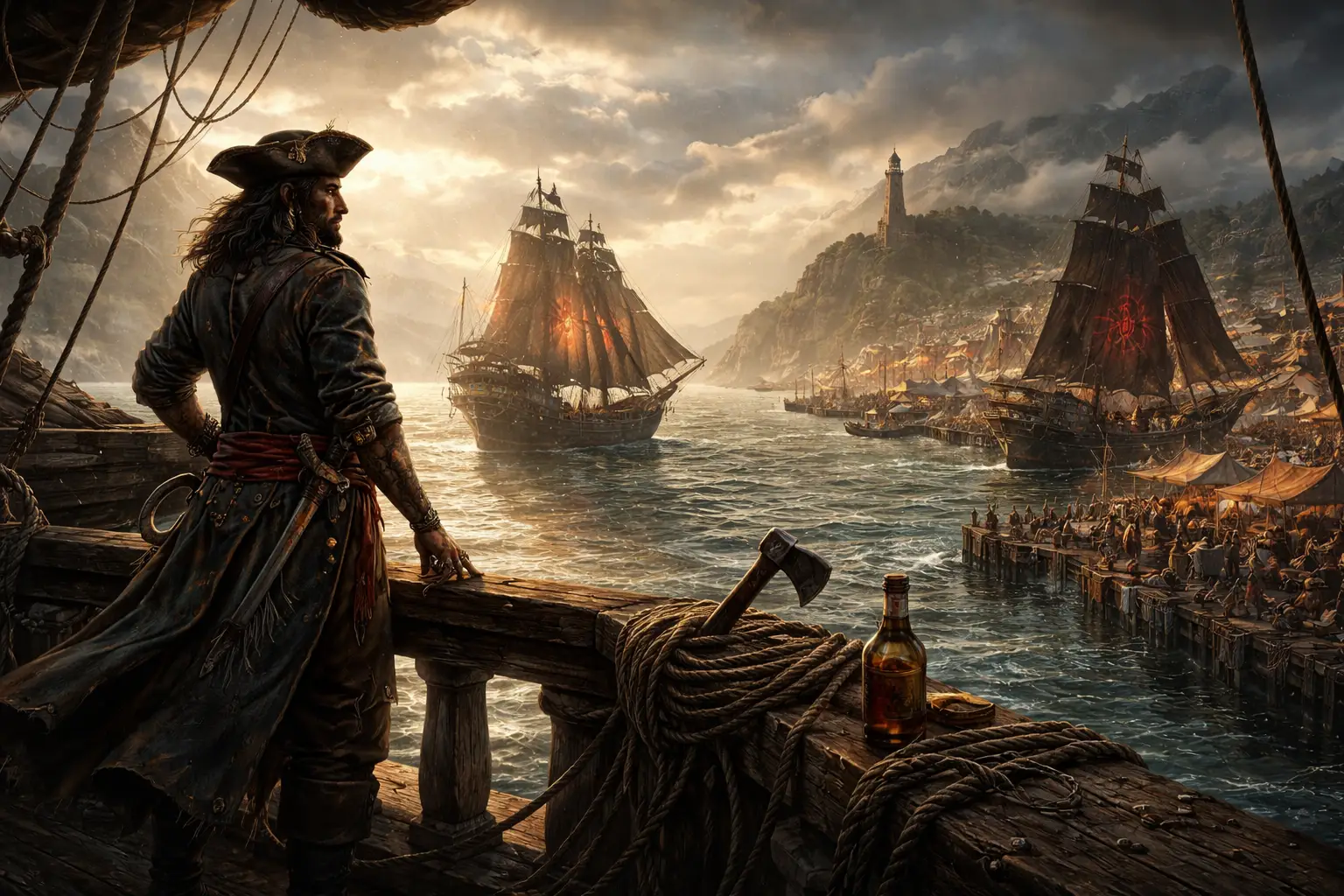
Lhazaar Principalities
Capital: Regalport | Ruler: High Prince Ryger ir'Wynarn (disputed) | Government: Loose confederation of independent principalities | Hallmarks: Fish, mercenaries, merchants, pirates, ships
"There are two kinds of people on the Lhazaar Sea: those who take what they want, and those who have what they want taken." — Captain Dera Salkess, overheard at the Pirate Exchange, Regalport, 997 YK
Three thousand years ago, a Sarlonan pirate queen named Lhazaar led a fleet of outlaws, renegades, and desperate refugees across the Sea of Rage and made the first human landfall on Khorvaire. The kingdoms that eventually became the Five Nations trace their origins to that migration, but the people of the Principalities never left the coast. They stayed where Lhazaar planted her flag — on the sea, among the mist-shrouded islands and jagged harbors — and built a culture that prizes freedom above comfort, ambition above station, and a good ship above almost anything else in the world. Every human nation on Khorvaire owes its existence to the woman who crossed that ocean and the Lhazaar Principalities are the only nation that still lives the way she did.
The Principalities occupy the northeastern coastline of Khorvaire and the hundreds of islands scattered across the Lhazaar Sea, from the Hoarfrost Mountains — the eastern face of the Ironroot range — to the open waters beyond. The mainland coast is rugged and cold, thick with evergreen forests, rocky harbors, and fishing villages clinging to cliffsides. The islands range from substantial territories supporting towns of several thousand to bare rocks barely large enough to anchor a lighthouse. The Treaty of Thronehold recognized the Principalities as a single allied nation, but in practice they are a loose confederacy of dozens of independent domains, each ruled by a prince who holds power for exactly as long as they can keep it, bound together by shared culture, mutual suspicion, and the grudging acknowledgment that the world takes them more seriously as one name on a treaty than as fifty squabbling fiefdoms.
POSTED NOTICE — Regalport Harbourmaster's Office, Olarune 998 YK
ALL VESSELS entering Regalport must fly colors and declare cargo at the outer buoy. Vessels failing to comply will be boarded. Vessels resisting boarding will be sunk. Vessels flying false colors will be sunk and their captains hanged from the Seadragon's Arch at the pleasure of the High Prince.
Freebooters take note: the Exchange tariff is three percent. Whatever you're hiding isn't worth your ship.
The Lhazaar Spirit
The national character runs on ambition, flamboyance, and an unshakeable belief that your fortune is out there waiting and the only thing standing between you and it is nerve. A deckhand scrubbing salt off the planks genuinely believes she might captain her own ship within a decade. A prince feasting in his hall knows that the cook has poisons stached among his spice rack, waiting for the right moment. This isn't paranoia — it's the social contract. Power in the Principalities is not inherited, not appointed, and not voted on. It is seized, held, and inevitably lost, and every Lhazaar knows it. You can start the morning as a common sailor and end the day as a prince — if the crew follows you, if you can hold the fleet, and if you're brave enough or mad enough to try.
The result is a culture of magnificent, swaggering self-invention. The Lhazaar are the most flamboyant people in Khorvaire — bold fashion, louder opinions, tall tales told with the absolute conviction of firsthand experience, and personal codes of honor held with iron sincerity. Reputation is currency. Your name precedes you into every port, and the stories told about you matter as much as the gold in your hold. The greatest insult in the Principalities is not treachery — treachery, at least, implies ambition — but mediocrity.
The dark side of all this romantic individualism is a society with very little patience for anyone who can't fend for themselves and absolutely no infrastructure to catch those who fall. Justice is swift, local, and only as fair as the prince dispensing it. There is no court of appeal. There is no social safety net. And the piracy that outsiders find so colorful is, for the merchants and fisherfolk who suffer it, simply robbery at sea.
"My grandfather sailed with the Cloudreavers. Lost an arm, an eye, and two ships. Died the happiest man I ever knew." — dockside conversation, Port Verge
Princes and Power
The fundamental political unit is the principality — a domain consisting of a fleet, whatever territory that fleet controls, and the people who live under the prince's protection. The title belongs to whoever commands the loyalty of the fleet, and it can change hands through challenge, mutiny, negotiation, or force. Some principalities have held the same ruling family for generations; others have changed hands three times in a year.
The principalities vary enormously. Some are legitimate merchant domains. Others are pirate kingdoms — the Cloudreavers being the most notorious. The Gray Tide is a principality founded by changelings with a mercantile tradition and a suspected sideline in piracy conducted under stolen faces. The Wind Whisperers of Orthoss are half-elves who carry the Mark of Storm as foundlings unconnected to House Lyrandar, and who covet airships with a hunger that borders on obsession. The Bloodsail Principality of Farlnen, settled by elves exiled from Aerenal, fields ghost-driven ships from an island charged with Mabaran energies. And the gnomes of Lorghalan build ships of near-indestructible wood and pilot them with stonesingers who literally sing to the water elementals propelling the hull.
High Prince Ryger ir'Wynarn of Regalport commands the Seadragon Principality — the largest fleet — and secured the Principalities' seat at Thronehold, after which he awarded himself the title of High Prince. The other princes tolerate him because his fleet protects the sea lanes and because the alternative is worse, but they have rejected every proposal for stronger central authority. His chief rival, Prince Kolberkon of the Direshark Principality, rules from Port Verge and courts alliances wherever he can find them — House Lyrandar, the Blood of Vol, and rumored contacts far more dangerous. Where Ryger thinks in terms of nationhood, Kolberkon thinks in terms of personal empire.
The Shape of the Sea
Regalport, seat of the Seadragon Principality, is the grandest city in the Principalities. The Pirate Exchange is the largest trading post east of the Ironroot Mountains. House Thuranni has made Regalport its headquarters, with Baron Elar d'Thuranni operating his espionage network from an enclave in the city. House Ghallanda maintains a significant outpost as well.
Port Verge, seat of the Direshark Principality, is Regalport's rival — a boomtown where the Blood of Vol has a strong presence and Kolberkon has invested heavily in new infrastructure and a Lyrandar enclave. Farlnen, the sunless island of the Bloodsails, is a huge Mabaran manifest zone where the living earn an undead afterlife through service, and the true power lies with the Grim, a council of ancient undead. Dreadhold, maintained by House Kundarak on a remote island, is the most secure prison in Khorvaire — holding prisoners too dangerous to execute and too powerful to contain anywhere else. And somewhere beyond the charts lies Trebaz Sinara, the legendary lost island where Lhazaar herself is said to be buried with the plunder of generations. It has not been sighted in five hundred years. Every captain in the Principalities is still looking.
INTERCEPTED LETTER — recovered off the Hoarfrost coast, Barrakas 997 YK
Captain — I don't care what Kolberkon promised you. You sail into Regalport under Direshark colors and Ryger's people will sink you before you clear the breakwater. Fly merchant colors. Claim a fish run. Keep your mouth shut and your crew sober until we know which way the wind blows. Burn this.
Faith and Culture
The Lhazaar are not devout. The Sovereign Host has adherents — Kol Korran and Arawai are invoked with some regularity — but the faith lacks institutional depth. The Blood of Vol has a visible presence, particularly in Port Verge, though the Bloodsails themselves follow their own necromantic theology rather than the faith of the Divinity Within. Most Lhazaar curse the Devourer when a storm comes, thank whichever Sovereign seems relevant when it passes, and spend very little time in temples. Superstition, on the other hand, is rampant — every ship has rituals for good luck and bad, every harbor its omens, and no captain in their right mind would set sail on the day the thirteenth moon is dark.
Lhazaar society is organized around ships and fleets, not land and lineage. Your crew is your family, your captain is your lord, and your ship is your home. Social mobility is real in a way it simply isn't in the Five Nations, and the Principalities are the most diverse population in eastern Khorvaire: humans form the majority, but Lhazaar dwarves from the Ironroots, changelings, half-elves, gnomes, and every other race in Khorvaire can be found in the islands — bound not by blood but by salt water and shared ambition. Fashion is loud — bright sashes, embroidered coats, jewelry taken as prizes — because reputation is currency, and looking forgettable is not an option.
"A Karrnathi walks into a room and you know his rank. A Brelish walks in and you know his business. A Lhazaar walks in and you know his entire life story, because he's wearing it." — attributed to an exasperated Thranish diplomat
Postwar Pressures
The Last War was good to the Principalities. For a century, Lhazaar captains served as privateers for every side that would pay and raided the ships of every side that wouldn't. The Treaty of Thronehold brought recognition but an uncomfortable question: what does a nation of privateers do when the letters of marque dry up? Most princes have returned to the merchant trade, but piracy has not vanished — it has simply lost its legal cover. Cloudreaver raiders still strike the northern coast, Bloodsail vessels hunt Karrnathi merchantmen, and the principalities that depend on trade need safe sea lanes, putting them in direct conflict with the principalities that depend on raiding.
Ryger's push for unity meets resistance from every direction. The Principalities were technically under Karrnathi governance from the Galifar-Lhazaar War of the first century YK until the Last War shattered all such arrangements, and Kaius III has not forgotten this. Meanwhile, rumors circulate of princes making dangerous bargains with dragons, fiends, and the Empire of Riedra. The Principalities are not a nation on the verge of collapse — they are a nation that has never quite finished becoming one, held together by shared waters and the conviction that whatever comes, the people of the sea will adapt, survive, and come out richer on the other side.
"They asked me at Thronehold whether the Principalities could govern themselves. I told them we'd been doing it for three thousand years. It's everyone else who keeps trying to make it complicated." — attributed to High Prince Ryger ir'Wynarn
External Relations
Karrnath is the most important and most complicated relationship — former overlord, current trading partner, potential future threat. The Bloodsail vendetta against Karrnathi shipping keeps the Bitter Sea tense. The Mror Holds are a natural trading partner across the Hoarfrost Mountains — transactional and uncomplicated, which both sides prefer. House Thuranni's headquarters in Regalport gives the Principalities a dragonmarked presence that is both prestigious and deeply unsettling. The rest of the continent views the Principalities with a mixture of romance and wariness: the finest sailors in Khorvaire, available for hire along with their swords, their silence, and their willingness to look the other way.
The Lhazaar Character
The Lhazaar character runs on two instincts that are easy to romanticize and harder to live with. The first is a restless, forward-looking hunger — not greed exactly, but the bone-deep conviction that the next horizon holds something better than the one behind you. Lhazaar do not dwell on the past. They name their ships after futures they intend to seize, not ancestors they intend to honor. This quality produces captains who gamble entire fleets on a rumor of treasure, merchants who sail into ports they've never seen with nothing but cargo and confidence, deckhands who learn three trades on a single voyage because standing still feels like drowning, and princes who build empires from nothing and lose them without complaint because they know they can do it again.
The second is an unshakeable faith in the personal over the institutional — a trust in individual competence, loyalty, and nerve that runs so deep it makes the Brelish look like monarchists. A Lhazaar does not ask what office you hold or what family you were born into. They ask what you've done, what you can do, and whether you'll hold steady when the sea gets rough. This quality produces first mates who follow a good captain into a hurricane without hesitation, shipwrights who build vessels they'd stake their own lives on, smugglers whose word is ironclad because their reputation is all they have, and old salts who've served six different princes and judge each one solely on whether the hold stayed full and the crew stayed fed.
The dark side of these qualities is a rootlessness that can become nihilism, a contempt for structure that leaves the vulnerable unprotected, and a culture that mistakes recklessness for courage so often that the distinction barely exists. The Lhazaar are full of people who would rather chase a legend across the sea than build something that lasts on solid ground — and for every captain who found their fortune, a hundred sank without a trace, unmourned and unremembered by a society that only tells stories about the ones who won.