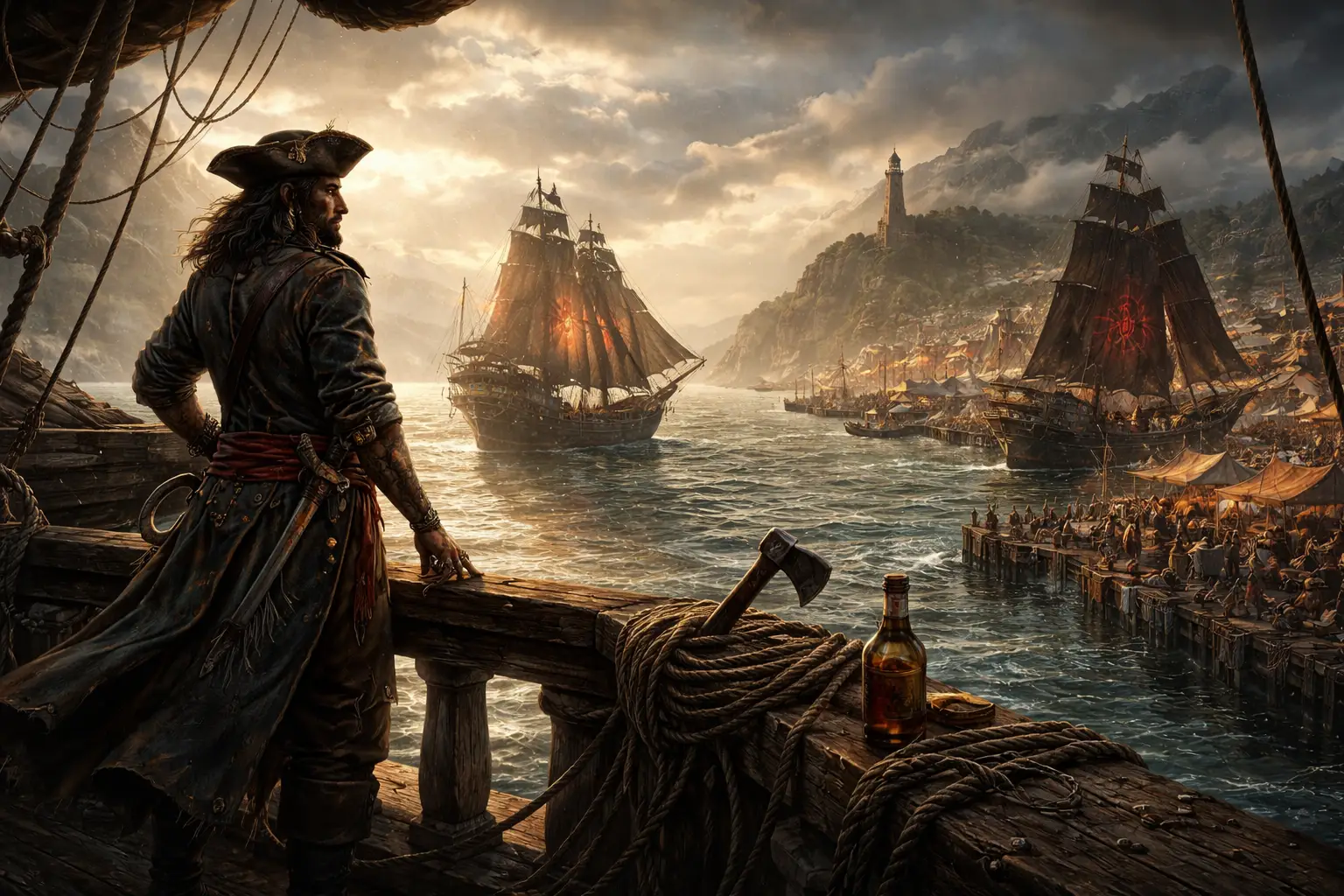
Economy & Industry of the Lhazaar Principalities
"A Karrnathi asked me what the Principalities export. I told him: everything that floats. Fish, timber, cargo, sailors, and the ships that carry all four. He asked what we import. I told him: everything that doesn't float. And a few things that used to, before we took them." — overheard at the Pirate Exchange, Regalport
An Economy Built on Water
The Lhazaar Principalities do not mine the wealth of the earth like the Mror or manufacture it in foundries like Breland. They move it. The economic engine of the Principalities is the sea itself — the fish in it, the cargo that crosses it, the ships that sail it, and the harbors where buyer meets seller under rules that vary from one port to the next. If the Mror Holds are a mountain of wealth and Zilargo is a workshop of secrets, the Principalities are a current: wealth flows through them, and anyone fast and clever enough to catch it gets rich.
The Principalities have no unified economy. There is no national treasury, no shared tariff policy, no central bank, and no institution that coordinates economic activity across the dozens of independent domains. Each principality is its own economic unit — fishing its own waters, building its own ships, setting its own prices, and trading with whoever offers the best terms. What binds the Lhazaar economy together is not policy but geography: the sea lanes that run through the Principalities connect Karrnath, the Mror Holds, and the eastern coast of Khorvaire to the wider continental trade network, and every principality that controls a stretch of that network profits from the traffic passing through.
The result is an economy that is simultaneously chaotic and robust — impossible to regulate, difficult to predict, and remarkably hard to kill. The Last War disrupted trade across the continent, but Lhazaar commerce adapted by switching from legitimate cargo to privateer contracts without missing a beat. The postwar transition reversed the process. The Principalities have survived three thousand years of feuds, raids, blockades, and the occasional naval war by doing what water does: finding a way around whatever obstacle is in the path.
MARKET REPORT — filed by a Sivis trade correspondent, Regalport, Nymm 998 YK
Fish: volume high, quality variable, prices set by auction at dawn. Mror iron: transiting through Regalport from Hoarfrost ports, steady volume, two percent Exchange tariff. Farlnen exotics: darkwood goods, Mabaran spices, limited supply, premium pricing, buyer assumes all associated risks. Lorghalan medicines: seasonal, small quantities, extraordinary demand. Karrnathi grain: flowing east in exchange for cod and herring, stable. Salvage and antiquities: unpredictable volume, no provenance guarantees, sold as-is.
General assessment: the sea lanes are busy, the Exchange is loud, and three separate merchants tried to sell me the same crate of "authentic Trebaz Sinara relics." I declined all three.
Fishing: The Foundation
Fishing is the oldest industry in the Principalities and the one that feeds everyone else. The Lhazaar Sea teems with cod, herring, mackerel, and a dozen species of deepwater fish that the mainland Five Nations import in quantity. Most Lhazaar communities — from the grandest port to the smallest island village — depend on fishing as their primary food source and a significant portion of their trade income. The daily fish auction at Regalport sets prices for the entire eastern coast, and the volume of preserved fish flowing westward to Karrnath represents one of the largest single trade relationships in the region.
Fishing in the Lhazaar Sea is not the placid activity it might be on an Aundairian river. The waters are cold, the weather is foul more often than not, and the deeper fishing grounds are home to creatures that regard fishing boats as a convenient meal. Sea drakes, reef sharks, and worse patrol the outer waters, and the boundary between "fishing expedition" and "combat encounter" is not always clear. Lhazaar fisherfolk are, by necessity, among the hardiest maritime workers in Khorvaire — and many of them double as sailors, scouts, or part-time pirates when the catch is poor and a merchant vessel looks tempting.
The mainland coast also produces timber from the evergreen forests of the Hoarfrost foothills, modest quantities of ore from the mountains' eastern face, and the kind of coastal agriculture — cold-weather root vegetables, hardy grains, and livestock — that sustains local communities without generating significant export income. The Principalities are not breadbaskets. They eat what the sea provides and trade for everything else.
The Pirate Exchange
The Pirate Exchange in Regalport is the economic heart of the Principalities and the largest trading post east of the Ironroot Mountains — a raucous open-air bazaar where legitimate commerce, grey-market trade, and outright fencing coexist with a cheerful indifference to the distinctions between them.
The Exchange operates under a simple set of rules enforced by the Seadragon fleet: merchants who pay the tariff — currently three percent of declared cargo value — can buy and sell without interference. Goods do not require provenance documentation. Sellers are not asked where their cargo came from, and buyers are not asked what they plan to do with it. The Exchange tariff is the closest thing the Principalities have to a national tax, and it is collected by Ryger's agents — a fact that gives the High Prince significant revenue and makes every principality that trades through Regalport financially dependent on his goodwill, which is exactly the point.
What can you buy at the Pirate Exchange? Fish, of course — fresh, smoked, salted, and dried. Mror metals transiting from the Hoarfrost ports. Karrnathi manufactured goods heading east. Aereni wine, Zil alchemicals, and Brelish textiles that have made their way up the coast through channels both legitimate and otherwise. Farlnen's exotic spices and darkwood goods, sold by Bloodsail merchants whose crimson-tattooed hands handle the cargo with the casual efficiency of people who have been doing this for centuries. Lorghalan medicines, wooden goods of extraordinary quality, and potent jungle spirits. Salvage from shipwrecks, relics from the ancient ruins scattered across the islands, and antiquities of uncertain provenance that may or may not be what the seller claims. And, inevitably, cargo that fell off a ship somewhere between Karrnath and the outer islands under circumstances that no one is willing to describe too precisely.
The Exchange also functions as an informal labor market. Captains looking for crew, merchants looking for escorts, and princes looking for capable adventurers all post notices at the Exchange. A traveler with useful skills and a tolerance for ambiguity can find employment in Regalport faster than in any city outside Sharn.
Some whisper that the Exchange is built directly on top of a Syranian manifest zone that has a backdoor portal directly to the Immeasurable Market somewhere.
"The Exchange has one rule: pay the tariff. After that, what you sell is your business, what you buy is your business, and what you did to get either is between you and the merchant who sold it." — attributed to an Exchange tariff collector
Shipbuilding
Ships are the Principalities' most important manufactured product and the foundation of their military, economic, and cultural life. Every major principality maintains shipyards of some kind, and the quality of Lhazaar vessels — built for rough northern waters by people who have been sailing them for three thousand years — is respected across the continent.
Lhazaar shipbuilding is craft, not industry. There are no Cannith-scale production facilities. Ships are built by family yards in harbor towns, designed by master shipwrights whose techniques are passed down through apprenticeships that last years, and constructed from timber harvested in the Hoarfrost forests or traded from the mainland. The result is vessels that are individually distinctive — every Lhazaar ship has its own character, its own quirks, and its own reputation — and collectively excellent for their intended purpose: fast, maneuverable, tough enough to survive the Lhazaar Sea, and easy to repair with materials available in any port.
Two principalities deserve special mention for their shipbuilding. Lorghalan ships are built from wood that rivals Aereni bronzewood in strength — harvested from the island's Lamannian jungles — and are accompanied by water elementals whose friendly spirits propel the hull, matching the speed of Lyrandar elemental galleons without any binding technology. The Lorghali do not export lumber, but they sell finished wooden goods of extraordinary quality. Bloodsail vessels are built from Farlnen darkwood — timber grown in a Mabaran manifest zone by necromantic botany — and are driven by the ghosts of elves who earned their afterlife but were bound to sails and hulls rather than achieving a higher form of undeath. A Bloodsail ship moves in dead calm, and its darkwood hull is nearly invisible against dark water at night.
House Lyrandar has watched the Lhazaar shipbuilding tradition with commercial interest and has recently established an enclave in Port Verge, offering Lyrandar-built vessels and elemental galleon services to Prince Kolberkon's fleet. This represents both an opportunity and a threat — Lyrandar ships are technologically superior, but if the house gains a monopoly on eastern shipping, it would undermine the independence that the Lhazaar shipwrights consider their birthright.
Piracy and Privateering
There is no honest discussion of the Lhazaar economy that does not include piracy. It is not an aberration in the economic system — it is a structural feature, as integral to the Principalities' commercial life as mining is to the Mror Holds or espionage is to Zilargo.
During the Last War, piracy was effectively legalized: princes sold their fleets as privateers to whichever belligerent would pay, and supplemented their contracts with freelance raiding on the side. Letters of marque from Aundair, Breland, Karrnath, or Thrane gave legal cover to attacks on enemy shipping, and the distinction between a privateer and a pirate was whatever flag you happened to be flying when the target was in sight. The century of war was, by most economic measures, the most prosperous period in Lhazaar history — a hundred years of state-sponsored piracy that filled every hold in the Principalities.
The Treaty of Thronehold ended the letters of marque, and most principalities have returned to legitimate merchant trade. But piracy has not disappeared — it has simply lost its legal cover. The Cloudreavers have returned to outright raiding. Smaller pirate fleets that thrived during the war have not all found honest work. And the Bloodsails, who hunt Karrnathi merchantmen as a matter of vendetta rather than commerce, maintain a level of predation in the Bitter Sea that makes insurance rates for Karrnathi shipping among the highest on the continent.
The principalities that depend on trade — Regalport first among them — need safe sea lanes, which puts them in direct conflict with the principalities that depend on raiding. Ryger's Seadragon fleet patrols the major trade routes and enforces the Exchange tariff, but his reach does not extend to the outer islands or the Bitter Sea, and any prince who wants to raid outside the patrol zone can do so with impunity. The tension between commerce and piracy is the defining economic fault line of the postwar Principalities, and it maps directly onto the political divide between Ryger's push for order and every raider prince's insistence on freedom.
INTERCEPTED MANIFEST — recovered from a Cloudreaver prize vessel, Barrakas 997 YK
Cargo seized from Karrnathi merchant Stormhawk, 14 Barrakas: 40 barrels salt pork, 12 casks Rekkenmark brandy, 6 bolts Karrn wool, 1 crate marked "FRAGILE — House Cannith," contents unknown. Captain and crew set adrift in longboat per Cloudreaver tradition. Ship scuttled after stripping; too damaged to sell at market.
Specialty Exports
Beyond fish, ships, and the proceeds of piracy, the Principalities produce a handful of specialty goods that command premium prices across the continent.
Farlnen's night-gardens produce exotic spices, wines, and darkwood goods found nowhere else in Khorvaire. The vegetation of the Bloodsail island grows in a Mabaran manifest zone under conditions that no normal plant could survive, and the flavors and properties of its products are unique — Farlnen spices are prized by alchemists and chefs alike, and Farlnen wine has a reputation for being either exquisite or terrifying, depending on the vintage. Darkwood goods — ship components, fine furniture, and luxury items carved from the nearly indestructible timber — are sold by Bloodsail merchants at the Pirate Exchange and command prices that reflect both their quality and the unsettling provenance of their material.
Lorghalan contributes medicines, drugs, and potent spirits distilled from the exotic plants of its Lamannian jungle, along with wooden goods of exceptional strength and quality. The Lorghali do not produce in volume — the island's economy runs on barter and family exchange rather than commercial export — but what they sell is unique and highly sought after. The gnomes allow other traders to carry their goods to distant markets, preferring to focus their small fleet on intra-Principality trade.
The Principalities also export mercenary services — Lhazaar sailors and marines are among the finest in Khorvaire, and their willingness to take contracts that more scrupulous outfits would refuse makes them attractive to clients who need results and do not ask too many questions about methods. The mercenary trade is not brokered through House Deneith, as it is in Darguun; Lhazaar captains negotiate their own contracts, set their own prices, and work for whoever pays.
The Dragonmarked Presence
The dragonmarked houses maintain a limited but strategically significant presence in the Principalities. House Thuranni, headquartered in Regalport, is the most prominent — its espionage network is layered atop the Principalities' existing information economy, and its agents operate in an environment where secrets are the most valuable commodity after fish. House Ghallanda maintains a substantial outpost in Regalport, providing the hospitality infrastructure that makes the port functional for foreign visitors. House Lyrandar has recently established an enclave in Port Verge, offering shipping services and vessel technology. House Kundarak operates Dreadhold but maintains no broader commercial presence.
The remaining houses maintain at most token presences, concentrated in Regalport and drawn by the Pirate Exchange's volume. The Principalities' distrust of concentrated economic power keeps the houses at arm's length — the Lhazaar have watched what the dragonmarked houses did to the Five Nations during and after the Last War, and they have no interest in becoming the next market to be captured. A house that overreaches in the Principalities will find its ships unwelcome in a dozen ports overnight, and no amount of institutional power compensates for a fleet that cannot dock.
"The houses think they can buy the Principalities the way they bought Breland. They can't. You can buy a Lhazaar captain, sure — but his crew will sell him to someone else the moment a better offer appears, and then you've bought nothing." — attributed to a Regalport dockmaster
Trade Routes and Partners
The Principalities sit at the junction of several major trade routes. Karrnathi goods — grain, manufactured products, finished metals — flow east through the Bitter Sea and the channels connecting it to the Lhazaar Sea. Mror metals transit through the Hoarfrost ports and across Mirror Lake to Lhazaar harbors, with Regalport serving as the primary redistribution point. Fish, timber, and specialty goods flow westward in return. The Principalities also handle traffic between the eastern coast and more distant destinations — Aerenal, Stormreach, and the routes south toward the Thunder Sea — though this long-distance trade is dominated by House Lyrandar's elemental galleons rather than Lhazaar vessels.
Karrnath is the largest single trading partner, despite the Bloodsail vendetta that makes Bitter Sea shipping expensive and occasionally fatal. The Mror Holds are the second largest, with the Hoarfrost trade passing through Kolkarun-managed routes. Beyond these, the Principalities trade with whoever shows up with cargo and coin — Brelish merchants, Zil factors, Aereni traders, and the occasional Riedran vessel whose crew is watched with particular suspicion by everyone in port.
There is no customs service, no trade regulation, and no mechanism for resolving commercial disputes beyond the prince whose port you happen to be standing in. A letter of credit from House Kundarak is good anywhere. A handshake deal with a Lhazaar captain is good for exactly as long as the captain's reputation says it is. Knowing the difference — and knowing whose reputation to trust — is the essential skill of anyone doing business in the Principalities.
From a Kundarak trade assessor's report, filed from Regalport, Eyre 998 YK:
"The Lhazaar economy defies formal analysis. There is no central data. There are no reliable statistics. There are no institutions that collect either. What there is, is an extraordinarily active commercial environment operating entirely on reputation, personal relationships, and the understanding that the sea punishes bad faith faster than any court.
I have been asked to estimate the Principalities' gross domestic product. I cannot. I can tell you that more cargo moves through the Pirate Exchange in a week than through most Five Nations ports in a month, that the tariff revenue alone makes Ryger one of the wealthiest individuals east of the Ironroots, and that at least a third of the commerce I observed was conducted in goods whose origins would not survive a customs inspection.
Recommendation: continue investment. Diversify counterparty risk. Do not lend to anyone who cannot produce a ship."