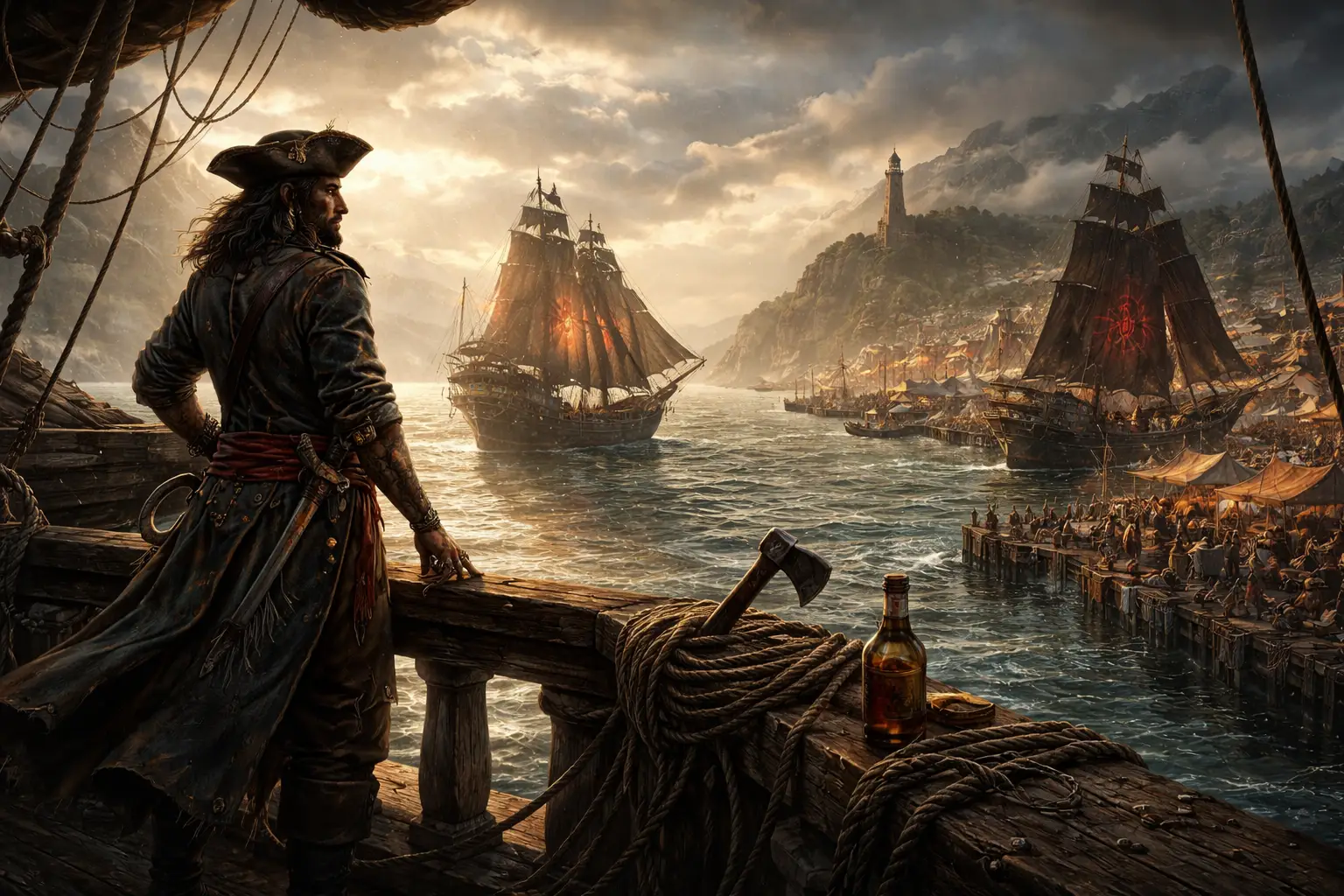
Military & Security of the Lhazaar Principalities
From the personal log of a Seadragon patrol captain, Zarantyr 998 YK:
Fog again. Three ships spotted, two identified — Direshark merchant and a Lorghalan trader. The third ran before we could close. Cloudreaver, most likely, though she flew no colors. The crew wanted to pursue. The don't know what I know about Cloudreavers.
Picked up a Karrnathi distress signal near the Bitter Sea channel. By the time we reached the coordinates, the merchant was listing hard to port with her mainmast gone and her crew in longboats. Bloodsail work — darkwood splinters in the hull, no bodies aboard. They don't leave bodies. The Karrnathi captain asked me why we don't do something about them. I asked him whether he'd like to be the one to sail to Farlnen and explain to a council of undead elves that their vendetta is bad for business.
He declined.
Every Ship Is a Warship
There is no Lhazaar navy. There are dozens of fleets that do not answer to each other, sailing waters so treacherous that any foreign force attempting to operate in them would be at a catastrophic disadvantage before it fired a shot. The Principalities have been defended this way for three thousand years — not by institutions but by geography, seamanship, and the simple fact that every vessel on the Lhazaar Sea is built to fight, because the sea demands nothing less.
Every Lhazaar ship is a warship because every ship is crewed by people who can pick up a boarding axe and a crossbow on a moment's notice, and the distinction between a merchant run and a combat engagement is determined by what the ship on the horizon is flying and whether the cargo in the hold is worth defending. A fishing boat that encounters a Cloudreaver raider does not call for help — there is no one to call. The fisherfolk fight, or they flee, or they surrender and negotiate, and all three responses are considered equally honorable depending on the odds.
Galifar needed a decade-long war to bring the Principalities to nominal submission. Karrnath could not hold them once the Last War split the kingdom's attention. No foreign power has successfully occupied the islands in three millennia of trying. The reason is not that the Lhazaar are the strongest navy in Khorvaire — they are not, and they know it. The reason is that the Lhazaar Sea is a fortress, and the people inside it were born there.
The Fleets
A prince's fleet is their army, their economy, and their claim to power — all the same thing. Lose the ships, lose the principality. This concentrates the mind in ways that land-based nations find difficult to appreciate.
The Seadragon fleet under High Prince Ryger is the largest — enough vessels to patrol the central trade lanes, enforce the Regalport tariff, and project the kind of stability that keeps House Thuranni and House Ghallanda doing business in the Principalities. The Direshark fleet under Kolberkon is the second largest and growing fast, fueled by new shipyards in Port Verge and the recent Lyrandar enclave that gives the Diresharks access to elemental galleon technology. The Cloudreavers maintain a mid-sized fleet of purpose-built raiders — fast, heavily armed, designed for the hit-and-run tactics their dwarven ancestors practiced against the first human settlers three thousand years ago. The Bloodsail fleet is smaller in number but may be the most feared afloat — darkwood hulls nearly invisible at night, ghost-driven sails that move in dead calm, and a crew that includes beings who stopped being alive centuries ago and did not stop being dangerous.
Smaller principalities field anything from a squadron to a single ship. Even a one-ship principality is a political entity if the captain controls territory and crew. The Gray Tide's fleet is of uncertain size — appropriate for a changeling nation whose vessels may fly different colors at every port. The Wind Whisperers channel the Mark of Storm through their half-elf foundling sailors, giving their ships an edge in weather that would cripple a conventional fleet. And the Lorghalan gnomes, though few in number, field ships of bronzewood-rival wood accompanied by water elementals that propel the hull at elemental-galleon speeds and armed with Lorghalan cannonballs — small earth elementals launched at enemy ships, where they roll across the deck demolishing everything in their path until someone figures out how to stop a living boulder that has no limbs and no interest in surrender.
STANDING ORDERS — Seadragon Patrol Fleet
Vessels flying recognized colors and bearing Exchange tokens are under Seadragon protection. Vessels without tokens may be boarded and assessed. Vessels resisting boarding will be engaged. Cloudreaver and Bloodsail vessels are to be tracked and reported. Do not engage Bloodsails without direct authorization from the High Prince. Do not engage Cloudreavers alone.
How They Fight
A Lhazaar engagement starts with pursuit, runs through fog, and ends on someone's deck.
The vessels are built for it — sharp-keeled, low-drafted, designed to catch a quarry in northern waters that would ground a heavier ship. Once in range, the attacker closes to grapple. Boarding parties armed with cutlasses, boarding axes, crossbows, and whatever else comes to hand swing across or leap the gap and fight on the enemy's deck. The goal is capture, not destruction — a seized ship adds to the fleet, a sunk ship adds to nothing. The Cloudreavers are the exception: they strip a prize to the waterline and scuttle it, setting the crew adrift in longboats as a signature that doubles as advertising.
Magic varies by principality. The Wind Whisperers summon gales that shred rigging and drive enemy ships onto rocks. The Bloodsails field necromantic capabilities that no other fleet can match — their dead crew does not tire, their ships move without wind, and when the Grim lords of Farlnen choose to involve themselves, the arcane power they bring to bear is the naval equivalent of a natural disaster. Lorghalan ships launch earth elementals as projectiles and deploy water elementals to capsize smaller vessels or trap an enemy in unfavorable current. Most other principalities fight without significant arcane support — seamanship, crew skill, and the willingness to close the distance.
When invaded, the Lhazaar do not form battle lines. They disperse. Ships scatter into fog, hide behind islands, wait for the invader to overextend, then strike supply lines and isolated vessels from every direction while refusing a decisive engagement. This is the strategy that bled Galifar dry during the Galifar-Lhazaar War, and it is the reason every naval strategist at Rekkenmark who has studied the Principalities has reached the same conclusion: you can occupy an island, but you cannot occupy a sea.
"A Karrnathi fleet fights in a line. A Lhazaar fleet fights like a school of fish — scatter when the predator comes, regroup when it's gone, and take bites from the tail every chance you get." — attributed to a Rekkenmark naval instructor
What a Century of War Taught Them
For a hundred years, the Last War turned every Lhazaar captain into a professional combatant.
Letters of marque from Aundair, Breland, Karrnath, Cyre, and Thrane gave legal cover to attacks on enemy shipping, and every principality sold its services to whichever belligerent offered the best contract. A captain flying a Brelish letter could raid Karrnathi convoys and return to port a patriot. The same captain might carry an Aundairian letter the following season if the rates improved. The ethical flexibility was the point — the Principalities had no stake in the Wynarn succession and no interest in pretending otherwise.
The century of privateering made the Lhazaar, ship for ship, the most experienced naval combatants in Khorvaire. They fought Karrnathi warships, Aundairian elementals, Brelish frigates, and Thranish galleys, often in the same season. They learned every navy's signals, every navy's tactics, and every navy's weaknesses. The Treaty of Thronehold ended the letters of marque, but it could not erase a hundred years of muscle memory. The Seadragon fleet now patrols the same lanes it once raided. The Cloudreavers have returned to piracy, seeing no reason to stop because the paperwork expired. And every crew in the Principalities carries the skills and the appetite for violence that sanctioned warfare produced. The Lhazaar are not fishermen who occasionally fight. They are fighters who occasionally fish.
Keeping Order (or Not)
There is no police force in the Principalities. Security within a principality is the prince's problem, enforced by the prince's crew and whatever arrangement the local community has developed for handling trouble.
In Regalport, Ryger's Seadragon marines patrol the harbor and the Exchange, enforce the tariff, and maintain enough order to keep foreign merchants comfortable. This is commerce, not altruism — a port where visitors get robbed is a port where visitors stop coming. Beyond the harbor district, Regalport is rougher, and neighborhoods farther from the docks are governed by whoever is toughest on the block. In Port Verge, Kolberkon's enforcers keep a different kind of order. In Farlnen, the Bloodsails' own traditions suffice — and what the living cannot handle, the Grim can. In the outer islands, there is no order at all.
Dreadhold — House Kundarak's fortress-prison on a remote island — is the only institution in the Principalities that maintains a consistent custodial standard, and it holds prisoners too dangerous for anywhere else. Sentinel Marshals of House Deneith are theoretically authorized to operate in the Principalities, but a Marshal chasing a fugitive into the outer islands is operating on borrowed luck, and most with sense confine themselves to Regalport and Port Verge where someone will at least answer a hail.
What's Out There
The Principalities face no single existential threat — no War Below, no succession crisis, no Mournland border. They face instead a constellation of persistent dangers that keep the sea lanes unpredictable.
Piracy is the primary concern for trade-dependent principalities. Cloudreavers raid openly. Smaller pirate fleets operate in the outer islands with impunity. The Bloodsail vendetta against Karrnathi shipping keeps the Bitter Sea tense and insurance rates ruinous.
The sea itself is hostile. Sea drakes, reef sharks, unnatural storms tied to manifest zones, and the outer islands' uncleared ruins — structures predating the Dhakaani Empire, not all of them empty — make routine sailing dangerous and exploratory sailing potentially fatal.
Karrnath watches with unresolved territorial claims and a navy currently committed to peace but perfectly capable of changing its mind. The warm relations individual princes maintain with Karrnathi warlords are commercially productive and strategically ambiguous — a warlord faction pushing for reconquest could find allies among the very princes it intends to subjugate.
And beneath the waves, the Eternal Dominion of the sahuagin claims jurisdiction over the deep waters of the Thunder Sea through which many Lhazaar trade routes pass. Captains who obtain beacons of passage — common magic items that authorize transit through Dominion waters — travel safely. Captains who do not can expect a sahuagin patrol with no interest in negotiation and no concept of surface law.
"The sea doesn't care about your treaty. The sea doesn't care about your fleet. The sea cares about whether you can sail it, and if you can't, the sea will teach you — once." — common Lhazaar saying