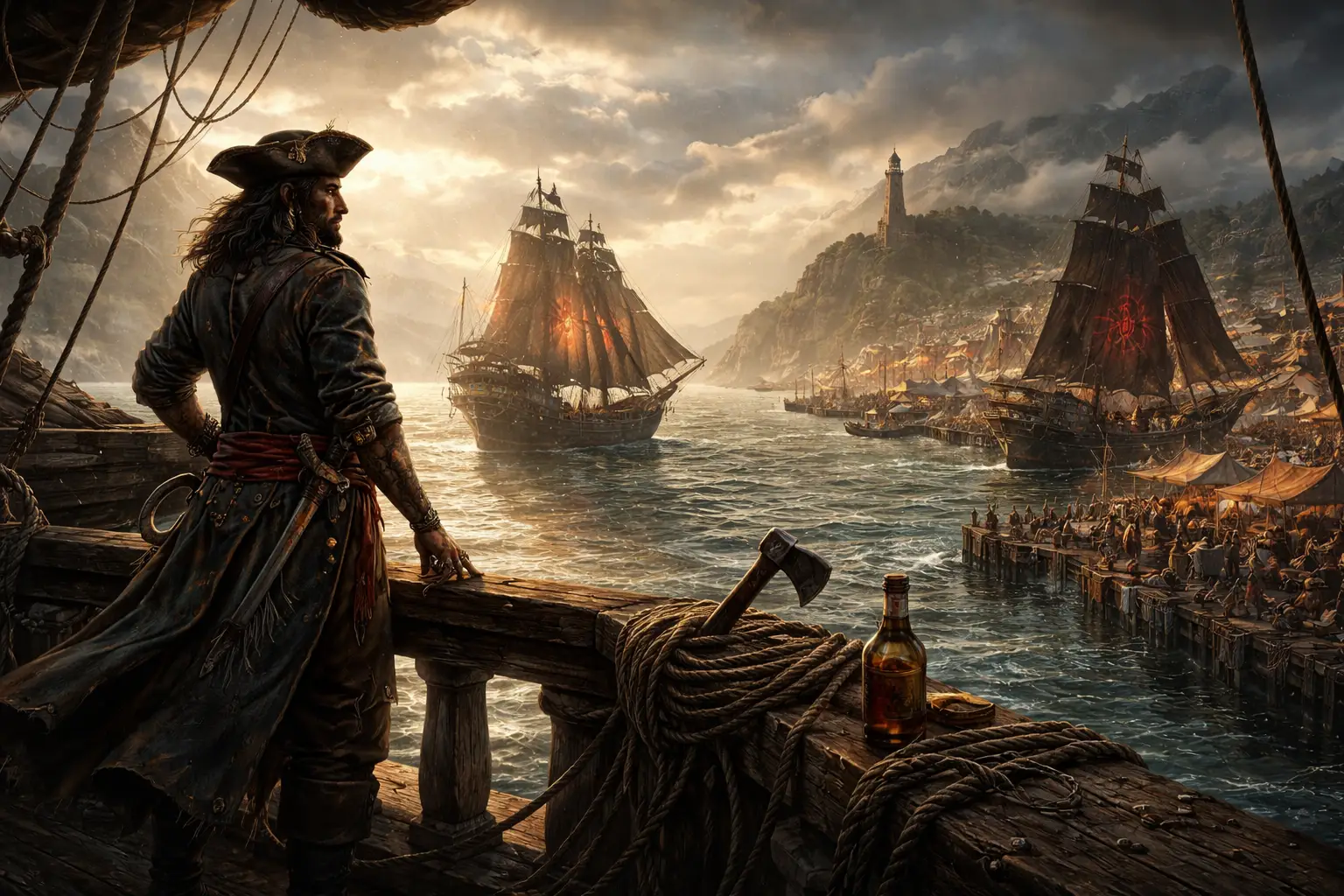
History of the Lhazaar Principalities
"The exiles forgot their past almost from the moment they stepped onto the boats, so desperate were they to burn away the horrors of what lay behind them. Or perhaps they sensed the greatness of their future and sought to leave space for that in the memory-yet-to-come of their race." — attributed to an aged Lhazaar storyteller, provenance unknown
Before the Crossing
The history of the Lhazaar Principalities does not begin on the sea. It begins across it — in Sarlona, three thousand years ago, in nations that no longer exist, among people so desperate to leave that they made a point of forgetting it all within a generation of landing on Khorvaire.
The northeastern coast of Khorvaire was not empty when the first human ships arrived. The Ironroot Mountains — which the Lhazaar now call the Hoarfrost range — had been home to dwarves for millennia, clans that had spread east from the main holds and established footholds along the coast and in the foothills. The region also held ruins from civilizations that predated even the Dhakaani Empire — ancient stone foundations on islands that no one has ever satisfactorily explained, and tombs whose builders left no other trace. Whatever came before, the land and sea were largely unclaimed by any organized power when the sails appeared on the eastern horizon.
In Sarlona, the period around –2,000 YK was an age of catastrophic upheaval. The Sundering — a centuries-long cascade of wars, riots, and social collapse — was tearing the old kingdoms apart. The Sarlonan settlers who crossed the Sea of Rage to Khorvaire were not the pride of their nations. They were outlaws, renegades, refugees, and rebels — people who had nothing left to lose and everything to gain from a continent no one they knew had ever returned from. The crossing was led by a woman named Lhazaar, a pirate captain whose courage, cunning, and raw charisma held a disparate fleet together through one of the most dangerous ocean passages in the world.
FRAGMENT — translated from Draconic runes found in a cavern on the Sarlonan coast, dated to the first century after the migration
The text speaks of challenges from the Rhiavhaar pirates and slavers who controlled the Sea of Rage, and of Lhazaar's dedication to a purpose whose meaning is not made clear. The narrative hints of a desperation underlying the dangerous journey east, and of some of the migrants in Lhazaar's flotilla fleeing devastating wars in Sarlona's western lands.
The Crossing and First Settlement (circa –2,000 YK)
Lhazaar's fleet made landfall on Khorvaire's northeastern coast — the rocky islands and mainland harbors that still bear her name. This was the first sustained human contact with the continent. From this landing, waves of settlers would eventually push inland and found the kingdoms that became the Five Nations: Lhazaar's lieutenant Malleon the Reaver sailed south to discover the Dagger River and found the city that would become Sharn. Other settlers ventured west through the mouth of Scions Sound, establishing the coastal towns that grew into Karrnath's earliest communities. Within a few centuries, human civilization stretched across Khorvaire — but it all started here, on the Lhazaar coast, with a pirate queen's fleet and the desperate courage of people who had nowhere else to go.
Lhazaar herself remained in the islands after arriving. The details of her life after the crossing are mostly legend — the dwarf talespinners who've made home in the Principalities treat her story the way the Mror treat their founding myths, as something too important to pin down with mere facts. She is said to have established her seat on Trebaz Sinara, an island that has not been sighted in over five hundred years, and to have been buried there with the treasures of a lifetime. Every generation of Lhazaar sailors has searched for the lost island. None have found it. The search itself has become part of the culture — a tradition as sacred as any faith and considerably more fun.
The early settlements were rough, improvised, and fiercely independent. Each island and harbor developed its own character, its own leaders, and its own way of doing things. There was no central authority, no shared government, and no particular desire for one. The settlers had just fled the collapsing empires of Sarlona; the last thing they wanted was another one. What they had was ships, shared waters, and a common culture of maritime self-reliance — and that was enough.
The dwarves of the eastern Ironroots were among the first people the settlers encountered. Some joined peacefully with the human fleets, establishing the mixed coastal towns that still define mainland Lhazaar. Others resisted — the ancient predecessors of the modern Cloudreavers trace their origins to dwarven clans who fought the arriving humans before eventually being absorbed into the broader Lhazaar culture. The elves of Aerenal were known at a distance, trading and occasionally raiding across the sea.
"She crossed the Sea of Rage with a stolen fleet and a hold full of criminals, and on the other side she built a world. I'd like to see Ryger try that." — overheard in a Port Verge tavern
The Arrival of the Bloodsails (circa –2,600 YK onward)
Long before the Galifar-Lhazaar War, the Principalities gained one of their most distinctive communities. Thousands of years ago, the Undying Court and the dragons of Argonnessen joined forces to eradicate the line of Vol on Aerenal. All elves who carried the blood of Vol were slain, but many who had supported the line without sharing its blood were offered a choice: swear allegiance to the Undying Court, or go into exile. A large force of these exiles traveled north across the Lhazaar Sea and claimed the island of Farlnen — a bleak, sunless territory charged with the energies of Mabar, the plane of endless night.
It was not an accident. The exiles included powerful necromancers who needed a strong Mabaran manifest zone to continue their work. Over centuries, they built a society unlike anything else in Khorvaire — one where the living earn an undead afterlife through deeds and service, paying velgys — blood money — to the lords of the island. Those who fail to earn enough are bound to objects after death, their spirits driving the sails of Bloodsail ships across windless seas. The Bloodsails share roots with the Blood of Vol but follow their own path — pragmatic necromancers who accept the certainty of undeath over uncertain spiritual promises. Some exiled sea elves who had sided with Vol followed their kin to the region; a few settled off the coast of Farlnen, while others joined the half-elves of Orthoss, eventually forming the core of what would become the Wind Whisperer principality.
The Bloodsails were recognized as one of the Lhazaar Principalities, and their darkwood-hulled, ghost-driven ships became a fixture of the sea — feared, respected, and left alone by anyone with the good sense to read the crimson sigils on their sails.
SAILOR'S WARNING — traditional, repeated in various forms across the Principalities
Black hull, red sail, no wind but she moves all the same. You see that ship, you don't signal, you don't hail, and you don't run. You just pray she's carrying spices and not looking for crew.
The Galifar-Lhazaar War (28–38 YK)
For nearly two thousand years, the Principalities existed as a loose, quarrelsome collection of independent domains — trading, raiding, feuding, and largely ignoring the growing power of the inland kingdoms. That changed when Galifar I unified the Five Nations and turned his attention to the coast.
In 28 YK, Galifar launched a decade-long naval campaign to bring the Lhazaar Principalities under the authority of the united kingdom. The shipyards of Narath — the Karrnathi port at the mouth of Scions Sound — were infused with royal money to build the warships Galifar needed to force the Lhazaar princes to heel. The war was fought across the Lhazaar Sea and the Bitter Sea, with Galifar's disciplined navy confronting the fragmented but ferocious Lhazaar fleets.
The result was a compromise. The Lhazaar could not match Galifar's combined resources — the unified kingdom simply had more ships, more soldiers, and more gold. But the Principalities could not be easily conquered, either. The islands were too numerous, the coastline too long, and the Lhazaar too willing to scatter into fog and regroup at their leisure. The war ended with the Principalities nominally brought under Karrnathi governance — the northeastern coast was technically Karrn's territory — but the arrangement was more formality than fact. The princes paid occasional tribute, acknowledged the crown's theoretical sovereignty, and then went about their business exactly as before. Galifar had other priorities, and enforcing meaningful control and cultural shift over several hundred islands full of pirates was never quite worth the effort.
This pattern would hold for the next nine centuries. The Principalities were, on paper, a Karrnathi possession. In practice, they governed themselves, raided who they pleased, and treated the authority of Korth as a polite fiction to be acknowledged when convenient and ignored when not.
Under Galifar (38–894 YK)
The centuries under nominal Karrnathi governance were, for the Principalities, a period of steady growth punctuated by enthusiastic lawlessness. The Lhazaar were technically subjects of the crown, but the crown's actual reach rarely extended past the mainland coast. The interior islands governed themselves. Piracy continued. Trade expanded — Lhazaar merchants were the primary carriers of goods between the eastern coast, the Mror Holds, and the wider continent, and the sea lanes between the Principalities and Karrnath became some of the busiest in Khorvaire.
House Kundarak established Dreadhold during this period — a fortress-prison on a remote island, warded by the finest magic the Mark of Warding could produce, designed to hold prisoners too dangerous or too valuable to keep anywhere else. It became the most secure prison on the continent, and House Kundarak's vaults within it are said to hold some of the house's greatest treasures. The Principalities also served as a base for piracy against the Riedran colony of Dar Qat in Xen'drik, with Lhazaar captains raiding the rich merchant ships traveling between Stormreach and the southern ports. Stormreach itself began its life as a Lhazaar pirate colony before Galifar's cooperation with the dragonmarked houses transformed it into a legitimate trade city in 802 YK.
Lorghalan was settled during the Galifar period as well. Gnomes who had fled the founding of the Trust in Zilargo sailed east and, after one failed colony vanished under mysterious circumstances, a later expedition claimed the distant tropical island — a territory poised on the edge of Lamannia, alive with earth and water elementals. The gnomes developed the tradition of stonesinging to communicate with these spirits, and their small but respected fleet joined the Principalities after a few early clashes established mutual respect.
Through it all, the Principalities remained what they had always been: a loose collection of independent domains that cooperated when it suited them and fought when it didn't. The princes paid lip service to Karrnath. The sea paid lip service to no one.
The Last War (894–996 YK)
When King Jarot died and the Last War erupted in 894 YK, the Principalities fragmented — not from the conflict, but into it. The nominal Karrnathi governance dissolved overnight. Individual princes made their own alliances, selling their fleets to whichever belligerent offered the best terms. Lhazaar privateers served Aundair, Breland, Cyre, Karrnath, and Thrane in turn — sometimes switching employers midseason when better offers appeared — and supplemented their income with freelance piracy on the side.
The Bloodsails were an early and solid Karrnathi ally, their ghost-driven ships helping to establish dominance in the Bitter Sea. Other princes cut deals with various nations as opportunity presented. The Principalities had no stake in the Wynarn succession; they simply recognized a century-long business opportunity when they saw one.
In 976 YK, the Karrnathi regent Moranna denounced the Blood of Vol, and the political landscape of the Principalities shifted. The Bloodsails — who had allied with Karrnath for reasons of their own — turned on Karrnath with particular savagery, contesting trade and travel through the channels connecting the Bitter Sea to the Lhazaar Sea. Karrnathi merchant vessels became the Bloodsails' primary targets, a vendetta that continues to the present day. Ironically, this break made other Lhazaar princes more willing to deal with Karrnath — with the Bloodsails out of the alliance, the remaining princes could profit from warm relations with Kaius and the warlords without worrying about being associated with necromantic elves.
The war years were, by most measures, good to the Principalities. The pirates got rich. The merchants got richer. And when the fighting stopped, High Prince Ryger ir'Wynarn of Regalport — who had spent the war building the largest and most powerful fleet in the sea — positioned himself as the Principalities' voice at the negotiating table.
"We didn't fight the Last War. We sold tickets to it." — common Lhazaar saying
The Treaty of Thronehold (996 YK)
Ryger's political maneuvering at Thronehold secured the Principalities formal recognition as a sovereign nation — the first time in their three-thousand-year history that the rest of the continent acknowledged the Lhazaar as anything other than pirates, subjects, or a nuisance. The treaty was signed. Ryger promptly awarded himself the title of High Prince.
The recognition was among the least contested provisions of the treaty. No nation had a practical claim to enforce — Karrnath's theoretical governance had been a dead letter for a century — and the Principalities' strategic position controlling the eastern sea lanes made them too useful to alienate. The dragonmarked houses, particularly Thuranni and Ghallanda, had already established significant presences in Regalport and had no interest in seeing the region destabilized.
Postwar Principalities (996 YK–Present)
The postwar Principalities face a question that no generation before them has had to answer: what kind of nation are they going to be?
For three thousand years, the answer was simple — they were whatever they needed to be, moment to moment, port to port. But Thronehold gave them a seat at the table, and seats at tables come with expectations. Ryger wants to build a unified nation from the confederacy. The other princes, by and large, do not. The tension between Ryger's ambition for nationhood and every other prince's determination to keep what they have defines the postwar political landscape.
Prince Kolberkon of the Direshark Principality has emerged as Ryger's most dangerous rival, investing heavily in Port Verge and courting alliances with House Lyrandar, the Blood of Vol, and — according to persistent rumor — parties far more dangerous. The Cloudreavers have returned to raiding now that the privateering contracts have dried up. The Gray Tide changelings continue their mercantile operations under a hundred faces. And the Bloodsails hunt Karrnathi ships with undiminished enthusiasm, a vendetta that keeps the Bitter Sea tense and complicates any effort to build stable trade relations with the east.
Karrnath watches with a proprietary eye. The warm relations Kaius III maintains with individual princes are not altruistic — the Principalities were technically Karrnathi territory for nine centuries, and Korth has never entirely accepted the loss. Meanwhile, rumors circulate of princes cutting deals with dragons, fiends, and the Empire of Riedra in pursuit of advantages that could reshape the entire sea.
The Principalities have survived for three millennia without a central government, a unified code of law, or a standing army. Whether they can survive the peace — whether the freedoms that made them what they are can coexist with the responsibilities of nationhood — is the open question of the postwar age. The Lhazaar have always bet on themselves. They are betting on themselves now.
Scratched into the stone above the main gate of the Pirate Exchange in Regalport, in letters so old no one remembers who carved them:
THE SEA WAS HERE BEFORE THE CROWN. THE SEA WILL BE HERE AFTER.