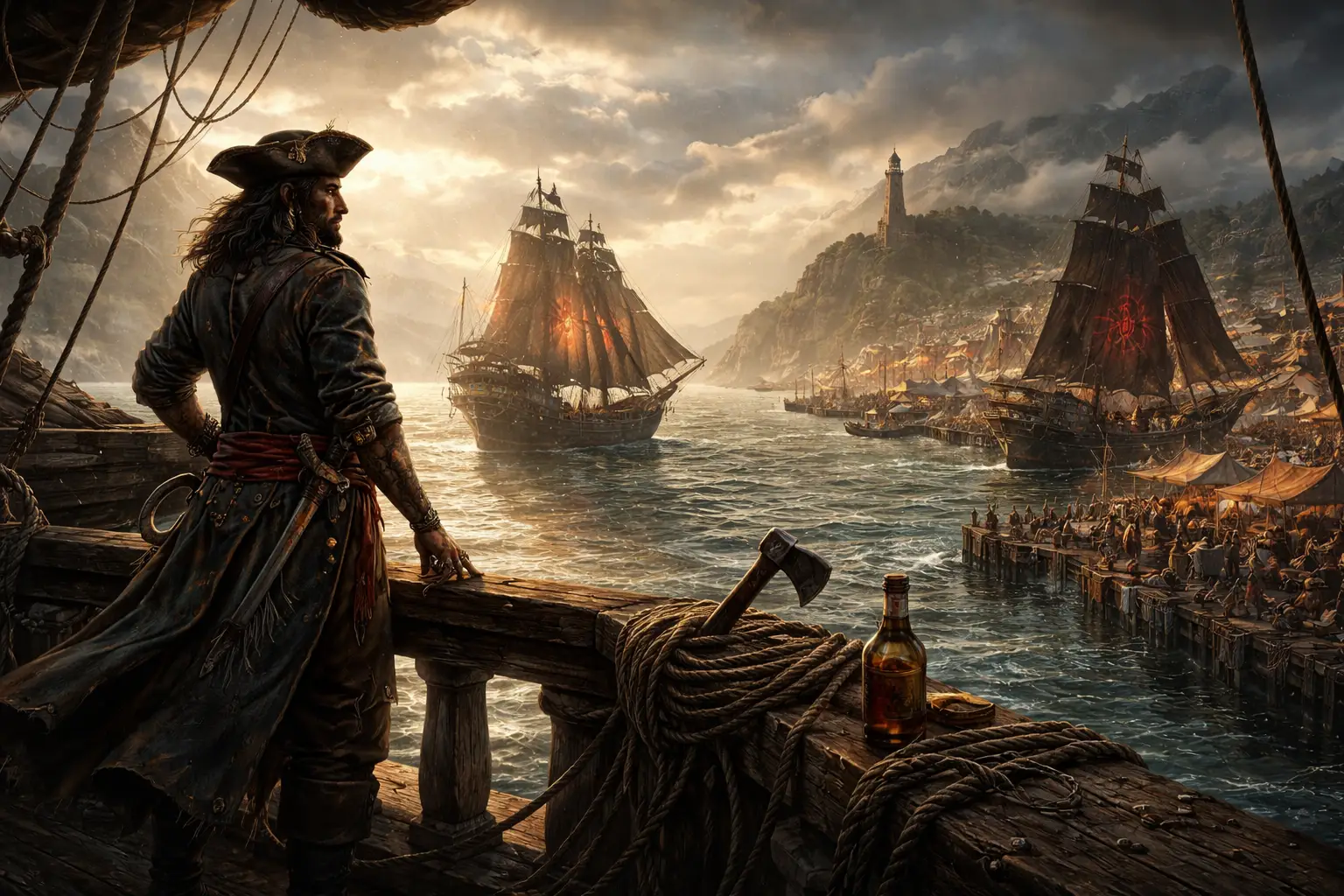
Art & Culture of the Lhazaar Principalities
The Ocean has its silent caves,
Deep, quiet, and alone;
Though there be fury on the waves,
Beneath them there is none.The awful spirits of the deep
Hold their communion there;
And there are those for whom we weep,
The young, the bright, the fair.
Calmly the wearied seamen rest
Beneath their own blue sea.
The ocean solitudes are blest,
For there is purity.The earth has guilt, the earth has care,
Unquiet are its graves;
But peaceful sleep is ever there,
Beneath the dark blue waves.— Prince Nathiel ir'Harthorne
A Hundred Ports, A Hundred Worlds
Walk the docks in Regalport on a busy morning and you'll hear six different accents before you reach the Exchange. A Seadragon deckhand in a coat covered with embroidered wave-patterns argues with a Direshark fishmonger over the price of herring. Two Cloudreaver dwarves drink something brown and evil-smelling from a shared flask, their facial scars thick as rope. A Gray Tide changeling — or at least, someone who was a changeling at breakfast — haggles for sailcloth in a voice that sounds Karrnathi today and might sound Aundairian tomorrow. A Lorghalan gnome inspects a crate of alchemical herbs, humming something that makes the harbor water ripple.
This is the thing outsiders get wrong about the Principalities. They hear "Lhazaar" and think of one culture — pirates, sea shanties, rum, the whole romantic package. But every principality is its own world, with its own slang, its own fashions, its own martial traditions, its own recipes for fish chowder, and its own firmly held opinion about what constitutes a proper knot. A sailor from the Seadragon fleet and a sailor from the Cloudreavers would recognize each other as Lhazaar in the same way that a Brelish spy and a Thranish templar recognize each other as human — a shared species, not a shared worldview. What makes Lhazaar culture coherent is not uniformity but the sea that connects every port, and the values the sea teaches: that your worth is measured in what you do, not where you came from; that a reputation gained is worth more than a title inherited; and that a good story, told well, outlasts the ship it was told on.
OVERHEARD — Pirate Exchange, Regalport
"My grandmother was Cloudreaver. My mother sailed the Sea Dragons. My father was Karrn, though he'd knife you for saying so. I was born on a ship, christened in salt water, and I've never set foot on the same island twice in one year. Tell me — which principality's culture am I?"
"Whichever one's buying."
Songs on the Water
Music in the Principalities lives where it was born — aboard ship, in the space between labor and sleep, passed from crew to crew across harbor and open water.
The shanty is the backbone. A lead singer calls the verse; the crew hammers the chorus in time with the work — hauling anchor, turning the capstan, running out the sheets. The rhythm coordinates dozens of hands pulling as one, and a shantyman who can set a pace that keeps the crew working without exhaustion is as prized as a navigator who can read the fog. Shanties are practical music, but practical does not mean disposable. A good shanty gets carried from one ship to another, modified with local verses, and sung for generations after the work it was written for has been replaced by better rigging.
Beyond the shanties are the ballads — long, narrative songs that serve as the Principalities' living history. A ballad tells the story of a captain's greatest prize, a storm that sank a fleet, a mutiny that made or ended a dynasty. Ballads travel faster than ships. A song composed in Port Verge about a Direshark captain who outran a Karrnathi warship can reach Regalport within a week, picked up by a crew that heard it in a tavern and carried it west with improvements. By the time it reaches the outer islands, the captain has gotten braver, the warship has gotten bigger, and the ending has changed twice. Nobody minds. A Lhazaar ballad is not a historical document — it is a reputation, and reputations are meant to grow.
Storytelling follows the same current. Everyone tells stories, all the time, about everything. Your first command, your worst storm, the fish you lost, the prize you took, the island you found that wasn't on any chart. The stories do not need to be true. They need to be good. The highest compliment a Lhazaar pays is not "well done" but "that'll make a song" — the acknowledgment that you've done something worth carrying. And the Lhazaar will carry it, because the culture's memory lives in mouths, not books, and a deed that nobody sings about might as well never have happened.
The outlier traditions are worth knowing. Bloodsail music is elven, ancient, and shaped by centuries in Mabar's shadow — darkwood instruments, harmonics that seem to come from somewhere behind you, compositions of beauty so complete that the silence after the last note feels like a wound. Lorghalan stonesingers perform a kind of music that is not quite performance and not quite magic — elemental communion expressed as melody, the water in your cup trembling in time with the song.
"I heard a Bloodsail play once. Couldn't tell you what the song was about. Couldn't tell you what language it was in. Can tell you that when she stopped, the whole tavern sat still for ten seconds, and then someone at the back said 'I think my drink just got colder.' It had." — Seadragon bosun
The Devourer's Bargain
Ask a Lhazaar about religion and you'll get a shrug. Ask about the Devourer and you'll get a story.
The Sovereign Host has temples in Regalport — Kol Korran for the merchants, Arawai for the farmers on the mainland coast, Boldrei's name over doorways in the harbor district. The Blood of Vol thrives in Port Verge and along the Bloodsail trade routes. But institutional faith has never taken deep root in the Principalities, and the reason is simple: the sea was there first, and the sea is a better teacher than any priest.
What the Lhazaar have instead is superstition — a web of rituals, omens, and taboos so dense and so deeply held that it functions as a complete spiritual framework, passed from captain to crew and from parent to child with the force of divine commandment. A cat aboard is luck. An albatross killed is doom. Whistling on deck calls a storm. Coins set in the keel during construction guarantee the ship will find her way home. A vessel renamed without the proper ceremony — rum on the bowsprit, the old name spoken one last time — is cursed beyond redemption, and the crew will desert before they sail it. These are not quaint traditions. They are articles of faith held with a ferocity that would impress a Thranish templar, and arguing them will earn you the kind of look that ends conversations.
The Devourer occupies a space in Lhazaar spiritual life that has no real parallel elsewhere in Khorvaire. Nobody worships the Devourer. Nobody likes the Devourer. But every sailor on the Lhazaar Sea has a personal, ongoing, deeply grudging relationship with the god of storms and sea monsters — a relationship conducted through curses when the storm comes and muttered thanks when it passes, delivered in the tone you'd use to acknowledge a landlord who chose not to raise the rent today. The Devourer is not abstract. The Devourer is the wave that swamps your deck at midnight, the kraken shadow under the hull, the storm that comes from nowhere and leaves nothing behind. The other Sovereigns are ideas. The Devourer is Tuesday.
The Traveler gets something closer to genuine respect — the shapeshifter's god, the patron of cunning and adaptability, whose portfolio maps so neatly onto the skills that keep a Lhazaar alive that even sailors who would never call themselves faithful tip their hat to the Traveler's cleverness. In the Gray Tide, where changeling spiritual traditions run deep, the Traveler is more than a figure of casual respect — but the specifics of Gray Tide theology are, appropriately, difficult to pin down.
SHIP'S LOG — recovered from a wreck off the Hoarfrost coast, date illegible
Day 14. Storm broke the foremast. Poured rum on the stump and cursed the Devourer by every name I know. Day 15. Wind died. Becalmed. Apologized to the Devourer. Day 16. Wind returned. Did not apologize for the apology.
Dressed to Be Remembered
In the Five Nations, clothing tells people your station. In the Principalities, it tells them your story.
The foundation is practical — a heavy oilskin sea coat, sturdy boots, layers for the northern cold. Everything above the foundation is autobiography. Sashes in principality colors. Coats embroidered with the names of ships served on, ports visited, prizes taken. Jewelry acquired piece by piece over a career and worn all at once — rings, earrings, chains, bone pendants, coins drilled and strung on leather, buttons pried from captured ships and sewn onto the coat as souvenirs. Tattoos that record kills, storms, crews, and the coordinates of places the wearer is not willing to share out loud. Every item means something, and the wearer can and will tell you what, in detail, at length, whether or not you asked.
The principalities diverge sharply in specifics. Cloudreaver fashion runs heavy — rough hide, bone ornament, ritual scars that mark a raider's career, and the dwarven heritage of the clan visible in the weight and craftsmanship of their metalwork. Bloodsail elves dress in close-fitting dark fabrics, bear crimson tattoos tied to family and vessel, and achieve a stark elegance that makes the rest of the Principalities look like they got dressed in the dark — which, to be fair, most of them did. Wind Whisperer half-elves layer loose, wind-catching garments designed for the perpetual storms of Orthoss and bear weathermarks — tattoos or scarification commemorating the worst gales they've survived. And the Gray Tide wears whatever the changeling underneath has decided to wear today, which could be anything from Seadragon finery to Karrnathi mourning black, and both appearances are exactly as honest as each other.
The critical point is legibility. In a culture where reputation is currency, your clothing is the first line of your resume. A Lhazaar who dresses plainly is either hiding — dangerous — or has nothing to show — contemptible. Neither invites trust.
"The Karrns dress for rank. The Brelish dress for weather. The Lhazaar dress for the ballad — they want to make sure whoever writes the song gets the details right." — Thuranni operative's personal journal, Regalport
Salt, Smoke, and Chowder
Lhazaar food has a reputation for being terrible. The reputation is earned aboard ship, where it is, and unearned ashore, where it isn't.
At sea, the diet is preserved provisions — salt cod, dried herring, hardtack, pickled vegetables, and whatever the cook can coax out of stores that have been in the hold since the last port. At sea, the food is fuel, not art, and nobody pretends otherwise. In port, the story changes. Regalport's dockside taverns serve fish chowders — thick, peppery, different at every establishment and fiercely defended by their regulars — that are as good as anything in Middle Dura. Grilled mackerel with fire-pepper sauce. Smoked herring on kelp bread. Salt cod with roasted turnips and mustard cream. The cuisine is built on what the sea and the cold northern islands provide — fish, root vegetables, kelp, game from the mainland forests — prepared with salt, smoke, fire, and the kind of aggressive seasoning that comes from feeding people who have been tasting nothing but hardtack for three weeks.
Two beverages define the Principalities. Lhazaar rum is distilled from potatoes, molasses, or whatever else ferments on the local island, aged in casks of questionable provenance, and consumed in quantities that concern visiting physicians. It tastes like the sea smells — an acquired taste that rewards persistence and punishes moderation. The islands also produce a potato spirit so potent that Mror dwarves have been known to nod approvingly at it, which the Lhazaar cite as an endorsement with entirely unjustified pride. For the adventurous, Farlnen wines are available at the Exchange — strange vintages from a Mabaran manifest zone, with flavors that linger in ways the seller does not fully explain — and Lorghalan jungle spirits arrive in small, expensive bottles and are served by the thimble for reasons that become apparent after the first sip.
MENU — The Stormbreaker, Regalport (dockside, no reservations, no refunds)
Fish chowder (today's catch). Smoked herring platter. Salt cod with turnip and mustard. Cloudreaver stew (ask at own risk). Rum by the glass or the bottle. Lorghalan spirit by the thimble. Farlnen wine by the glass (management assumes no liability for aftertaste, dreams, or existential unease).
The Founder's Toast and Other Occasions
On the first day of Zarantyr, every captain in the Principalities pours rum into the sea and drinks a measure in the same breath. The toast is the same from Regalport to the outer islands: "To the queen who crossed the sea." After that, the customs diverge — races, markets, brawls, and drinking until dawn, each island celebrating in its own fashion.
Ship-namings carry the weight of a coronation. Rum on the bowsprit, a speech from the captain, whatever blessing the crew's superstitions require, and a feast aboard the new vessel that ends when the provisions do. The name is sacred. Changing it without the full ceremony is the worst luck anyone can imagine, and crews have deserted rather than sail a ship carrying a cursed name.
The Olarune market fair in Regalport is the closest thing the Principalities have to a national event — the Exchange spills into the streets, princes attend with full entourages, and the social hierarchy of the sea recalibrates itself in real time based on who arrived with the biggest fleet, the fullest hold, and the best stories about what happened since the last one.
"Other nations celebrate what they've built. We celebrate what we're going to do next. That's the difference. That's why we're still here." — overheard at the Founder's Toast, Regalport, Zarantyr 998 YK