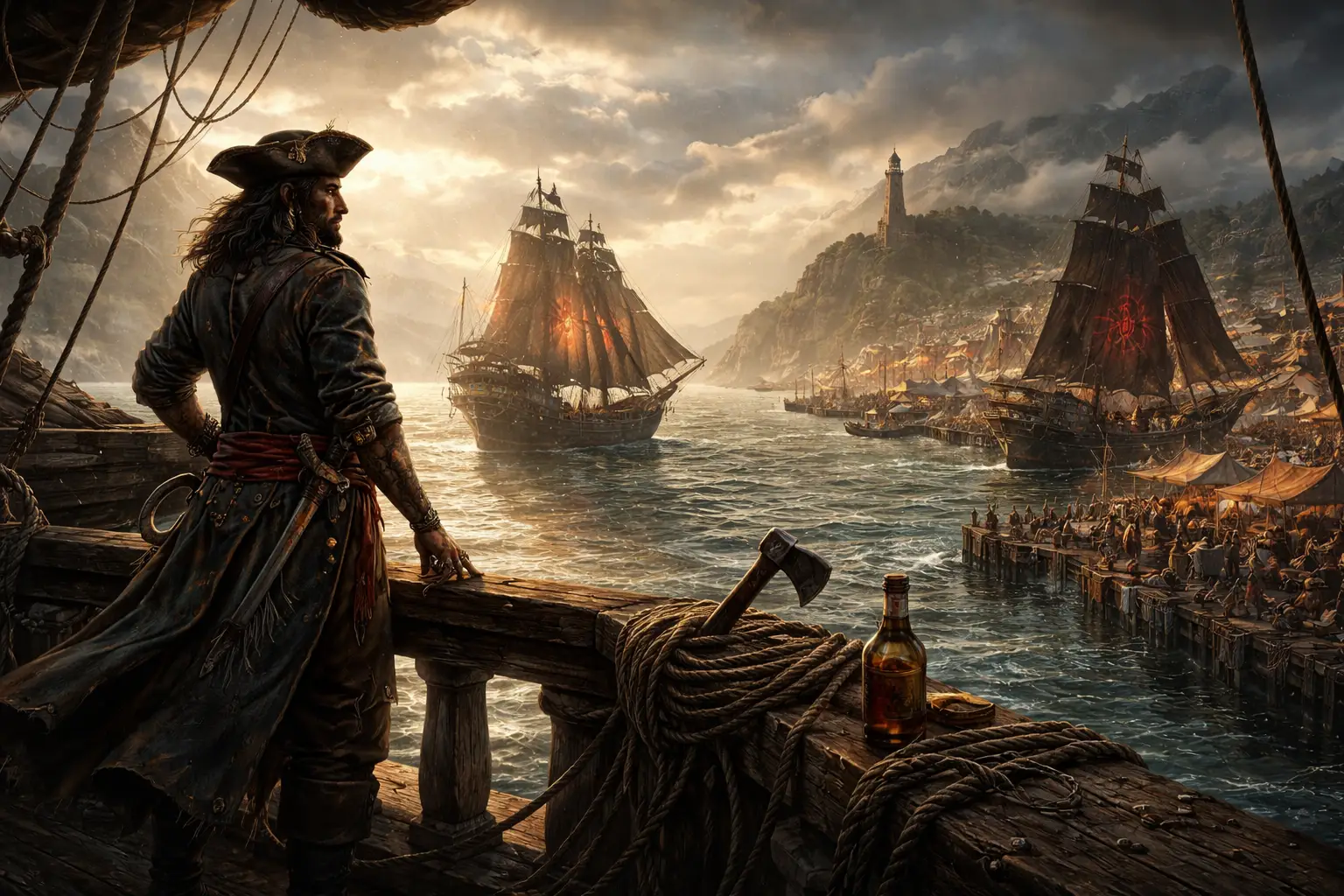
Politics of the Lhazaar Principalities
From a report submitted to the Korranberg Chronicle editorial desk, Olarune 998 YK, unpublished:
I spent three weeks in Regalport trying to understand how the Lhazaar Principalities govern themselves. I attended no sessions of parliament, because there is no parliament. I reviewed no legal code, because there is no legal code. I observed no elections, because there are no elections. What I observed instead was a fish auction that turned into a knife fight, a prince who settled a trade dispute by challenging the losing party to a drinking contest, and a changeling diplomat whose name and face changed between the morning session and the afternoon one.
I was told this is normal. I was told, in fact, that this was a slow week.
I recommend the Chronicle devote a full feature to the Principalities.
The Governing Structure
The Lhazaar Principalities have no central government, no constitution, no unified legal code, no standing army, and no civil service. What they have is a collection of independent domains — each ruled by a prince whose authority extends precisely as far as their fleet can enforce it — loosely bound by shared waters, shared culture, and the Treaty of Thronehold's polite fiction that all of this constitutes a nation.
This makes the Principalities the political inverse of almost every other state in Khorvaire. Where Breland has a parliament and a crown, the Principalities have neither. Where Darguun is held together by one hobgoblin's personal authority, the Principalities are held together by the absence of anyone powerful enough to impose authority on the rest. Where the Mror Holds manage twelve stubborn clans through a deliberative council, the Lhazaar manage dozens of stubborn princes through the simple expedient of not managing them at all.
The system works — to the extent that it works — because the Lhazaar Sea demands cooperation. Pirates who raid the same trade lanes need informal agreements about who strikes where. Merchant fleets need safe harbors. Every principality depends on trade routes that pass through waters controlled by others. This web of mutual dependency produces a rough, unwritten order that functions without institutions: a prince who makes enemies of every neighbor will find their harbors blockaded and their cargo unsellable. A prince who cooperates will prosper. The incentive structure does the work that a bureaucracy would do elsewhere, and it does it with considerably less paperwork.
The critical question of the postwar era is whether this arrangement can survive contact with a world that expects the Principalities to behave like a nation — to sign treaties, honor agreements, maintain consistent trade policy, and present a unified diplomatic face to foreign powers. High Prince Ryger ir'Wynarn believes it can, but only if the principalities accept a stronger central authority. Most of the other princes believe the question answers itself: they have survived for three thousand years without a central authority, and they see no reason to start now.
"Other nations have laws. We have the sea. The sea punishes stupidity faster than any court." — common Lhazaar saying
The High Prince
The title of High Prince did not exist before the Treaty of Thronehold. It was invented by Ryger ir'Wynarn of the Seadragon Principality, who awarded it to himself after his political maneuvering secured the Principalities a seat at the negotiations. The other princes tolerate the title because Ryger earned it — his fleet is the largest, his port the wealthiest, and his diplomacy the reason the Principalities are a recognized nation rather than a footnote in someone else's treaty. They do not, however, treat the title as granting him authority over them.
Ryger governs from Regalport and commands the Seadragon fleet — the most powerful naval force in the Lhazaar Sea. He uses this position to protect the major trade lanes, maintain order in Regalport, and project enough stability to keep the dragonmarked houses doing business in the Principalities. He also uses it to push, constantly and so far unsuccessfully, for a stronger union among the princes — shared tariff policy, coordinated naval patrols, something resembling a national treasury. The princes listen, nod politely, and go home to do exactly as they please.
The High Prince has no legal authority to tax, conscript, legislate, or adjudicate disputes beyond his own principality. What he has is the biggest fleet, the busiest port, the best intelligence network, and the relationships he has cultivated with House Thuranni and House Ghallanda — relationships that give him access to information and hospitality infrastructure that no other prince can match. His power is soft power, built on commerce and reputation rather than law and force. In the Principalities, that is the only kind of power that lasts.
"NO KILLIN" — The only written rule at the Bilgewater Tavern in Regalport
The Princes
A prince is anyone who commands a fleet, controls territory, and can hold both against all comers. The title is not inherited by blood in most principalities — it belongs to whoever the captains and crews are willing to follow. In practice, this means that a prince holds power through a combination of wealth, tactical skill, personal charisma, and the ability to keep the hold full of cargo and the crews full of rum. A prince who stops winning — who loses ships, loses trade, or loses the confidence of their captains — will be replaced, and the replacement process is rarely gentle.
Some principalities have maintained stable dynastic rule for generations, where a prince's child inherits the fleet and the loyalty that comes with it. Others change leadership with the tides. The distinction has less to do with law than with whether the current prince's heirs are competent enough to hold what they were given. A prince's child who cannot command respect will be deposed by a captain who can, and the fleet will follow whoever fills the hold.
Each principality governs itself by whatever customs its prince establishes. There is no shared legal code, no court of appeal, and no mechanism for one principality to interfere in another's internal affairs short of war. A merchant who is cheated in Port Verge has no recourse in Regalport. A sailor who murders a crewmate in the Gray Tide answers to the Gray Tide's prince, not to any higher authority. Justice is local, personal, and only as fair as the prince dispensing it.
The council of princes — an informal assembly that Ryger has tried to formalize — meets irregularly, usually when a crisis forces the principalities to coordinate. It has no fixed schedule, no permanent seat, and no binding authority. Decisions are reached by rough consensus among whichever princes bother to attend, and enforcement depends entirely on whether the princes who agreed actually follow through. It is, in the words of one exasperated Sivis diplomat, "a tavern argument with geopolitical consequences."
The Principalities
The principalities vary so dramatically in character that treating them as a single political entity is an exercise in creative fiction. What follows are the domains that matter most in the postwar political landscape.
The Seadragon Principality — The largest and most powerful fleet, ruled by High Prince Ryger ir'Wynarn from Regalport. The Seadragons control the busiest sea lanes and the grandest port in the Principalities. Regalport is the economic center of Lhazaar life — home to the Pirate Exchange, the largest market east of the Ironroot Mountains, and to the enclaves of House Thuranni and House Ghallanda. Ryger's position is built on trade, diplomacy, and naval superiority. He is the closest thing the Principalities have to a national leader, and the fact that everyone resents it does not change the fact that everyone needs him.
The Direshark Principality — Ruled by Prince Kolberkon from Port Verge, the Diresharks are the Seadragons' primary rival. Kolberkon is ambitious, aggressive, and openly courting alliances — with House Lyrandar, which has recently established an enclave in Port Verge; with the Blood of Vol, which has a strong presence in the city; and with parties considerably more dangerous than either. Where Ryger builds through commerce and diplomacy, Kolberkon builds through sheer appetite for power. Port Verge has the hungry energy of a boomtown and the moral flexibility to match.
The Bloodsail Principality — Ruled by Prince Shaen Tasil from the island of Farlnen, the Bloodsails are elves exiled from Aerenal who have built a necromantic society in a Mabaran manifest zone. The living earn an undead afterlife through deeds and the payment of velgys — blood money. The true power on Farlnen rests with the Grim, a council of ancient undead whose members pursue agendas that range from the civic to the esoteric. Bloodsail ships — darkwood-hulled, ghost-driven, and unmistakable — are feared across the Lhazaar Sea. Since Kaius III denounced the Blood of Vol, Karrnathi vessels have been the Bloodsails' preferred targets. Despite sharing roots with the Blood of Vol, the Bloodsails follow their own pragmatic necromantic theology.
The Cloudreavers — The most notorious raiders in the Principalities, the Cloudreavers are a principality of pirates whose idea of diplomacy is choosing which ships to board first. Their origins trace to the dwarven clans who resisted the earliest human settlers, and they have maintained a tradition of violent self-reliance ever since. The Cloudreavers returned to raiding when the Last War's privateering contracts dried up, and they represent the sharpest challenge to Ryger's efforts to make the Principalities respectable.
The Gray Tide — A principality founded by and for changelings, with the largest changeling population in Khorvaire. The Gray Tide maintains a strong mercantile tradition — and, according to everyone who is not a member, a thriving sideline in piracy conducted under a hundred stolen faces. The Gray Tide is politically neutral in most inter-principality disputes, which makes it either the most trustworthy broker in the sea or the most dangerous, depending on how much you trust a nation of shapeshifters.
The Wind Whisperers — Based on the island of Orthoss, the Wind Whisperers are primarily half-elves, many of whom carry the Mark of Storm as foundlings with no connection to House Lyrandar. The Wind Whisperers covet airships with an intensity that borders on obsession and have indicated their willingness to obtain them by any means necessary. Their fleet includes exiled sea elves who sided with the line of Vol and traveled north after the persecution on Aerenal. Orthoss is cold, mountainous, and battered by perpetual storms — a fitting home for a principality that channels the weather itself.
Lorghalan — A distant tropical island settled by gnomes who fled the founding of the Trust in Zilargo, Lorghalan sits on the edge of a Lamannian manifest zone alive with earth and water elementals. The gnomes govern through a Cornerstone Council of family representatives, and their prince — currently the young Shasi Stormlyn — holds the title only as "the cleverest on the island," a position claimed and lost through duels of wit rather than combat. Lorghalan ships are built from wood that rivals Aereni bronzewood, accompanied by water elementals, and in battle are known for launching small earth elementals at opposing vessels — living cannonballs that wreak havoc after impact. The Lorghali are respected far out of proportion to their small fleet.
"Every prince in the Principalities is the most important prince in the Principalities. Ask any of them." — variant of a common saying heard across the sea
Law and Justice
The Lhazaar Principalities have no unified legal system. The Galifar Code of Justice technically applies but is not enforced. What passes for justice is whatever the local prince says it is, and the standard varies from one harbor to the next with a randomness that would make a Karrnathi judge weep.
In Regalport, Ryger has established a rough baseline: merchants who pay the Exchange tariff operate under his protection, foreign ships that fly their colors and declare cargo are not molested, and the Seadragon fleet enforces these terms within the strait. This is not law — it is the prince's word, backed by the prince's ships, and it lasts exactly as long as the prince does. In Port Verge, Kolberkon's rules are different. In Farlnen, Bloodsail law applies, and Bloodsail law involves concepts — the earning of undeath, the payment of blood money, the authority of the Grim — that have no equivalent in any human legal tradition.
Outside the major ports, there is effectively no law at all. Pirates operate freely in the outer islands. Isolated communities govern themselves by custom. A traveler who is robbed on a remote island has no recourse unless they have the strength to take it or a patron powerful enough to demand it. House Kundarak's Dreadhold is the only institution in the Principalities where a consistent standard of justice applies — and Dreadhold's standard is imprisonment, not due process.
The practical consequence for travelers is straightforward: know whose water you are sailing in, know whose protection you are operating under, and do not assume that the rules in one port apply in the next. A letter of credit from House Thuranni will open doors in Regalport that do not exist in the Cloudreaver islands. A Deneith seal means something in Port Verge and nothing at all in the Gray Tide. Navigating the Principalities is a matter of navigating relationships, and the only universal law is the one the sea enforces: if you can't survive the crossing, the question of whose jurisdiction you died in is academic.
Foreign Relations and the Dragonmarked Houses
The Principalities conduct foreign relations the way they conduct everything else — individually, opportunistically, and with no particular concern for consistency. There is no foreign ministry, no ambassador to Thronehold, and no unified diplomatic stance. Each prince maintains whatever relationships serve their interests, and two principalities may have diametrically opposed positions on the same foreign power.
House Thuranni is the most significant dragonmarked presence, headquartered in Regalport under Baron Elar d'Thuranni. The House of Shadow's espionage network is layered atop the Principalities' existing culture of secrets and betrayal, making Regalport one of the most information-rich cities in Khorvaire — and one of the most dangerous for anyone with something to hide. House Ghallanda maintains a substantial outpost in Regalport as well, providing the hospitality infrastructure that makes the city functional for foreign visitors. House Lyrandar has recently established an enclave in Port Verge at Kolberkon's invitation — a move that gives the Diresharks access to Lyrandar shipping resources and gives Lyrandar a foothold in the eastern sea trade that does not depend on Ryger's goodwill.
House Kundarak operates Dreadhold but maintains no broader political presence in the Principalities. House Deneith has limited operations — the Principalities produce their own fighters and have no need of mercenary brokers. The remaining houses maintain at most token presences in Regalport, drawn by the Pirate Exchange's commercial volume but wary of the political instability beyond the harbor walls.
Karrnath is the Principalities' most complex foreign relationship — former overlord, current trading partner, and the only nation with historical claims to the territory. Individual princes maintain warm commercial ties with Karrnathi warlords, but the Bloodsail vendetta against Karrnathi shipping keeps the Bitter Sea tense and prevents any broader rapprochement. The Mror Holds are a natural trading partner across the Hoarfrost Mountains. The rest of Khorvaire views the Principalities with a mixture of romantic fascination and commercial wariness, happy to buy what the Lhazaar sell but unwilling to invest in a region where the political landscape can change between one tide and the next.
From a letter found in the personal effects of a Thuranni operative, recovered from Regalport harbor, Barrakas 997 YK:
The Principalities have no secrets. They have ten thousand secrets, each one belonging to a different captain in a different port, and none of them connected to each other by anything except salt water and mutual suspicion. This is both the best and the worst intelligence environment I have ever worked in. There is so much information available that the challenge is not finding it but determining which of it matters.
I have been here six months. I still cannot tell.