For generations the gnoll tribes of Imperion were dismissed as scattered raiders, a nuisance on the trade roads and nothing more. Then a warlord named Angash gave them a single banner, and the borderlands learned how wrong they had been. The war he lit still shapes the four tribes that fought it, for each came out of it scattered and cursed.
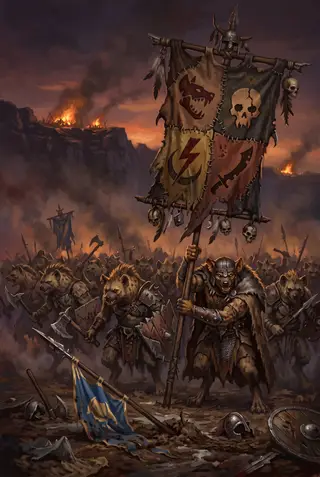
At a Glance
Type: History (Age of Chaos and Redemption)
When: 2,500 to 2,510 AC
Where: Imperion, with the decisive battle at the Valentis Fields
The spark: The warlord Angash united four gnoll tribes into a single army
The tribes: Bloodfang, Bonechewer, Moonhowler, and Blackclaw
How it ended: Angash was broken at the Battle of Valentis Fields in 2,505 AC and his host scattered
The mark it left: By 2,510 AC each of the four tribes had fallen under a curse; the memorial Memoria Bellum Valenti stands where the last battle was won
Overview
Ignited in 2,500 AC, the Gnoll Wars were the conflict that turned Imperion's gnoll problem from a matter of caravan guards into a matter of armies. A warlord of rare cunning named Angash exploited old tribal rivalries and shared grievances against the spreading human and elven lands to bind four powerful tribes under one banner. What followed was years of raids, sieges, and pitched battle, ending only when Angash himself was defeated and his coalition broke apart. Every tribe that marched with him left the war changed, and not one of them left it whole.
"In the days when Angash the Unifier arose, he spoke not just of conquest but of a vision, a gnoll empire forged from the bones of those who dared oppose them. He found allies in the four most powerful tribes, each one unique in its strength and curse. The Bloodfangs, whose fury was unmatched; the Bonechewers, masters of death and dark magic; the Moonhowlers, shrouded in the mysteries of the moon; and the Blackclaws, who moved as shadows in the dark.
Yet not all was as it seemed. The Bloodfangs, cursed by a vengeful sorceress, found their rage turning inward, tearing at their unity. The Bonechewers were haunted by spirits, their mastery of death becoming a daily struggle against madness. The Moonhowlers, caught between their twin forms, sought answers in the stars, wondering if the curse was a test or a trial. The Blackclaws, bound to the shadows, were forever torn between light and dark, their loyalty always in question."
— From The Chronicles of the Four Tribes
The Course of the War
In the decades before the war, gnoll incursions grew from opportunistic raids into something organized. Caravans, farms, and outlying settlements came under attack by bands that no longer scattered when soldiers arrived. Word spread of a warlord who had done the impossible and united the feuding tribes.
Initial Skirmishes (2,500 AC)
The war opened with raiding parties probing the defenses of Imperion's cities, testing walls and garrisons for weakness rather than seeking plunder.
Siege of the Outlying Settlements
Angash's army turned to coordinated assaults on smaller settlements, cutting supply lines and thinning the resistance before any larger blow could fall.
Guerrilla War
As the fighting dragged on it became a war of ambush. Gnoll bands struck supply convoys and harried isolated units, then vanished before a counterattack could form.
The Battle of Valentis Fields (2,505 AC)
The turning point came at the Battle of Valentis Fields, where a daring offensive stormed Angash's stronghold. With the warlord defeated, his coalition shattered and the surviving tribes scattered to the corners of the land. By 2,510 AC, each of the four had fallen under a curse.
"The gnolls came at us in waves, relentless and fierce, but we held the line. They fought like demons, but it was clear they were fractured. I saw a Bloodfang berserker turn on his own, a Bonechewer shaman whispering madly to the air, and a Blackclaw assassin betrayed by his own shadow.
But it was the Moonhowlers who caught my eye. They seemed divided, yet united. By day they walked among us as humans, gathering intel, sowing confusion. By night, they were gnolls again, launching surprise attacks. It was as if they were fighting themselves as much as us."
— From a soldier's journal of the final assault
The Four United Tribes of Angash
Each tribe brought a different strength to Angash's banner. Each has its own tab on this page.
Tribe | Known for | Their part in the war |
|---|---|---|
Bloodfang | Berserker fury, brutal close combat | Shock troops who broke enemy lines |
Bonechewer | Necromancy and death-rites | Raised the fallen and sowed fear |
Moonhowler | Lunar mysticism, night raids | Seers and nocturnal strike-forces |
Blackclaw | Stealth and assassination | Spies and saboteurs behind the lines |
The Curses and the Legacy
The war's end did not spare the tribes. As the coalition fell apart, each of the four was struck by a curse that has followed it ever since, the Bloodfangs into an eternal rage that turns on friend and foe alike, the Bonechewers haunted by the very dead they once raised, the Moonhowlers split between human and gnoll by the turning of day and night, and the Blackclaws bound to the shadows and betrayed by their own. Whether these curses were divine judgment or the work of vengeful hands, the tribes carry them still.
A memorial, the Memoria Bellum Valenti, stands in the Valentis Fields where the decisive battle was won, honoring those who fell defending the land.
Superstitions & Customs
Border farmers still nail a painted fang above the door at harvest, an old ward said to turn a Bloodfang's eye from the household.
Soldiers of the Valentis garrison pour out the first cup at muster for the dead of the memorial, and will not speak Angash's name after dark.
Parents warn wandering children that a howl on a moonlit night means the Moonhowlers are abroad, and that a shadow that moves against the light is a Blackclaw's mark.