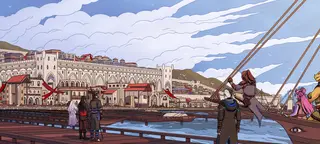
The Busat Protectorate is a unique, multi-racial nation built on the foundations of trade, diplomacy, and resilience. At its heart lies Busat, the City of Gates, a thriving port metropolis that serves as the crossroads of the world, connecting the northern continents of Kutalla, Gyte, and Galeaha to the vast southern expanse of Lomiindor. The protectorate encompasses a diverse landscape, from the arid Southern Flats to the dense jungles of Malinamei and Eastern Kutalla, with the Haldegant Grasslands providing a fertile valley for those brave enough to settle outside the bustling port.
Originally established as a neutral trade hub, Busat flourished as a center of commerce, innovation, and cultural exchange. Despite the upheavals of history—where kingdoms fell and new powers emerged—Busat remained a beacon of stability. When the elven capital of Gweyir was sacked, Busat became the rallying point for resistance against the tyrant Buroz the Corruptor. After decades of war, Buroz was defeated, but the scars of conflict left the world in turmoil. For over a century, civilizations struggled to rebuild, yet through it all, Busat endured, transforming into the de facto capital of the modern world, where representatives of all peoples gather to maintain peace.
Capital City
Busat, The City of Gates
Geography
A mix of dense jungles, arid flats, and fertile grasslands, bordered by the sea, making it a natural trade hub.
Climate
Tropical rainforest (Af) in the jungles, semi-arid (BSh) in the Southern Flats, and tropical savanna (Aw) in the Haldegant Grasslands.
Population
Estimated: 1.5 million
Humans (35%), Elves (15%), Dwarves (12%), Orcs (10%), Halflings (7%), Goblins (5%), Gnomes (5%), Dragonborn (3%), Lizardfolk (3%), Kitsune (2%), Tengu (2%), other uncommon ancestries (1%)
Government
A multi-racial council-based government, where representatives from various factions, races, and trade guilds maintain a delicate balance of power.
A Short History
Originally founded as a collaborative effort between multiple races, Busat was envisioned as a neutral ground where merchants, adventurers, and diplomats could coexist. Over the centuries, the city blossomed into a vital economic and cultural hub, where diverse traditions blended, and alliances were forged. Though kingdoms rose and fell around it, Busat remained steadfast, evolving into an independent city-state with an identity beyond any single nation.
During one of the world's darkest eras, the fall of Gweyir plunged the world into chaos. With the elven capital lost, Busat transformed from a neutral trade hub into the center of the resistance against Buroz the Corruptor. The city's diverse population united under a temporary war council, drawing strength from its multicultural roots to stand against tyranny. After decades of conflict, Buroz was defeated, but the world remained fractured, its old power structures shattered.
In the aftermath, Busat emerged as a beacon of stability, its ruling council adapting to meet the world's new needs. While some regions struggled to recover, the city expanded its influence, ensuring trade routes remained open and diplomacy flourished. Over the following century, the Busat Protectorate was formalized, encompassing the city and its surrounding lands. Though the world still bears the scars of war, Busat remains a neutral haven, a place where all peoples can find refuge, conduct business, and negotiate the fragile peace of a new age.
General information
Geography
The Busat Protectorate occupies the southern tip of Kutalla, a region of contrasting landscapes. To the northwest, the Jungle of Malinamei thrives with towering trees, hidden ruins, and ancient secrets, largely unexplored by outsiders. To the northeast, the Eastern Kutalla Jungle stretches across the coastline, rich with exotic flora, deadly fauna, and communities that have adapted to the unpredictable wilds.
Between these jungles lies the Haldegant Grasslands, a sweeping lowland valley nestled amidst the region’s rugged terrain. This fertile region, though sparsely populated, serves as a vital agricultural belt. However, it is not without dangers, as nomadic bands, wandering beasts, and remnants of ancient conflicts still roam the lands.
To the far south, the Southern Flats present a stark contrast—a harsh, arid wasteland where water is scarce, and only the hardiest creatures and settlers endure. Despite the inhospitable conditions, the Flats are home to hidden trade routes, outlaw refuges, and desert-dwelling tribes that have learned to thrive where others falter.
Settlements of Note
Brispon – A bustling port city on the western coast, serving as a key stop for northern-bound fleets and the launching point for expeditions to Holdarima, the frozen edge of Cyorion.
Sagoro – A once-small village that has transformed into the heart of an alpaca empire, led by the ambitious and charismatic Oliver Whistlefoot, a family man who runs his alpaca farms alongside his wife, Rose, and children, a daughter named Maxine and a boy named Timothy. Under his rule, Sagoro has become a center of trade and textile production, with its alpaca-based economy fueling new industry in the region.
Bie'enta – The hidden city of the Aumafeya, a reclusive elven people who have preserved their ancient traditions. Strictly forbidden to outsiders, the city is veiled in mystery, with only whispers and rumors hinting at its true nature.
Government
The Busat Protectorate operates under a council-based governance model, where representatives from various races, factions, and trade guilds convene to debate policies, resolve disputes, and oversee the city's prosperity. The council, known as the Conclave of Gates, is structured to ensure no single race or organization holds absolute power, with members elected from within their respective communities.
The Conclave consists of:
Five District Representatives, each elected from one of Busat’s five districts, ensuring that the city's diverse population and interests are fairly represented.
Trade Guild Delegates, representing the vast mercantile interests that fund the city's economy and drive its global influence.
Racial Representatives, selected by their communities to advocate for the needs and rights of various ancestries within the protectorate.
The Watcher’s Seat, an independent, neutral arbiter tasked with preventing corruption and upholding neutrality in city affairs.
The Sentinel’s Assembly, a military and security branch that ensures Busat’s defenses remain strong without becoming an oppressive force.
While Busat is largely self-governing, the surrounding protectorate territories maintain local leadership, with oversight from the Conclave to ensure peace and cooperation. Despite its neutrality, politics within Busat are a delicate dance of power, influence, and intrigue, as competing factions vie for control while maintaining the fragile harmony that defines the protectorate.
Regional Gods