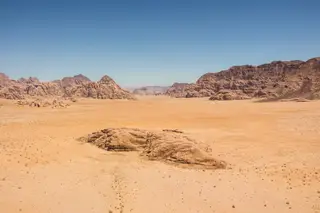
Ashihoya is a vast, ever-moving kingdom spanning the Ethriol Desert, a massive expanse of shifting sands and towering dunes covering approximately 9.2 million square kilometers. Unlike traditional kingdoms, Ashihoya has no fixed capital, no centralized government, and no stationary settlements. Instead, it is defined by its great walking cities—colossal wooden constructs lined with copper sails, harvesting moisture from the air as they roam endlessly across the dunes. These cities follow distinct migration routes, some moving clockwise, others counterclockwise, ensuring constant trade, shifting alliances, and occasional clashes.
Capital City
None - Negotiations between princes occurs in Shah'Veluud
Geography
The Ethriol Desert is an unforgiving land of endless dunes, scorching days, and frigid nights. The terrain is marked by hidden oases, deep ravines, and ruins of ancient civilizations long swallowed by the sands. Some regions of the desert are dangerous wastelands, while others hold untapped magical energies that the artificers of Khatia and other cities seek to harness.
Climate
The Ethriol Desert has an arid (BWh) climate, with scorching daytime heat exceeding 50°C (122°F) and bitterly cold nights. Rain is almost nonexistent, but the walking cities sustain themselves by harvesting moisture from the air using their copper-lined sails.
Population
Estimated: 6-8 million (highly nomadic)
Tiefling (Ashithari) 30%, Human 25%, Nagaji 8%, Elf (Waesari) 7%, Orc (Gurash) 5%, Dwarf 5%, Halfling (Mahutara) 5%, Leshy 5%, Gnome 5%, Kitsune 5%, and Other (Ratfolk, Tengu, Kobold, etc.) 5%
Government
Decentralized Oligarchy - The kingdom has no single ruler. Instead, each walking city is governed by a Trade Prince or Princess, who controls commerce, law, and security within their domain.
A Short History
Long before the rise of the great walking cities, the vast Ethriol Desert was home to a fierce and nomadic people—the ancestors of modern Tieflings. These early desert-dwellers were a warrior culture, thriving in the harsh dunes through raiding and skirmishing. Their small, mobile vessels—precursors to the walking cities—allowed them to navigate the desert swiftly, launching raids on trade caravans and isolated outposts along the Tiverbourg Mountains, the great natural barrier marking the southern border of Ashihoya. Beyond these mountains lay the Waesmanor Forest, home to Elves renowned for their wealth, powerful magics, and advanced craftsmanship. The desert raiders sought to claim these riches, launching hit-and-run assaults across the mountain passes and retreating before the Elves could counterattack.
For centuries, this cycle of raids continued—until the Elves marshaled their allies. A coalition of Elves, Dwarves, Gnolls, Kobolds, and Halflings formed a defensive front, pushing back against the desert warbands. Outmatched and on the verge of total defeat, the desperate raiders turned to a forbidden pact, offering themselves as vessels of dark magic in exchange for power. The fiends of the abyss answered their call, warping the raiders into Tieflings—beings infused with unnatural might, stronger, faster, and deadlier than their former selves. But this transformation alone was not enough. To turn the tide, they created and enslaved the first Orcs, bred as mindless shock troops to serve their new masters in an all-out war against the southern alliance.
The war reached a terrifying climax—the newly empowered Tieflings and their orc legions smashed through the mountain passes, threatening to eradicate their enemies. The Elves and their allies were on the verge of collapse—until the Orcs turned on their creators. In a violent uprising, the Orcs shattered their chains, nearly wiping out the Tieflings in an act of revenge. The surviving Orcs fled far to the southeast, settling in the Arid Expanse, leaving the Tieflings to languish in the desert, scattered and broken.
In the centuries that followed, the Tieflings abandoned raiding and warfare, instead embracing a nomadic existence, surviving through trade, craftsmanship, and diplomacy. The old raiding vessels were disassembled, their wood and metal repurposed to construct the first walking cities—massive mobile fortresses designed for survival rather than war. The Treaties of Shah’Veluud formalized peace between the desert Tieflings and their southern neighbors, bringing an era of commerce and cooperation. Today, the Tieflings are a proud and thriving people, still bearing the scars of their past, yet now among the most prominent merchants, artificers, and diplomats of Ashihoya.
General information
Geography
The Ethriol Desert is a land of extremes, with its vast dunes stretching endlessly beneath the scorching sun. Towering sandstorms sweep across the landscape, shifting the dunes so frequently that maps become obsolete within weeks. The northern and central regions are the most traveled, home to the migration routes of the great walking cities, while the southern reaches are dominated by the Tiverbourg Mountains, whose jagged cliffs form a natural barrier against the Waesmanor Forest. These mountains, though treacherous to cross, contain hidden passes once used by the raiding ancestors of the Tieflings, and they are still rumored to house abandoned strongholds and lost battlefields. Beneath the dunes lie subterranean rivers and forgotten ruins, remnants of civilizations long consumed by the shifting sands.
Some areas of the desert are actively avoided, known for their mystical dangers and deadly landscapes. The Black Dunes, a stretch of dark, obsidian-like sand, is a place of ill omens where travelers vanish without a trace. Scholars speculate it may be the site of an ancient magical catastrophe, but no expedition has returned with proof. In contrast, the Oasis of Iovis is whispered to be a hidden paradise, blessed by the great blue moon, Iovis, which is said to bring cold winds and the touch of a frost goddess. Travelers claim that when Iovis is full, the air around the oasis cools to a refreshing crispness, making it a lush sanctuary of misty pools and vibrant flora in the heart of the desert. Some believe it is a divine refuge, while others insist it holds the secrets of a forgotten civilization, waiting to be uncovered beneath its moonlit waters.
Among the ruins rumored to exist but never discovered, Karesh-Amun, the City of a Thousand Eyes, is said to have been ruled by sorcerer-kings who could see through time before it sank beneath the dunes. Some claim its artifacts still appear in Ashihoya’s markets, but none know their true origin. Another lost city, Vorlithis, the Silent Necropolis, is whispered to be a tomb-city where the dead still stand, its streets lined with statues that were once living beings, frozen forever by an unknown force. Legends say that any who find Vorlithis risk joining its silent ranks, trapped beneath the desert sun for all eternity.
Government
Ashihoya operates under a decentralized mercantile oligarchy, where each walking city is independently governed by a Trade Prince or Princess. These rulers are not hereditary monarchs but rather business magnates, guild leaders, or merchant dynasts who control a significant share of their city’s economy. A Trade Prince's authority is tied to their wealth, influence, and ability to manage commerce, and they can be challenged or replaced if their rule falters. Each city functions autonomously, enforcing its own laws, trade regulations, and social policies, though most adhere to a common code of conduct regarding inter-city trade, taxation, and movement between settlements. While some rulers govern fairly, others impose harsh taxes, labor restrictions, or monopolistic control, making life vastly different from city to city.
Despite this autonomy, the cities must cooperate to maintain stability and economic balance, and for this purpose, Shah’Veluud serves as a neutral ground for diplomacy and negotiation. Every few years, the Grand Trade Summit is held there, where the Trade Princes and Princesses convene to settle disputes, negotiate trade routes, and establish inter-city policies. While there is no singular ruler of Ashihoya, this summit acts as the closest thing to a unifying authority, with agreements binding the cities through mutual interest rather than centralized governance. However, power struggles are common, and the alliances between the cities are constantly shifting, ensuring that political maneuvering, corporate espionage, and mercantile warfare are as much a part of Ashihoya’s landscape as the shifting sands of the Ethriol Desert.