
Influence Encounter
Perception: 1d20+3
Will: 1d20+2
Discovery
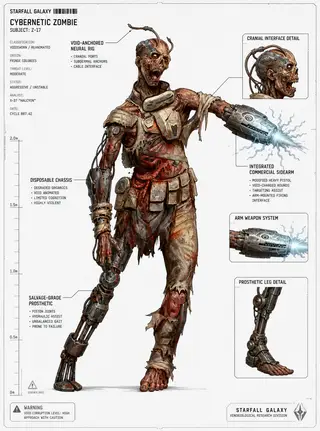
Perception / Crafting DC 18: Notice control ports, signal lights, or remote-signal jitter; learn that the zombie is actuated by a cybernetic rig and not true necromancy alone.
Void Lore / Undead Lore DC 17: Identify that void energy sustains the chassis but cybernetics govern movement and shooting; discover that void-channel rites can “stall” the rig without destroying the body.
Guild Lore / Underworld Lore DC 17: Recognize standard guild “salvage-asset” markings; learn that guild protocols require remote handlers to obey certain codes (e.g., deactivation or recall phrases) when presented with proper authorization or leverage
Computers DC 15
Influence Skills
Skill | DC | Notes |
10 | Hack the rig to limit fire modes, set it to stand down, or lock its actuators | |
16 | Use void-channel rites to disrupt the rig’s feedback loop, pacify the void charge in its weapon, or bind it long enough to restrain and secure the chassis. | |
12 | Approach calmly under covering actions, then perform a rapid “field surgery” to disconnect critical actuators without triggering self-destruct—essentially a nonlethal disarm and immobilize via influence rather than attack rolls. | |
14 |
Thresholds
Stabilize (4IP)
The zombie’s aim degrades and movement slows: treat it as slowed 1 and unable to use reactions (including Self-Destruct). PCs can withdraw, negotiate with a handler, or set up a safe capture.
Override (7IP)
The rig accepts new instructions or a handler issues a stand-down order: the zombie stops attacking and can be guided to a designated location or powered down. The encounter resolves without further combat.
Requisition (10IP)
PCs gain full control or legal salvage rights: they can shut the rig off, prevent self-destruct, and potentially repurpose the chassis as study material, evidence against a guild, or even a future companion (if your campaign allows).
Resistances
Mindless Rig: Traditional charm or emotional appeals (Diplomacy, Performance) have higher DCs or auto-fail unless a remote handler is present; increase DC by 2–5 for “purely social” checks aimed at the corpse itself.
Hostile Environment: Loud, chaotic combat zones impose penalties on delicate Medicine or Engineering Influence attempts unless the PCs create cover or distraction first.
Weaknesses
Cheap Workmanship: Engineering that exploits bargain-bin components (e.g., known recall bugs in a popular rig model) reduces DCs by 2–5 or grants bonus Influence Points.
Legal Leverage: Guild Lore or Underworld Lore that cites contract law, broadcasting the threat of legal sanctions or reputation damage against the operator, can sharply reduce DCs for handler-focused Influence.
Condition #