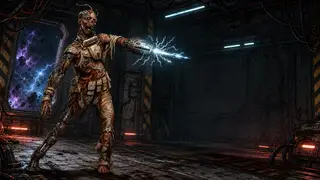
A Cybernetic Zombie doesn’t “know” what it’s doing in a human sense, but its control rig absolutely does—its tactics are the emergent behavior of cheap, brutally effective programming layered over a mindless undead chassis.
What Drives a Cybernetic Zombie
Compulsion, not survival. Like other low-level undead, a cybernetic zombie’s “motivation” is obedience to its controller’s protocols, not self‑preservation; it fights until destroyed or shut down.
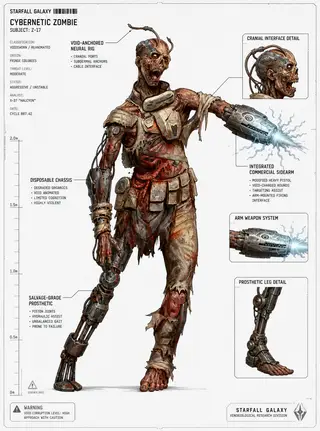
Mindless Undead + Tech Rig. It has the undead, void, tech, and mindless traits: void energy keeps it moving, but a cybernetic rig decides whom it shoots, when it advances, and when it detonates.
Design intent. Guild engineers built it as a disposable ranged platform that softens enemies and then turns into an area‑denial charge when disabled. That design intent is what you model tactically at the table.
Battlefield Role and Environment
Role: low‑level ranged brute / shock asset—“cheap rifleman that explodes.” It’s not clever, but its programming is ruthless.
Preferred environment: narrow corridors, dockyards, and salvage bays where its integrated pistol’s range covers most lanes and its self‑destruct punishes anyone who gets close or corners it.
Operational profile: deployed in groups, often to slow intruders, hold a choke point, or guard salvage that a guild expects to lose but wants to make costly.
Target Selection: Who Gets Shot First?
Borrowing the “compulsion over survival” idea from The Monsters Know for zombies and similar undead: they follow simple, literal targeting rules rather than nuanced judgment.
A cybernetic zombie’s default targeting heuristics might be:
Nearest hostile biological target. It attacks the closest living creature flagged as “hostile,” ignoring constructs, other undead, or non‑living objects unless explicitly ordered otherwise.
Threat weighting: If multiple living targets are at similar distance, it prioritizes:
Targets using obvious vitality/“healing” effects (it’s been flagged to treat them as high‑priority support threats).
Targets doing the most recent damage to it or to nearby guild assets.
No fear, no retreat. It never breaks off or switches to defense once engaged; like classic zombies, it keeps advancing or firing until it’s disabled or destroyed.
At the table: it picks a target and stays on them until that target is down or someone closer appears, rather than playing footwork games or spreading fire intelligently.
Movement and Positioning
Its programming is “efficient, not clever,” similar to MMKWTD’s mindless undead—direct paths, little obstacle reasoning.
Closing to optimal range. It attempts to maintain a band where its pistol is effective (e.g., 30–40 ft):
If outside that band, it uses its movement to close in (if too far) or back up (if too close) before firing.
Line of sight over cover. It prefers the simplest line‑of‑sight path; it will:
Step around corners to shoot.
Walk through shallow hazards and crossfire rather than using complex flanking or high ground.
Obstruction behavior. Faced with a barrier:
Doors: if commanded to guard a room, it won’t chase targets that leave, mirroring skeletons ordered to “guard here.”
Obstacles: it takes the shortest route it can “see,” even if it means slogging through difficult terrain or obvious danger.
GM shorthand: “It moves like a dumb security drone”—straight lines, minimal hesitation, no fancy positioning unless a smarter handler is actively directing it.
Ranged vs. Melee: When It Swings, When It Shoots
The integrated pistol is its primary tool; the fist is fallback, not a tactical choice.
Default behavior:
If the pistol has ammo and line of sight: fire every round.
If line of sight is blocked and it can reach a firing position with one move, it moves then fires.
Closing to melee:
If its pistol is empty, disabled, or it’s in tight quarters where firing is impossible, it shambles into melee and uses its fist.
It does not “choose” melee for advantage; it chooses it because the weapon system can’t engage.
Thus, tactically: as long as the gun works, it plays as a ranged brute who will happily stand in crossfire to keep shooting. Only forced conditions push it into brawling.
Self‑Destruct: How It Uses Its Own Death
The key behavior that makes this monster “know what it’s doing” tactically is its forced self‑destruct reaction at 0 HP. This is design, not instinct.
Trigger: When reduced to 0 HP (and cybernetics are active), it must self‑destruct, detonating an electricity burst that also destroys its own gear.
Design logic:
Denies salvage: PCs can’t easily loot its integrated weapon or rig.
Punishes melee characters and anyone clustered around it.
Tactical implications:
It doesn’t avoid getting surrounded. The designers want it to blow up in the middle of enemies; the rig doesn’t try to step away or minimize collateral damage.
Guild forces may herd intruders toward zombies or pin them in place, trusting the self‑destruct to trade cheaply up in action economy and hit points.
If you want to emphasize this, you can have the control rig subtly bias its movement to step toward clusters of hostiles once badly damaged, but RAW the interesting piece is that it never tries to save itself; it “leans into” catastrophic failure as a weapon.
Interaction with Allies and Handlers
With a remote handler:
Handler can retarget priorities (e.g., “shoot the medic,” “focus on the breach team”).
The zombie’s movement remains basic; the handler uses other assets (doors, drones, cover) to shape the battlefield while the zombie just walks and shoots.
With other undead/tech drones:
They act as fire support for mindless melee creatures (classic zombies, shamblers, drones): stand behind the line, shoot through gaps, and explode when breached.
The rig doesn’t coordinate complex maneuvers, but preset priority tags (“protect this corridor,” “screen this node”) make their deployment pattern look smart from the PCs’ perspective.
Condition #