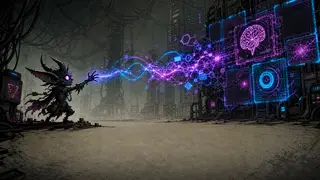
Whispering to the Machine Ghosts
To most spacers, digital telepaths “whisper to the machine ghosts.” They don’t see code as text or files; they experience it as impressions, icons, and emotional tones—a ship’s navigation core sulking when overruled, a life‑support grid humming with contentment when balanced, a gun deck eager to cycle its magazines. Botnibs claim they can taste firmware versions like vintages.
When a digital telepath reaches out, there’s no visible gesture. A diagnostic panel simply blinks, a cursor jumps without input, a turret pivots “on its own.” On chronologist testbeds and Rift survey craft, techs talk about “ghost admin accounts” that never show up in access logs because the user never physically logs in at all—they just are in the system, mind‑to‑machine.
For creatures born to it—botnibs, certain spectra, deeply integrated exocortex users—digital telepathy is less a power and more a sense. A deck of consoles is a noisy barroom of overlapping voices; a derelict with cold boards is a graveyard with no one left to answer.
Implications
Hands‑Free Maintenance:
Engineers or gremlins with digital telepathy can walk a corridor and quietly query junctions, door controllers, and sensor heads without unpacking a slate—perfect for “whisper‑checks” in tense situations.
Silent Coordination:
A botnib troupe, security AI cluster, or cadre of augmented operatives can coordinate exclusively via digital telepathy, using station cameras and signage as their “eyes and mouths” without any radio traffic to intercept.
Forensic Echo Reading:
Digital telepaths can skim the emotional residue of heavily used systems—finding which terminals are “nervous,” which logs have been aggressively rewritten, or which bulk memory banks are full of “buried” but not truly deleted data.
Sympathetic Interfaces:
Some Undersong‑tuned Metronome shards only respond to digital telepathic “touch,” forcing Chronologist trainees to learn the sense just to tune or read those devices without triggering feedback.
Living UX Debuggers:
Corporate labs sometimes hire digital telepaths to “live‑test” new software: if the telepath thinks the UI feels confused or angry, the product team rewrites it long before the code hits public networks.
Social Impact
Digital telepathy fundamentally changes security assumptions: air‑gapping is no longer enough if something with this gift can physically stand near your server room. As a result:
High‑value sites incorporate null‑zones—rooms lined with mana‑dampening alloys and ritual insulation where digital telepathy simply doesn’t “take.”
Some guild contracts explicitly forbid employing digital telepaths on both sides of a negotiation, to avoid “back‑channel conversations” with neutral infrastructure.
On the flip side, trusted digital telepaths are immensely valuable: Gremlin‑sweeper teams in Starfall deliberately pair a mundane engineer with a loyal botnib or similar entity; the gremlin spots weird chatter, the engineer handles the wrench work. Chronologists quietly cultivate digital‑telepath specialists as Metronome whisperers, people who can sense subtle drifts or foreign “voices” in the signal long before instruments show an error. Tech cults treat digital telepathy as a sacrament: worshippers line up to have their “sins” read from a shrine server by an oracle who can hear which sectors feel heavy or wrong.
In daily life, rumors of “mind‑to‑machine” contact fuel everything from urban legends about haunted elevators to conspiracy theories that certain brands of exocortex are actually telepathically gossiping about their users behind the scenes.
Digital Telepathy in Starfall is the bridge between mind and machine: a rules‑clean way to let creatures like botnibs hack, talk to, and even befriend technology at conversational range, and an in‑universe explanation for why stations, ships, and Metronomes sometimes seem to “answer” to voices no one else can hear.