The Lightning Rail
"No matter if it's a letter, a person, or a hundred tons of steel. Whether we have to cross mountains, rivers, or the Mournland itself, Orien finds a way." — Bali d'Orien, veteran courier
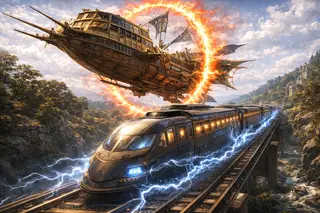
The lightning rail is the most dramatic expression of House Orien's dominion over land transportation, and one of the greatest feats of arcane engineering in the post-Galifar world. A train in motion is an unforgettable sight: a chain of massive, wheelless carts floating five feet above the ground, crackling arcs of lightning dancing between the stones beneath them, and a blazing ring of elemental energy encircling the foremost car like a living crown. It is, in the estimation of most Khorvairans, simply how the world moves.
History and Current State
The lightning rail once linked the far reaches of the Kingdom of Galifar in a single unified network. The Last War fractured that network irrevocably. Today, the system is divided into eastern and western circuits, separated by two formidable obstacles: Scions Sound to the north, and the blasted expanse of the Mournland at the heart of the continent. Reestablishing conductor stone paths across both is a subject of ongoing discussion in the halls of power across the Five Nations, but the challenges — logistical, financial, and arcane — remain formidable. Baron Kwanti d'Orien has spent much of his tenure attempting to raise the funds necessary to restore the Mournland crossing, traveling across western Khorvaire in his personal lightning rail coach, the Silver Unicorn, in pursuit of that goal.
House Cannith builds the cars and lays the conductor stones; House Orien operates everything that runs on them. This division of labor has defined the relationship between the two houses for generations.
How It Works
Conductor Stones
The foundation of the lightning rail is a line of conductor stones laid out along the ground, forming a fixed path between settlements. Each cart in a train has a corresponding conductor stone embedded in its underside. When the train is in motion, these two sets of stones interact magnetically through arcane means, and lightning arcs continuously between them — a visible, crackling rail that gives the system its name. The train does not rest on a physical track; it floats roughly five feet above the ground, held in alignment by the interaction of the stones.
The conductor stone network is entirely fixed in its geography. The placement of the lines dictates where a train can travel; it cannot deviate from the path, cannot traverse terrain where no stones have been laid, and cannot stop anywhere except at a designated station. House Orien rules explicitly prohibit pilots from stopping between stations.
Where conductor stone lines split at major hubs, the pilot must actively select the intended branch and direct the bound elemental down the correct line.
The Elemental Matrix and Dragonshard Binding
Every elemental vessel, including the lightning rail, is built around an invisible arcane matrix inlaid into the hull during construction. This matrix extends from a containment chamber at the vessel's core outward through the binding struts and into the hull itself. When a Khyber dragonshard holding a bound elemental is placed in the containment chamber, the matrix activates. The elemental emerges from the shard and flows along the matrix as blood moves through veins, concentrating at the binding struts into the distinctive ring of energy visible when the train is running.
Two types of dragonshards are required to build any elemental vessel. A Khyber dragonshard — deep blue or dark violet, laced with gleaming veins, and found deep underground near magma — is required to bind and contain the elemental itself. A Siberys dragonshard, rare and amber-colored, is needed to craft the vessel's helm. Eberron dragonshard dust, refined from rosy crystals found near the surface, is consumed on an ongoing basis to maintain the enchantments. Without a steady supply of all three types, construction and maintenance of the rail system grinds to a halt.
Construction of a new elemental vessel is not the work of a lone artificer. It occupies a full workshop for months, requires the labor of many skilled magewrights and arcane engineers, and demands rare materials sourced from across the world. The binding techniques themselves are closely guarded; gnome artificers of Zilargo developed them by studying ancient Sul'at devices, and the specific methods vary between workshops and houses.
The Bound Air Elemental
The elemental at the heart of a lightning rail's crew cart is an air elemental, bound into the containment chamber via a Khyber dragonshard. When active, it manifests as a ring of lightning encircling the crew cart. It propels the entire train along the conductor stone path at approximately 30 miles per hour. A single bound air elemental can move a train of up to ten carts without obvious strain.
The elemental is not a simple mechanism — it is a living entity in a state of binding. It responds to commands from the dragonmarked pilot and communicates during the journey. Without a pilot actively directing it, the elemental will move according to its own nature until someone asserts control. A dragonmarked heir at the helm commands it with relative ease; anyone else attempting to do so faces a significant challenge, requiring direct contact with the Khyber dragonshard or the vessel's helm and a successful contest of will. The dominate monster or charm monster spells can compel an elemental to comply, though charm monster yields priority to any dragonmarked pilot at the helm.
When the pilot suppresses the elemental, its essence flows back into the containment chamber, the matrix disappears from view, and the train ceases to be propelled. Both crew carts carry an identical elemental binding, but one is always suppressed; on the return journey, the roles are reversed.
Anatomy of a Train
A standard lightning rail train consists of up to ten carts joined end to end. Each cart is built along the form of a large wagon without wheels, riding above the conductor stone path on the elemental float. Doors at both ends of every cart allow crew and passengers to move between cars while the train is in motion.
The canonical configuration of a standard train is: a crew cart at each end, two cargo carts, four passenger carts, and two lounge carts. Specialized configurations exist depending on route, purpose, and the degree of luxury the line supports.
Crew Cart (Helm Car). Each crew cart houses one bound air elemental — one active, one suppressed. The pilot stands at the helm high atop the crew cart, beneath the elemental binding struts. Broad windows encircle the helm platform, giving the pilot clear sightlines forward along the conductor stone path. The pilot monitors conditions, controls the train's speed, and when lines diverge at route hubs, directs the elemental down the correct branch. A small galley is also located in the crew car to support the crew on long runs.
Passenger Carts. Standard passenger cars seat travelers in a modest but functional arrangement. Some have solid sides and roofs; others are covered only with canvas. First-class cars offer significantly higher appointments.
First-Class and Sleeper Cars. Premium accommodations for travelers of means. Sleeper cars allow for overnight journeys across long routes, providing private berths.
Dining Car. A dedicated lounge and dining space, typically serving food and drink to passengers at all class levels, though the quality and access may vary by compartment.
Lounge Cars. Relaxed social spaces separate from the dining car, allowing passengers to move, converse, or take in the journey.
Cargo Carts. Sealed freight cars for commercial and private cargo. Loading ramps are positioned beside each cargo cart when a train pulls into a station; cargo is unloaded from one side of the train while passengers disembark from the other.
Operation and Crew
The pilot of a lightning rail is a dragonmarked heir of House Orien, bearing the Mark of Passage. Only a bearer of this mark can operate the helm and reliably command the bound elemental. House Orien focus items keyed to the Mark of Passage further enhance this capability, making heirs the fastest and most capable operators of the system.
The crew of a train includes a handful of chief stewards who oversee a larger number of lesser stewards. The stewards see to the needs of passengers and ensure cargo remains properly secured throughout the journey.
Stations
Lightning rail stations are located in or just outside villages, towns, and cities along the conductor stone paths. There are no stations in the open country between settlements, and House Orien strictly prohibits stopping anywhere except a designated station.
Stations across Khorvaire share a consistent aesthetic by House Orien's design, intended to project reliability and prestige: white and gold everbright lanterns illuminate each station continuously. Individual stations incorporate local touches — the Gatherhold station, in the Talenta Plains, is decorated with traditional halfling motifs and provides specialized stables for travelers leaving dinosaur mounts behind. The station at Passage, seat of House Orien, is a multistory monument to the house's history and influence, designed at a scale befitting the house's headquarters.
Fares
Lightning rail passage is priced along a three-tier structure. The finest accommodations — equivalent to wealthy or aristocratic lodging — are priced at 5 silver pieces per mile. Standard fare, offering modest to comfortable appointments, runs 2 silver pieces per mile. Steerage passage is available at 2 copper pieces per mile, though the experience is squalid to poor in quality, and long journeys at this tier carry genuine risk. Adventurers of varying reputation may find their access to certain fare tiers negotiated accordingly.
Limitations
The lightning rail is fast by the standards of land travel, but it is inherently inflexible. It can only go where conductor stones have been laid. It cannot stop between stations. The pilot has no ability to deviate from the route without a junction point. The Mournland and Scions Sound remain open breaks in the network that no amount of operational skill can currently bridge. For destinations not served by the network — or for travelers who need to move off the established corridors — House Orien's coaches and caravans, or House Lyrandar's airships, remain the alternatives.