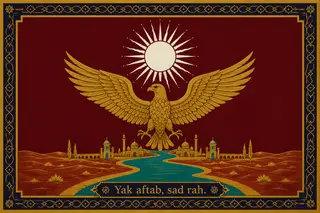
Background
The Asharan Sultanate occupies more territory than any other state in Mediath.
Its lands stretch from the Throatlands in the west to the Karsenic Mountains and the jungles bordering Lusavhara in the southeast. More than 7,000 kilometres of coastline follow the continent’s northern edge before turning south along the Erynic Ocean.
The state claims 10,105,266 square kilometres.
Most of this territory consists of the Asharan Steppe. The name conceals considerable geographic variation. The interior contains open grasslands, gravel desert, scrub, salt basins, broken badlands, dry river valleys, and immense reaches where settlements are separated by days of travel.
The southeastern coast is radically different. Warm Erynic currents and heavy rainfall support a long belt of tropical forest extending from Shahvazir toward Lusavhara. The capital stands near the northern end of this fertile coastal zone.
The Sultanate originated from one of the succession wars that followed the collapse of the Arvessan Empire. An imperial governor, several Asharan aristocratic houses, and the largest pastoral confederations formed a coalition around Shahvazir. Their eventual victory created a state that combined imperial bureaucracy, Asharan court culture, tribal autonomy, and dynastic rule.
The Sultanate remains powerful, but its size is deceptive. The government exercises direct authority around Shahvazir, the eastern coast, major ports, settled river valleys, and selected caravan routes. Much of the steppe is governed indirectly through tribal agreements, tax compacts, hereditary governors, and negotiated allegiance.
Summary
The Asharan Sultanate is a wealthy but uneven continental power.
Shahvazir is one of the richest and most extravagant cities in Mediath. Its palaces contain tiled halls, fountains, gardens, libraries, wine cellars, kitchens, aviaries, baths, theatres, and private canals. Court feasts can serve several thousand guests and retainers. The royal household employs more servants than some lesser cities contain inhabitants.
Beyond the capital, Ashara becomes progressively more austere. Towns are built around wells, caravan roads, forts, grazing grounds, and market squares. Much of the population lives in mobile or semi-mobile pastoral communities.
Large Azraqi populations inhabit the central steppe. Their lands predate the Sultanate and are not administered as ordinary provinces. Azraqi communities pay negotiated tribute in dairy products, livestock goods, hides, wool, guides, and specialist labour. In return, the Sultanate recognizes their grazing corridors, water rights, internal law, and exemption from ordinary human military service.
The Sultanate’s prosperity rests upon coastal trade, pastoral production, agriculture, mining, customs, and its enormous market for foreign luxuries. Its principal strategic problem is moving people, taxes, goods, and soldiers across a territory larger than many continents.