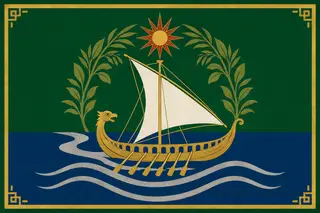
Background
The Republic of Lusavhara occupies the mouth of the Karsen River on Mediath’s eastern coast, approximately 800 kilometres north of the equator.
For most of its history, Lusavhara was not a territorial state in the ordinary sense. It was a sovereign port, a commercial republic, and the eastern gate of the Bright Road. Its wealth came from controlling the point where Erynic maritime trade became river and caravan traffic.
Prevailing winds and ocean currents once made Lusavhara the most practical human port for commerce with Eryndor. Erynari ships, Lusavharan carriers, and foreign merchants converged at the Karsen estuary. Their cargo then travelled west along the Bright Road, a route extending approximately 5,400 kilometres across Mediath toward Ilyriaz and Valessar.
The republic remained politically independent during the Arvessan imperial period. The Empire accepted Lusavharan neutrality because the city’s commercial institutions served imperial merchants more efficiently than direct annexation would have. Lusavhara survived the Empire’s collapse without revolution, conquest, or dynastic change.
Steam navigation undermined the commercial system that had sustained the city. Ships no longer needed to follow the old wind and current patterns. Human ports could trade directly with Eryndor. Cargo that once passed through Lusavhara, Kharavin, and Ilyriaz increasingly travelled by sea.
The last full Bright Road caravan departed Lusavhara 15 Veyrathian years (about 10.3 Cycles) ago, in 1272 AB.
Summary
Modern Lusavhara is a diminished but functioning free city.
Approximately 25,000 people live within the city. Another 500 inhabit Khadar, the only permanent settlement recognized beyond the lower Karsen. Several thousand prospectors, railway workers, river crews, refugees, fugitives, hunters, and temporary labourers pass through the republic during a typical local year.
The republic claims an immense hinterland of rainforest, river basin, savannah, and mountain foothills. Effective government rarely extends more than a short distance from the city, the lower river, or the unfinished railway.
Lusavhara survives through shipping, fishing, river commerce, ship repair, customs, prospecting services, tropical products, and limited trade with the Asharan Sultanate. Gold is believed to exist throughout the interior in enormous quantities. Most deposits remain inaccessible, unverified, or commercially useless because of terrain, disease, rainfall, transport costs, and administrative corruption.
Lusavhara has become an escape town for people who have exhausted their prospects elsewhere. Political exiles, failed merchants, deserters, debtors, adventurers, dissidents, prospectors, disgraced officers, and fugitives arrive expecting anonymity or fortune.
Most find neither.