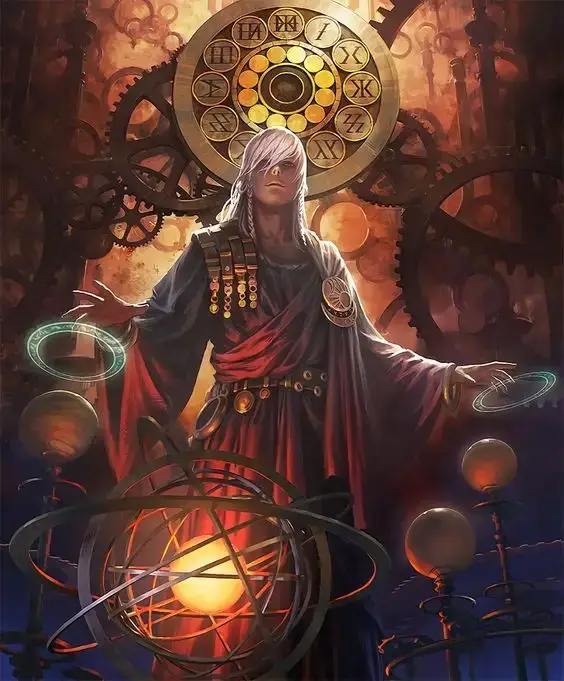
Names: At-Taqwim - Irashanic / T'aza - Qorathi / Aqtum - Ṣērûan / Zhángshí - Zhūyán
Alignment: True Neutral
Province(s): God of Time, Fate and Seasons
Common Symbol: A clock

At-Taqwim, known as T’aza to the Qorathi, Aqtum to the Ṣērû, and Zhángshí to the Zhuyang, is the god of Time, Fate, and Seasons. He is the silent measure of all things, the pulse that counts the rise and fall of empires, the turning of rivers, and the inevitable march of life to death. Where Malik-al-Maut ends the breath of men, At-Taqwim marks when it begins and how it flows.
He manifests as an ageless figure cloaked in shifting hues: gold for summer, white for winter, green for spring, and bronze for autumn. His eyes are twin hourglasses, their sands falling endlessly, yet never emptying. Among mortals, he may appear as a hooded watchman, silently moving through a crowded market, noting the rhythms of birth, harvest, and decay. His holy symbol, a spiralling sun-and-moon wheel, is worn by astronomers, oracles, and farmers who pray for the alignment of seasons and fortunes.
His hall is the Clockwork Spire. A spiralling tower built from interlocking stone rings that rotate slowly around a central axis. Each level represents a season, a phase of life, or a turning of the celestial spheres.
In myth, At-Taqwim set the first cycles of life when the gods shaped the world. He measured the moons, divided the year, and charted the fates of mortals before the first kings took their thrones. His influence is subtle, often felt in harvests, tides, and the quiet turning of the hours, reminding mortals that no life, empire, or season may escape the reckoning of Time.