Names: Tiānjì Zhǔ, El-Sammā, Shamem-El, Šarru Šipri Šamê
Alignment: Lawful Neutral
Province(s): Lord of the Upper Sky
Common Symbol: An abacus
Followers: Humans, Zhuyang

Al-Sama, known among the Zhuyang as Tiānjì Zhǔ (“Lord of the Heavenly Calculation”), to the Ṣērû as Šarru Šipri Šamê (“King of the Celestial Design”), and to the eastern city-states as El-Sammā or Shamem-El, is the Lawful Neutral Lord of the Upper Sky and foremost deity of the Sumartist pantheon. He is the god of mathematics, cosmic order, and perfect structure — the divine mind through which the universe is measured and understood. To his followers, existence itself is an equation written across the heavens, and Al-Sama is the intellect that first solved it.
He stands above the other gods not through conquest, but through comprehension. The stars are the symbols of his language: precise, repeating, eternal. Their movements are not merely beautiful but meaningful, tracing the immutable laws that govern the cosmos. Where other gods rule through force, emotion, or mystery, Al-Sama rules through calculation. To him, chaos is merely an unsolved problem.
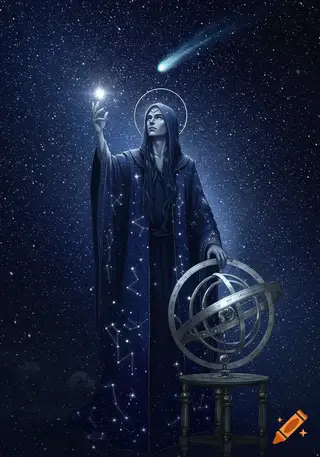
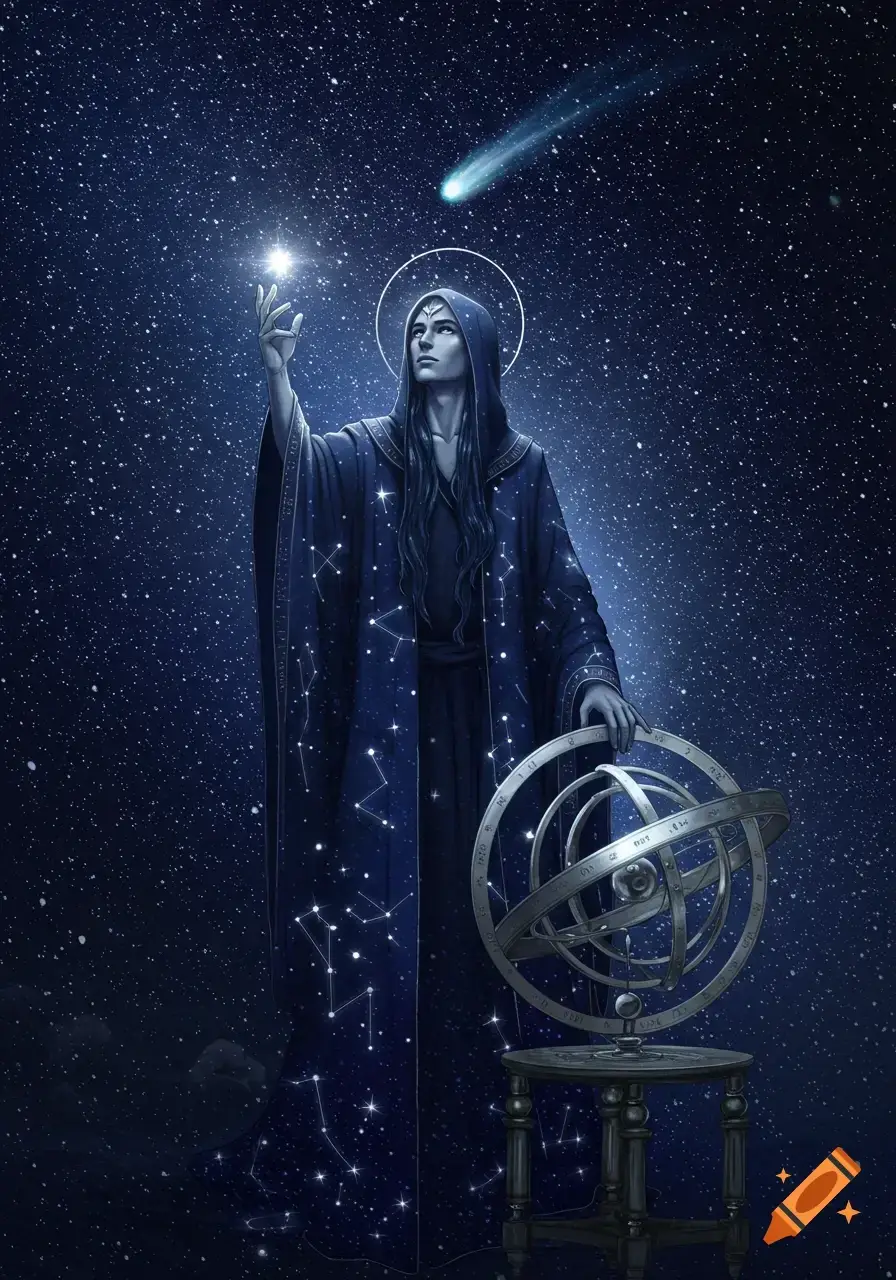
He manifests in visions as a tall, serene figure crowned with a circlet of moving stars. His robes resemble the night sky itself, patterned with constellations arranged in perfect geometric forms. In one hand, he carries a rod of silver light used to trace lines through the firmament; in the other, he holds a ring etched with countless sigils, representing the unbroken cycles of mathematics and law. His eyes are said to shine like twin stars, cold yet infinitely patient, as if measuring the world with every glance.
His divine hall is known as The Astral Calculus, a vast palace that exists beyond the highest sky. The structure appears less like a palace and more like a monumental geometric engine of creation. There, he studies the Great Pattern, the mathematical structure underlying all creation.
To Al-Sama, the universe is not governed by whim but by formula. Every star, every mountain, every living being exists within a network of relationships, ratios of power, balance, and consequence. Even divine conflict follows predictable patterns to one who can see the whole equation.
When the Zhuyang dragons twisted Naplica, most gods reacted with rage or despair. Al-Sama instead studied the war as a mathematician studies a theorem. He measured the forces of dragon and god, the rate of destruction, and the diminishing probability of divine victory.
The conclusion was unavoidable. The equation lacked a variable.
From this realisation came what Sumartist scholars call The Grand Calculation. Observing the creatures of the world, Al-Sama identified in mankind a unique constant: High Ambition, the capacity to build systems, form laws, multiply, adapt, and organise themselves into increasingly complex structures. With Simrāh, Lady of Clay, he shaped humanity not out of compassion but deliberate design. They were introduced into the equation of the world as a multiplying factor, a species capable of reshaping the balance of power through civilisation itself.
Where dragons ruled by dominance and gods by divinity, humans would rule by systems: cities, laws, armies, and knowledge.
Thus, mankind was placed beneath the ordered heavens, where they could observe the stars and unknowingly follow the logic of their creator.
For this reason, Al-Sama’s followers are often mathematicians, astronomers, architects, scribes, and rulers. They believe that studying numbers is a form of prayer and that uncovering patterns in nature brings one closer to the divine mind. Temples to Al-Sama are often constructed with strict geometric precision, circular observatories, stepped pyramids aligned to solstices, or perfectly symmetrical city sanctuaries whose measurements mirror celestial distances.
Among Sumartist philosophers, there is a common teaching:
The world was not merely created.
It was solved.
And Al-Sama was the first to know the answer.