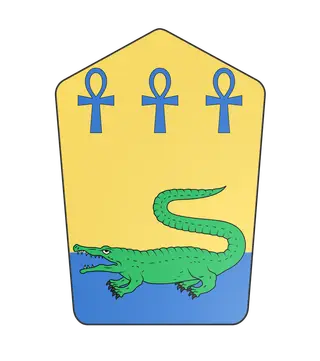
Sheltered by natural barriers and hidden beyond the reach of Māt Ṣēri, the land of Bakem is a realm of winding waterways, fertile marshes, and life drawn from the slow flow of its great river.
Unlike the plains beyond its borders, Bakem thrives in abundance. Reeds, floodplains, and black soil define the land, and its people have long mastered the rhythms of water and growth. Protected by surrounding hills, Bakem has developed in relative isolation, forming a civilisation both ancient in character and deeply tied to its environment.
Though unified under divine kingship, Bakem is not without internal distinction. Its people are shaped by where the river flows, and how it is lived beside.
Its people are known collectively as the Khemeti, the People of the Black Land, named for the rich soil that sustains their civilisation. Though united under a single culture and divine kingship, the Khemeti are shaped by the different regions of the river, giving rise to distinct identities within their shared heritage.
The Khemeti:
The core of Bakemi civilisation, these Khemeti dwell along the main riverbanks and fertile floodplains. They are farmers, scribes, and officials—the keepers of order and tradition. Their settlements form the spine of the kingdom, and it is from among them that most administrators, priests, and nobles arise.
The Khemeti-Sekhet:
Dwelling within the reed-choked wetlands and delta regions in the south, these Khemeti are masters of the waterways. Fisherfolk, hunters, and boatmen navigate the labyrinth of channels with ease. Their customs are older and often more superstitious, with strong ties to spirits of water, reeds, and hidden places.
The Khemeti-Kharu:
Living along the hilly edges that protect Bakem from Māt Ṣēri, these Khemeti are more hardened and martial. They guard the passes, maintain watch-fortresses, and serve as the first line of defence against incursions. Their culture is more austere, placing emphasis on duty, endurance, and vigilance.
The Khemeti-Deshret:
Found in the drier southern regions where the fertile land begins to give way to harsher terrain, these Khemeti bridge the gap between river and wasteland. Traders, caravan guides, and intermediaries are the most outward-facing of the people, often dealing with foreigners and distant lands.
Physicality: Generally, the Khemeti have average height with lean, wiry builds adapted to heat and humidity. Skin tones range from deep bronze to dark brown. Hair is typically black, often braided or bound. Eyes are most commonly dark brown, with kohl commonly worn for both cultural and practical reasons.
Culture and Society:
Bakem is a civilisation defined by water, order, and divine rule:
River Dependency: Life revolves entirely around the flood cycles and irrigation.
Divine Kingship: The ruler is seen as both monarch and intermediary with the divine.
Agrarian Foundation: Farming and water management are the backbone of society.
Ritual and Afterlife: Strong beliefs in death, legacy, and continuity beyond life.
Isolation and Stability: Protected geography has preserved ancient traditions.
Bakemi Naming Conventions:
Male Names: Akhmen, Setari, Ramose, Khepri, Menkara, Djoser, Tarek, Nebamon, Hori, Senus
Female Names: Nefira, Aseta, Merit, Khamet, Tia, Neferu, Seshat, Amara, Henut, Zareta
House / Lineage Names: Often tied to temples, regions, or divine association. Examples include: of the Bakem, Keeper of Reeds, House of the Western Gate, and Servant of the Sun Throne.
The people of Bakem endure as one of the most stable civilisations in Therba. While empires rise and fall beyond their mountains, they remain.