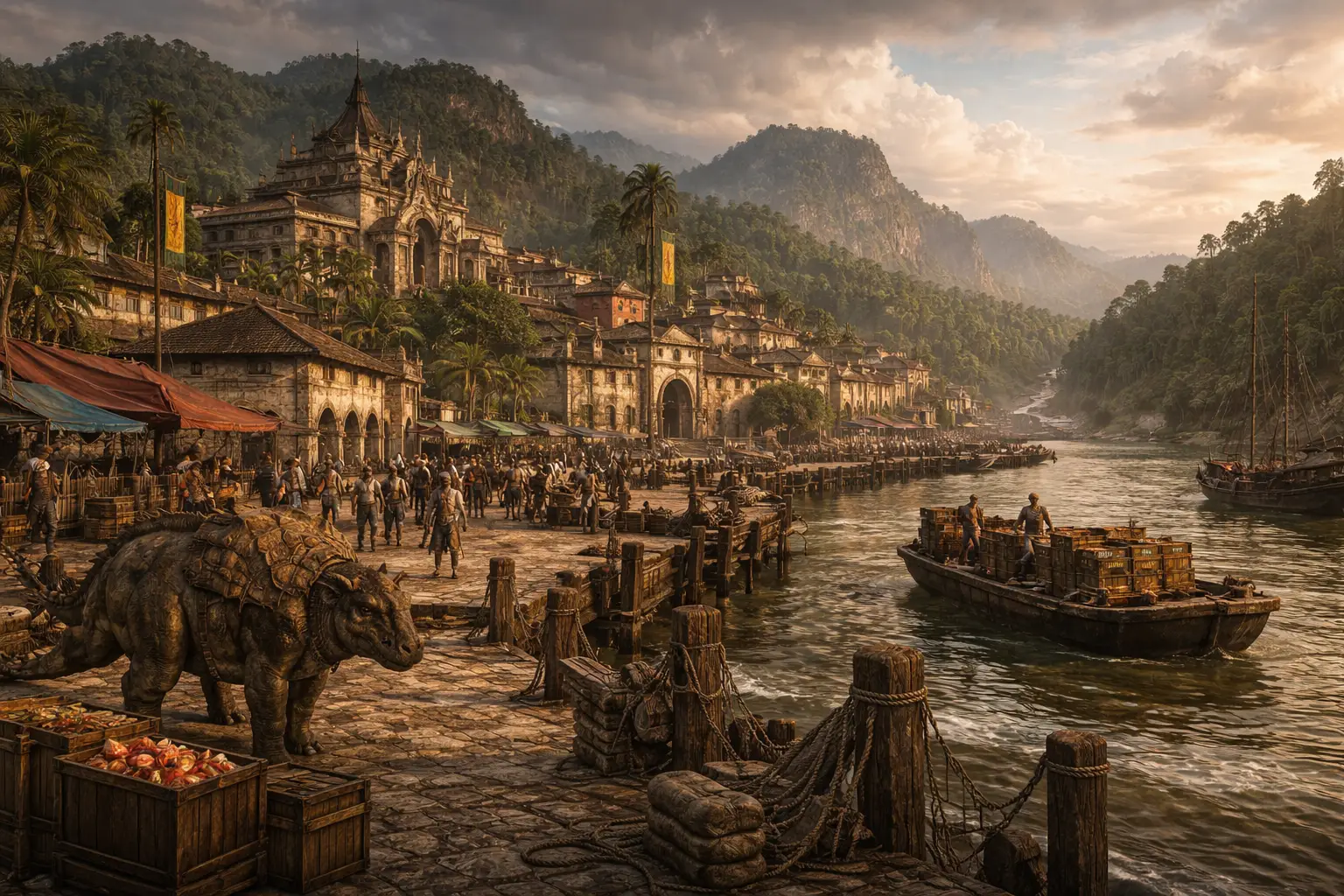
Politics of Q'barra
From a briefing prepared by Alzia ir'Kesslan, First Minister of New Galifar, for King Sebastes, Eyre 998 YK:
Brother — I will be direct. We govern by the grace of three things: the treaty with the Cold Sun, the dragonshards that pay our soldiers, and the willingness of the people outside the Adder watershed to pretend that we are their king. The treaty is being violated daily by prospectors who do not answer to us. The dragonshards are being sold by a House that does not answer to us. And the people of Hope have never pretended anything of the sort.
Our Riedran allies offer more troops. The Tharashk factor offers more money. Neither offer comes without a price I can see and a price I cannot.
I recommend we discuss this in person. I do not trust the walls.
The Governing Structure
Q'barra is a feudal monarchy in theory and a factional pressure cooker in practice. The official name — the Kingdom of New Galifar — appears on treaties, letters of marque, and the palace doors in Newthrone, and is quietly ignored by everyone living more than two days' travel from the capital. King Sebastes ir'Kesslan rules from Newthrone with a ducal council, a small garrison, and the increasingly desperate conviction that the institutions of old Galifar can be transplanted into a jungle where the most common form of governance is whoever holds the most loaded crossbows.
What makes Q'barra unlike any other nation in Khorvaire is that it is not one political system but three, stacked on the same map and pulling in different directions. In Newthrone and the Adder settlements, the crown governs through a feudal court whose noble ranks descend from the founding expedition — a system that functions, barely, because the people within it chose to come here. Beyond the Adder watershed, Hope operates as a loose constellation of self-governing frontier towns that answers to no authority at all. And beyond both human territories, the indigenous reptilian civilizations maintain political structures older than human civilization — structures the settlers barely perceive and have never been invited to understand.
The result is a nation suspended between two incompatible identities: one as a principled colony built to preserve the noble model of old Galifar, the other as a boomtown frontier bound increasingly to foreign coin, dragonmarked industry, and alliances of convenience that the founding families never anticipated and are not certain they can survive.
The Crown and the Ducal Council
King Sebastes ir'Kesslan is the grandson of Duke Ven ir'Kesslan of Cyre, who crowned himself the first king of New Galifar upon arrival in 928 YK. The Kesslans are not Wynarn blood — Ven was a duke who made himself a king in a jungle with no competition for the title, and the dynasty holds because no one with a better claim has shown up to contest it. Sebastes is generally considered a just ruler — a man who cares about his subjects, who secured recognition for Q'barra at the Treaty of Thronehold, who forged the Newthrone Accords with the Cold Sun Federation, and who has spent the better part of a decade trying to hold a kingdom together that seems determined to pull itself apart at the seams.
His grip on power is weakening. The ducal council that advises the crown — five titled lords whose duchies encompass the settled territory of New Galifar — was designed as an advisory body, modeled on the old Galifaran court. In the seventy years since the founding, it has evolved into something considerably more muscular. The dukes control the land, the local militias, the shard revenue from their territories, and the loyalty of the settlers who live under their protection. The king controls Newthrone, the harbor, and the authority to negotiate with foreign powers — but his authority beyond the capital depends entirely on the dukes' willingness to enforce it, and that willingness has become the central question of Q'barran politics.
Unlike Breland's parliament or the Mror Holds' Iron Council, the ducal council has no formal mechanism to remove the king. What it has instead is the weight of collective leverage — the ability to refuse cooperation, withhold militia support, redirect shard revenue, and construct what Q'barran legal scholars call bills of influence: formal resolutions that do not technically compel the crown but that carry enough combined economic and military pressure to make royal defiance suicidal. A king who governs against the unanimous will of his dukes is a king who cannot pay his soldiers, supply his garrison, or maintain his port. No bill of abdication has been introduced. Several drafts are rumored to exist.
OVERHEARD IN NEWTHRONE — attributed to a visiting Brelish merchant, 997 YK
"I asked who I should speak to about a trade license. They said the King. I asked who handles customs disputes. They said the King. I asked who runs the harbor authority. They said the King's sister. I asked if there was anyone else. They looked confused."
The Factional Divide
The ducal council — and the broader political landscape of New Galifar — is fractured along two dominant lines that go deeper than simple policy disagreement. These are competing visions of what Q'barra is and what it should become, and they touch everything from trade policy to faith to the fundamental question of whether the colony's survival depends on opening itself to the wider world or protecting itself from it.
The Old Settlers represent the founding families — descendants of Ven ir'Kesslan's original expedition, the Cyran idealists who crossed the Endworld Mountains to preserve the principles of Galifar in a new land. Their power base lies in the older Adder River holdings, the agricultural estates, and the fishing communities along the southern coast. They worship the Sovereign Host — Arawai and Balinor especially — and they view New Galifar not as a frontier outpost in need of modernizing but as the last true bastion of old Galifar's ideals. To them, the colony's purpose was always preservation, not expansion, and the arrival of Riedran soldiers, Tharashk miners, and foreign influence of every kind is a betrayal of the founding vision.
Three dukes anchor this faction:
Duke Torlan ir'Kesslan, a first cousin of the king, third in line to rule, and lord of the upper Adder holdings, commands broad respect among the original settler families and the colonial militias. Torlan is the most dangerous opponent on the council — not because he is radical but because he is patient, principled, and deeply convinced that the Riedran alliance will cost the colony its soul. He has never called for Sebastes's abdication, but he has authored more bills of influence than any other duke, and his name appears on every draft resolution that has circulated in private. His wife maintains a Sovereign Host shrine that draws worshippers from across the Adder settlements.
Duke Jorik ir'Tanneth, a merchant lord with shadowed ties to Lhazaar shipping networks, controls much of the independent trade infrastructure — the warehouses, the river barges, the coastal storage facilities that operate outside Tharashk's supply chain. Jorik is not an idealist; he is a pragmatist who has calculated that Tharashk's dominance of the dragonshard market threatens the economic independence of every settler family in Q'barra, and he would rather deal with Lhazaar smugglers than watch the House swallow the colony's economy whole. His connections to the Lhazaar Principalities are widely suspected and never officially acknowledged.
Duchess Maren ir'Sarrin, a half-elf and one of the oldest living original settlers, represents the rural communities and deepwater fishing villages of Q'barra's southern coast. Maren is a hardline isolationist who has actively obstructed Riedran surveys, Tharashk expansion into her territory, and any attempt by the crown to extend its administrative apparatus beyond Newthrone. She trusts no one who arrived after the founding fleet, and she has said so to their faces. Her people love her for it.
The Pragmatists draw their strength from the newer arrivals — merchants from the Five Nations, dragonmarked house agents, Cyran refugees who have invested in the colony's growth, and veterans of the Last War who have come to believe that Q'barra's isolation is a liability that will get everyone killed. They worship the Sovereign Host and the Silver Flame in roughly equal measure, favor stronger ties to the dragonmarked houses and to Riedra, and argue that the colony's survival depends on modernization, expanded trade, and the military resources that only foreign alliances can provide.
Two dukes anchor this faction:
Duke Cassan ir'Valen, a former Cyran military officer who received his title through a land grant after the Mourning, is the most vocal advocate for the Riedran alliance and for expanded Tharashk operations. Cassan is competent, ambitious, and convinced that the old settlers' resistance to foreign investment is going to get the colony overrun — by the scales, by the Valenar, or by the jungle itself. He is close friends with Vesmir Dain, the Newthrone watch captain, who served under him during the Last War. He has cultivated close relationships with both Ambassador Jhakanath and Lord Khalar Velderan d'Tharashk, and is the crown's primary liaison to the Riedran garrison. His loyalty to Sebastes is genuine — he simply believes the king is not being pragmatic enough.
Duke Aldren Thul, the youngest member of the council and a gifted administrator who arrived in Q'barra as a Kundarak-backed investor, controls a duchy carved from recently cleared territory north of Newthrone. Aldren is an idealist with mainland sensibilities — fluent in Galifaran legal theory, passionate about civic institutions, and often naïve to the realities of frontier politics. He has voted with the old settlers on cultural issues when suitably motivated, which makes him the swing vote on the council and the target of intensive lobbying from both factions. His recent betrothal to the daughter of a Lhazaar merchant prince with ties to the Aurum has complicated his position further.
King Sebastes himself occupies an uneasy middle ground. His personal sympathies lie with the founding vision — he is a Kesslan, and the colony is his family's legacy — but his practical needs have pushed him steadily toward the pragmatists. He accepted the Riedran alliance because he needed troops. He tolerates Tharashk's expansion because he needs revenue. He knows that every concession erodes the colony's independence, and he knows that refusing to make concessions may erode the colony's existence. His sister Alzia, as First Minister, walks the same knife's edge — tasked with identifying threats to the kingdom from every direction, including the directions the crown's own allies are coming from.
PRIVATE NOTE — found in the margins of a ducal council session transcript, authorship uncertain, undated
Torlan wants to preserve. Cassan wants to expand. Jorik wants to profit. Maren wants to be left alone. Aldren wants to matter. The King wants to survive. And Alzia? Alzia wants to know which of them is lying.
The Riedran Presence
The most politically volatile element of the Newthrone court is the Riedran garrison and advisory presence. King Sebastes is the only ruler in Khorvaire to have formally entered into a treaty with the Inspired lords of Riedra, and the arrangement has become a defining fault line in Q'barran politics.
The Inspired ambassador Jhakanath has provided the crown with a garrison of Harmonious Shield troops — disciplined, well-equipped soldiers who help defend the settlements and maintain order in the capital. A Riedran quarter has grown up in Newthrone, a closed ward where only Riedrans and Inspired are permitted to enter. Jhakanath is purchasing large quantities of Eberron dragonshards from House Tharashk and has secured permission from Sebastes to begin Riedran mining operations — a concession that the old settler faction views as the first step toward annexation.
The old settlers see the Riedran presence as an infiltration. The pragmatists see it as a lifeline. The truth — as Alzia ir'Kesslan has spent considerable effort trying to determine — may be both.
House Tharashk
If the crown is the formal authority in Q'barra, House Tharashk is the economic authority — and in a frontier colony where soldiers need paying and fortifications need building, the distinction between the two is dangerously thin.
Lord Khalar Velderan d'Tharashk runs the house's Q'barra operations out of Newthrone. Tharashk is the primary buyer of Eberron dragonshards, operates the largest mining operations, and employs a workforce that includes many independent prospectors who neither know nor care where the Newthrone Accords draw their lines. The house's enclave is the largest dragonmarked presence in Q'barra — bigger than the Ghallanda hostelries, the Jorasco healing stations, or the token outposts maintained by the other houses.
Khalar lobbies the crown relentlessly for expanded mining rights. He has presented the ducal council with evidence — some genuine, some strategically inflated — of increasing scale aggression, arguing that the Newthrone Accords should be renegotiated. Duke Cassan supports him. Duke Torlan opposes him. Duke Jorik undercuts him by running shards through Lhazaar channels that bypass Tharashk's supply chain entirely. The king tries to keep all three happy and satisfies none of them.
NOTICE — posted at the Tharashk enclave, Newthrone, permanent fixture
House Tharashk purchases Eberron dragonshards at fair market rates. Sellers must present valid claim documentation or a sworn affidavit of independent recovery. The House accepts no liability for shards recovered from territory covered by the Newthrone Accords. Sellers operating in disputed areas are advised to consult a priest before consulting a factor.
Hope: The Ungoverned Frontier
Beyond the ducal territories, Hope exists in a state of organized anarchy that the crown has learned to tolerate because it cannot prevent. There is no governor, no magistrate, no link to the ducal council. Each town governs itself by whatever customs its founders established.
Wyrmwatch, the largest settlement, is led by Elder Nevillom, a Last War veteran and Silver Flame evangelist whose authority rests on personal courage, moral conviction, and the willingness to stand between his town and whatever wants to destroy it. Nevillom is not a politician — he is a preacher who became a leader because someone had to. Other settlements have sheriffs, claim bosses, or nothing at all.
Hope's relationship with New Galifar runs on mutual contempt moderated by economic necessity. The old settlers view Hope as a collection of lawless squatters. The people of Hope view the crown as a government that abandoned Cyre, crowned itself in a swamp, and now expects everyone else to pay taxes for the privilege. Trade flows between them because it must — Hope produces dragonshards, New Galifar has the port — but loyalty does not flow with it.
The "Mourners" — Cyran refugees who refuse to live alongside citizens of the nations that fought against Cyre — operate somewhere between guerrilla movement and criminal gang, and the bandits who prey on Tharashk convoys ask no questions about ideology before taking what they want.
Scratched into the bar of a tavern in Wyrmwatch, author unknown:
The king's law ends at the Adder. Out here we have Elder Nevillom, the Silver Flame, and a loaded crossbow. Two out of three on any given day.
The Newthrone Accords
The single most important political document in Q'barra is the Newthrone Accords — the treaty between the crown and the Cold Sun Federation that defines where the settlers may live and where they may not.
The Accords are also a monument to catastrophic miscommunication. The settlers understood the document as a binding legal treaty. The Cold Sun Federation does not have a concept of legal documents — the lizardfolk have no written language. When their representatives sat down with King Sebastes, they were not signing a contract but stating a fact: these places matter, do not go there. The distinction matters enormously when one party starts violating the agreement, because the settlers think they are breaking a law that can be renegotiated, while the lizardfolk think the settlers are ignoring reality and must be corrected.
The Accords cover the territory of New Galifar. They do not cover Hope, which was settled after the treaty was signed by people who had no knowledge of it. The result is that the treaty is observed in the territory where it was not needed and ignored in the territory where it was.
The Scales: Governance Beyond the Accords
Beyond the territory claimed by the settlers, the indigenous peoples of Q'barra maintain political structures that predate human settlement by millennia. The settlers know almost nothing about how these societies govern themselves.
The Cold Sun Federation operates as a loose alliance of tribes united by shared spiritual traditions rather than centralized authority. The tribes do not feud, do not compete for resources, and respond to threats with a coordination that suggests communication channels the settlers cannot perceive. There is no Cold Sun king, no council, no parliament — and yet when the Federation acts, it acts as one.
The Trothlorsvek dragonborn maintain a more recognizable structure organized around clans, cities, and martial traditions. High Elder Bhisma of the Flamebrow Clan has emerged as the primary dragonborn interlocutor with the settlers, but Bhisma does not speak for all dragonborn, and individual clan leaders — including the warlord Mishva Garodya Stormhorn, who views the settlers as invaders — may pursue agendas that contradict the High Elder's policies.
The Poison Dusk has no discernible political structure, no leaders the settlers have identified, and no interest in negotiation.
"I have been First Minister of New Galifar for six years. In that time I have negotiated with Lhazaar pirates, Valenar warchiefs, Inspired ambassadors, Tharashk factors, Cyran refugees, Hope bandits, and dragonborn clan elders. The only negotiation I have failed at entirely is explaining to a lizardfolk chief why our prospectors are digging where they should not be. The chief listened. Then he said 'the land remembers.' Then he left. I have thought about that sentence every day since." — Alzia ir'Kesslan, in a private letter