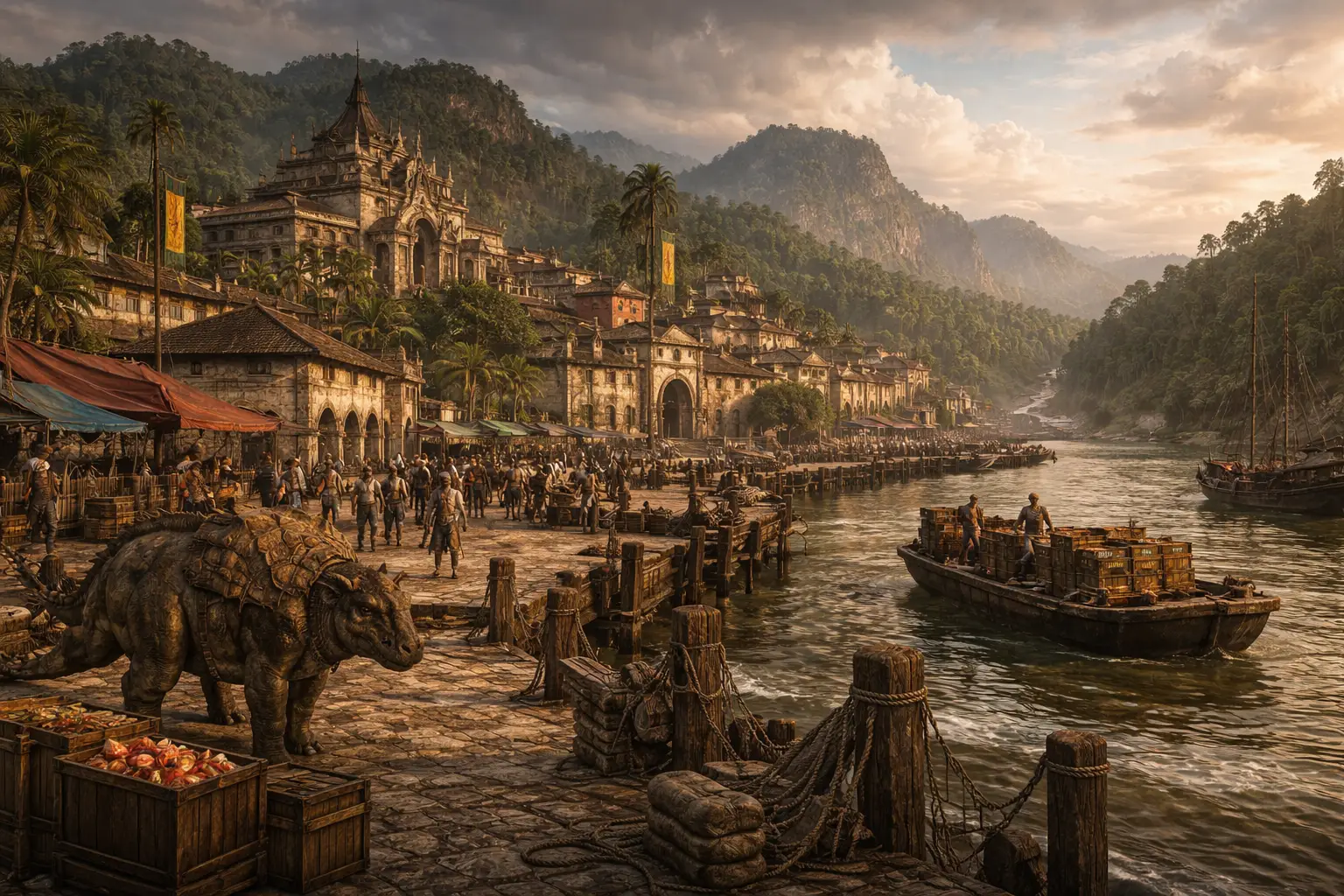
Military & Security of Q'barra
FIELD REPORT — Sentinel Marshal Dara d'Deneith, Newthrone, to Sentinel Tower, Sypheros 997 YK
Commander,
I will be direct. Q'barra does not have a military. It has a town guard that cannot leave the capital, a collection of village militias that answer to their local duke and nobody else, a Riedran garrison that answers to an ambassador the king barely understands, and a frontier region called Hope where the concept of "law enforcement" means whoever brought the biggest crossbow to the dispute.
The nation faces external threats from five directions simultaneously — scales from the interior, Valenar warbands from the southwest, Lhazaar raiders from the north, Poison Dusk ambushes from everywhere, and the jungle itself, which has killed more settlers than all four of those combined. It does not have the forces to address any one of these threats adequately, let alone all of them at once.
I was asked whether Q'barra could defend itself in a full-scale conflict. The answer is no. The better question is how it has survived this long, and the honest answer is: because nobody has yet decided it is worth the trouble of conquering.
The Newthrone Guard
Q'barra is defended — to the extent that it is defended — by the Newthrone town guard, a handful of ducal militias, a foreign garrison that reports to an Inspired ambassador, and the willingness of frontier settlers to pick up whatever is handy and fight with it when something comes out of the jungle.
The Newthrone guard is the closest thing the colony has to a professional military force, and it is exactly as impressive as a frontier port town's budget allows. Approximately sixty trained warriors serve in the guard, wearing studded leather emblazoned with the Kesslan badge — a green serpent coiled around a crown — and armed with clubs, shortswords, and crossbows. They patrol the capital in pairs, stationed at guardhouses near the main road into Newthrone and at a smaller station on the docks, where their primary function is quelling the nightly brawls that erupt among sailors, prospectors, and the assorted flotsam of a boomtown harbor. Beyond the city walls, guard patrols ride Talenta-trained three-horns — sturdy, ill-tempered ceratopsians that have proven more reliable in the jungle than horses — more heavily armed and armored with chain mail, longswords, and heavy crossbows.
The guard is overseen by Watch Captain Vesmir Dain, a Last War veteran from Cyre who migrated to Q'barra after the Mourning, and a close friend of Duke Cassan ir'Valen, whom he served under. Most of the guard are military veterans — competent, disciplined, and entirely out of their depth against the scale and variety of threats Q'barra presents. Locals view the guard with mixed feelings; many of the old settler families see them as outsiders and meddlesome loyalists, particularly since the guard's ranks are filled almost exclusively with post-Mourning arrivals who owe their positions to the pragmatist faction on the ducal council. When trouble strikes, however, the same locals who curse the guard on calm days are the first to shout for them.
In times of crisis, a militia of several hundred residents can be mustered from Newthrone and the surrounding Adder settlements. These militia members are minimally trained civilians expected to hold positions until the guard or the Riedran garrison can respond — a defensive doctrine that works tolerably well against bandit raids and fails catastrophically against anything more organized.
STANDING ORDERS — Newthrone Guard, posted at all guardhouses
Patrol assignments are effective until rescinded. All personnel are reminded: scale encounters within the Adder watershed are to be reported immediately and are NOT to be engaged without reinforcement. Poison Dusk raids are a military matter; notify the Riedran garrison commander. Bar fights on the docks are your problem.
Watch Captain Dain does not wish to hear about the bar fights.
The Ducal Militias
Beyond the capital, military force is organized at the ducal level. Each duke maintains a militia drawn from the settlers in their territory — farmers, fishers, and tradespeople who drill on a seasonal basis and who answer to their local lord in times of crisis. These are not soldiers in any professional sense; they are people who own weapons because they live in a jungle full of things that want to eat them, and who have learned through bitter experience that a community without a militia is a community that does not survive the rainy season.
Militia quality varies sharply by duchy. Duke Torlan ir'Kesslan's upper Adder militia is the most experienced — the old settler families who populate his territory have been fighting scale incursions and jungle predators for decades and can form a competent shield wall on short notice. Duchess Maren ir'Sarrin's southern coastal communities maintain fishing-boat militias that double as a rough naval defense against Lhazaar raiders. Duke Cassan ir'Valen's militia is the newest and most conventionally organized — Cassan is a former Cyran officer and has imposed something approaching actual military discipline on his settlers, though his forces are small and his territory is the most recently cleared.
The militias answer to their dukes, not to the crown. Sebastes can request that a duke contribute forces to a shared defense, but he cannot compel it, and a duke who decides that their militia is better employed guarding their own territory than marching to the capital's aid is making a political calculation that the crown has no mechanism to override. This was manageable when the colony faced only the routine dangers of the frontier. It becomes considerably less manageable in a crisis — and the ducal militias have never been tested against a coordinated Cold Sun assault of the kind that struck in 969 YK.
The Riedran Garrison
The most capable military force in Q'barra does not answer to the King of New Galifar. It answers to Ambassador Jhakanath.
The Harmonious Shield garrison — Riedran troops provided under the terms of Sebastes's treaty with the Inspired lords of Riedra — is stationed in and around Newthrone, with outposts along the Adder River approaches. These are professional soldiers: disciplined, well-equipped, trained to operate in coordinated units, and possessed of a calm competence that the colony's own guard cannot match. They help defend the settlements against scale raids, maintain order in the capital, and project the kind of stability that encourages the dragonmarked houses to keep doing business in Q'barra.
The garrison operates from the Riedran quarter in Newthrone — a closed ward where only Riedrans and Inspired are permitted to enter (with exception for the king and his royal retinue of course). The quarter has its own barracks, supply stores, and command structure entirely independent of the Newthrone guard. The Riedran soldiers patrol the city alongside the guard, respond to scale incursions alongside the ducal militias, and have proven themselves reliable in combat — but they take their orders from Jhakanath, not from Watch Captain Dain, and their deployment priorities do not always align with what the crown would choose.
The old settler faction views the garrison as a foreign occupation. The pragmatists view it as the only thing standing between the colony and catastrophe. Both are partially right, and the tension between these positions defines the military politics of Q'barra as surely as any threat from the jungle.
The External Threats
Q'barra faces military pressure from more directions than it has forces to cover — a problem that no amount of Riedran assistance has resolved and that the colony's geography makes structurally insoluble.
Valenar warbands are the most persistent conventional military threat. The elves of Valenar have continued to raid Q'barra in open defiance of the Treaty of Thronehold, launching cross-border strikes from the southwest in search of worthy combat. High King Shaeras Vadallia has promised to rein in his warriors and denied any connection to the "rogue clans" who attack Q'barran settlements; no one in Newthrone believes him. The Valenar are not interested in territory or resources — they are interested in fighting, and Q'barra's stretched defenses make it an irresistible target. Sebastes has been negotiating with the High King for a more durable peace, so far without result.
Lhazaar raiders prey on Q'barra's coastal shipping with a regularity that has made the sea lanes between Newthrone and the Lhazaar Principalities as much a hazard as a lifeline. King Sebastes seeks agreements with individual Lhazaar princes to curb the piracy, but the Principalities are not a unified state, and an agreement with one prince does nothing to restrain the captain from another who decides that a Q'barran shard convoy looks profitable. The southern coastal communities under Duchess Maren's domain bear the brunt of the raids.
The Poison Dusk is the enemy the settlers understand least and fear most. Poison Dusk raids are ambushes: fast, violent, and targeting isolated camps and caravans in the deep jungle. The raiders strike without warning, kill without mercy, and retreat into terrain the settlers cannot follow them into. The guard and the militias can respond to Poison Dusk attacks; they cannot prevent them.
The Cold Sun Federation is not currently at war with the settlers — the Newthrone Accords hold, technically — but every violated shard claim in the interior pushes the lizardfolk closer to the kind of coordinated assault that nearly destroyed the colony in 969 YK. The Cold Sun do not raid. When they fight, they fight together, and the coordination the settlers observed during that assault — multiple tribes striking simultaneously across a wide front — suggests military capabilities that the colony's defenses are not prepared to face again.
The jungle itself kills more settlers than any foreign enemy. Dinosaurs, venomous wildlife, tropical disease, flooding, and the sheer difficulty of maintaining supply lines through terrain that actively resists human habitation are constant attrition factors that the guard and the militias cannot patrol away. Q'barra's casualty rate from environmental hazards exceeds its combat losses in most years, and the medical infrastructure to deal with jungle ailments is limited to whatever House Jorasco's small Newthrone enclave can provide.
"I've fought Karrns, Thranes, Valenar, and a bugbear who didn't know the war was over. Nothing I fought in the Last War scared me as much as the first time I saw the jungle move and realized it wasn't wind." — retired militia sergeant, lower Adder settlement
Hope: No Law But What You Carry
Beyond the ducal territories, Hope has no guard, no garrison, and no military infrastructure. Security in Hope is whatever the people in each settlement can provide for themselves — which ranges from competent to nonexistent depending on the town, the season, and whether the person with the biggest crossbow is sober.
Wyrmwatch, the largest settlement, maintains the closest thing Hope has to an organized defense: Elder Nevillom's personal authority, a core of Last War veterans who have settled in the town, and a loose militia of prospectors and refugees who drill when Nevillom can persuade them and fight when the alternative is dying. Nevillom is not a military commander — he is a preacher who fights because his faith demands it and whose sermons on the duty to protect one's neighbor have proven more effective at mustering volunteers than any formal chain of command.
Other settlements in Hope have sheriffs, claim bosses who double as warlords, or nothing at all. Tharashk mining operations maintain their own armed guards — professional security forces that protect house assets and house personnel but have no obligation to defend independent settlers. A prospector whose claim is raided by Poison Dusk guerrillas or Mourner bandits can appeal to the nearest Tharashk factor for help and will receive it only if the factor calculates that the cost of assistance is less than the cost of losing a supplier.
The people of Hope defend themselves, or they do not get defended. This is the fundamental security reality of the frontier, and every settler who crosses the Adder watershed understands it — or learns it quickly.
The Mourners
The Mourners are Q'barra's most persistent criminal threat — a loose confederation of Cyran refugees whose grief has curdled into violence and whose operations have grown from petty banditry into something that the crown's overstretched guard cannot ignore and cannot suppress.
The Mourners began as a category more than an organization — a label applied to the refugees who chose Q'barra after the Mourning specifically because they refused to accept charity from the nations they held responsible for Cyre's destruction. These were not criminals by temperament; many were soldiers, tradespeople, or minor nobles who had lost everything and found that their rage was the only thing that survived the journey east. Over the four years since the Mourning, that rage has organized. What was once scattered acts of vengeance against settlers from nations that fought Cyre — robberies, arsons, beatings — has consolidated into a gang with recognized leadership, established safe houses, and the operational discipline of people who spent a century fighting the Last War before the mists took their country.
The Mourners target new arrivals and Tharashk operations with particular venom, striking where the guard's presence is weakest and making examples of anyone connected to the nations that warred against Cyre. Bold members frequent the public houses in Newthrone's dock quarter, where the town guard is hesitant to patrol in force. They rob shard convoys, sabotage mining equipment, and have been implicated in at least two murders of Tharashk factors in the past year. Their activities have sparked bitter political strife in the ducal council: the pragmatist faction accuses the Mourners of being old settler sympathizers and Cyran extremists aiming to disrupt the colony's economic growth. The old settler dukes publicly disavow the gang — but seem unmotivated to curb the mischief, as long as it primarily affects pragmatist targets and Tharashk assets.
The line between Mourner ideology and common banditry has blurred thoroughly in the jungle. Some Mourners are genuine political actors — displaced patriots who believe they are fighting a just war against the nations that destroyed their homeland. Others are opportunists who discovered that wrapping a robbery in a Cyran flag makes it harder for the guard to find witnesses willing to talk. The distinction matters to the Mourners themselves; it matters considerably less to the Tharashk factor whose warehouse was burned or the Karrnathi-born prospector who was beaten bloody behind a dock tavern.
The crown has issued warrants but lacks the resources for a sustained crackdown, particularly with the guard stretched thin across the colony's other security demands. The Riedran garrison has offered to assist — an offer that Alzia ir'Kesslan has so far declined, on the grounds that inviting foreign soldiers to suppress a population of Cyran refugees is the kind of decision that could unite every faction in Q'barra against the crown, and not in a way that ends well for anyone.
POSTED HANDBILL — found nailed to a warehouse door in the Newthrone docks, Barrakas 998 YK, removed by the guard within hours
TO THE NATIONS THAT WATCHED CYRE BURN:
We didn't forget. We didn't forgive. And we didn't come east to start over.
We came east because you're here.
— The Mourners remember.
Law and Justice
Q'barra applies the Galifar Code of Justice within Newthrone and the ducal territories — the colony was founded to preserve the institutions of old Galifar, and its legal framework reflects that aspiration. Justice falls to the local lord or magistrate, is dispensed swiftly and often harshly, and the standard of fairness depends entirely on the territory you are standing in and the disposition of whoever administers it. The courts in Newthrone are functional; the courts in the outer duchies are rough; and beyond the Adder watershed there are no courts at all.
Sentinel Marshals of House Deneith are technically authorized to operate within Q'barra under treaty law, but a Marshal pursuing a fugitive into Hope needs either the local community's cooperation or the kind of luck that songs are written about. The crown does not extradite to the Five Nations except under direct diplomatic pressure, and Q'barra's geographic isolation makes it a haven for anyone whose past has made the western nations uncomfortable — deserters, war criminals, exoriates, and people whose names appear on wanted lists they hope the jungle has made irrelevant.
The Newthrone Accords complicate law enforcement further. Crimes committed by settlers against the scales — claim jumping in treaty territory, destruction of sacred sites, violence against lizardfolk — are technically violations of the Accords, but the crown has no mechanism for prosecuting them and no political will to try. Crimes committed by the scales against settlers are treated as military incursions, not criminal acts, and are handled by the guard or the garrison rather than the courts. The result is a legal system that applies to humans dealing with humans within the settled territory, and that has nothing useful to say about the relationship that generates the colony's most dangerous conflicts.
The Scales: Military Capabilities Beyond the Accords
The settlers know that the scales can fight. They learned this in 969 YK, when the Cold Sun Federation launched a coordinated assault that nearly destroyed the colony. What they do not know — and what the crown's intelligence apparatus has never been able to determine — is how the scales fight, how many of them there are, and what they are capable of when fully mobilized.
The Cold Sun Federation demonstrated in 969 YK a capacity for large-scale coordinated military action that the settlers found deeply alarming — multiple tribes striking simultaneously across a wide front, with a tactical coherence that suggested communication and planning capabilities the settlers could not explain. The settlers repelled the assault through superior magical weapons and organized tactics, but the margin of victory was narrow, and the colony has grown both larger and more spread out since then. Whether the settlers could win the same fight today is a question the ducal council prefers not to ask aloud.
The Trothlorsvek dragonborn maintain a martial tradition organized around feuding clans — warriors who train for combat as a cultural expectation and who have been fighting the Poison Dusk for millennia. High Elder Bhisma has forbidden clans from attacking human settlements, but individual clan leaders command their own forces, and the warlord Mishva Garodya Stormhorn has made no secret of her view that the settlers should be driven out by force. The dragonborn have never mobilized against the colony. If they did, in coordination with the Cold Sun Federation, the settlers would face a military challenge that no amount of Riedran assistance could answer.
The Poison Dusk fights as guerrillas — ambushes, raids, hit-and-retreat strikes from terrain the settlers cannot navigate. Its forces include corrupted creatures of multiple species, some of them physically transformed by fiendish influence into something far more dangerous than their original forms. The settlers treat the Poison Dusk as a persistent nuisance. The Cold Sun and the Trothlorsvek treat it as an existential threat — a distinction that should concern the settlers far more than it does.
"The scales don't have an army. They don't need one. They have the jungle, they have each other, and they have something we don't — patience. They've been here for longer than we've been a species. If they decide we need to leave, the question won't be whether we can fight them. The question will be whether we can get to the boats in time." — Alzia ir'Kesslan, in a private briefing to the ducal council