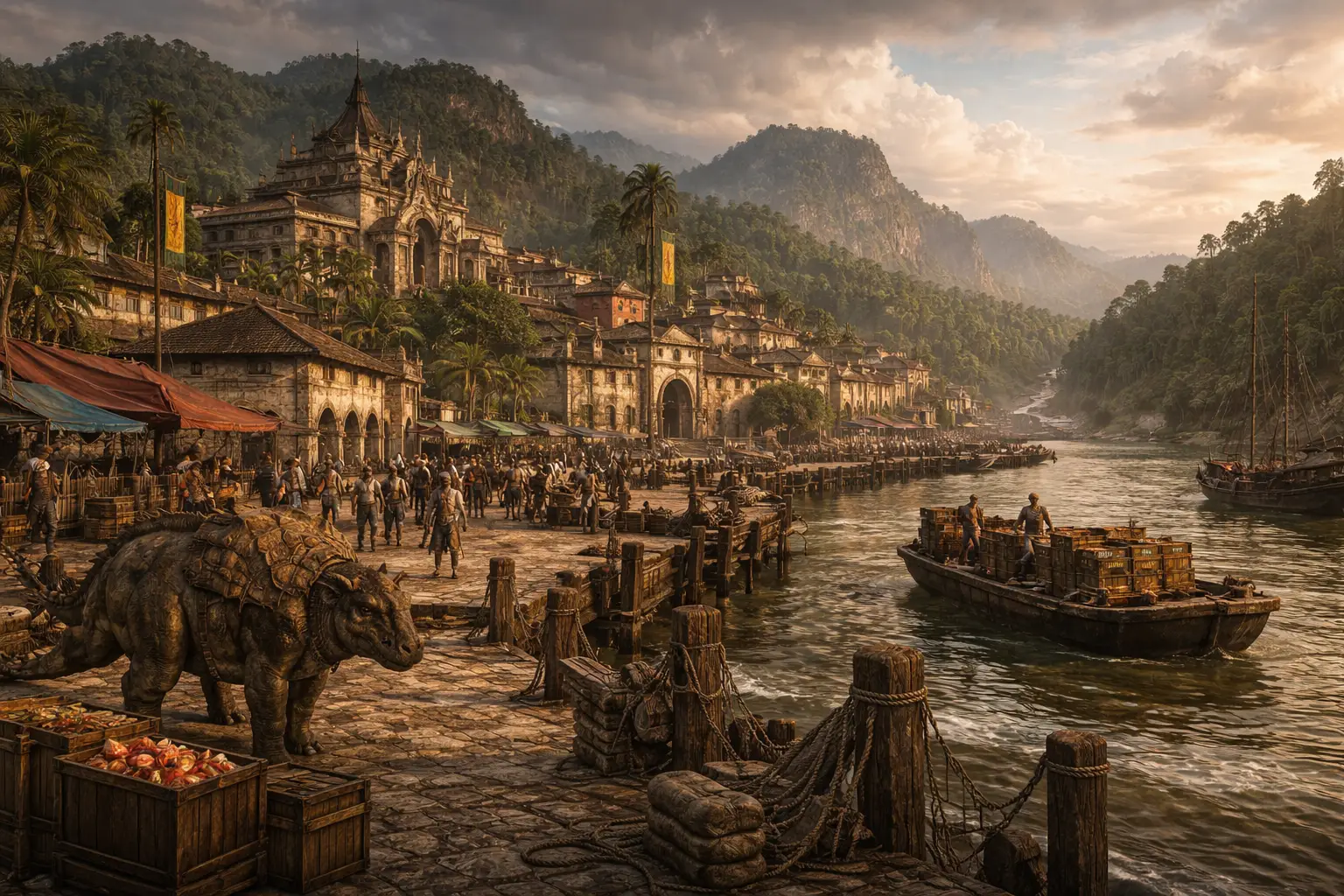
History of Q'barra
"The settlers think this land has seventy years of history. The scales know it has seventy thousand. Neither side is wrong, exactly. But one of them is standing on a prison they don't know exists." — Joseth ir'Kalain, unofficial Q'barran representative, Sharn
Before the Softskins
The history of Q'barra does not begin with Duke Ven ir'Kesslan's fleet, or with the Last War, or with anything that happened in the Kingdom of Galifar. It begins in the Age of Demons, when fiendish Overlords ruled Eberron and the land east of the Endworld Mountains was the domain of one of the most feared among them — a horror whose name the settlers of New Galifar have never heard and whose prison they are, at this very moment, accidentally dismantling.
During that age, the celestial couatl waged their long war against the children of Khyber. When the couatl made their great sacrifice — fusing their celestial essence together to forge the Silver Flame and bind the Overlords in Khyber — an Overlord was imprisoned beneath the jungles of what is now Q'barra.
[For more information on this subject, see the forests of Q'Barra for yourself]
FRAGMENT — translated from a carving on a basalt column, deep interior of Q'barra, recovered by a Morgrave University expedition that did not return in full
Here the light was bound. Here the cold was sealed. The children of the dream keep watch. Let no hand disturb what sleeps below.
The Galifar Era: A Blank Space on the Map
For the thousand years of the Kingdom of Galifar's existence, Q'barra was a blank space on the map — technically part of Karrnath's territorial claims, but entirely ignored. The Endworld Mountains formed a natural barrier that no one had any particular reason to cross. The Lhazaar Principalities knew the eastern coast and its waters, and Lhazaar sailors brought back stories of dense jungle, hostile wildlife, and reptilian humanoids who did not welcome visitors. A few Galifaran cartographers marked the territory; none of them explored it. The Kingdom had more pressing concerns to the west, and the jungle offered nothing that justified the cost of crossing a mountain range into a region with no roads, no ports, no infrastructure, and an emphatic surplus of things that could eat you.
This indifference would prove to be the most consequential decision the Kingdom of Galifar ever made about Q'barra — because it meant that when the Last War began and a desperate duke led a fleet of settlers east, the colonists arrived in a land they knew virtually nothing about. They had Lhazaar sailors' rumors and Korranberg cartographers' guesswork. They did not have the faintest understanding of who already lived there, what they were guarding, or why.
The Founding of New Galifar (928 YK)
In 928 YK — thirty-four years into the Last War — Duke Ven ir'Kesslan of Cyre led a fleet of settlers east across the Endworld Mountains. Ven was a duke of the Dollen region, a man of ideals and means who watched the war consume everything Galifar had built and decided he would rather build something new than fight over the wreckage. He was not of Wynarn blood, but he had a title, a retinue, money, and the charisma to convince thousands of people to follow him into a jungle that no human had ever successfully settled. He called his colony New Galifar and declared his intention to recreate the noble model of the old kingdom in untouched land. The few counts who supported his cause were named dukes; wealthy donors who funded the expedition became counts. A feudal aristocracy was proclaimed over what amounted to a muddy harbor and several miles of cleared jungle around the mouth of the Adder River.
That harbor became Adderport, and from Adderport grew the capital — Newthrone, named with the kind of optimism that only a man building a throne in a swamp could muster. The early years were brutal. The jungle was hostile. The climate was punishing. Dinosaurs were not a story but a daily hazard. And the settlers quickly discovered that the land they had claimed was not, in fact, uninhabited — the surrounding jungles teemed with reptilian peoples the colonists had never encountered and could not easily communicate with. Ven's settlers called them "scales" and left it at that.
Duke Ven, to his credit, attempted diplomacy. The initial contact with the indigenous peoples was not hostile — the lizardfolk, whose relationship with territory was fundamentally different from the human concept of ownership, withdrew from the areas the settlers occupied without immediate conflict. For a time, the arrangement held. The settlers stayed near the coast and the Adder River. The scales stayed in the deep jungle. Neither side understood the other, but neither side was killing the other, and in Q'barra that counts as progress.
LETTER — recovered from the personal effects of Duke Ven ir'Kesslan, undated, addressed to his wife in Cyre
Dearest,
We have made landfall. The harbor is adequate, the timber is extraordinary, and the wildlife is as alarming as the Lhazaar captains warned. I have not yet met the reptilian inhabitants the sailors described, though we have found evidence of their presence — cleared trails, structures of shaped stone, and carvings I cannot read. I believe we can coexist. I believe this because I must.
Your husband, your duke, and your optimist, Ven
Growth and Conflict (928–969 YK)
Over the next four decades, Adderport grew into Newthrone and new settlements spread along the Adder River and the coast. The population swelled as more individuals — displaced by the Last War, disillusioned with the Five Nations, or simply looking for opportunity — made the crossing. Duke Ven became King Ven, and the colony began to function as a genuine, if small, feudal state. Newthrone developed fortifications, a port, and a market. The dragonmarked houses — primarily House Tharashk — sent agents to assess the region's potential.
The settlers did not know — could not have known — that as they spread across the landscape, they were encroaching on sites of profound significance to the indigenous peoples. The dragonshards that studded the riverbeds and jungle hillsides were not merely valuable commodities. They were sites deemed holy by the indigenous tribes and not to be touched by outsiders.
In 969 YK, after forty-one years of uneasy coexistence, the Cold Sun Federation launched a coordinated assault on the human settlements without warning. The surprise attack was devastating — the settlers suffered severe losses, entire outlying communities were overrun, and the colony nearly collapsed. Veterans of the Last War organized militias and took command as field officers. After approximately a year of bloody fighting, the settlers managed to repel the lizardfolk through superior magical weapons and organized tactics, though the cost was enormous on both sides.
The war's end came not through military victory but through an unexpected diplomatic overture. Roughly five years after the initial assault, representatives of the Cold Sun Federation — specifically the Twilight Walkers tribe — approached Newthrone and sat down with King Sebastes ir'Kesslan, Ven's grandson, who had inherited the throne. The result was the Newthrone Accords — a treaty that specified areas on a map of Q'barra that the Cold Sun Federation valued most and would fight to preserve, and areas the settlers could claim.
The Accords were a monument to mutual misunderstanding. The settlers understood the document as a binding legal treaty. The lizardfolk, who have no concept of legal documents and no written language, took it as a simple statement of fact — these places matter, do not go there. The distinction would prove catastrophic.
From the Newthrone Dispatch, Barrakas 975 YK:
PEACE WITH THE SCALES — KING SEBASTES HAILS "NEW ERA"
In a ceremony at the Royal Court, King Sebastes ir'Kesslan signed the Newthrone Accords with representatives of the Cold Sun Tribes, formally establishing territorial boundaries between human and lizardfolk holdings in Q'barra. "We have proven that civilization and the wild can coexist," the King declared. Representatives of the lizardfolk delegation did not comment.
The Shard Rush and the Rise of Hope (980s–994 YK)
In the late 980s, a House Tharashk expedition discovered an enormous cache of Eberron dragonshards in the swamps west of Newthrone. Subsequent surveys confirmed that this was not an isolated find — Q'barra sat atop some of the richest dragonshard deposits on the continent. The discovery transformed Q'barra overnight from a quiet backwater colony into a destination.
A new wave of settlers poured in — prospectors, fortune-seekers, opportunists, criminals fleeing the long arm of western law, deserters from the Last War, and adventurers drawn by stories of easy wealth and ancient ruins. These newcomers did not share the original settlers' idealism about recreating Galifar, and they had no interest in King Sebastes's authority or his treaty with the scales. They pushed north and west beyond the Adder watershed, beyond the territory covered by the Newthrone Accords, and established a loose constellation of mining towns, shard camps, and trading posts in a region that came to be known as Hope.
Hope had no government, no law, and no respect for the Newthrone Accords. Prospectors harvested dragonshards wherever they found them, including in areas the Cold Sun Federation had been guarding for millennia. House Tharashk established large-scale mining operations and became the dominant economic power in the region, buying shards from independent prospectors and shipping them west. The dragonmarked house had no particular reason to enforce the treaty, and the Kesslan crown had no ability to enforce it beyond its own narrow territory.
The shard rush made Q'barra richer and considerably more dangerous. It also set the stage for the escalation that would follow.
The Mourning and After (994–998 YK)
On 20 Olarune 994 YK, Cyre was destroyed. The Mourning sent shockwaves across Khorvaire, and one of the largest waves of Cyran refugees washed east — to Q'barra.
The new arrivals were different from the original settlers in almost every way that mattered. Ven ir'Kesslan's colonists had left Cyre by choice, early in the war, out of idealism. The Mourning refugees had stayed in Cyre through a century of war and lost everything in a single day. Many chose Q'barra specifically because they refused to accept charity from nations they held responsible for Cyre's destruction — Breland's refugee camps felt like a humiliation, and New Cyre felt like someone else's kingdom. Q'barra, at least, offered the chance to build something with their own hands.
The cultural gap between the old New Galifarans and the Cyran refugees was immediate and bitter. The New Galifarans, whose families had left Cyre decades before the Mourning, often viewed the refugees with contempt — these were the people who had stayed for the war and paid the price. The refugees, in turn, saw the New Galifarans as cowards who had abandoned Cyre in its hour of need and then had the audacity to name their muddy colony after the kingdom they'd betrayed. Economic necessity forced cooperation, but the underlying resentment never healed.
A subset of the refugees — known as "Mourners" — went further. These were survivors who chose Q'barra not for opportunity but for vengeance, refusing to live among the nations that had fought against Cyre. The Mourners rob and kill settlers from those nations, and the line between Mourner ideology and common banditry has blurred thoroughly in the jungle.
Meanwhile, King Sebastes accepted an offer of military assistance from the Inspired lords of Riedra — the only ruler in Khorvaire to formally welcome Riedran troops onto his soil. Riedran soldiers now help maintain order in Newthrone, and Inspired advisors walk the palace corridors. The Riedrans even maintain a small ward of the capital where only Riedrans and Inspired are permitted to enter.
The Treaty of Thronehold (996 YK)
When the Treaty of Thronehold was negotiated to end the Last War, Q'barra participated — though its representatives had little love for the Five Nations and attended primarily to secure recognition of their sovereignty. The treaty recognized Q'barra as one of twelve sovereign states. King Sebastes used the occasion to establish formal diplomatic ties with the Mror Holds and the Lhazaar Principalities, nations he considered less corrupt than the Five Nations. He rebuffed most overtures from Breland, Aundair, and Thrane.
It was a Trothlorsvek emissary who represented the indigenous peoples in whatever discussions touched on the scales, though the historical record is unclear on this point and the settlers have not asked.
The Postwar Colony (996 YK–Present)
Two years after the Treaty of Thronehold, Q'barra is a nation held together by geography, dragonshard wealth, and the absence of anything better. King Sebastes controls Newthrone and the lower Adder — a narrow strip of territory bound by treaty with the Cold Sun Federation. Beyond that strip lies Hope, which answers to no one. Beyond Hope lies the unclaimed interior, where the Cold Sun Federation and the Trothlorsvek carry on a vigil that has lasted since before human civilization began.
The Newthrone Accords are collapsing. Prospectors in Hope violate the treaty constantly, and every violated shard claim pushes the Cold Sun Federation closer to another coordinated assault. The Poison Dusk — the third indigenous faction, hostile to everyone — grows bolder. Valenar warbands cross the southern border looking for worthy combat. Lhazaar pirates prey on the coast. House Tharashk's operations expand. And the Riedran advisors in Newthrone grow more deeply embedded in the workings of the court with each passing season.
The settlers have built something in Q'barra — something real, something hard-won, something that matters to the people who live there. Whether it will survive depends on questions they have not yet thought to ask about the land beneath their feet, the peoples whose territory they have claimed, and the thing that sleeps in the dark beneath the jungle — the thing that everything in Q'barra's history, from the couatl's sacrifice to the Newthrone Accords to the price of dragonshards in the Newthrone market, has always been about.
They just don't know it yet.
Scratched into the wall of a shard-weighing station in Wyrmwatch, author unknown:
First the jungle. Then the scales. Then the shard money. Then whatever comes next.
We're still here.