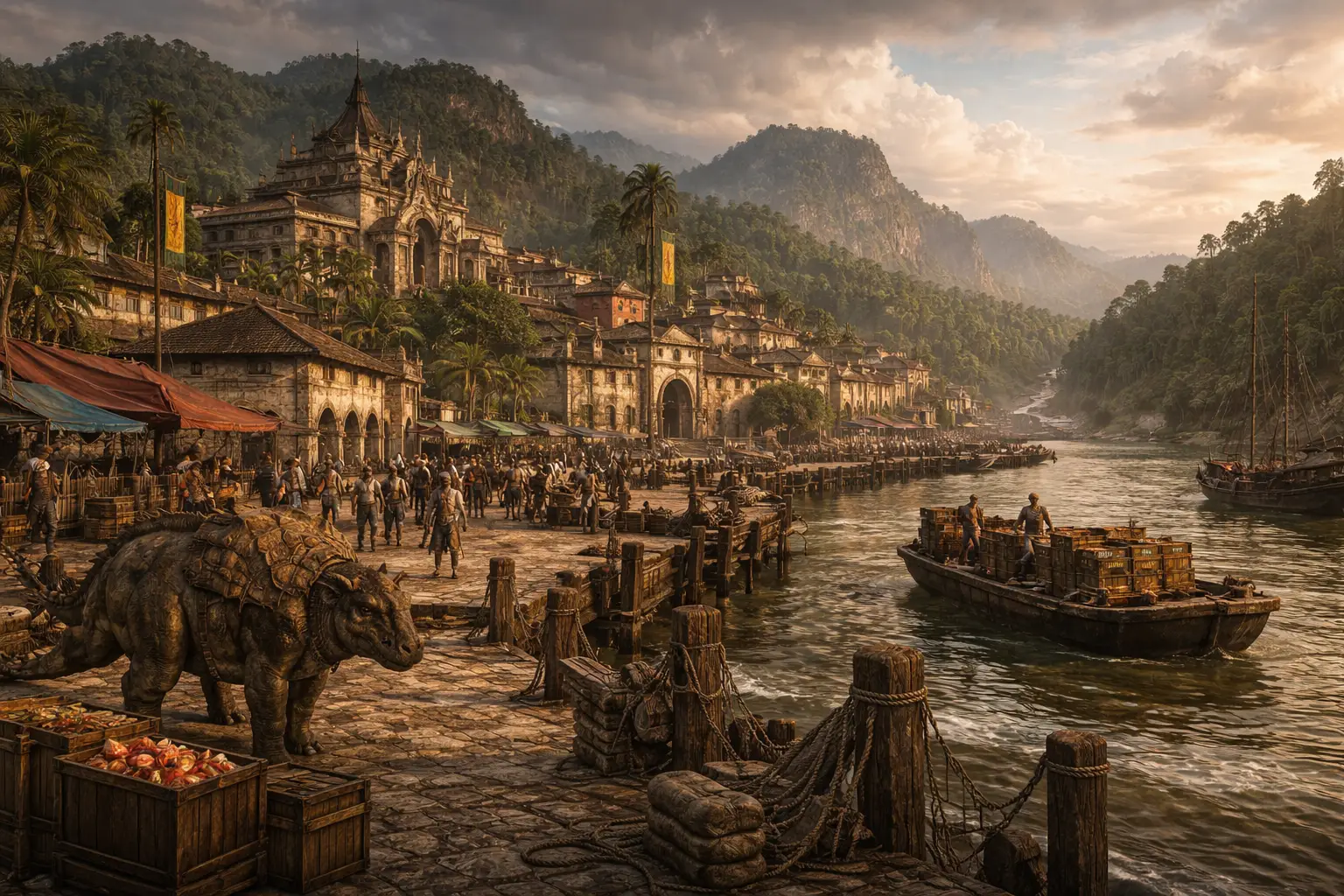
Art & Culture of Q'barra
"My grandmother kept a glamerweave cloak in a cedar chest for forty years. She brought it from Cyre in the first fleet. It still shifts colors — sea-green to violet, slow as breathing. She wore it once a year, on Unity Day, in a tavern with a dirt floor and a roof that leaks. Nobody in the room had ever seen Metrol. Half of them had never seen a city. But when she put that cloak on and the colors moved, the whole place went quiet, because they remembered what they came here to save." — Tam ir'Kesslan, Newthrone, 997 YK
Seventy Years of Mud and Memory
Q'barra does not have a culture in the way that Cyre had a culture. Cyre had a thousand years of accumulated tradition, a Grand Stage in Metrol, House Phiarlan's enclaves, and the wealth and leisure to debate whether arcane casting was an art or a science. Q'barra has seventy years, a jungle, and whatever the settlers carried across the Endworld Mountains in their heads and their luggage. What has emerged is not a high civilization — it is something rougher, stranger, and more honest than that: a patchwork of inherited traditions from half a dozen nations, all of them decaying in the humidity, all of them being rebuilt with whatever materials are at hand, and all of them shaped by the one experience that every Q'barran shares — the knowledge that you are very far from home, the jungle does not care what you brought with you, and survival is the art that matters most.
The cultural divide between New Galifar and Hope mirrors the political one. The old settler families of the Adder valley preserve Cyran traditions with careful devotion: Sovereign Host observances on the proper days, the old Galifaran festival calendar, formal court manners that look increasingly absurd in a palace built from jungle hardwood. The people of Hope — prospectors, refugees, deserters, criminals, misfits — brought whatever they had and invented the rest. The result is that Newthrone and Wyrmwatch, separated by three days of jungle trail, might as well be on different continents.
What unites them — the one thread running through all of Q'barran settler culture — is music. The fiddle tunes that carry over the evening air in every settlement from the docks of Newthrone to the shard camps of Hope are the closest thing Q'barra has to a national art form, and they are beautiful, and they are the sound of people making something out of nothing because silence is worse.
What They Brought
The founding settlers were Cyrans, and the bones of Cyran culture still structure the formal life of New Galifar — the court etiquette, the noble titles, the Sovereign Host liturgical calendar, the instinct to blend traditions and call the result something new. But Cyran culture was built on material abundance — glamerweave, filigree, mithral thread, dragonshards used as decoration rather than currency — and none of that survived the crossing.
Cyran fashion persists in attenuated form. The old settler families still cut their clothing in the Cyran style — the practical base layer, the coat as centerpiece, the gloves, the emphasis on personal expression over display of wealth. But the materials have changed utterly. Glamerweave is impossibly rare and impossibly expensive in Q'barra; a single glamerweave cloak is an heirloom, not a wardrobe staple. What the settlers wear is jungle-adapted Cyran cuts: lightweight linens and cottons in place of wool, oilskin cloaks in place of traveling capes, leather dyed with local plant pigments that fade to brown within a season. The Cyran love of color survives as an aspiration; the jungle's love of mildew and rot works against it constantly.
Masks appear at formal occasions in Newthrone — the old Cyran tradition of enhancing identity rather than concealing it — though the masks are now carved from jungle hardwood and painted with local pigments rather than crafted from copper and glass. Feathers are everywhere, because the jungle provides them in abundance and the Cyran habit of decorating everything with feathers turns out to be one tradition the environment actively supports. Bells — the other great Cyran accessory — are rarer, because metal is imported and expensive, and a miner who can afford bells can afford better tools.
The Mourning refugees brought Mourning wear — Cyran-cut clothing entirely in black — and it has become the dominant mode among the Cyran community in Hope. In Wyrmwatch, where the Mourning is a living wound rather than a historical event, black is not a fashion choice but a statement of identity: we are the people who survived, and we have not stopped grieving. Some settlers in New Galifar find the Mourning wear morbid and ostentatious. The refugees find the old settlers' continued use of bright Cyran colors offensive — an appropriation of a culture they abandoned seventy years ago.
OVERHEARD IN THE NEWTHRONE MARKET — two women arguing over a bolt of fabric, Nymm 998 YK
"That's Cyran green." "It's just green." "There is no 'just green' in Cyre." "Cyre doesn't exist anymore."
(The Sivis chronicler recording the exchange notes that the conversation ended abruptly and the fabric was not purchased by either party.)
Faith on the Frontier
The Sovereign Host is the majority faith of New Galifar, carried east by the founding settlers and maintained with the same careful preservation they apply to everything else from the old country. Arawai and Balinor hold particular prominence — in a land where the harvest and the hunt are daily realities rather than seasonal metaphors, the Sovereign of the fields and the Sovereign of beasts earn their worship through practical relevance. Temples in Newthrone follow the old Galifaran architectural model — Sovereign Host iconography woven into even secular buildings, the way it was done in Cyre before the mists came — though the scale is humbler and the building materials are local stone and jungle hardwood rather than marble and filigree.
The Church of the Silver Flame has a devoted and growing following, concentrated in Hope. Elder Nevillom's ministry in Wyrmwatch has made the Flame the spiritual backbone of the Cyran refugee community — not the institutional Church of Thrane, which most Q'barrans distrust, but a frontier interpretation of the Flame's teachings: protect the innocent, stand against darkness, keep the light burning in a place where the darkness is literal and the things that live in it are real. Nevillom's sermons draw on the Flame's martial tradition — the idea that faith is something you defend with your body as well as your soul — and his congregation includes soldiers, prospectors, and people who found that the Sovereign Host could not explain why an entire nation was destroyed and who needed a faith that offered a sword as well as a prayer.
In the mining towns of Hope, religion is pragmatic to the point of comedy. Shrines to Kol Korran sit next to shard-weighing stations. Prospectors invoke Olladra before cracking a geode. Balinor gets a prayer before any trip into the jungle that might involve something with teeth. The Traveler receives quiet, semi-serious devotion from the gamblers and wandslingers who populate the frontier towns — people who live by luck and deception and who see no reason not to honor the god who embodies both. And in the darkest corners of the frontier, among the desperate and the damned, the whispers of the Dragon Below find ears willing to listen — cults that promise power drawn from the jungle's ancient ruins, from the things that sleep beneath the ground, from sources that anyone with sense would refuse and that desperation makes attractive.
The Sound of Q'barra
Fiddle music is the soul of Q'barran settler culture, and if you visit any settlement in the colony — from the docks of Newthrone to the most remote shard camp in Hope — you will hear it. The tradition descends from Cyran folk music, adapted across seventy years of frontier living into something that Cyre would barely recognize and that belongs entirely to Q'barra.
The melodies are built on Cyran bones — the old add-a-verse ballad structures, the syncopated dance rhythms that once filled provincial stages across central Cyre — but the lyrics are new, the tempo has slowed to match the heat, and the subject matter has shifted from the romantic and the heroic to the specific and the immediate. Q'barran ballads are about shard strikes and snakebites, about the river rising and the scales coming, about the woman who rebuilt her farmstead three times and the man who walked into the jungle and didn't walk out. They are sung in taverns on payday nights, on river barges between settlements, around campfires at shard camps where the nearest town is two days away and the nearest help is further. The fiddle carries because it is portable, durable, and loud enough to fill a room without competing with a drum, and because a single fiddler can hold a crowd the way a full Cyran ensemble once held an audience at the Grand Stage — with less polish and more feeling.
The drinking songs are the most distinctive Q'barran contribution to the musical traditions of Khorvaire. Heavy, rhythmic, built for voices thickened by cheap rum and exhaustion, they are work songs adapted for the end of the working day — melodies that acknowledge the hardship without pretending it is noble and that find their beauty in the communal act of singing rather than in any individual voice. A Hope tavern on a payday night, with forty miners and prospectors bellowing a chorus about the river and the shards and the things that live in the jungle, is one of the rawest and most genuine musical experiences available on the continent. It is not beautiful in the way that a Cyran court performance was beautiful. It is beautiful in the way that survival is beautiful — rough, unglamorous, and entirely earned.
Drums have arrived with the Mourning refugees — heavy hand-drums that owe more to Karrnathi military cadence than to Cyran folk tradition, played at Mourning observances and at the Day of Mourning gatherings where the refugees sing the old songs for the dead. The drums and the fiddle have not yet merged into a single tradition, but they are beginning to — and the sound that emerges when a Hope fiddler sits down with a Cyran drummer is something new, something that neither tradition produced alone, and something that belongs to Q'barra.
"My grandmother told me about the Grand Stage in Metrol. Crystal chandeliers. Illusory lighting. I play fiddle in a tavern where the ceiling leaks and last week a monitor lizard walked in during my second set. I like it better." — Corinne Hass, musician, Wyrmwatch
What the Jungle Feeds
Q'barran cuisine is, like everything else in the colony, a collision between what the settlers brought and what the jungle provides — and the jungle, it turns out, provides abundantly if you are willing to eat things that look alarming and taste like nothing you have encountered before.
The base of the Q'barran diet is fish and rice — coastal fish from the abundant waters off Newthrone, river fish from the Adder and its tributaries, and a starchy grain cultivated in the lower valley clearings that the settlers call paddyrice, grown in flooded fields that the jungle climate is ideally suited for. Root vegetables from the cleared farmland supplement the staple, along with tropical fruits — some recognizable from Five Nations imports, others native to Q'barra and discovered through cautious experimentation and the occasional bout of illness.
What makes Q'barran food distinctive is the jungle layer — wild herbs, pungent roots, and fiercely hot peppers that grow in the underbrush and that the settlers have learned to use from observation, from trial and error, and, occasionally, from watching what the scales eat and cautiously following suit. The result is a cuisine that starts with Cyran techniques — the blending, the appreciation, the instinct to take something from every available source — and adds a heat and intensity that central Cyre never imagined. A Q'barran fish stew bears the same relationship to its Cyran ancestor that a Wyrmwatch fiddle tune bears to a Metrol court melody: recognizable in outline, utterly transformed in execution.
Meat is whatever the jungle offers and the hunter can catch. Dinosaur is not exotic in Q'barra; it is Tuesday. Clawfoot haunch is a common tavern dish, roasted over open coals with local peppers. Glidewing — leaner and tougher — is smoked and dried into trail jerky that prospectors carry into the interior. The old settler families raise livestock imported from the Five Nations — chickens, goats, a few hardy cattle breeds — but the domestic herds have never thrived in the jungle climate, and most protein comes from the hunt and the water.
Drink follows the same pattern of decay and reinvention. The Cyran appreciation for fine wine persists as a memory; what the settlers actually drink is rum distilled from sugarcane cultivated in the lower valley, jungle-fruit spirits fermented in clay jars, and — in Newthrone's harbor taverns — whatever the Lhazaar ships brought in last. Imported Brelish ale and Aundairian wine command premium prices. Mror spirits occasionally appear in the market and are treated with the cautious reverence that any substance capable of stopping a human heart deserves. The local rum is rough, sweet, and strong enough that two cups make the fiddle sound better and three cups make you forget why you came east, which is, for many Q'barrans, the entire point.
MENU — scrawled in chalk on a board outside the Lizard's Rest, Newthrone docks
Fish stew (peppered) — 3 cp Clawfoot haunch (roasted, bone-in) — 5 cp Rice balls, plain — 1 cp Rice balls, stuffed (ask what's in them if you dare) — 2 cp Rum — 2 cp / 15 cp (bottle) Aundairian red — 1 sp (glass) — don't ask for a bottle, we don't have one Water — free, boiled, don't drink it otherwise
Festivals and Observances
The formal festival calendar of New Galifar follows the Sovereign Host's liturgical year — Wildnight, the Brightblade competitions, the Aureon's Crown scholarly observances — maintained by the old settler families as acts of cultural preservation. These festivals are observed in Newthrone with the same careful devotion the court applies to everything inherited from the founding: formal, sincere, and increasingly disconnected from the daily reality of frontier life.
The Day of Mourning — 20 Olarune — is the most significant civic observance in Q'barra, and the one that draws the sharpest line between the old settlers and the refugees. In Hope, the day is marked by stories of the dead, traditional Cyran songs, communal meals, drum circles, and a grief so raw that it has occasionally erupted into violence against settlers from the nations that fought Cyre. In Newthrone, the observance is quieter — the old settlers acknowledge the Mourning but did not experience it, having left Cyre decades before, and the emotional gap between the two communities is never more visible than on this day.
The one festival that belongs entirely to Q'barra — that did not come across the mountains in anyone's luggage — is Shardsfall, an unofficial holiday observed in the mining towns of Hope on the anniversary of the first major dragonshard discovery. It is a day of drinking, gambling, competitive shard-weighing, tall tales about legendary strikes, and the kind of cheerful chaos that happens when an entire community of prospectors decides simultaneously that today is not a day for working. Elder Nevillom disapproves. Everyone else attends.
What the Jungle Holds
Beyond the settler territories, the indigenous peoples of Q'barra maintain artistic and cultural traditions that the settlers have barely glimpsed and do not understand.
The Cold Sun Federation's culture is invisible to outsiders by design. The lizardfolk have no written language, no permanent architecture, no material culture that the settlers would recognize as art. What they have is the dream — the shared communal experience that teaches them everything they need — and whatever artistic expression flows from it is internal, experienced in sleep, and inaccessible to anyone who does not share it. Settlers who have observed Cold Sun rituals from a distance report rhythmic movement, low vocalizations, and a stillness that feels deliberate and purposeful rather than passive. Whether these are religious ceremonies, social gatherings, or something the settlers have no category for is unknown. The lizardfolk do not explain themselves. They have never needed to.
The Trothlorsvek dragonborn maintain a visible martial culture that the few settlers who have encountered it describe with a mixture of admiration and alarm. Dragonborn warriors train publicly, forge weapons of considerable quality, and practice clan traditions that involve elaborate ritual combat, oral histories chanted in Draconic, and displays of physical prowess that echo the martial traditions of the dragons who created them. Their cities — glimpsed by a handful of explorers who returned to tell the tale — feature architecture of ancient stone and living jungle, structures that have stood for millennia and that make Newthrone's palace look like a garden shed.
The settlers know almost nothing about these cultures. Most of them have never tried to learn. The few who have — a handful of crown diplomats, a Morgrave scholar or two, the occasional frontier herbalist who trades with dragonborn at the jungle margin — report that the experience is humbling: the realization that the "primitive scales" possess traditions of depth and sophistication that make seventy years of settler culture look like exactly what it is.
"A visting Brelish scholar asked me what Q'barran culture was. I told her: it's whatever you had when you got off the boat, mixed with whatever the jungle provides, played on a fiddle in a tavern while something with teeth circles outside. She wrote that down, but I don't think she understood." — dockworker, Newthrone