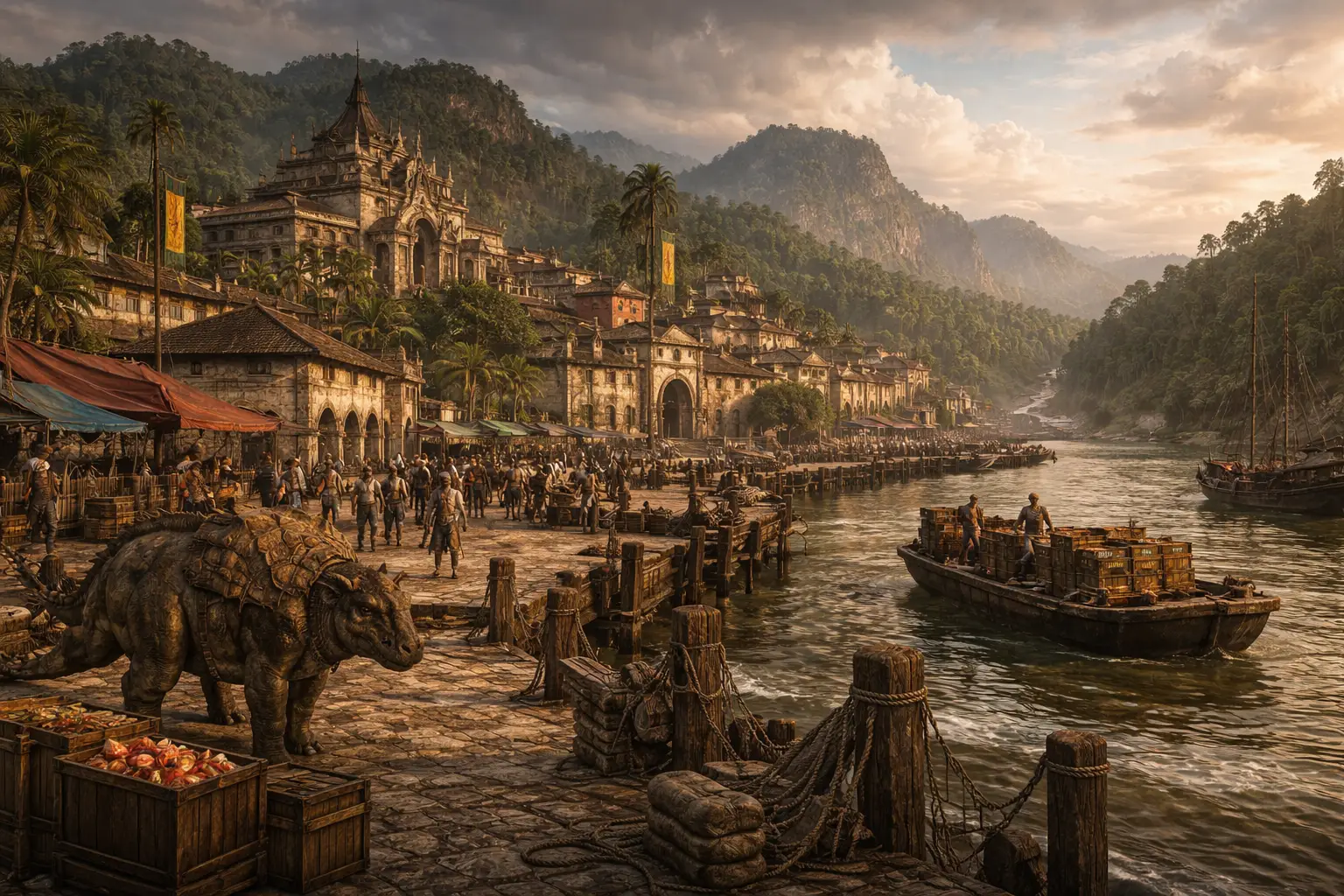
Economy & Industry of Q'barra
"You want to understand Q'barra's economy? It's simple. There is one thing under the ground that everybody wants, and one house that buys it, and one port that ships it, and about ten thousand people with shovels who will kill each other for the chance to dig it up. Everything else — the fishing, the farming, the smuggling, the praying — exists to keep those ten thousand people alive long enough to fill the next crate." — overheard at the Tharashk factor's office, Newthrone
A Frontier of Dragonshards
Q'barra's economy is, at its core, an extraction operation — a single commodity pulled from the jungle floor by any means available, bought by a single dragonmarked house, and shipped west to feed the magical industry of a continent. Everything else that happens in Q'barra's markets, harbors, and muddy frontier towns exists in orbit around that commodity, and the commodity is Eberron dragonshards.
Eberron dragonshards are the fuel that keeps Khorvaire's magical civilization running. They are rosy crystals with crimson swirls flowing in their depths, usually found encased in geode-like stone shells buried in shallow soil. Refined into a glowing powder, dragonshard dust can substitute for virtually any material component in spellcasting. It is used in the creation of magic items, the maintenance of the lightning rail and elemental airships, the binding of elementals, and a hundred other applications that the Five Nations depend on daily. If dragonshards are Eberron's answer to oil, then Q'barra is its richest and most volatile oilfield.
The deposits were discovered roughly a decade ago, when settlers pushing into the interior stumbled on concentrations of shards richer than anything found in the Shadow Marches — the previous primary source. Prior to the Last War, Q'barra was a shunned backwater that nobody thought to prospect. The discovery transformed the colony virtually overnight from a quiet idealist settlement into a boomtown, drawing prospectors, fortune-seekers, dragonmarked agents, and criminals in a shard rush that has not slowed since. The richest deposits lie in the deep jungle — in the lands of the scales, beyond the territory covered by the Newthrone Accords — which is why the shard rush is not merely an economic phenomenon but a political and military crisis.
The dark side of Q'barra's wealth is that the colony produces almost nothing else of continental significance. It has no manufacturing base. It has no lightning rail. It has no refineries, no forges of note, no arcane workshops. It imports nearly all manufactured goods and depends on dragonshard revenue to pay for them. If the shards dried up — or if the Cold Sun Federation launched another coordinated assault that shut down the mining camps — the Q'barran economy would collapse within a season, and the settlers who depend on it would be left in a jungle with no way to pay for the supplies they need to survive.
MARKET REPORT — filed by a Sivis trade correspondent, Newthrone, Nymm 998 YK
Eberron dragonshards (raw): strong demand, rising prices, supply constrained by scale territory and rainy season accessibility. Rare jungle herbs: modest volume, high value per unit, Jorasco purchasing aggressively. Foodstuffs (local): fish and produce adequate for domestic consumption, no significant export. Manufactured goods (imported): chronically short, prices elevated, Lhazaar intermediaries taking increasingly bold margins.
General assessment: Q'barra's economy is a dragonshard economy. Everything else is footnotes.
House Tharashk and the Shard Trade
House Tharashk dominates the dragonshard economy of Q'barra with a thoroughness that makes every other economic actor in the colony — including the crown — look like a supporting player.
Khalar Velderan d'Tharashk runs the house's operations out of its Newthrone enclave, the largest dragonmarked presence in Q'barra. Tharashk's role is threefold: it operates large-scale mining operations using its own workforce and dragonmark-enhanced prospecting tools — the prospector's rod, a focus item that channels the Mark of Finding to detect dragonshard deposits on an industrial scale — it serves as the primary buyer for independent prospectors working claims across Hope and the Adder watershed, and it handles the logistics of shipping refined shard product west through Newthrone's harbor.
Tharashk's Q'barra operation is a relatively recent development. The house began as an organization of hunters and bounty-seekers in the Shadow Marches; large-scale prospecting is a newer branch of its business, driven by the invention of the prospector's rod and by the surging continental demand for dragonshards that has outpaced the Shadow Marches' supply. When settlers in Q'barra reported rich deposits roughly a decade ago, Tharashk responded quickly, establishing operations that have scaled up every year since. Today, the house employs hundreds of miners, guards, bounty hunters, and laborers, and its factor in Newthrone wields more practical economic influence than most of the crown's dukes.
The independent prospectors of Hope sell to Tharashk because they have no other realistic option — the house controls the supply chain, the refinement process, and the shipping infrastructure. A prospector who strikes a rich deposit can sell raw shards to Tharashk's factors at the going rate, or attempt to move them through Lhazaar smuggling channels at better prices and considerably higher personal risk. Most choose the former. Those who choose the latter fuel a parallel economy that operates outside the crown's oversight and that Duke Jorik ir'Tanneth's trade network has quietly cornered.
Tharashk has also begun lobbying the ducal council to expand mining rights beyond the territory permitted by the Newthrone Accords — arguing, with evidence that is part genuine and part strategically inflated, that increasing scale aggression makes the treaty unenforceable and that the richest deposits lie in areas the Cold Sun Federation claims as sacred. The crown has so far refused, but the house's economic leverage grows with every shipment that leaves the harbor.
NOTICE — posted at the Tharashk enclave, Newthrone, permanent fixture
House Tharashk purchases Eberron dragonshards at fair market rates. Sellers must present valid claim documentation or a sworn affidavit of independent recovery. The House accepts no liability for shards recovered from territory covered by the Newthrone Accords.
Fishing, Farming, and the Subsistence Economy
Before the shard rush, Q'barra's economy ran on fish, jungle produce, smuggling, and stubbornness. It still does — the dragonshards pay the bills, but the food keeps people alive, and the fishing and farming communities of the lower Adder and the southern coast are the foundation that everything else is built on.
Fishing is the oldest industry in the colony and still employs more settlers than any other trade outside the mines. The coastal waters off Q'barra are abundant — wealthier families own their own boats, while those less fortunate hire out as deckhands. The work is grueling and the waters are not safe — Lhazaar pirates, sea creatures, and the occasional Valenar raiding party all present hazards — but a diligent deckhand can save enough over several years to buy their own vessel, and that promise of earned prosperity is vital to the fishing communities, who see the shard rush newcomers as a threat to the balance that has sustained them for decades.
Farming is limited by the jungle climate and the difficulty of clearing land, but the lower Adder valley and the southern coastal strip produce enough food to sustain the domestic population. The surrounding farms export foodstuffs upriver to Newthrone — grain, fruit, and livestock — while most manufactured goods are imported. Q'barra is not the Eldeen Reaches; it does not feed the continent. It feeds itself, barely, and the margin between sufficiency and shortage is thinner than most settlers would like to admit.
Rare jungle herbs are the colony's second-most-valuable export after dragonshards. The Q'barran interior produces medicinal plants and alchemical reagents that cannot be found elsewhere in Khorvaire, and House Jorasco maintains purchasing agents in Newthrone specifically to acquire them. The volume is small, but the value per unit is high, and the herb trade sustains a community of jungle harvesters and herbalists who operate at the margins of settled territory, often deeper into scale country than the crown would prefer.
Smuggling and the Black Market
As a frontier port with robust docks connecting to every corner of eastern Khorvaire, Newthrone has been an ideal market for contraband since the colony's founding. Lhazaar Princes, Last War deserters, Cyran refugees, and merchant lords evading New Galifar's export tithes fuel a thriving black market that operates in plain sight — because nobody with the authority to shut it down has the resources to do so, and because the people who benefit from it include most of the population.
Fishing boats meet ships at sea to load and unload contraband. Cartels conduct business at secluded shore points along the southern coast. Smugglers sell goods at reduced prices to sympathetic locals in exchange for silence, earning themselves a romanticized reputation that obscures the reality — many smugglers are entirely unscrupulous, transporting anything profitable without concern for what it is or who it hurts. The goods that move through Q'barra's black market include everything from basic household necessities that the legal supply chain cannot provide at affordable prices to dreamlily, weapons, and — in the ugliest corners of the trade — living beings.
Duke Jorik ir'Tanneth's independent trade network controls much of the infrastructure that smuggling depends on — warehouses, river barges, and coastal storage that operate outside Tharashk's supply chain. Jorik's operation is not technically illegal, because Q'barra's legal framework does not extend far enough to make it so, but it exists in a grey zone that the crown has learned to tolerate and that Tharashk views with undisguised hostility.
The Riedran Market
The Inspired lords of Riedra are Q'barra's most unusual trading partner and its most generous — a combination that has made the crown richer and the old settler faction deeply suspicious.
Eberron dragonshards are as useful to the psions of Riedra as they are to the artificers of Khorvaire, and such shards are extremely rare in Sarlona. This makes Q'barra one of the most strategically valuable territories on the continent from the Inspired perspective, and the Riedran quarter in Newthrone exists as much to facilitate dragonshard procurement as it does to house troops. Ambassador Jhakanath purchases large quantities of shards from House Tharashk at prices that do not invite complaint, and has secured permission from King Sebastes to begin Riedran mining operations — the only foreign power other than a dragonmarked house to hold mining rights in Q'barra.
Riedra also provides manufactured goods, finished materials, and military supplies that the colony cannot produce domestically — transactions that flow through the closed Riedran ward in Newthrone and that the crown's customs officials do not inspect. What Q'barra sells to Riedra is clear: dragonshards, in quantity. What Q'barra receives in return is clear enough on the surface — troops, trade goods, and diplomatic support. Whether the full ledger balances in the colony's favor is a question that First Minister Alzia ir'Kesslan has reportedly raised more than once, and that Ambassador Jhakanath has reportedly answered with a smile.
Trade and Transit
Q'barra is one of the most isolated economies in Khorvaire, and its trade routes reflect that isolation. There is no lightning rail east of the Endworld Mountains. There are no Orien trade roads. The colony's connection to the outside world runs through three channels: Newthrone's harbor, the Lhazaar sea lanes, and a single airship docking tower that handles what little air traffic reaches the east.
Newthrone's port is the bottleneck through which virtually all legal commerce passes. Ships arrive from the Lhazaar Principalities carrying manufactured goods, finished materials, and passengers; they leave carrying dragonshards, rare herbs, and whatever else the colony can scrape together for export. The Mror Holds are Q'barra's most significant western trading partner — dwarven metalwork and Kundarak banking services flow east while shard revenue flows into Kundarak vaults and fishing exports into subterranean Mror granaries. The Lhazaar Principalities handle the bulk of the maritime trade, and individual princes maintain commercial relationships with specific Q'barran merchants that amount to parallel economic channels outside the crown's customs apparatus.
The colony imports nearly everything it cannot grow or catch. Finished goods — tools, weapons, clothing, alchemical supplies, arcane equipment — come from the Five Nations by way of Lhazaar intermediaries, at prices inflated by the distance and the risk. Newthrone's market is expensive, its selection limited, and its supply chain fragile. A bad storm in the Lhazaar Sea or a pirate raid on a convoy can leave the colony short of basic necessities for weeks.
Internal transit is worse. Jungle trails connect the settlements of the Adder valley, but the roads — such as they are — wash out in the rainy season, flood during monsoons, and are never entirely safe from wildlife, bandits, or scale raids. River barges carry goods along the Adder and its tributaries, and this waterborne network is the colony's true circulatory system — slow, vulnerable, and irreplaceable.
"You want something shipped from Newthrone to Wyrmwatch? That's three days by barge if the river is high, five if it's low, and never if the Poison Dusk burned the dock again. You want something shipped from Newthrone to Sharn? That's three weeks by sea if the Lhazaar are feeling friendly and your cargo doesn't interest them. Either way, get ready for a wait." — dockworker, Newthrone harbor
The Korth Edicts and House Ambition
The Korth Edicts — the ancient agreements that limit dragonmarked house power, forbidding them from holding land, noble titles, or standing armies — apply in Q'barra as they do across the Treaty of Thronehold nations. In theory. In practice, the frontier erodes legal niceties with the same efficiency it erodes everything else.
House Tharashk's enclave in Newthrone is the largest institutional presence in the colony after the crown itself. Its workforce constitutes a de facto private military. Its factor wields more economic influence than most dukes. The house does not hold land or a noble title — but its mining concessions, its warehouse leases, and its purchasing contracts give it effective control over territory that the Edicts were designed to prevent any house from possessing. Whether Tharashk's Q'barra operation violates the spirit of the Korth Edicts while technically observing the letter is a question that the colony's legal scholars — all three of them — disagree about, and that the crown has chosen not to press because it cannot afford to lose Tharashk's revenue.
House Ghallanda and House Jorasco maintain smaller but significant enclaves in Newthrone, providing the hospitality and healing services that the colony's limited domestic infrastructure cannot. The other houses maintain token outposts — enough to keep a foothold in a market that could explode in value at any time, not enough to draw the kind of attention that would force them to invest real resources in a jungle full of dinosaurs and pirates.
The Invisible Economy
Beyond the settler territories, the indigenous peoples of Q'barra maintain economic systems that the settlers do not perceive and would not understand if they did.
The Cold Sun Federation does not trade. The lizardfolk have no currency, no markets, and no concept of economic exchange as the settlers understand it. They gather what they need from the land, share resources among tribes without dispute, and produce nothing that the settlers would recognize as a commodity — except, of course, for the dragonshards they have been guarding for millennia, which the settlers recognize very well indeed.
The Trothlorsvek dragonborn maintain a more recognizable material culture — they forge weapons, build cities, and produce goods of considerable quality — but they do not trade with the settlers in any systematic way. Individual dragonborn have occasionally bartered with human communities at the margins of settled territory, but Ka'rhashan's economy is self-contained and inward-facing, and the clans see no reason to integrate with a people who have been here for seventy years and may not be here for seventy more.
What the settlers see when they look at the jungle is an untapped resource — land that could be farmed, rivers that could be mined, territory that could be claimed. What the indigenous peoples see is a landscape that has sustained them without extraction, without currency, and without the kind of ambition that builds ports that pollute the very waters they need to survive. The collision between these two economic worldviews is not a misunderstanding that better communication could resolve. It is a fundamental disagreement about what land is for.