Q'barra
Capital: Newthrone | Ruler: King Sebastes ir'Kesslan | Government: Feudal monarchy (New Galifar); lawless frontier settlements (Hope) | Hallmarks: Eberron dragonshards, rare jungle herbs, frontier culture
"You want to know why I came east? Because in Q'barra, nobody asks why you came east." — overheard in a Hope tavern, 997 YK
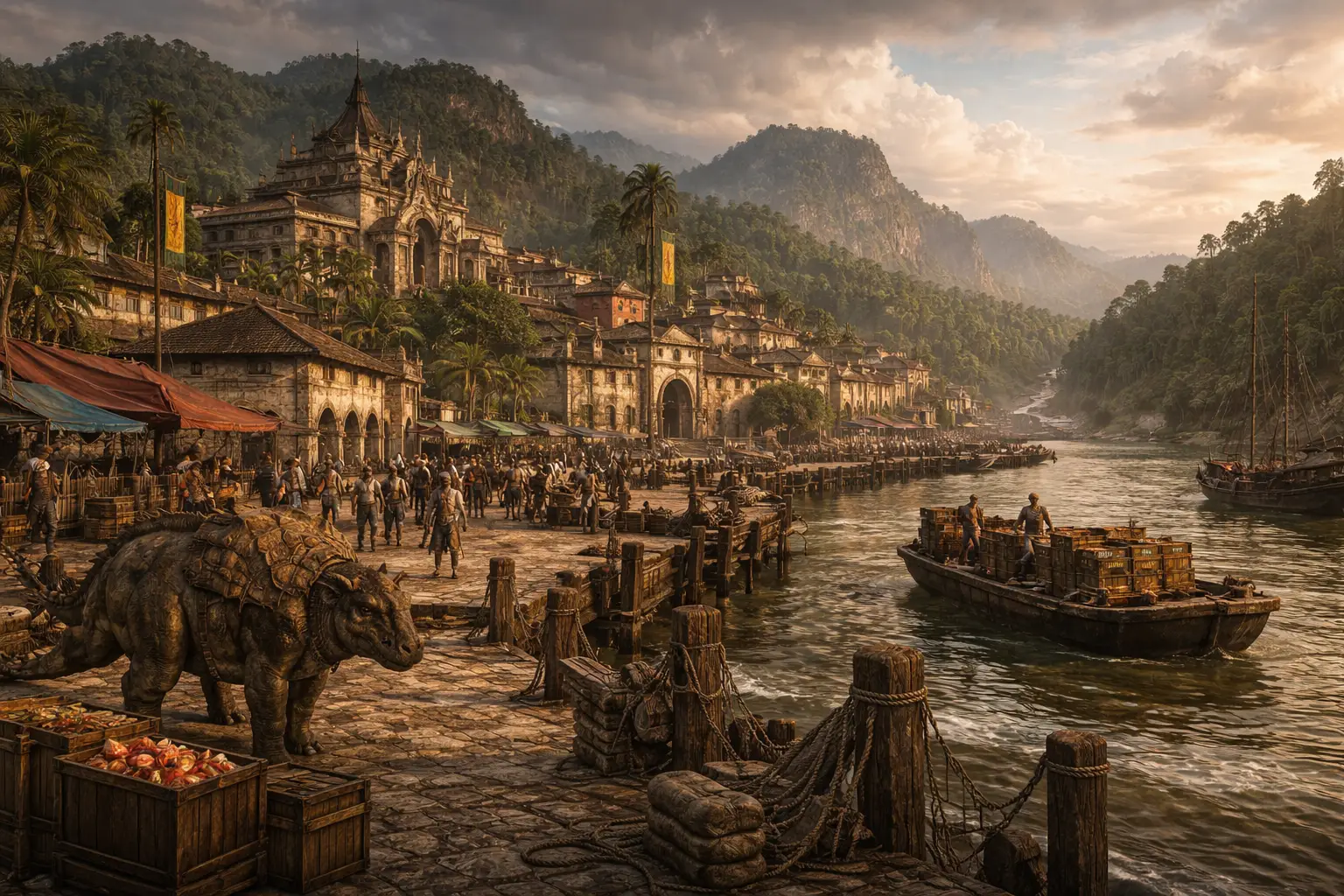
Seventy years ago, nobody in the Five Nations could have pointed to Q'barra on a map. Today it is a nation — barely — sprawled across the jungles and sweltering river deltas east of the Endworld Mountains, where human settlers who fled the Last War discovered the richest Eberron dragonshard deposits on the continent, a jungle full of dinosaurs, and ancient reptilian civilizations.
Q'barra occupies the easternmost reach of Khorvaire, bordered by the Endworld Mountains to the west, the Talenta Plains and Valenar to the southwest, the Lhazaar Sea to the north, and open ocean to the east and south. The interior is dense tropical rainforest broken by sluggish rivers — the Adder, the Whitecliff, and a dozen smaller tributaries — that carry silt, dragonshards, and occasionally trouble down to the coast. Dinosaurs are not a metaphor here; they are wildlife, and a farmer tilling a clearing outside Newthrone can watch clawfoot raptors hunting in the treeline while deciding whether the fence will hold. There is no lightning rail east of the Endworld Mountains. There are no Orien trade roads. Travel is by river barge, jungle trail, or airship from Newthrone's small docking tower.
The Q'barran Spirit
The settlers of Q'barra are not a single people with a shared identity — they are fragments of other identities, thrown together by desperation. The original colonists were Cyran idealists who left during the Last War's early decades to preserve the principles of Galifar in a new land, untouched by the Last War. The later arrivals — prospectors drawn by dragonshards, Cyran refugees from the Mourning, deserters, war criminals, freed warforged, and opportunists — came for reasons that range from noble to mercenary. What unites them is the conviction that the past is something to be escaped and the future is something that has to be wrestled into shape with your own hands before the jungle takes it back.
Q'barrans are practical, suspicious of grand institutions, deeply aware that the nearest help may be days away, and possessed of the particular gallows humor that develops in communities where a bad week means a dinosaur ate your livestock and a worse week means the scales burned your shard claim. The settlers are also, by and large, profoundly ignorant of the land they have claimed — they know the jungle is dangerous, they know the indigenous peoples are sometimes friendly but more often are hostile, and most of them have not bothered to learn why.
From the Newthrone Dispatch, Therendor 996 YK:
BLACKSCALE RAID ON ADDERPORT — A band of enormous lizardfolk broke through the fortifications at Adderport and killed thirteen residents before retreating into the jungles. Khalar d'Tharashk has announced a plan to track the perpetrators under the sponsorship of King Sebastes.
Crown and Colony
The Kingdom of New Galifar was founded in the early years of the Last War by Duke Ven ir'Kesslan of Cyre, who led a fleet of settlers east with the intention of recreating the noble model of old Galifar in untouched land. Ven was not of Wynarn blood, but he was a duke with a retinue, and in a jungle with no competition for the title, he made himself king. The few counts who supported his cause became dukes; wealthy donors became counts. A feudal aristocracy was proclaimed over a territory that consisted of a single muddy harbor town and several miles of cleared jungle.
Today Ven's grandson, King Sebastes ir'Kesslan rules a nation he can barely control, from a throne he can barely defend, over subjects many of whom arrived after his family and feel no particular loyalty to his crown. Sebastes secured recognition at the Treaty of Thronehold and forged the Newthrone Accords with the Cold Sun Federation — the largest indigenous coalition of indigenous scales — but his authority extends little further than Newthrone and the lower Adder River. His most controversial decision has been accepting Riedran troops and advisors to help maintain order — the only ruler in Khorvaire to formally accept Inspired military assistance.
North and west of New Galifar, beyond the Adder watershed and the reach of the crown's soldiers, lies Hope — a loose collection of mining towns, shard camps, and settlements established by people who could not or would not live under the Kesslan crown. Cyran refugees who found New Galifar's original settlers unsympathetic, prospectors, deserters, and misfits of every description. The law in Hope goes only as far as the people willing to enforce it. The largest settlement is Wyrmwatch, a prospecting town built by Cyran refugees and held together by Elder Nevillom, a veteran and evangelist of the Silver Flame whose sermons and courage have made the Flame the spiritual backbone of the community.
Hope's economy runs on dragonshards. The jungle soil contains some of the richest Eberron dragonshard deposits on the continent — rosy crystals encased in geode-like shells, found in shallow river deposits and jungle hillsides. House Tharashk runs large-scale mining operations and serves as the primary buyer, but independent prospectors work claims throughout the region, selling to Tharashk or to Lhazaar smugglers who pay better and ask fewer questions.
POSTED NOTICE — Newthrone Harbor, Nymm 997 YK
BY ORDER OF THE CROWN — All dragonshard claims within the Adder River watershed must be registered with the Royal Survey Office and are subject to a tithe of one-fifth of gross yield. Unregistered claims will be seized. Claimants operating beyond the Adder watershed do so outside the King's protection and at their own considerable risk.
— Sincerely ignored by everyone in Hope.
The Scales
The settlers call them "scales" — a single word that flattens at least three distinct civilizations into a convenient category of things-to-worry-about. A scholar in Morgrave might know the difference between the Cold Sun Federation and the Trothlorsvek dragonborn. The average farmer in Hope does not care. Tall or short, tails or no tails — they are all scales, and they are all in the way.
The Cold Sun Federation — the Masvirik'uala — are the largest indigenous population, an alliance of dozens of lizardfolk tribes whose spiritual tradition blends primal druidic magic with powers similar to that of the Silver Flame. Their culture appears primitive to outsiders — no written language, temporary settlements, terse speech — but the simplicity is misleading. Their emotional experience is fundamentally different from the warm-blooded races — flatter, colder, more detached — which makes communication with humans extraordinarily difficult and has cost lives on both sides. The Cold Sun Federation does not own territory in the way humans understand; they steward it. When settlers arrived, the lizardfolk initially withdrew without conflict. When prospectors began harvesting dragonshards, the Cold Sun struck back, prompting a series of conflicts that were eventually settled by the Newthrone Accords. The treaty holds, technically. The prospectors of Hope violate it constantly.
The Trothlorsvek — the dragonborn clans of Ka'rhashan — are fewer in number but more willing to engage with the newcomers. Tens of thousands of years ago, the dragons of Argonnessen established a garrison of dragonborn in Q'barra to guard the region against the Lords of Dust. Over time the Trothlorsvek built a nation that once expanded into the Talenta Plains and clashed with the Dhakaani Empire, but it was shattered when a fiendish Overlord stirred and corrupted many of their own. The survivors retreated to strongholds in Q'barra's deep interior, where they maintain ancient cities and a proud martial tradition organized around feuding clans. High Elder Bhisma has forged an alliance with Newthrone and forbidden clans from attacking human settlements, but the dragonborn have their own ancient duties and are not trying to integrate. Most humans who encounter them assume they are another variety of lizardfolk — a misidentification the dragonborn find somewhere between amusing and insulting.
The Poison Dusk is the reason the other two factions exist. The settlers assume it is just another tribe. It is not. The Poison Dusk is a corruption — a confederation of lizardfolk, kobolds, dragonborn, and other reptilian creatures twisted by outside influence. Its champions are physically transformed, their features warping toward something serpentine and draconic — the enormous "Blackscale" raiders that terrify the settlers. The Poison Dusk operates from the deep jungle, hostile to settlers, Cold Sun, and Trothlorsvek alike.
"I asked the lizardfolk chief why his people attacked the shard camp. He said one word — 'dreaming' — and walked away." — journal entry, Surveyor Alara Tammen, Hope
The Shape of the Nation
Newthrone, the capital of New Galifar, is a crowded harbor town where people from across Khorvaire mingle in streets that smell of salt air and ambition. The dragonmarked houses maintain outposts here, Tharashk factors haggle over dragonshard prices, and soldiers pay little heed to the rampant crime, viewing it as part of port life. Wyrmwatch, in Hope, is everything Newthrone is not — small, earnest, and held together by faith and stubbornness. Ka'rhashan, the dragonborn citadel deep in the unclaimed jungle, is largely unknown to the settlers. Most who have heard the name assume it is a ruin. It is not.
The Sovereign Host is the majority faith in New Galifar — Arawai and Balinor especially — and the Silver Flame has a devoted following in Hope. In the mining towns, faith is practical: people pray to whatever god seems most likely to keep a dinosaur from eating them. Q'barran settler culture is defined by its rawness — taverns with dirt floors, general stores that double as courthouses, and shard-weighing stations where fortunes change hands. The one cultural artifact the settlers have produced in abundance is music: fiddle tunes adapted from Cyran melodies, miner's ballads about shard strikes and snakebites, and the drinking songs that fill Hope's taverns on payday nights.
"My grandmother told me about the Grand Stage in Metrol. Crystal chandeliers. Illusory lighting. I play fiddle in a tavern where the ceiling leaks and last week a monitor lizard walked in during my second set. I think I like it better." — Corinne Hass, musician, Wyrmwatch
Postwar Pressures
The influx of Cyran refugees after the Mourning has reshaped Q'barra. Most are peaceful, but the "Mourners" — refugees who chose Q'barra because they refused charity from nations they blame for Cyre's destruction — rob and kill settlers from those nations. The cultural gap between New Galifarans and the newer Cyrans is bitter: the originals feel the refugees got what they deserved for staying, the refugees feel the New Galifarans abandoned their homeland.
The fundamental crisis remains the escalating conflict between settlers and scales. Every violated shard claim pushes the Cold Sun Federation closer to another coordinated assault. The Poison Dusk raids grow bolder. Valenar warbands cross the border looking for combat. Lhazaar pirates prey on coastal shipping. And House Tharashk has no particular reason to restrain the prospectors whose output fills its coffers. Something is going to give. The question is whether it will be the settlers, the treaty, or something much older and much worse.
External Relations
Q'barra has little interest in western politics — the citizens of New Galifar consider the Five Nations corrupt warmongers. The nation participated in the Treaty of Thronehold but maintains no embassy in Sharn; its interests there are represented unofficially by Joseth ir'Kalain, who lives modestly, owns a dragonshard mine, and trusts the people of Sharn about as far as he can throw a clawfoot. Primary trading partners are the Mror Holds, the Lhazaar Principalities, and the Inspired lords of Riedra. Karrnath regards Q'barra as a pitiable curiosity. House Tharashk is the dominant dragonmarked presence; the other houses maintain a light footprint and let Tharashk take the risks.
"We came east to escape a war. We found one waiting. The difference is that this one has been going on since before humans learned to speak, and we walked into the middle of it without asking what it was about." — Joseth ir'Kalain, unofficial Q'barran representative, Sharn
The Q'barran Character
The Q'barran character runs on two instincts that are easy to confuse with recklessness. The first is a stubborn, almost irrational optimism — the belief that the next shard strike will pay out, that the next season will be better, that the jungle can be tamed if you just hold on long enough. This is the quality that keeps people in a place where the climate will kill you, the wildlife will eat you, and the neighbors — human and otherwise — may burn your house down for reasons you do not understand. It produces prospectors who rebuild a shard camp three times after raids, refugees who plant orchards in soil they do not own, preachers who deliver sermons in taverns, warforged who walked east because someone told them there was a place where nobody would tell them what they could not be, and frontier sheriffs who enforce the law in towns that have not yet written any.
The second is a deep, pragmatic indifference to where someone came from and a fierce interest in what they can do right now. Q'barra strips away the titles, the bloodlines, the house affiliations, and the old grievances, because the jungle does not care about any of them. A former viscount and a former criminal carry equal weight in Hope if they can both swing an axe and keep watch. This produces communities where a dwarf from the Mror Holds, a Cyran refugee, a Lhazaar deserter, and a warforged who does not remember its designation sit at the same table and buy each other drinks — not because they have overcome their differences, but because the differences stopped mattering the moment they crossed the Endworld Mountains.