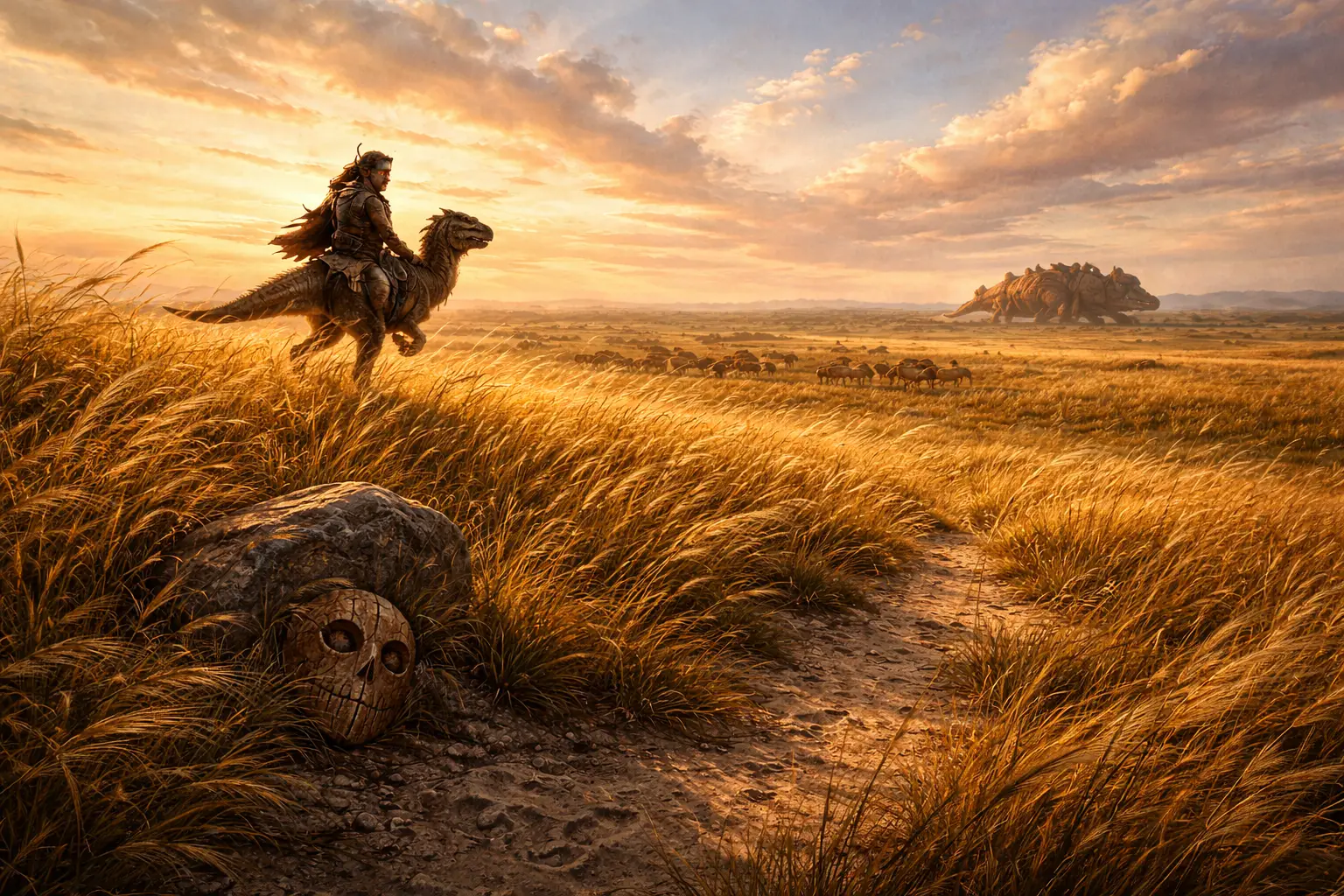
Politics of the Talenta Plains
"The people of the Talenta Plains have little interest in political machinations. Stories say that they draw straws to see who has to serve as an ambassador, but these rumors are false. In truth, they fight duels, with the losers being sent to the courts of the western nations." — Sivis diplomatic briefing on the Talentan embassy in Sharn
How a Tribe is Governed
There is no word in the Halfling language for "government." There are words for leading, listening, deciding, and walking together, but no word for the thing the Five Nations mean when they say government — a permanent institution, separate from the people it governs, that makes rules and enforces them from above. The halflings do not have this. They have tribes, and the tribes have laths, and the laths lead because the tribe trusts them to.
A lath is a chieftain — chosen by merit, not bloodline. All members of the tribe are treated as equals, but the lath determines the tribe's movements, settles disputes, and makes decisions in times of crisis. The lath holds authority for exactly as long as the tribe's confidence holds. There is no fixed term. There is no election. If a significant voice for change stirs within the tribe, the lath can be replaced — not through a vote or a challenge but through the quieter process of the tribe shifting its attention to someone else. A lath who no longer leads is simply a lath who no longer has anyone following.
The shamans serve as spiritual advisors — consulting the ancestors, reading the spirit world, choosing migration paths, mediating between the living and whatever else shares the territory. The shamans do not rule, but their counsel carries weight that no lath would ignore. A lath who moves the tribe against the shamans' advice and meets disaster will not be lath for long. A spiritual leader can serve as lath — Holy Uldra is both shaman and chieftain — and when this happens, the authority of the two roles reinforces itself in ways that can make a single leader extraordinarily influential.
For most questions, the tribe debates around the campfire and consensus rules. The lath has the final say, but it is rare for a lath to override the consensus without clear reason — and rarer still for the tribe to accept it gracefully if they do.
"A Brelish diplomat asked me how the lath is chosen. I told him the tribe chooses. He asked how they vote. I told him they do not vote. He asked how they decide. I told him they talk until they agree. He asked what happens if they cannot agree. I told him they talk longer. He looked very tired." — attributed to a Talentan envoy, Gatherhold, undated
The Lathon and the Council
Occasionally a lath is so charismatic, so trusted by multiple tribes, that they are able to unite many tribes beneath one banner. These leaders are given the title of Lathon — a word that implies both leadership and the temporary nature of the arrangement. The Lathon has authority to negotiate for the tribes as a whole, to represent them in dealings with outsiders, and to coordinate action across tribal boundaries. The title is rare. It is not hereditary. It lasts as long as the crisis that produced it, and when the crisis passes, the Lathon goes home.
Lathon Halpum earned the title during the Last War by pulling the tribes together into the first unified alliance in living memory. He represented the Plains at the Treaty of Thronehold. He won sovereign recognition. And then, when the war ended, he gave up the title and returned to leading one tribe — because that is what a Lathon does when the crisis is over. He continues to urge peace and cooperation, to argue for the vision of a nation of nations in which the tribes work together while maintaining their independence. But he is no longer Lathon; he is a lath with a reputation.
The councils at Gatherhold are where inter-tribal politics happen. All tribes come to Gatherhold to trade, hold councils, and settle disputes. The town was built for this — a meeting ground, not a capital. There is no permanent government seated there, no parliament, no bureaucracy. When the tribes have something to decide, they send their laths and shamans to Gatherhold and talk until they reach a decision or fail to. The process is slow, informal, and maddening to foreign diplomats who are used to agendas, quorums, and binding resolutions. The halflings do not see this as a problem; the system has worked for thousands of years. What the diplomats call inefficiency, the halflings call patience.
The Divide
The postwar politics of the Plains can be reduced — crudely but not inaccurately — to one argument.
Halpum believes the tribes can engage with the wider world without losing themselves. He envisions Gatherhold as a seat of something like governance, the tribes cooperating on matters of defense and trade while remaining independent in their internal affairs. He wants to build relationships with Karrnath, with the dragonmarked houses, with the Treaty nations — relationships on Talentan terms, from a position of recognized sovereignty. His model has no precedent in Talentan history, and he knows it. He is asking the tribes to become something they have never been, and he is betting that the world will not let them remain what they have always been.
Holy Uldra says the opposite. She is a powerful shaman, a lath in her own right, and the most forceful voice for isolation on the Plains. She urges halfling warriors to join together for a single purpose: drive the outsiders out, close the borders, maintain the ancient traditions without compromise. Following the path of the Five Nations, she argues, goes against the spirits of the ancestors and the beasts with which the halflings share the Plains. The traditions exist because they work. The spirits demand they be preserved. Every concession to the outside world — every trade agreement, every Karrnathi fort, every dragonmarked house expansion — is a step toward becoming something the ancestors would not recognize.
Most of the tribes have not committed to either side. They went home after the treaty. They would like to be left alone. The question is whether the world will cooperate, and the answer — with Valenar warbands on the borders, Mournland horrors to the west, settlers crossing to Q'barra, and the houses circling Gatherhold — appears to be no.
The Houses at Gatherhold
House Ghallanda maintains Gatherhold, but Gatherhold belongs to the people, not the houses.
Ghallanda and Jorasco both originated on the Plains. Their dragonmarked lines still run through the tribes — halflings carrying the Marks of Hospitality and Healing who have never set foot in a Ghallanda inn or a Jorasco hospital. The houses maintain a presence at Gatherhold and provide services there. Other dragonmarked houses offer services as well. The relationship is respectful but complicated: the houses are halfling institutions that left the Plains and became something else, and the tribes are not sure what to make of entities that wear the blink dog emblem but answer to the Twelve rather than the shamans.
Ghallanda's role at Gatherhold is maintenance, not governance. The house keeps the town running — the lodgings, the commons, the trade infrastructure — but it does not set policy, does not mediate inter-tribal disputes, and does not speak for the Plains in foreign affairs. Baron Yoren d'Ghallanda and his daughter Chervina have expanded the house's presence even in remote areas, guided by their study of the Draconic Prophecy — an interest that the Talentan shamans regard with something between curiosity and suspicion.
The houses that concern the tribes most are not Ghallanda and Jorasco but Tharashk — whose prospectors have been surveying dragonshard fields and mineral deposits on the Plains — and Cannith, whose interest in the ancient ruins has not gone unnoticed. The shamans' position on the ruins is the same as it has always been: do not enter them. The houses' position on the ruins is that they contain artifacts worth recovering. This disagreement has not yet become a crisis. It will.
External Relations
The Talenta Plains are a recognized Thronehold nation, but barely. The halflings have a seat at the table and no particular interest in sitting in it.
Ambassador R'tannan represents the Plains in Sharn. He attends diplomatic meetings and trade negotiations but is far more interested in gambling, especially on the many races that occur in the city. The Talenta embassy has no direct connection to the Boromar Clan, House Ghallanda, or House Jorasco — a deliberate separation that the tribes maintain to ensure their diplomatic voice is their own, not a house's. The Boromars, for their part, maintain ties to the Plains — their Clawfoot barbarian squad is recruited from Talentan warriors — but these are clan connections, not state connections, and the embassy does not acknowledge them.
Karrnath is the most significant external relationship. Under the Treaty, Karrnath has established forts in halfling territory for the mutual protection of both nations against Valenar raids. This alliance is real and functional — some Talentan tribes have shifted their migration routes to pass through southern Karrnath, and new tribes have settled in the Vulyar buffer zone, blending Talentan and Karrnathi traditions. Whether this constitutes genuine partnership or a quiet re-annexation depends on whom you ask. The Karrnathi government, from monarch to reeve, hopes to recruit the halflings as a permanent buffer against the elves. The halflings have been useful buffers before. They remember how that ended.
Valenar is the most urgent external threat — not because the elves intend to conquer the Plains, but because their warbands cross Talentan territory freely, treating the grasslands as open ground for raiding and provocation. The elves' interest is in provoking Karrnath, not the halflings, but the halflings are the ones whose herds are scattered and whose migration paths are disrupted.
The Mournland leaks horrors into the western Plains with increasing frequency. Q'barra generates settler traffic and bandit clashes. And behind all of it, the dragonmarked houses circle, patient and smiling, waiting for the moment when the tribes need something only the houses can provide.
"Everyone wants something from us. Karrnath wants soldiers. The houses want resources. The elves want a fight. The Cyran refugees want sympathy. And all of them act surprised when we tell them we just want to ride." — overheard at the Gatherhold council, 998 YK