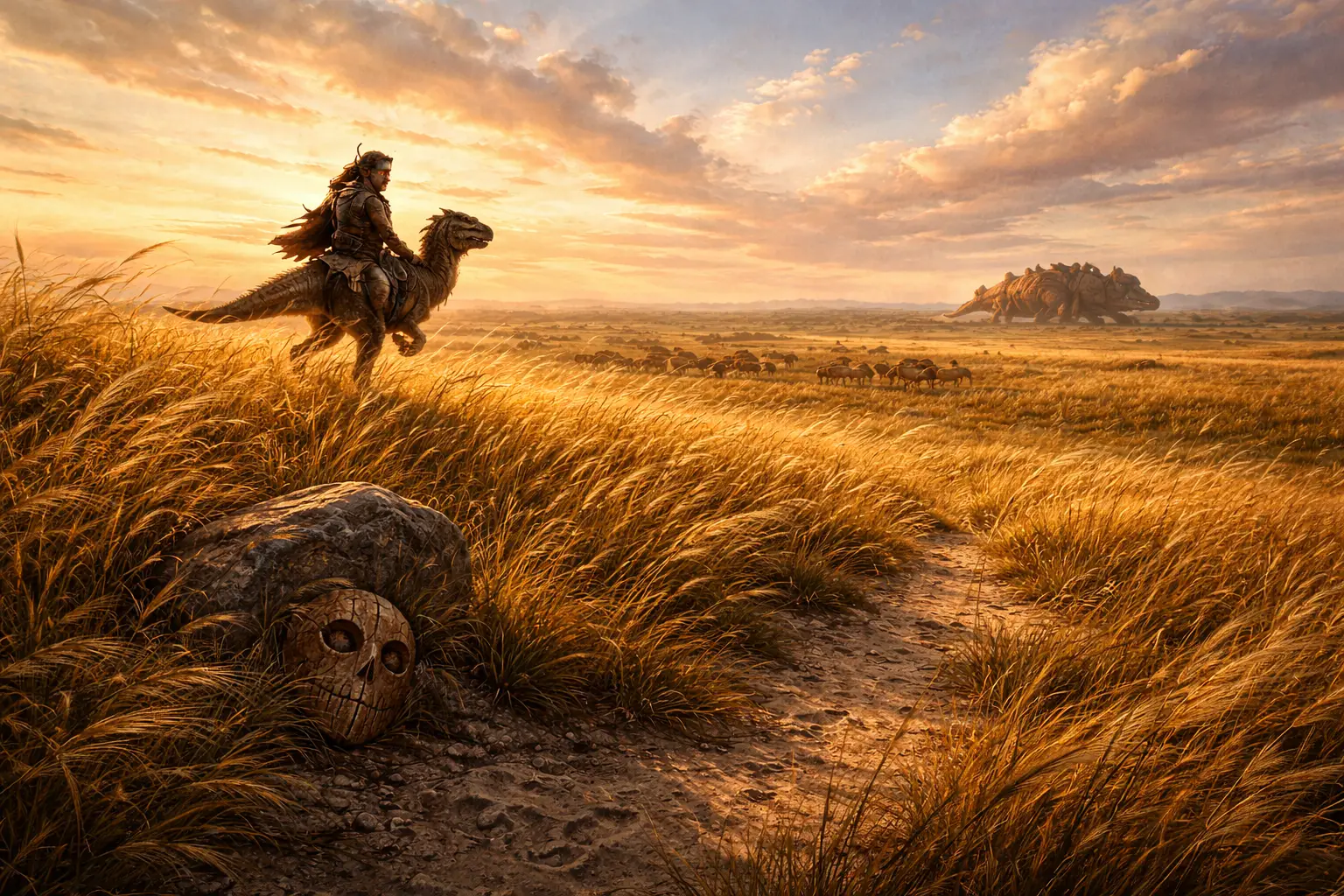
Military & Security of the Talenta Plains
"A howling halfling warrior charging in on a clawfoot raptor? Most terrifying thing I've ever seen." — Sir Danton ir'Lain, Brelish knight
No Army
The halflings have survived for thousands of years — through the Age of Monsters, through the expansion of the Dhakaani Empire, through the occupation of the Q'Barra dragonborne, through the arrival of humanity and Karrn's wars of conquest, through a century of the Last War fought across their grasslands — without ever once fielding a conventional army. They have done this by being small, fast, hard to find, and absolutely terrifying when they decide to stop hiding. A Karrnathi warlord who marches a column of heavy infantry into the Plains will find no one to fight. His supply lines will be harassed by riders he cannot see. His scouts will not come back. His camps will be raided at night by warriors on clawfoot raptors who hit fast and vanish into the grass. And if he has the patience to wait, the grass will do the rest — the spirits will become restless, the arcane systems will start to fail, and the land itself will make it clear that he was not invited and is not welcome.
The halflings do not fight the way the Five Nations fight. They fight the way the grass fights: by being everywhere, by being patient, and by outlasting whatever tried to stand on top of it.
The Warrior
Every halfling who can ride can fight. The distinction between hunter and warrior is a matter of what you are hunting, not a matter of training or class. A hunter who tracked tribex last season might ride against Valenar raiders this season and return to the herds the season after. When a threat appears, the lath calls the riders, and the riders come.
Talentan warriors favor speed, stealth, and finesse over brute force; their fighters are barbarians, rangers, and rogues, not plate-armored knights. The halflings' small size, natural agility, and the Lightfoot talent for stealth make them devastating skirmishers: a clawfoot-mounted rider is nearly invisible in tall grass, faster than a warhorse over open ground, and capable of closing to melee range before the target understands what is happening.Typical engagement involves loose volleys on the charge, switching to melee and tooth-and-claw, and whipping back out before the fight becomes a true engagement, covering the withdrawal with more ranged volleys. It is not a tactic designed to hold ground, for the Talenta have no ground to hold; it is a tactic designed to make the enemy regret entering ground that was not theirs.
The bond between rider and mount is military as well as spiritual. A Talentan warrior does not ride a clawfoot the way a Karrnathi lancer rides a horse — as a vehicle that carries the fighter to the fight. The rider and the clawfoot are a single combatant. The rider rarely dismounts, even in situations where a human soldier would. The raptor fights with its own teeth and claws while the rider strikes from the saddle. Spirit riders — warriors with a deeper bond — can direct their mount through the spiritual connection, coordinating attacks with a precision that no spoken command could achieve. A spirit rider and a clawfoot in full charge, moving as one creature, is one of the most dangerous things a soldier can face on any battlefield in Khorvaire.
Shamans support warriors through primal magic — spirit consultation, warding rituals against fiends and fey, healing, and the ability to speak with the land in ways that make ambush and evasion almost supernaturally effective. A tribe whose shaman has spoken with the spirits of a particular stretch of grassland knows every hollow, every rise, every place where the wind carries sound and where it does not.
"We asked a Deneith officer what the halflings were like in the field. He said: 'Fast. Quiet. Angry. Precise.' We asked if they were effective. He looked at us like we were children." — from the notes of a Morgrave researcher studying Last War mercenary deployment
The Mounts
Clawfoot raptors are the primary war mounts — fast, aggressive, and capable of fighting independently while the rider strikes from above. A clawfoot charge is not a cavalry charge in the Karrnathi sense; it is closer to a pack of predators hitting a target from multiple angles at speed.
Fastieth serve as swift riding mounts and pursuit animals — faster than horses over distance, used for scouting, flanking, and the rapid withdrawals that define Talentan combat.
Glidewings provide aerial reconnaissance. A glidewing rider can see further than any ground scout, track movement across miles of grassland, and carry messages between dispersed tribal groups faster than any land-based system. In a conflict, the tribe that controls the air controls the information — and the halflings have controlled the air over the Plains for as long as anyone can remember.
Three-horn bellows — the deep calls of triceratops — carry across great distances and are used for signaling between dispersed groups. A lath coordinating a response across miles of grassland does not need a Sivis message station. She needs a three-horn.
Mercenary Service and the Last War
The halflings' combat skills were not a secret, and during the Last War, the nations paid for them. Talentan warriors — primarily scouts and light cavalry — served as mercenaries through House Deneith, fighting for Karrnath, Cyre, and occasionally other employers. Some tribes allied directly with one side or the other. Some signed on with Deneith and fought for whoever paid, sometimes serving multiple employers in the same season. The halflings had been useful to empires before. They knew how the arrangement worked.
Veterans of the Last War who fought alongside — or against — Talentan scouts remember the experience with vivid discomfort. A halfling scout on a clawfoot can cross terrain that would stop conventional cavalry, can disappear into grass that barely reaches a human's knee, and can return with intelligence gathered from positions that the enemy thought were secure. Career soldiers from every nation describe the same thing: the halflings were there, and then they were not, and then they were behind you.
The Boromar Clan in Sharn maintains a direct connection to the Plains through the Clawfoots — a squad of Talentan barbarians recruited for brute force operations in the city. Once a year, Saiden Boromar sends a delegation to the Plains with gifts and supplies for the old family. If talented warriors want to join the Clawfoots, they travel back with the delegation. The arrangement is not tribal policy — the Talentan embassy in Sharn has no connection to the Boromar Clan — but it is a real pipeline between the Plains and the criminal underworld of Khorvaire's largest city.
Postwar Threats
The Plains face four active security concerns, none of which can be solved by an army the halflings do not have.
Valenar. The most urgent and most persistent. Tairnadal warbands cross Talentan territory regularly, raiding into Karrnath and treating the grasslands as open ground. The elves are not interested in conquering the Plains — they are interested in provoking Karrnath into a wider war, and the halflings are caught in between. A Talentan tribe whose herds are scattered by an elf warband on its way to raid Vulyar has been harmed just as surely as if the elves had attacked them directly, and the distinction between "passing through" and "invading" is cold comfort to a lath whose migration route has been disrupted.
The Mournland. Horrors slip out of the dead-gray mist on the western border with increasing frequency — living spells, mutated beasts, and things no shaman has a name for. The tribes that migrate near the Mournland's edge have adapted, posting glidewing scouts and avoiding the worst zones, but the threat is unpredictable and worsening.
Q'barra traffic. Settlers, merchants, and bandits cross the Plains on their way to Q'barra, clashing with each other and disrupting tribal migration routes. The halflings are hospitable to peaceful travelers, but armed groups are assessed as threats, and the distinction between "merchant caravan" and "bandit column" is not always clear from the back of a glidewing.
The Karrnathi alliance. Karrnath has established forts in halfling territory for the mutual protection of both nations against Valenar raids. The alliance is functional — some tribes have shifted migration routes to pass through southern Karrnath, and new tribes have settled in the Vulyar buffer zone. But the forts are Karrnathi forts, garrisoned by Karrnathi soldiers, and the halflings have a long memory of what Karrnathi "protection" looked like under Galifar. Whether the alliance remains mutual depends on whether Karrnath continues to ask for cooperation or begins to expect it.
"The Karrns built a fort on the northern grass and told us it was for our protection. We thanked them. We are very polite. But we remember the last time someone built something permanent on our grass, and we remember what happened to it." — a Talentan lath, speaking at the Gatherhold council