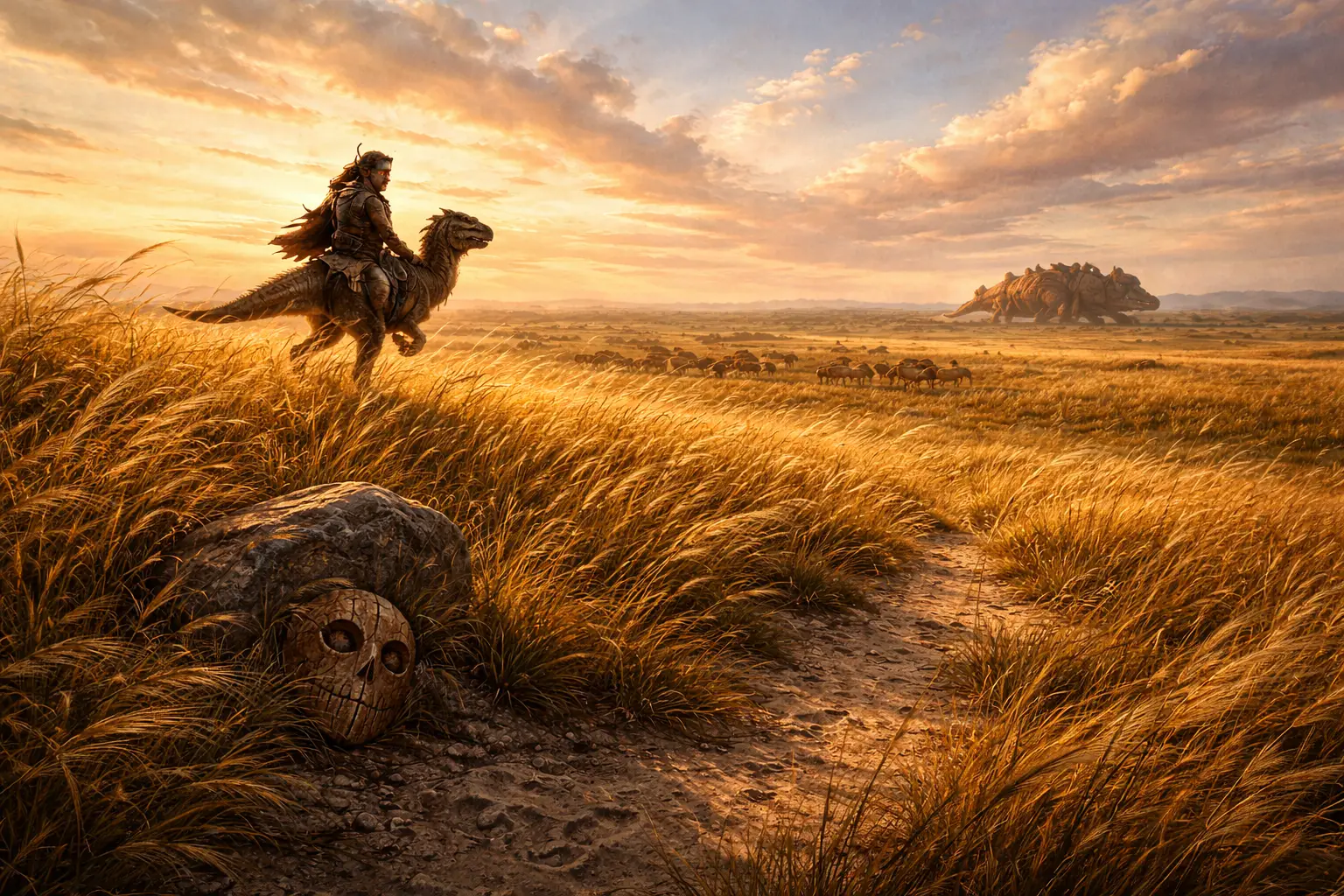
Art & Culture of the Talenta Plains
"You don't understand the concept of 'facts.' To you, everything is a story, and truth is in how you tell it." — a halfling quirk, as recorded by a Morgrave ethnographer who did not realize it was also an insult
Everything Is a Story
The halflings of the Talenta Plain tell stories about everything — history, law, medicine, navigation, the proper way to approach a camp, the names of the dead, the routes the herds should take in autumn. It is all carried in stories told around a fire, passed from speaker to listener, adjusted with each telling, and remembered not as fixed text but as living narrative.
A Talentan speaker or spirit-keeper who can recite centuries of names, routes, and events is performing a feat of memory that a Sivis scribe would find staggering. The stories carry more than facts. They carry meaning — why a thing happened, what it teaches, what spirit moved through the event and left its mark. A Five Nations historian records that a tribe crossed the southern grass in the year 600 YK. A Talentan speaker tells you the story of the crossing: why the shaman chose that route, what the spirits said about the weather, how a young rider's clawfoot saved the herd from a glidewing storm, and what mask the lath wore when she decided to turn west instead of south. Both accounts are true. The Talentan account is also useful.
The halflings' relationship to truth is shaped by this. "Facts" in the Five Nations sense — fixed, verifiable, independent of the teller — are not quite what the halflings mean when they say something is true. A story is true when it teaches the right lesson. Whether it happened exactly the way it is told is a secondary question, and asking it marks you as someone who has not understood what stories are for.
The Spirit World
The Plains are full of spirits. Fey, ancestors, elementals, fiends, and things that fit no clean category — they are all present, all the time, layered over the grass like weather. The concentration is unusual even by Eberron's standards. The ambient energies of Lamannia, Thelanis, and Dolurrh are strong in this region, but most of the spirits are not from those planes — they are native, shaped by Thelanian or Dolurrhi energy into forms that belong to the Plains themselves. A fey clawfoot is not a visitor from Thelanis; it is Thelanian energy that has been shaped by the land and by deep archetypes into something that looks like a clawfoot and acts like a fey and has a story it wants someone to hear.
The halflings know this. Their entire spiritual tradition is built around navigating a landscape where the spirit world is not somewhere else — it is here, underfoot, in the wind, in the behavior of a clawfoot that turns its head toward something only the shaman can see. The religion of the Plains is a blend of ancestor worship, reverence for natural spirits, and a practical layer of the Sovereign Host — notably, Balinor is understood to have been a legendary Talentan hunter, and Arawai to have blessed the herds. The shamans do not treat these as separate categories. Ancestors, nature spirits, Sovereigns, and the fey are all part of the spirit world, and the spirit world is everywhere.
Masks
The spirit mask is the most visible expression of Talentan culture — the practice that outsiders notice first and understand last.
Warriors and shamans both wear masks. The mask is not a disguise. It is not a decoration. It is a vessel for the spirit of the wearer — a way of presenting a face to the spirit world that says who you are and what you intend. A warrior in a clawfoot mask is telling the spirits I hunt. A shaman in an ancestor's face is saying I listen. A mourner wearing the mask of a dead companion carries that spirit forward.
The masks are made by Maskweavers — a spiritual tradition that deals primarily with fey and elemental spirits. Each mask is unique. Within a tribe, there is a common general style, but the subject of the mask varies and is often more abstract than concrete. A mask might depict a dinosaur, an ancestor, a spirit of the weather, or something the weaver saw in a dream. The point is not representation — it is resonance. The mask must feel right to the wearer and right to the spirits. A Maskweaver who produces a mask that does not resonate has failed, regardless of how well it is carved.
When a mount dies, the warrior carves a mask in its likeness. When a person dies, their mask is broken, burned, or ritually dismantled and redistributed among family. Names are added to tribal memory chants. Bodies are given to sky, flame, or beast, returning them to the Plains' cycles. The Talentan do not build tombs.
"A visitor from Sharn asked to buy one of the masks. The Maskweaver explained, very patiently, that the mask was not hers to sell. It belonged to the spirit it carried. The visitor asked who the spirit was. The Maskweaver said she did not know yet — that was why she was still making it."
Everyday Magic
The Talenta halflings are what some might call a Wide Primal society. They have never pursued the arcane science that defines the Five Nations — in part because they have never needed to, and in part because arcane magic does not work reliably on the Plains over time. Instead, they employ a primal tradition: druid magic, fey pacts, and spirit bargains, woven into daily life the way magewright services are woven into life in Sharn.
Gleaners — the Talentan equivalent of magewrights — know a few cantrips and can cast a handful of spells as rituals, typically druid spells, though those who work with fey spirits often employ enchantment and illusion. The everyday magic of the Plains includes animal friendship, animal messenger, beast bond, beast sense, and speak with animals — but with a critical limitation: these specialized rituals typically only work on reptiles. This is one reason the halflings work so closely with dinosaurs; their magical tradition evolved to work with them. A gleaner's speak with animals can communicate with a clawfoot but not a tribex. The traditions are more limited than their arcane equivalents in some ways and more effective in others — a spirit rider's trance, combining beast bond and beast sense, allows hours of telepathic communion with a dinosaur companion that no arcane equivalent can match.
These traditions do not work when a halfling leaves the Plains. The spirits are not there in Breland or Karrnath. This is why Ghallanda and Jorasco employ arcane science in the Five Nations rather than the primal tradition they grew up with — the magic of the Plains stays on the Plains.
Music and Sport
The dinosaurs are instruments. Hammertail drums — the deep, resonant strikes of an ankylosaurus tail — accompany somber rituals. Three-horn bellows carry across the grasslands for signaling between distant groups. Dartwing choirs — flocks of small pterosaurs whose calls blend under a handler's direction — support other musicians. Scale singers blend the traditions of spirit rider and bard, riding a dinosaur and singing with its voice — a performance tradition that exists nowhere else in Khorvaire.
Bards carry news between tribes, traveling with the migration routes the way the Wandering Inn does. Baker describes the Talentan bard tradition as flamboyant and physical — storytellers, entertainers, and carriers of culture who keep the oral tradition alive and bridge the distances between dispersed tribes.
Dalasci — a mounted sport somewhat like aggressive polo — is the primary competitive tradition, effectively combat training disguised as recreation. Scamp races are the other common sporting event, and a reliable basis for gambling at Gatherhold.
Food and Taboo
Talentan cuisine is built around tribex (milk, meat, leather), foraged plants, and dinosaur eggs. Scamp eggs are a dietary staple available year-round. Other dinosaur species lay unfertilized eggs only seasonally — typically between Nymm and Lharvion — and these seasons are celebrated as times of feasting and honoring the dinosaurs that share the gift. The tribes do not keep dinosaurs for the eggs. The eggs are a bonus from a relationship that is sacred.
The most important food taboo derives from the legend of Orlasca, the Hungry Hunter. The greatest hunter of his age, Orlasca swore to eat every creature he killed. When he was forced to kill another halfling, his oath compelled him to consume the body — and he developed an insatiable appetite for halfling flesh. After he slew his whole tribe, Orlasca was finally killed. But his spirit lingered, slipping into the forms of lesser creatures, trying to work its way back to halfling form. The taboo: never consume the flesh of a creature that eats its own kind — because doing so allows the spirit of Orlasca to pass into you and transform you into a ghoul. The Orlasca ghouls that haunt the Plains inhabit beast forms and are guided by a single predatory consciousness. The halflings avoid their hunting grounds. The shamans say the taboo is real. On a plane-touched grassland thick with Dolurrhi manifest zones, they may be right.
The Peoples of the Plains
The halflings are not alone on the grass.
The Trascalando — centaur-like beings blending humanoid and tribex — travel with herds across the Plains. Most Trascalando bands are friendly toward the halflings and maintain a long tradition of trade and storytelling. The Valenar incursions have strained this relationship; the Trascalando are deeply suspicious of elves.
The Talenta Plains are the only nation in Khorvaire with a significant population of planetouched Changelings — beings born with the changeling nature not through the Children of Jes but through the influence of Thelanis on unborn children. Further, the Plains are home to a larger population of genasi than most; rare humanoids touched by the elements of Lamannia. Rarer still are Masquers: minor spirits of Thelanis who have been dislodged from their stories and drifted into the mortal world, taking mortal form. Some Masquers embrace mundane life. Others yearn to become the heroes of their own stories — to matter in a way they never did in Thelanis. The halflings treat all these as ordinary members of the community, because on the Plains, being touched by the spirit world is not remarkable. It is Tuesday.
"The spirits are everywhere. In the grass, in the wind, in the bones beneath the camp. You do not have to believe in them. They do not need your belief. They were here before you arrived and they will be here after you leave. All you have to decide is whether you are going to listen." — a Talentan shaman, to a party of newcomers