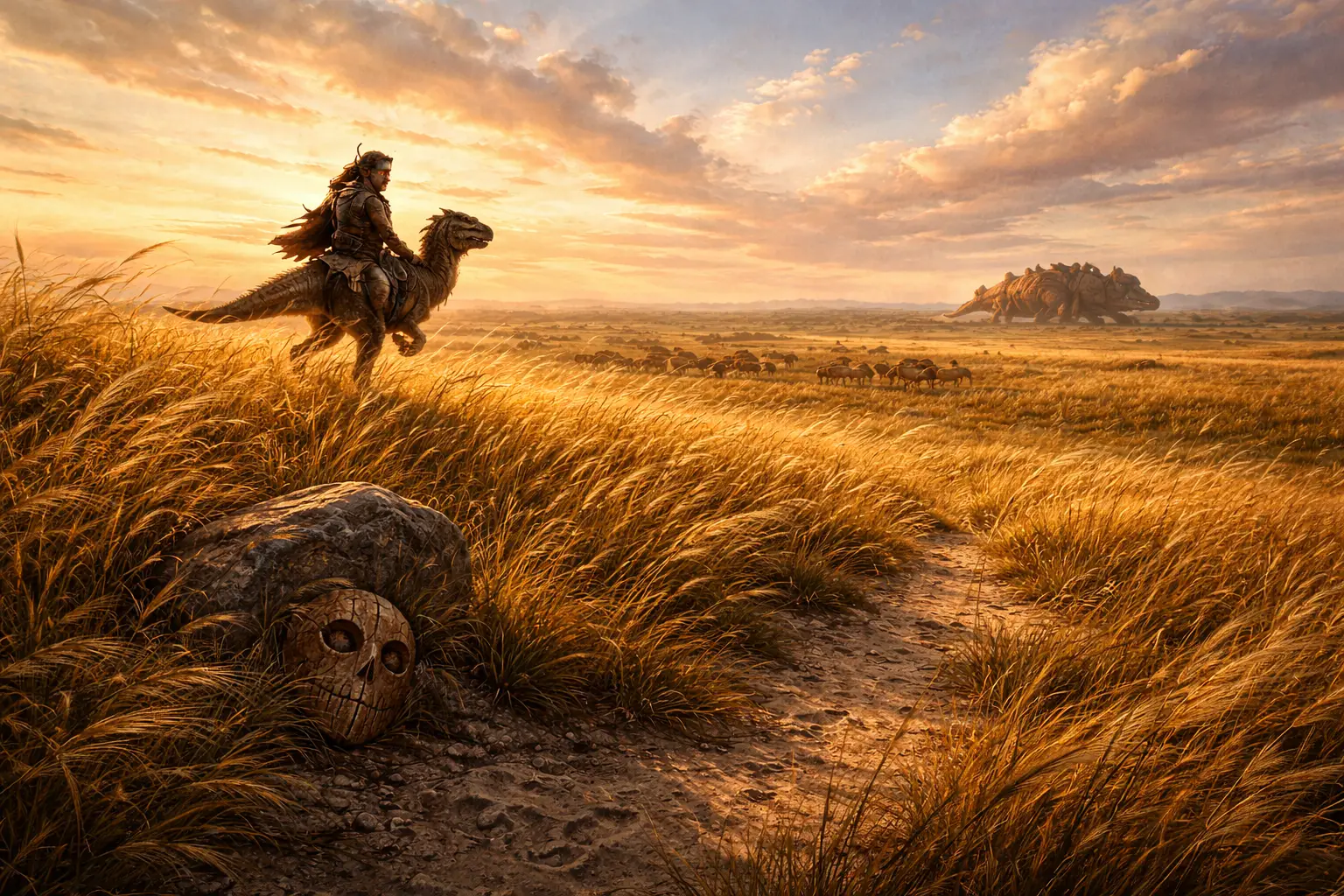
History of the Talenta Plains
"My esteemed colleague's suggestion of establishing vast farms in the Talenta Plains shows his ignorance of history and lack of common sense. Why do you suppose the Talenta tribes are nomadic?" — Alina Lorridan Lyrris, Aurum Concordian
A shaman sits by a fire and says: before the goblins came, before the humans came, before the elves came, the grass was here, and we were here, and the great lizards were here with us. She does not give a date. She does not name a year. She tells the story, and the story is enough.
The scholars of Morgrave and Korranberg have tried to pin dates to what the halflings remember. They have managed a rough outline. They have not managed to explain the most important thing about the Plains — why the halflings are still there, still nomadic, still practicing primal magic instead of the arcane science every other civilization on Khorvaire adopted centuries ago. That question has an answer. The halflings know it. They do not share it with surveyors.
Before Anyone Was Counting
The halflings are native to eastern Khorvaire. How long they have been on the Plains, no one can say — not even the shamans, who will tell you that the ancestors go back further than the ancestors can remember, and that this is answer enough. The Plains contain ruins that predate every known civilization: structures so old that the halflings themselves do not know who built them, only that the spirits inside are not friendly. The Boneyard — a vast graveyard holding the bones of dragons — sits somewhere in the deep grass, avoided by every tribe. The ruins of Krezent hold older secrets still.
There are no Dhakaani ruins in the Talenta Plains. The great goblin empire that dominated Khorvaire for millennia never settled here. Whatever kept the Dhakaani out of the Plains — whether the spirits, the dinosaurs, or something else entirely — kept them out thoroughly. The Trothlorsvek, a lizardfolk empire that expanded from Q'barra, did push into the Plains. Their empire collapsed — with, the shamans say, threats of a great fiend bound somewhere beneath the region. The halflings survived that too.
Dinosaurs thrive in the Plains and in Q'barra but are not widespread elsewhere in Khorvaire. The halflings domesticated them — or the dinosaurs chose the halflings — at some point so far back that the distinction between rider and mount has become part of the spiritual fabric of both peoples. The bond is not merely practical. It is the oldest relationship the halflings have, older than their relationship with the spirits of the dead, older than the dragonmarks, older than anything they can name.
The Dragonmarks (~3,200–3,000 YK)
The Mark of Hospitality appeared among the halflings of the Plains approximately 3,200 years ago — among the earliest dragonmarks to manifest on Khorvaire, appearing centuries before humans arrived on the continent. Those who manifested the mark saw it as a blessing and formed the Ghallanda tribe, dedicated to helping all those in need. Roughly two hundred years later, the Mark of Healing appeared among a separate group of halfling families who became the Jorasco clan.
Both marks were boons to nomadic life — Hospitality providing sustenance and shelter in a dangerous land, Healing mending what the Plains inflicted on those who traveled them. In their earliest days, House Ghallanda used the Mark of Hospitality to help travelers survive the many dangers of the region. The Wandering Inn is the oldest expression of this tradition, and it predates the house that maintains it.
The marks would eventually draw the halflings outward. But that came later.
The Humans Arrive (~3,000 YK–)
When humanity spread across Khorvaire following Lhazaar's landing around –3,000 YK, most of them shunned the Plains. The land was haunted. The spirits were real. The dinosaurs were large and aggressive and did not respond to conventional animal handling. Settlers from Metrol, soldiers from Korth, explorers from Zilargo — some ventured into the grasslands, drawn by tales of ancient ruins and strange magics. None stayed long. Those who survived often did so because the halflings helped them.
Stories of the helpful halflings spread, and eventually the houses took notice. The Severin-Harn Expedition — a joint operation of House Cannith and House Sivis — was dispatched to investigate the Plains: the ruins, the magics, and the rumored dragonmarks. Severin-Harn found everything it was looking for. It was fortunate that it did — without the assistance of Ghallanda and Jorasco, the explorers would have died a dozen times over.
This encounter changed the trajectory of both houses. Ghallanda and Jorasco were recognized by the dragonmarked community, and halflings bearing the marks began to migrate outward — spreading healing and hospitality along the same routes humanity was using to settle the continent. The halflings who left adapted. They learned Common, adopted human customs, built inns and healing houses in human cities. They became the urban halflings of the Five Nations — indistinguishable in manners and dress from their human neighbors.
The halflings who stayed on the Plains kept riding.
"The Plains are vast and dangerous, and when humanity spread across Khorvaire most shunned this haunted land. But over the course of centuries, some folk did plumb the mysteries of the Plains. None stayed for long, but they delved deep enough to encounter trouble — and some of them, to be offered respite by the Wandering Inn." — from a Sivis chronicle of the Severin-Harn Expedition
Karrn and the Northern Border (Pre-Galifar)
When Karrn the Conqueror united the human kingdoms of the northeast around –1,000 YK, his territories extended south through the grasslands. His campaign of extermination against the goblinoids was thorough — Karrnath has the smallest goblinoid population of any Five Nation — but the halflings were not subject to the same genocide. They were pushed south by the encroaching human kingdoms, their range contracting as settlers claimed the northern grasslands for agriculture.
The border between the halfling Plains and the human north was never clean. Before Galifar, there were times when Karrn warlords subjugated nomad tribes, demanding tribute and forced service. And there were times when Talentan raiders struck deep into Karrnath, riding clawfoot raptors through farming communities with a speed and violence that the northern garrisons could not match. The relationship was tumultuous — neither side controlled the other, and the borderland between them shifted with every generation.
Some nomad tribes chose to settle in the border region, adopting agriculture and swearing fealty to Karrnathi warlords in exchange for protection. Their descendants still live in small halfling towns in southeastern Karrnath — communities that think of themselves as Karrns but retain elements of the Talentan faith, speak both Common and Halfling, and keep domesticated fastieth and glidewings. The Jorasco clan, drawn by primal spirits or the draconic prophecy, resettled in the Karrnathi city of Vedykar and established Resthold — the foundation of what would become House Jorasco's continental operations.
Under Galifar (1–894 YK)
When Galifar unified the Five Nations in 1 YK, the Talenta Plains were formally included in the kingdom. The duchy of Vulyar was made responsible for collecting taxes and tribute from the nomadic halflings, who had no fixed towns to govern.
The arrangement worked well enough — which is to say, it worked entirely on the halflings' terms. The tribes carefully concealed their wealth, revealing just enough to remove suspicion and paying tribute that was too small to matter and too consistent to question. The Vulyar tax collectors made their rounds. The halflings smiled and handed over the agreed-upon herds. The collectors went home satisfied. The halflings went back to their lives. This continued for nearly nine hundred years.
Galifar brought one genuine change: stability on the northern border. The raids and counter-raids of the pre-Galifar era ended. The borderland halfling communities settled into a permanent existence between two cultures. And the dragonmarked houses — Ghallanda operating from Gatherhold, Jorasco from Vedykar — expanded their continental operations using the trade routes and institutional frameworks that the unified kingdom provided.
The Plains themselves remained what they had always been: an ocean of grass, full of spirits, crossed by nomads on dinosaurs, and largely ignored by the empire that claimed to own them.
"The halflings pay their tribute late, in livestock, and with a cheerfulness that makes me suspect I am being swindled. I have never been able to prove it." — private correspondence of a Vulyar tax official, circa 750 YK
The Last War (894–996 YK)
The death of King Jarot in 894 YK ended Galifar, and with it the arrangement that had kept the Plains quiet for centuries. The tribute dried up. The borders became battlefields. The Cyre River — the long border between Vulyar and Cyre — became a key point of contention, with Karrnathi forces pushing into Cyre and being pushed back across territory the halflings had been crossing freely for generations.
The tribes responded as they always had when the big people went to war: they cut deals with everyone. Some allied with Karrnath, their traditional overlord. Others sided with Cyre, which shared a border and offered better trade terms. Still others signed on as mercenary scouts through House Deneith, serving every side simultaneously and fighting with a speed and ferocity that earned Talentan halflings a reputation that veterans of every nation remember with visible discomfort. A howling halfling barbarian on a clawfoot raptor was, by widespread agreement, one of the most terrifying things a foot soldier could encounter on any front.
The war was not kind to the Plains. Armies marched across the grasslands. Camps were burned. Migration routes were disrupted by military operations that did not know they existed and would not have cared if they did. The halflings endured — they had been enduring foreign armies for millennia — but the scale and duration of the Last War was unlike anything the tribes had faced.
In 956 YK, the Tairnadal mercenaries Cyre had hired to fight Karrnath seized eastern Cyre and declared the independent nation of Valenar. This brought a new and unwelcome presence to the region — elven warbands riding through Talentan territory, treating the grasslands as open ground. The elves were not cruel, exactly, but they were indifferent to boundaries they had not agreed to, and they regarded the halflings as somewhere between curiosity and obstacle. The Valenar raids added a pressure the tribes had not anticipated: a military force that was not interested in tribute or territory but in combat itself, and that would not stop provoking because provocation was the point.
Halpum and Thronehold (994–996 YK)
On 20 Olarune 994 YK, Cyre was destroyed. The dead-grey mists swallowed the nation overnight, turning the western border of the Plains into the edge of the Mournland. Lake Cyre — where Gatherhold sits — now looks out over haunted territory. The water passage that once connected the Plains to Cyre is gone.
In the aftermath, Lathon Halpum accomplished what no halfling had managed in recorded history: he united the tribes. Not all of them — Holy Uldra and the traditionalist shamans refused — but enough to present a unified front at the Treaty of Thronehold in 996 YK. Halpum argued that the halflings had defended their land through a century of war and deserved recognition as a sovereign nation. He won it. The Talenta Plains became one of the twelve nations recognized by the treaty.
What that recognition means remains the open question. The tribes that united under Halpum have mostly gone home. The council system at Gatherhold was built for trade and dispute resolution, not governance. Halpum talks about a nation of nations. Uldra says the treaty is a piece of paper written by foreigners and the tribes should close their borders and forget it exists. Most halflings are somewhere between the two — glad the fighting stopped, uncertain what comes next, and hoping that if they go back to riding the grass, the grass will still be there when they need it.
"We did not ask to be a nation. We did not need to be a nation. The big people made us one because they needed a name to write on their treaty. Fine. They have their name. We have our grass. We will see which one lasts longer." — attributed to a tribal lath, Gatherhold council, 996 YK