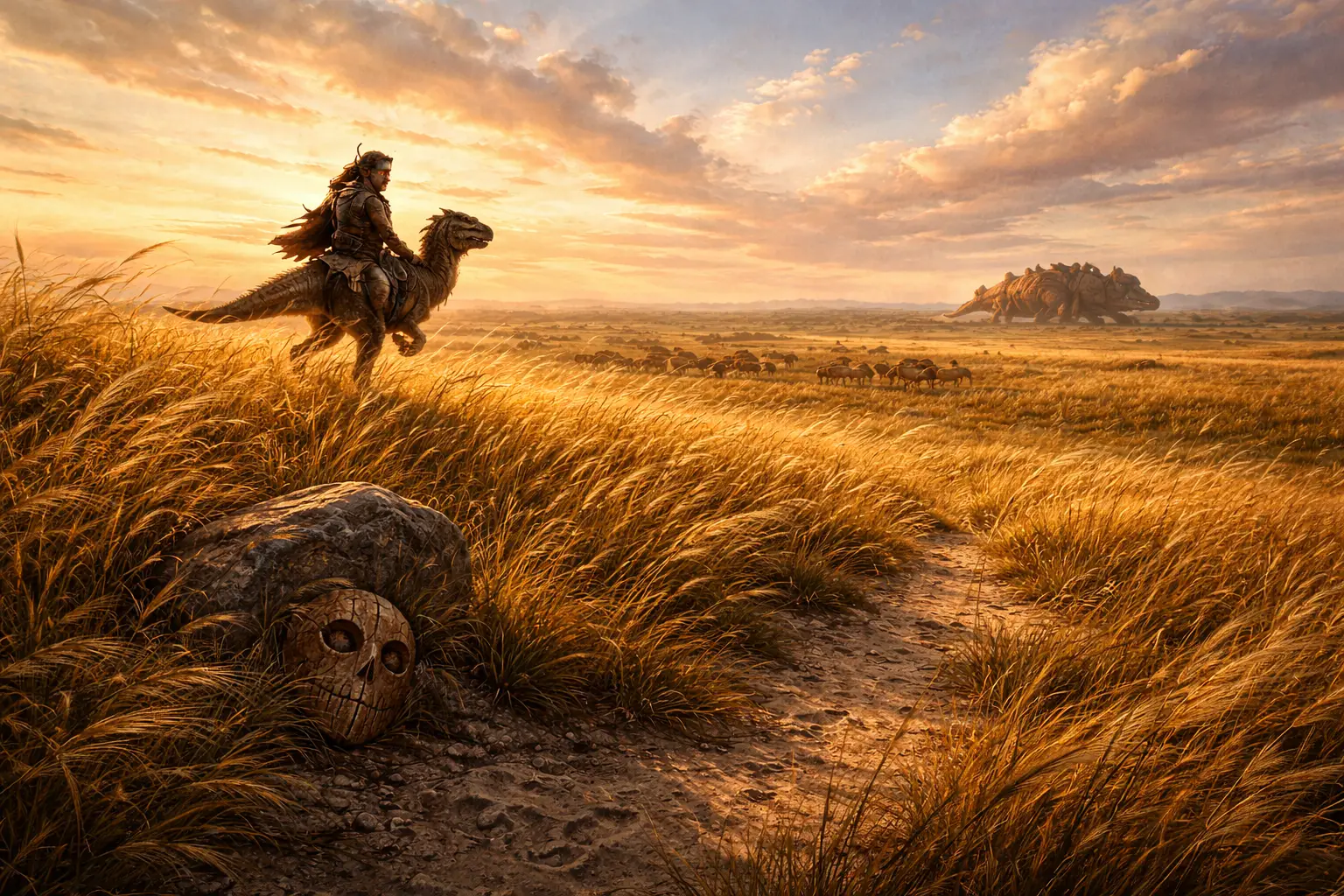
Economy of the Talenta Plains
"My esteemed colleague's suggestion of establishing vast farms in the Talenta Plains shows his ignorance of history and lack of common sense. Why do you suppose the Talenta tribes are nomadic, Danison? Why hasn't House Ghallanda established its own farms in its ancestral homeland, or brought home the arcane tools they use across the Five Nations? Dig deeper and you may find stories of a Scale empire that spread from what we now call Q'barra into the Plains — where is that empire today?" — Alina Lorridan Lyrris, Aurum Concordian
The Way the Tribes Provide
The Talenta halflings are not poor. They have everything they need, and they do not need what the Five Nations are selling. This is the fact that Khorvaire's economists, house agents, and colonial dreamers cannot get past. The tribes are self-sufficient — concerned with producing enough to sustain themselves, not with generating the surplus that drives international trade. They hunt. They herd. They move with the seasons. They trade with each other when paths cross, and they bring what they have to Gatherhold when the councils meet, and when none of that is happening, they ride, and the grass provides. A Cannith factor looking at the Talenta Plains sees untapped resources. A Talentan shaman looking at the same grass sees a larder that has kept her people fed for ten thousand years without anyone needing to build a warehouse.
The tribes are hunter-gatherers, but this undersells what the halflings actually do. They manage herds of tribex — large, mammalian livestock that provide milk, meat, and leather. They harvest seasonal foods from the grasslands. And they work with dinosaurs in ways that no arcane technology has replicated — not because the halflings lack sophistication, but because their sophistication takes forms that Cannith artifice does not recognize as sophistication.
The Dinosaur Economy
The dinosaurs are not livestock. They are not property. They are not raised for food. They are partners — and the distinction matters, because it means the dinosaur economy works nothing like the cattle economy of Karrnath or the magebred industry of Vadalis.
Different tribes specialize in different types of dinosaurs, and this specialization is one of the primary drivers of inter-tribal trade. A tribe known for breeding clawfoot raptors trades with a tribe that breeds fastieth. A tribe with a bloodstriker — a large burrowing herbivore used to establish camps and, in Gatherhold, to maintain latrines and serve as a living mining tool — provides a service no other tribe can match. Glidewing and dartwing breeders are particularly valued: their flying reptiles serve as scouts, couriers, and the only fast communication system the Plains possess.
The larger dinosaurs serve as infrastructure. Hammertails — ankylosaurs — are used as mobile homes; a family can live in a howdah tent on the animal's back, and the tribe moves with its housing attached. A few tribes have thunderherders — diplodocus — which require enormous amounts of food but serve as the lath's living quarters, leading to the expression that someone important "rides the thunder." In Gatherhold, thunderherders lift people to high chambers that can only be reached from a dinosaur's back. Three-horn bellows carry across great distances and are used for signaling between tribes. Hammertail drums accompany somber rituals. Dartwing choirs support other musicians. Scale singers blend the talents of spirit rider and bard, riding a dinosaur and singing with its voice.
A Talentan tribe does not have factories. It has dinosaurs, and the dinosaurs do the work that factories do elsewhere — transportation, construction, communication, labor, music, and war — without requiring Cannith forgeholds, Orien rail lines, or Sivis message stations.
"A Vadalis agent offered to buy three clawfoot yearlings. The lath asked him what he intended to do with them. He said he would breed them. She asked him if he intended to ride with them, hunt with them, sleep beside them, learn their names, and carry their spirits when they died. He said he intended only to breed them. She told him to leave." — overheard at Gatherhold, 997 YK
Tribex and the Herds
If the dinosaurs are partners, the tribex are the livestock — large, mammalian herd animals that the halflings have driven across the grasslands for as long as anyone can remember. Tribex provide the staples: milk, meat, leather, and bone. Talenta use tribex specifically because they do not talk to them — the primal magic of the Plains works with reptiles, and the halflings maintain a deliberate boundary between the animals they bond with spiritually and the animals they eat. The tribex are valued, cared for, and managed with the same attention any herding culture gives its livestock. They are not sacred. The dinosaurs are.
The Trascalando — centaur-like creatures blending humanoid and tribex forms — are nomads who travel with herds of tribex across the Plains. Most Trascalando bands are friendly toward the halflings and maintain a long tradition of trade and storytelling. The Valenar incursions have disrupted this relationship; the Trascalando are deeply suspicious of elves.
Trade Between Tribes
Inter-tribal trade happens when migration paths cross — which, given that the shamans choose the paths, is not always accidental. Tribes exchange dinosaur breeds, crafts, preserved foods, spirit masks, and news. Some tribes specialize in particular crafts — leatherwork, bone carving, the weaving of spirit masks — and are sought out by other tribes for these skills. The scale of this trade is small by Five Nations standards: it is designed to support passing tribes, not to fill warehouses.
The one significant exception is the Castalaloa — "Those who prefer to walk between." This clan of stout halflings settled on the sheer cliffs of the southwestern Ironroot Mountains. Climbers of legendary skill, they dwell in caves high on the cliff face and are renowned breeders of glidewings. The Castalaloa interact with the dwarves of the high cliffs above them, the Talentan tribes who pause in passing along the plains below, and the Jhorash'tar orcs. They are the only Talentan group that functions as a permanent trading node — a fixed point in an otherwise mobile economy — and their glidewing breeding program is one of the few Talentan enterprises that produces something the outside world actively wants.
Gatherhold
Gatherhold is where the Talentan economy meets the continental one, and neither is entirely comfortable with the arrangement.
The town on Lake Cyre has always served as a trading point — historically, it gave the tribes access to Cyran and Karrnathi markets by water. The Mourning cut off the lake passage, but overland trade continues, and the dragonmarked houses maintain services at Gatherhold. Ghallanda runs the lodgings and the commons. Jorasco provides healing. Sivis keeps a message station. Orien marks the waypoint. The result is a settlement that functions as a market town, a diplomatic meeting ground, and the only place on the Plains where a foreign merchant can reliably conduct business.
The people of Gatherhold have drifted somewhat from nomadic traditions — they are more comfortable with direct commerce, more willing to set prices and negotiate in galifars. This drift makes Gatherhold useful to the outside world and faintly suspect to the traditional tribes. Holy Uldra's followers view Gatherhold as the crack through which the Five Nations' influence seeps into the Plains. Halpum's supporters view it as the proof that engagement is possible without surrender.
What the Houses Want
The dragonmarked houses see the Talenta Plains the way a Tharashk surveyor sees an unmapped swamp: full of untapped potential. Mineral deposits. Dragonshard fields. Tribex herds that could be commercially exploited. Dinosaur bloodlines that Vadalis has spent decades trying to replicate and cannot. Ancient ruins that Cannith believes contain artifacts worth recovering. And a population that, from the houses' perspective, is sitting on a fortune and refusing to dig.
House Tharashk is the most aggressive. Its prospectors have been surveying the Plains for dragonshard deposits and mineral resources, and the house's experience in the Shadow Marches — where it turned a similarly reluctant tribal population into a resource extraction operation — provides the model. House Vadalis wants the dinosaurs and has been rebuffed; traditionally, the Talenta would never sell a dinosaur, and giving one to an outsider is a profound gift of trust, not a commercial transaction. In dark times, at least one tribe has reportedly begun selling captured wild dinosaurs to Vadalis — behavior other tribes consider vile. House Cannith is interested in the ruins the halflings avoid, and the shamans' position on the ruins has not changed: do not enter them.
Ghallanda and Jorasco occupy an uncomfortable middle position. They are Talentan houses — born on the Plains, carrying Talentan blood — but they are also continental businesses that answer to the Twelve. Their presence at Gatherhold is genuine hospitality. Their expansion plans are genuine commerce. Whether the tribes can tell the difference, and whether it matters, is one of the quieter questions shaping the Plains' economic future.
"They keep telling us what the grass is worth. We keep telling them the grass is not for sale. Eventually one of us will stop talking." — a Talentan lath, on the subject of Tharashk prospectors