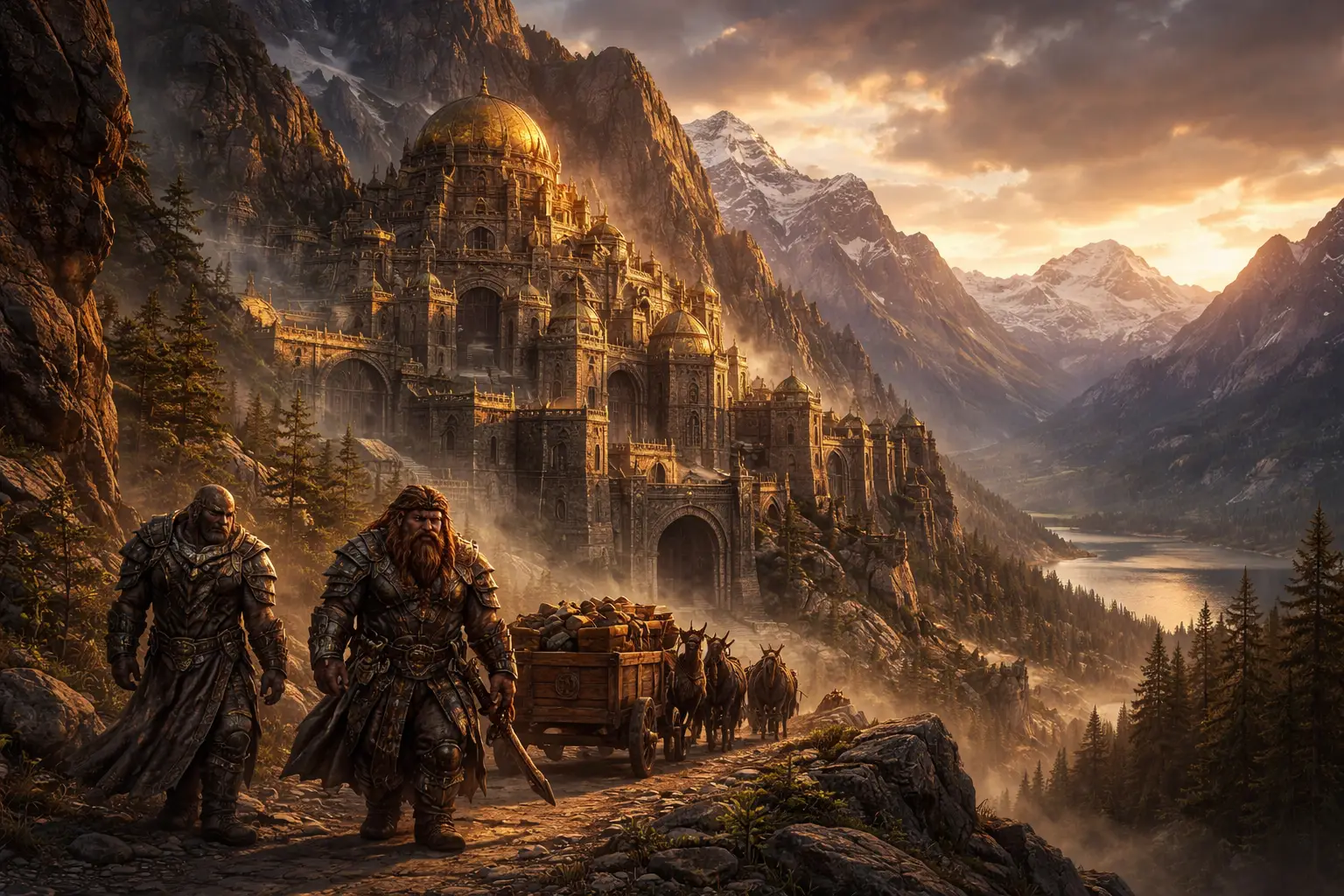
Art & Culture of the Mror Holds
"The dwarf showed up to the trade summit in Korth wearing a mithral brooch worth more than my house. I complimented it. He spent forty-five minutes telling me the story of the brooch — who forged it, which ancestor wore it to which battle, how many times it was stolen and recovered, and why the scratch on the left pin was never repaired because the scratch itself had a better story than the brooch. Then he tried to give it to me. I declined. He seemed insulted." — Brelish trade factor, in a letter home from Krona Peak
Dinner in the Iron Mountains
Picture this. You have been invited to a clan feast in Doldarunhold — a trade negotiation that your Sivis handler assured you would last two hours. You are now on hour five. The stone hall is lit by continual flame chandeliers that have burned since before anyone alive can remember. The table is granite, polished by centuries of elbows. Your host has just finished a forty-minute story about how her great-grandfather's war-hammer was lost in a mineshaft cave-in, recovered a century later by a cousin, and then broken in a fight with a dolgrim abomination a mile below the very floor you are sitting on — and she has pulled the haft from beneath the table to show you the repair, and the repair is exquisite, and the smith who did the work is sitting three seats down and is now telling his story about how he fixed it, and your host is pouring you something that smells like lamp fuel and handing you a bowl of stew that appears to be moving.
You eat the stew. It is delicious. It is also making your eyes water and your sinuses vibrate. The drink turns out to be mushroom spirit so strong that your fingers go numb on the second sip. Your host is watching you with enormous warmth and genuine concern and absolutely no intention of letting you leave before you have heard the story of every object on the table, offered a story of your own, and tried the cheese.
Do not try the cheese.
This is the Mror cultural experience. It is warm, generous, loud, proud, occasionally terrifying, and completely impossible to rush. A civilization that has been telling itself stories over food and drink in stone halls for longer than most human nations have existed — and that has recently discovered a lost empire full of wonders beneath its feet and horrors in the dark beyond them — is not going to summarize itself for your convenience. You are going to sit down. You are going to listen. You are going to eat things that challenge your biology. And when you leave, you will have stories of your own, and the dwarves will be delighted, because that was the point all along.
GIFT-GIVING LOG — Clan Doldarun Winter Feast, Silverblade Keep, Vult 997 YK (as recorded by a Sivis scribe, who notes that each tale lasted between eight and forty minutes)
Lord Braeda Doldarun: Presented a mithral shield recovered from the third gallery, bearing an unknown clan sigil. Story: the recovery itself, including a dolgrim ambush and the death of two clan soldiers whose names were recited in full.
Forge-Master Olla Soranath: Presented an adamantine chisel reverse-engineered from an ancient forge tool. Story: three years of failed attempts and the breakthrough that finally worked, attributed to Onatar's direct intervention.
Trade-Captain Ren Kolkarun: Presented a bottle of Lanarak deep-cave reserve, vintage unknown, sealed with wax that predates the Iron Council. Story: how he acquired it. (The scribe notes: "Kolkarun declined to elaborate on the acquisition method. The host did not press the matter.")
Tol Kollan: The Art of the Story
Tol kollan! — "That reminds me of a story!" — is the phrase you will hear more than any other in the Mror Holds. It is a greeting, a toast, a conversational override, and a warning that the next half hour of your life has been claimed. The Mror do not write histories, maintain archives, or trust ink to carry anything that matters. Records of debts and contracts are handled by Sivis scribes, because the gnomes love paperwork and the dwarves find it tedious. What the Mror trust is the spoken word, and the keepers of that word are the talespinners — clan storytellers who hold positions of genuine honor and who preserve history, values, and self-image through an oral tradition of staggering depth and cheerful inaccuracy.
A Mror tale identifies heroes and villains by family name alone. In the story of Mroranon and the Troll King, it does not matter which Mroranon did the deed, or when. In one telling the hero is a brash youth; in another, a battle-scarred grandmother. They are the same Mroranon, and every living Mroranon is expected to live up to the example. The point is never what happened — the point is what the story says about the family, the clan, and the kind of dwarf you ought to be. The scholars of Korranberg find this maddening. The Mror find the scholars' obsession with "facts" quaint, and faintly sad.
If you travel with a Mror dwarf, your own exploits will be narrated back to you at the next inn — improved, embellished, and attributed to you by name with a pride that is completely sincere and only mildly exaggerated. A story about someone else's heroism still belongs to the family that witnessed it, and the Mror consider it a duty as much as a pleasure to carry. A feast without stories is a failed feast. A negotiation without time for tales is an insult. And every Mror lord, smith, miner, and soldier knows that the life they lead is raw material for the talespinners, and they conduct themselves accordingly — because a dwarf whose deeds are not worth telling has, in the eyes of the Holds, not done very much at all.
When miners broke through to Sol Udar in 913 YK and found inscriptions in archaic Dwarvish carved into every wall, it was the first time many Mror had encountered their own language as written record. The inscriptions told stories no living talespinner knew — lost chapters of a history measured in voices, not books. For a culture that defines continuity as an unbroken chain of telling, the implication that entire eras had gone unspoken was deeply unsettling. The talespinners responded the only way they could: they started telling the new stories too.
The Things You Carry
At a formal feast, each honored guest presents a treasure to the host and tells the story of how they came by it. The one who gives the finest gift — where "finest" is measured by the tale as much as the object — is served first. A mundane dagger with a magnificent history outranks a magic sword with a boring provenance. The tradition captures everything you need to know about the Mror relationship with possessions: every object should account for itself. Quality over appearance. Function over flash. And always, always, a story.
This runs from the wealthiest clan lord to the humblest tenant miner. A Soranath blade, a Kundarak lock, a suit of Mroranon mithral plate — these are objects where form and function are so perfectly united that the thing seems inevitable, as though it could not have been made any other way. Five Nations collectors pursue them with the same energy they bring to Aereni antiquities. But a Mror dwarf values the dented iron cup their grandmother carried in the War Below as much as any masterwork, because the cup has a story that no forge can replicate.
The discovery of Sol Udar flooded the Holds with objects whose stories nobody knew — ancient weapons, ornaments, tools of uncertain function, recovered from sealed galleries where continual flames had burned for millennia without tending. A Mror lord might serve guests from a bottomless cauldron of wine hauled up from the depths. Another might study strangers through a crown of eyes — a living artifact of daelkyr make that the lord insists reveals all evil intent. The relics are simultaneously treasure and political statement: owning one proves your clan has the courage to venture into the deep and bring something back. Whether you find this thrilling or horrifying depends on which side of the symbiont debate you stand on, and in the Mror Holds, that question follows you into every room.
"A Soranath masterwork axe will cost you eight hundred galifars and a six-month wait. A Realm Below artifact will cost you whatever the clan decides to charge — assuming they'll sell, which they usually won't. A Soldorak symbiont axe will cost you your sleep, your dignity, and possibly your soul, and the axe will moan when it draws close to an enemy. I recommend the Soranath." — overheard at a Krona Peak auction house
What the Dwarf Is Wearing
Mror fashion tells you three things before a word is spoken: clan, wealth, and where the wearer stands on the question that is tearing the Holds apart.
The dultar — the blood blade — comes first. A dagger worn at the belt, it is simultaneously a tool and a declaration of identity: each ruling clan has a distinctive dultar style, and any Mror dwarf can read another's allegiance at a glance from the blade on their hip. Recognizing a dultar design as an outsider earns respect. Getting it wrong earns a correction that will come with a story attached.
Brooches carry enormous communicative weight — family crests, ruling clan seals, the symbol of a favored Sovereign, or coded moods: some brooches signal "leave me alone" while others signal "looking for company." Beard beads invoke Sovereigns or honor particular family lines. Rings, chains, and bracelets appear on dwarves of all genders: gold and gemstones for those who can afford it, decorative iron for those who cannot. Many clans favor a martial aspect — thin alloy panels and decorative armor that evokes heavy plate while weighing nothing — because the War Below has made "ready to fight at any moment" a permanent fashion statement rather than a temporary military one.
And then there is the new fashion. Among the clans that have embraced symbionts — Soldorak, Narathun, and increasingly Soranath — clothing itself has become alive. Living garments made from daelkyr-derived organic material shift color with the wearer's mood, ripple of their own accord, incorporate chitin plating and hornlike protrusions, and feed on perspiration. They are self-cleaning and self-mending. Narathun artisan-breeders produce the most refined work; styles evolve constantly. A Soldorak lord wearing living armor to a diplomatic function is making a statement as deliberate as a military salute: I have claimed something from the enemy, and I wear it as proof. For Doldarun, watching that lord walk into the Iron Council in a breastplate that breathes is watching the beginning of the end — confirmation that the corruption has already reached the surface and dressed itself up as fashion.
NOTICE — posted at the gates of Doldarunhold, Aryth 997 YK
By order of Lord Doldarun: No person bearing daelkyr-crafted items, symbionts, or living materials of any kind may enter the borders of this hold. Visitors will be inspected. Violators will be turned away. There are no exceptions and there will be no debate.
A Survival Guide to the Mror Table
Mror cuisine is delicious. It is also, for anyone without dwarven poison resistance, a medical event.
The Mror palate is calibrated to a toxin threshold that would hospitalize a human. Mushrooms, mosses, and fermented cave-cultures form the base of most cooking — harmless to dwarves, capable of producing effects in humans ranging from intense nausea to vivid hallucination. The ubiquitous mountain stew — thick mushroom broth with red pudding, iron-moss, and whatever the cook found in the cavern that morning — will sicken any creature that has not spent its evolutionary history being poisoned by its own dinner. Red pudding is a form of peaceful ooze raised as livestock, with the texture of firm custard and a flavor that Mror dwarves call "savory" and humans, when they can taste anything through the burning, call "unprecedented."
Mror spirits are worse. Dwarven constitutions require exceptional potency before alcohol registers, and the brewing clans — Lanarak and Londurak, feuding siblings on opposite sides of Mirror Lake who agree on nothing except that the other's spirits are inferior — produce mushroom-based drinks that would strip lacquer off a Cannith assembly line. A human who drinks Lanarak deep-cave reserve undiluted will, in the best case, lose consciousness. In the worst case, they will lose considerably more. Careful hosts steer visitors toward approved beverages. A guest who asks to try the real thing is given it, because the Mror believe that someone who knows the risk and takes it anyway deserves the experience. The resulting spectacle is considered excellent entertainment.
The Lanarak-Londurak rivalry deserves its own paragraph, because it has outlasted wars, secessions, and the discovery of an ancient empire. Lanarak holds the edge in traditional spirits because it still farms mushrooms in the upper levels of Sol Udar. Londurak, which sealed all its deep passages, counters that surface-grown ingredients are purer and that Lanarak's underground fungi may be tainted by the daelkyr's proximity. The accusation is deeply offensive. It is also not entirely baseless — Lanarak has suffered outbreaks of madness over the last few decades that the clan attributes to dolgrim incursion and that Londurak attributes to contaminated mushrooms. Whether Lanarak deep-cave reserve is the finest spirit in the Holds or a slow-acting vector for aberrant influence is a question that nobody in the valley clans wants to answer too loudly.
Many Talenta halflings can handle Mror cuisine without difficulty — one of the quiet bonds between two peoples that outsiders rarely notice. Elves and humans should ask, politely, for the visitor's menu, a term the Mror find slightly embarrassing, like being asked for a children's portion.
ADVISORY — posted at Mror taverns in Krona Peak that serve non-dwarven clientele, in Common
GUESTS ARE REMINDED that beverages marked with a red stone are brewed for dwarven constitutions and may cause illness, hallucination, or death in non-dwarven patrons. The management accepts no liability.
The Sound of the Holds
The sound that defines the Mror is not a melody. It is the ring of hammers — the percussive heartbeat of a civilization that has been shaping metal for longer than anyone can remember. Talespinners chant their stories over this rhythm. Drinking songs follow it. Even the deep-line soldiers in Sol Udar keep time by it: the measured ring of pickaxes in a working mine is as much a Mror cultural artifact as any tale or feast. The Holds are active at all hours — dwarven circadian rhythms are flexible, and "nightlife" is not a meaningful concept when the forges never cool and the mines never close.
Formal music exists primarily in religious observance — hymns to Onatar at the forge-lighting ceremonies, chants to Kol Korran at the opening of markets, songs of mourning for the deep-line dead that can fill a stone hall with a grief so heavy it seems to change the temperature. Clan Narathun produces bards and entertainers of haunting quality, though the Narathun aesthetic runs toward the morbid: their compositions are beautiful but shadowed, and outsiders who attend a Narathun musical evening often leave feeling they have heard something extraordinary and will now need a drink. Fortunately, the drinks are available. Unfortunately, they may kill you.
"In Fairhaven, they applaud the performer. In Sharn, they applaud the spectacle. In the Mror Holds, they applaud the story — and then they argue about whether the story is true, and the argument lasts longer than the performance, and someone buys a round, and then someone else tells a better story, and then the sun comes up because it has been that kind of night. Bring a strong constitution." — Kessler d'Sivis