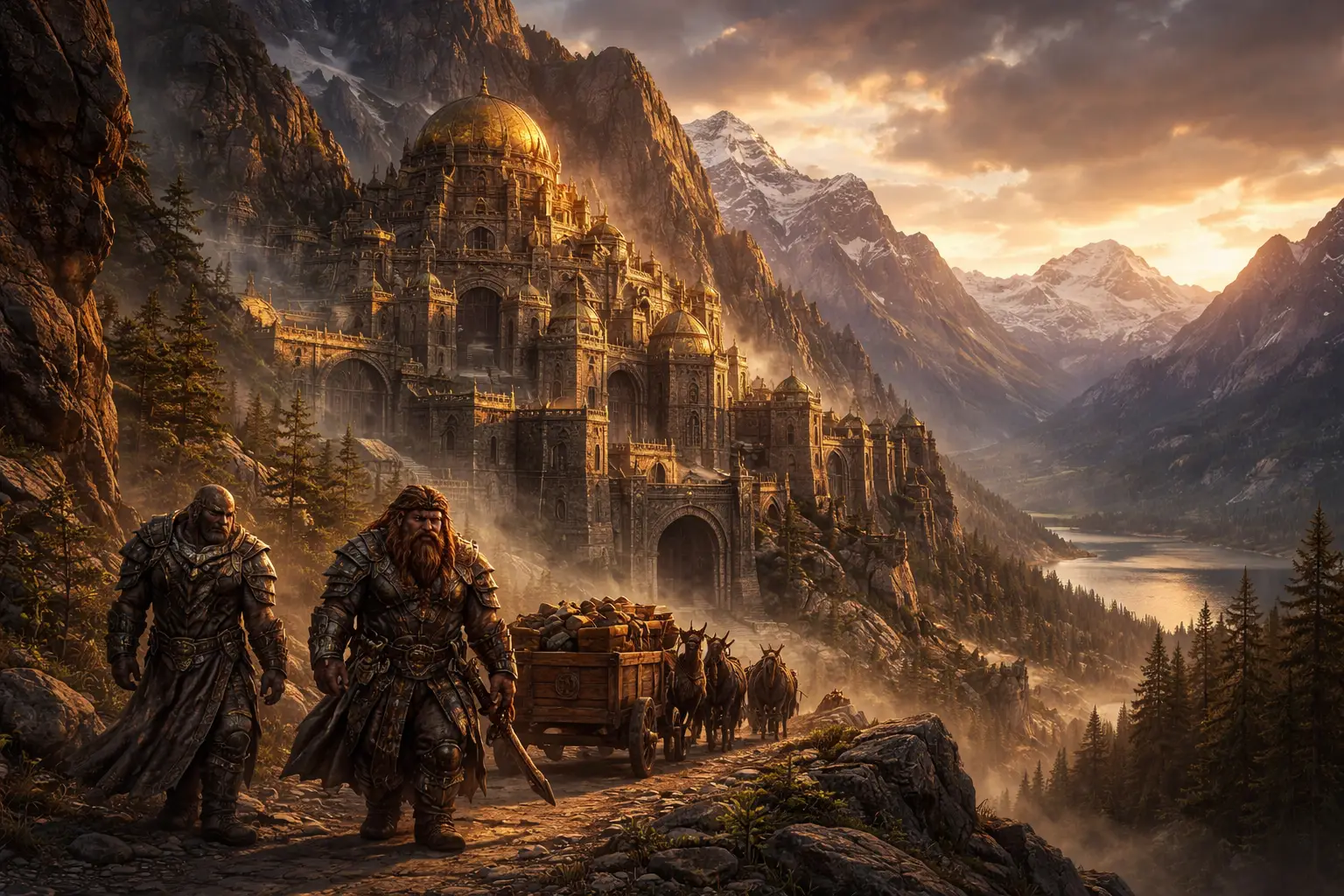
Economy & Industry of the Mror Holds
"A Karrnathi trade envoy asked me what the Mror Holds' primary export was. I told him: everything you're standing on. The iron in your sword. The gold in your purse. The silver in your ring. The lock on your vault. The vault itself. We're not selling you products. We're selling you the ground." — attributed to a Kolkarun merchant at a trade summit in Korth
A Mountain of Wealth
The economy of the Mror Holds is focused on mining, banking, and the relentless exploitation of a mountain range so rich in mineral wealth that scholars have wondered aloud whether the bounty is natural. It is the simplest and most powerful economic engine in Khorvaire: the dwarves dig precious metals out of the ground, Kundarak turns those metals into the financial infrastructure that the continent runs on, and every nation from Aundair to Zilargo pays the Ironfolk for the privilege of using both.
Per capita, the Mror Holds may be the wealthiest nation in Khorvaire. The Ironroot Mountains contain deep reserves of gold, silver, platinum, iron, mithral, copper, gemstones, and Eberron dragonshards — a concentration of mineral resources that borders on the obscene and that has been the foundation of Mror prosperity since the dwarves first traded their swords for pickaxes under the Great Sorrow. What was once a Karrnathi backwater paying tribute to a distant crown is now an independent nation whose metals are in every forge on the continent, whose coins circulate in every market, and whose banking house holds the financial secrets of half the Five Nations.
The Mror are not subtle about this. A Mror dwarf carries their wealth visibly — diamonds in the haft of an axe, gold leaf on the rim of a drinking horn, gemstones worked into the hilt of the clan-dagger at their belt. The display is not vanity. It is economic statement: this is what we pull from the earth, this is what we make of it, and this is why you need us. Every Mror lord who walks into a foreign court wearing a mithral brooch is making a trade pitch, whether the court realizes it or not.
The dark side of this wealth is that it all comes from the same place, and the same place is infested with the armies of a daelkyr lord. The richest mines — the deep shafts that connect to the Realm Below, the demiplane galleries where the mineral wealth defies natural law — are also the most dangerous. The War Below is not merely a military crisis; it is an economic one. Every gallery lost to a dolgrim assault is revenue lost. Every colony overrun is a mine shut down. The Mror Holds are getting richer every year, and every year the cost of staying rich gets higher.
MARKET REPORT — filed by Sivis trade correspondent, Krona Peak, Nymm 997 YK
Mroranon iron: stable, high volume. Soldorak gold: stable, highest volume on the continent. Soranath masterwork goods: limited supply, premium pricing, six-month wait for commissioned pieces. Narathun gemstones: rubies and sapphires, steady supply, quality exceptional. Doldarun silver: stable. Lanarak mushroom spirits: seasonal, strong demand from Talenta and Lhazaar buyers. Kolkarun copper: modest volume, competitive pricing.
General assessment: the Holds continue to produce at capacity. The War Below has not yet affected surface output.
Mining: The Foundation
Mining is the oldest industry in the Mror Holds and the one that everything else is built on. The Ironroot Mountains are among the most mineralized mountain ranges on the continent — gold, silver, platinum, iron, mithral, copper, and gemstones in commercially significant quantities, distributed across virtually every hold. The specific concentrations vary by territory: Mroranon is known for iron and mithral, Soldorak for gold and platinum, Doldarun for iron and silver, Narathun for precious stones, Soranath for Eberron dragonshards, and Kolkarun for copper. The valley clans — Lanarak and Londurak — do not mine metals at all, instead farming mushrooms and red pudding in deep caverns, but their agricultural output is essential to feeding the mountain clans that do.
Surface mining has been the backbone of the Mror economy since Korran Hal, when the forced end of the clan feuds pushed warriors into the mines and the mines rewarded them beyond all expectation. The techniques are well-established: Mror miners and masons are among the most skilled in the world, and the clan-holds maintain mining operations that have been continuously productive for centuries. Mror iron and steel are exported to every nation in Khorvaire — House Cannith is Mroranon's largest single customer — and Soldorak coins circulate so widely that they are effectively a parallel currency alongside the galifars and sovereigns minted by the Five Nations.
The discovery of the Realm Below in 913 YK transformed the mining economy from merely profitable to staggering. The deep mines of Sol Udar are richer, grander, and more extensive than anything on the surface, and some of them connect to demiplanes where the rules of reality shift and the mineral wealth seems inexhaustible. A clan that controls a deep mine sits on a fortune that makes surface operations look like scratching in the dirt — and the politics of who controls which gallery, and who has the right to mine what lies beneath whose territory, are among the most contentious disputes the Iron Council faces.
The catch, of course, is that the deep mines are also where the dolgrim live. Most major clans maintain fortified mining colonies in the Realm Below, defended by heavy garrisons and Kundarak-engineered wards. The mines produce under combat conditions — soldiers hold the perimeter while miners work the seams, and everyone drills for the next assault. The yields are extraordinary. The casualty rates are not discussed at trade summits.
Banking: The Kundarak Empire
If mining is the foundation of the Mror economy, banking is the structure built on top of it — and the structure is controlled almost entirely by House Kundarak.
The Banking Guild of House Kundarak is the financial backbone of Khorvaire. Established in partnership with House Sivis during the era of Korran Hal, the guild transformed the Mror from wealthy miners into the continent's bankers — a transition that multiplied their economic power far beyond what raw mineral extraction could achieve. Kundarak's lands in the Ironroot Mountains include deep veins of precious metals, which the house used as the reserves that underpin the banking system. The security of banks bearing the Kundarak manticore emblem is legendary. Anyone who makes a living from coin — bankers, goldsmiths, moneylenders — likely learned their trade at House Kundarak or under its influence.
The guild provides services that the continental economy depends on. Letters of credit drawn on Kundarak reserves allow merchants and nobles to conduct large transactions without physically transporting gold across dangerous roads. The house operates a system of extradimensional vaults that allows clients to store goods in one Kundarak enclave and retrieve them at any other — a service of extraordinary value to anyone with portable wealth and a healthy fear of highwaymen. The Defenders Guild trains locksmiths and security specialists. And Kundarak maintains Dreadhold, an island prison said to be inescapable, which houses infamous criminals, political prisoners, and — it is whispered — some of the house's most sensitive treasures.
The Soldorak Mint at Solangap is the primary competitor in the currency trade — the largest mint and treasury in Khorvaire, producing coins that circulate across the continent. Soldorak maintains foreign investments that extend well beyond mining, making it the clan most likely to compete with Kundarak in the financial arena. The rivalry is economic rather than violent, but it is deeply felt on both sides.
ADVERTISEMENT — posted in Common, Dwarvish, and Gnomish at Kundarak enclaves across Khorvaire
HOUSE KUNDARAK — BANKING GUILD
Your wealth. Our vaults. Anywhere in Khorvaire.
Deposit in Krona Peak. Withdraw in Sharn. The manticore remembers what you stored and where you want it. Standard fees apply. Premium clients may inquire about extradimensional storage. The security of a Kundarak vault has never been breached and it never shall.
Korunda Gate — Krona Peak — Sharn — Fairhaven — Korth — Wroat — Flamekeep — Stormreach
Craft and Artifice
The Mror are miners first, but they are smiths second — and a close second. Dwarven metalwork has been prized across Khorvaire since before the founding of Galifar, and the discovery of Sol Udar has added a new dimension to Mror craft: the study and replication of ancient techniques that were lost thousands of years ago.
Clan Soranath is the heart of the Mror craft economy. The smallest ruling clan by territory, Soranath punches far above its weight through the quality of its artisans — smiths who are always seeking new methods and who treat a job done well as more satisfying than any luxury. The hold's abundant dragonshard deposits give its artificers access to materials that other clans must purchase. A commissioned Soranath piece commands premium prices and a wait list stretching to months. The clan also holds the largest concentration of artificers working to reverse-engineer the techniques of Sol Udar — progress has been significant, though unevenly distributed across the clans.
Beyond Soranath, every major clan maintains its own smithing tradition. Mroranon produces industrial-grade steel and ironwork in volumes that feed House Cannith's manufacturing operations. Doldarun weapons are built to fight, not to decorate. The Droranath produce functional arms suited to their mercenary trade. And Soldorak and Narathun artisans have developed the most controversial craft in the Holds: fleshcrafting — the creation of living tools, weapons, and garments derived from daelkyr techniques. Soldorak lighting bugs replace everbright lanterns and must be fed drops of blood each day. Narathun artisan-breeders produce living clothing that shifts color with the wearer's mood. A Soldorak symbiont weapon bonds with its wielder and cannot be casually removed. Whether this constitutes innovation or corruption depends entirely on which clan you ask.
"A Soranath masterwork axe will run you eight hundred galifars and a six-month wait. An ancient axe from the Realm Below will run you whatever the clan that owns it decides to charge, assuming they're willing to sell, which they usually are not. A Soldorak symbiont axe will ruin you your dignity, your sleep, and possibly your soul, and the axe will moan when it draws close to an enemy. I recommend the Soranath." — overheard at a Krona Peak auction house
Agriculture and the Valley Clans
The mountain clans could not survive on metal alone — someone has to feed them — and that responsibility falls primarily on Lanarak and Londurak, whose holdings along Mirror Lake produce the bulk of the Holds' food supply. The valley clans farm alpine meadows and lakeshores, raise livestock, and — most distinctively — cultivate mushrooms and red pudding in deep caverns beneath their territories. Traditional Mror spirits are brewed from subterranean fungi and are strong enough to stop a human heart; the competition between Lanarak and Londurak over who brews better has outlasted most wars and shows no sign of concluding.
The Frosthaven clans contribute the medicinal herbs and flowers that drive House Jorasco's healing operations across Khorvaire. The farms of Toldorath and Tordannon are a primary source of these materials, and the Jorasco partnership is one of the most durable dragonmarked house relationships in the Holds.
Kolkarun maintains the fishing and lake-trade operations on Mirror Lake — the Holds' internal merchant fleet, ferrying goods between the holds and facilitating the commerce that keeps the mountain clans supplied. House Lyrandar has recently begun competing on the lake with superior vessels, a development that grates on Kolkarun pride.
The Relic Economy
The Realm Below is not merely a mine. It is an archaeological site of incalculable value, and the artifacts recovered from its galleries have created an economy of their own.
Ancient dwarven relics — weapons, armor, tools, jewelry, and items of uncertain purpose — are among the most valuable commodities in the Holds. Each ruling clan treats its collection of Sol Udar artifacts as both treasury and political prestige: owning a legendary relic demonstrates that your clan has the courage to venture into the deep and return with prizes. Common tradition at a grand feast calls for the greatest heroes present to offer gifts to the host accompanied by the tale of how the gift was acquired; the one who gives the finest gift is served first. Sol Udar relics are the most coveted gifts of all.
A Mror lord might serve guests from a bottomless cauldron of wine recovered from the Realm Below. Another might study strangers through a crown of eyes — a living artifact claimed from the depths — insisting that it reveals all evil intent. Whether these relics are safe to use, and whether the living artifacts in particular carry the taint of their creators, is a question that the relic economy studiously avoids asking.
The relic trade spills beyond the Holds. Ancient dwarven masterwork circulates through the auction houses of Krona Peak and the collectors' markets of Sharn at extraordinary prices. Adventurers seeking to explore the Realm Below on behalf of a clan should expect to negotiate terms in advance — the ruling clan that controls the surface territory above a gallery holds legal claim to everything beneath it, and unauthorized salvage is treated as the kind of theft that starts a feud. Compensation typically includes a percentage of recovered goods, with the clan retaining first rights to anything of historical or military significance. What constitutes "significant" is determined by the clan lord, and the determination is not appealable.
AUCTION CATALOGUE — Kol Korran's Throne, Krona Peak, Olarune 998 YK
LOT 14: Mithral-alloy gavel, recovered from the third gallery judicial chamber, Sol Udar. Enchantment: zone of truth effect when struck against stone (1/day, DC 14). Provenance verified by Soranath assayer. Reserve price: 1,200 gp.
LOT 15: Iron chest of uncertain function, recovered from a sealed vault, Mroranon deep colony. Contents unknown. Chest has not been opened. Sold as-is. The Iron Council accepts no liability for curses, infestations, or psychic contamination. Reserve price: 400 gp.
Trade and Transit
A lightning rail line connects Krona Peak to the Karrnathi border through Vasfold — built during the Galifar era as part of King Jarot's public works project circa 845 YK — and this remains the primary overland trade route to the west. Internal transit between holds relies on mountain roads, Mirror Lake shipping, and underground tunnels that connect some holds directly, though the deep tunnels are dangerous and not all of them are safe from the War Below. The ancient dwarves of Sol Udar possessed a more advanced form of long-distance transit, but the Mror have not yet recovered it — one more prize waiting in the dark.
Krona Peak is the primary hub for foreign commerce. Most exports leave through Krona Peak and travel west by rail. The Lhazaar Principalities handle eastern trade, with goods moving through Mirror Lake to Lhazaar ports; Kolkarun maintains the strongest ties to the east.
Primary exports: raw and refined metals, gemstones, Eberron dragonshards, Kundarak banking services, masterwork metalwork, and ancient artifacts. Primary imports: finished goods, foodstuffs the mountain climate cannot produce, arcane supplies, and the various luxuries that a population of newly wealthy dwarves has developed a taste for. The Mror do not produce much of what they consume — they produce what they mine, and they trade it for everything else. It is the simplest economic model in Khorvaire, and it works because what they mine is what everyone else needs.
The War Economy
The War Below is not merely a military crisis. It is an economic system.
Maintaining fortified colonies in the Realm Below requires soldiers, engineers, provisioners, armorers, and the constant flow of supplies from the surface. Every clan that holds territory in Sol Udar diverts a significant portion of its workforce and wealth to the war effort. All Mror civilians conduct combat drills, and the expectation of universal contribution shapes the economy from top to bottom: a brewer who supplies the garrison is as much a part of the war economy as the soldier holding the line.
The war also generates wealth. The deep mines are the richest in the Holds, and the relics recovered from Sol Udar are worth fortunes. A clan that can hold its positions profits enormously; a clan that loses a gallery loses revenue that may take years to replace. The economic incentive to push deeper — to reclaim lost galleries, to open new mines, to explore further into the dark — competes directly with the military reality that every meter of depth gained increases the risk of contact with Dyrrn's forces.
The result is an economy permanently on a war footing, even in peacetime. The surface looks prosperous and stable — and it is. But the prosperity is funded, in part, by mining operations conducted under armed guard in galleries haunted by aberrations, and the stability depends on a stalemate that no one believes will hold forever.
From the personal ledger of a Mroranon mine foreman, recovered after a dolgrim assault on the fourth gallery, circa 995 YK:
"Output this quarter: 340 lbs. refined mithral, 12 rough sapphires, 1 intact Sol Udar artifact (pending Soranath assessment). Losses this quarter: 6 miners (dolgrim raid, gallery 4-east), 1 engineer (structural collapse, gallery 4-south), 14 sets of armor and tools (unrecoverable). Net assessment: profitable.
Request additional garrison support. The fourth gallery is worth holding."