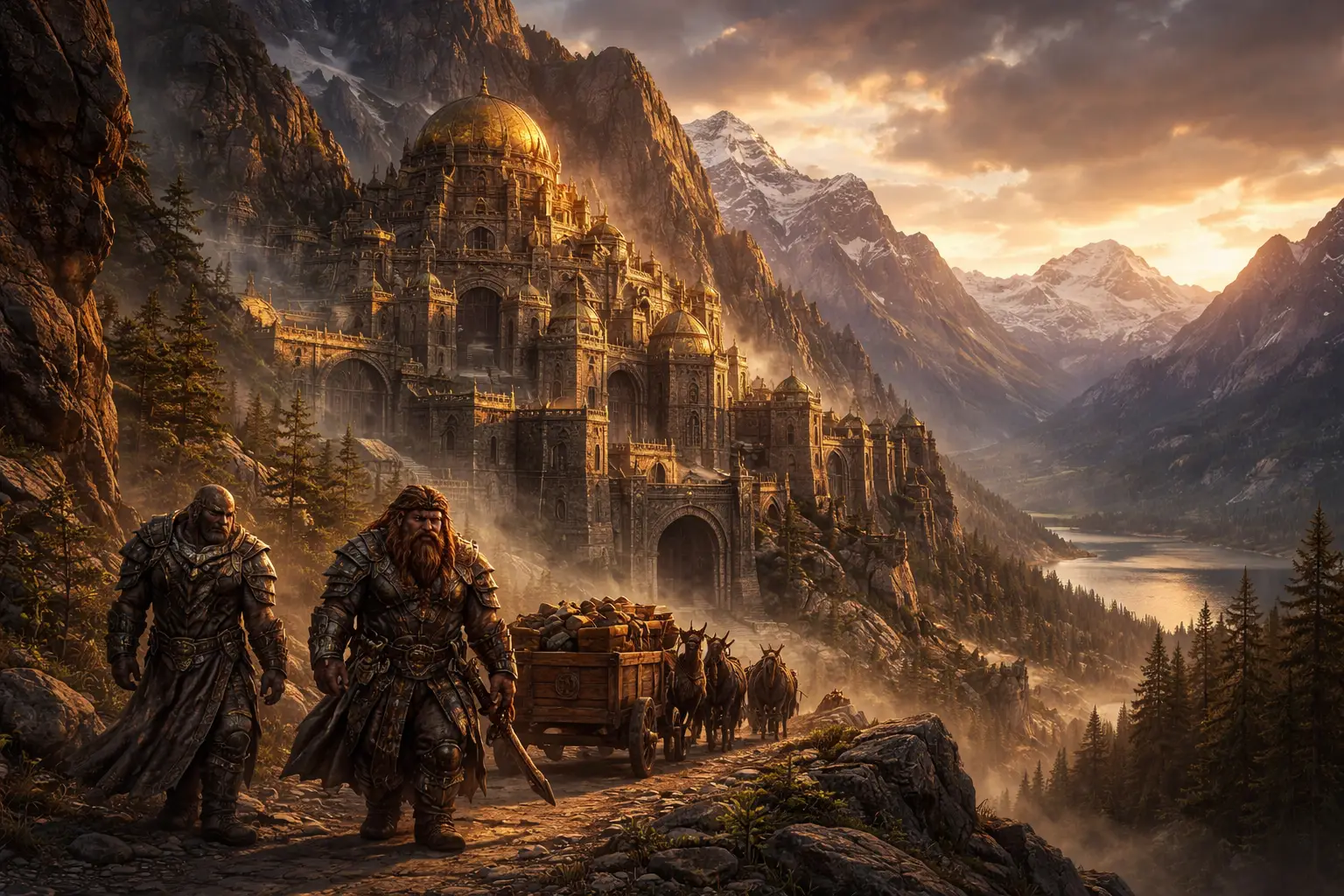
Military & Security of the Mror Holds
FIELD REPORT — Blademark Captain Essen d'Deneith, dispatched to observe Mror defensive operations, to Sentinel Tower, Aryth 997 YK
Commander,
I will be blunt. The Mror do not have an army. They have twelve armies that do not answer to each other, a civilian population that can pick up a warhammer and form a shield wall on six hours' notice, and a set of mountain fortifications that no force on the surface of Khorvaire has ever breached. They also have a war that they are fighting underground, right now, against an enemy that does not negotiate, does not tire, and does not stop.
The Karrnathi general staff asks whether the Holds could be reconquered. I will answer honestly: not by Karrnath. Not by anyone. The mountains are impregnable from outside. The question is whether the Holds can be conquered from below — and if the dwarves aren't asking themselves the same thing, they should be.
The Mror Holds have no standing army, no unified command structure, no officer corps, and no military academy. They are defended by clan militias, mountain fortifications that have never been breached, the staggering wealth to arm every citizen with the finest equipment gold can buy, and the simple geological fact that the Ironroot Mountains are one of the most defensible positions on the continent. On paper, this looks like a nation that would crumble under sustained military pressure. In practice, it is a nation that has successfully deterred Karrnath — the most militaristic of the Five Nations — from attempting reconquest for over eighty years, and whose real war is not against anything on the surface at all.
The Mror fight on two fronts: upward, against the theoretical threat of Karrnathi aggression or foreign invasion, and downward, against the very real and ongoing threat of Dyrrn the Corruptor and the aberrations of Sol Udar. The surface defenses are passive and structural — mountains, fortresses, wealth. The War Below is active, grinding, and has consumed the military resources of the Holds for the better part of a century. Every other aspect of Mror military life is shaped by the simple reality that the dwarves are fighting a war in their own basement and have been losing people to it since the 920s.
The Clan Militias
There is no national army of the Mror Holds. Military force is organized, funded, and commanded at the clan level. Each ruling clan maintains its own militia — warriors drawn from the clan's families and tenant households, equipped with weapons and armor forged in the clan's own smithies, and answering to the clan lord and no one else. The Iron Council can request that clans contribute forces to a shared effort, but it cannot compel them, and the willingness of a clan lord to commit warriors to someone else's problem depends entirely on the political calculus of the moment.
What the clan militias lack in unified command, they compensate for with depth of training and quality of equipment. The War Below made soldiers of everyone. When the dolgrim hordes first erupted from the depths, every Mror civilian was pressed into service — combat drills became mandatory, and everyone was expected to contribute, whether by fighting on the front lines, repairing arms and armor, maintaining fortifications, or producing supplies. This was not a temporary wartime measure. It has become the permanent baseline of Mror society. The dwarven racial aptitude for weapon training and tool proficiency that outsiders observe is not innate — it is the product of a civilization that has been on a war footing for seventy years and has no expectation that the footing will change.
The result is a population where virtually every adult can fight competently and many can fight well. A Mroranon miner who has never served on the deep line can still form up in a shield wall, hold a chokepoint, and use a crossbow at range. A Doldarun tenant farmer's son has been drilling with an axe since he was old enough to hold one. The militia system produces soldiers who are individually skilled, well-equipped — the Mror can afford the best, and they buy it — and capable of defending fixed positions with extraordinary tenacity. What it does not produce is the kind of coordinated, multi-clan offensive capability that a conventional army provides. The Mror can hold ground better than almost anyone on the continent. Taking ground — especially taking it together — is another matter entirely.
Militia size varies enormously by clan. Mroranon, the largest and wealthiest hold, can field the most warriors and maintains the largest permanent garrison in the Realm Below. Doldarun fields the best-trained and most aggressive soldiers — career warriors who view the War Below as a sacred calling. Droranath fields the fiercest individual fighters but the fewest total numbers, being one of the smallest and poorest clans. Soldorak fields warriors equipped with symbiont weapons and armor that terrify conventional opponents, and its warlocks add arcane capability that no other clan can match. The valley clans — Lanarak and Londurak — field the fewest warriors and prefer to seal their passages to the deep rather than fight.
"A Karrnathi regiment is a machine. You feed it orders and it produces results. A Mror clan militia is a family. You insult its honor and it produces corpses." — attributed to a Rekkenmark instructor, in a lecture on unconventional warfare
The War Below: The Primary Front
The War Below — Dol Udar — is the defining military reality of the Mror Holds, and it has been since the 920s YK. Every other security concern — Karrnath, the Jhorash'tar, banditry, trade disputes, even the Last War itself — is secondary to the ongoing conflict in the depths.
The war began when Mror miners and explorers, pressing deeper into the newly discovered Realm Below, encountered the forces of Dyrrn the Corruptor — a daelkyr imprisoned in a demiplane that abutted the deepest reaches of Sol Udar. Dolgrim hordes, mind flayers, derro, chokers, and things without names boiled out of the lower galleries and overran the colonies the dwarves had established. The early years were catastrophic. Entire outposts were consumed. The illithid general Dyrrashar seized the colony below Loran's Gate in Soldorakhold in 943 YK and broadcast a psychic message known as Dyrrn's Promise — a telepathic communication that has never been satisfactorily translated but whose meaning was unmistakable: You have drawn the gaze of the Overmind. Everything will change. Soldorak eventually retook Loran's Gate, but Dyrrashar remains at large.
The war's intensity forced a critical discovery. Clan Londurak, suffering grave losses, withdrew its forces entirely and sealed all passages to Sol Udar. The expected surface assault never came. This pattern repeated across other holds: Dyrrn's forces would not pursue beyond the boundaries of the Realm Below. The reason is unknown — sages speculate it is tied to the wards that bind Dyrrn within its demiplane — but the practical effect was to establish the terms of the stalemate. The dwarves can hold their positions in the upper galleries. The aberrations control the deep.
Today, most major clans maintain fortified outposts in the Realm Below — colonies and mines defended by heavy fortifications that Kundarak engineers helped design and build. Serving on the deep line is the most dangerous military posting in the Holds, and the rotation system varies by clan. Doldarun maintains a permanent garrisoned colony below Silverblade Keep and is building strength for a new offensive — the clan's leadership has never accepted the stalemate and considers anything less than total victory a betrayal of their sacred duty. Mroranon holds multiple colony outposts, including one tied to a demiplane mine and another occupying an ancient fortress. Soldorak has invested deeply in the Realm Below and is second only to Mroranon in subterranean holdings. Kolkarun holds a few outposts, often with Droranath mercenary support. Toldorath has employed Jhorash'tar orc mercenaries to help secure its colony — a practical experiment in integration that the rest of the Holds watches with keen interest and considerable unease. Londurak and Tordannon have sealed all passages and refuse any traffic with the depths.
The threat is not confined to the deep. Individual aberrations occasionally reach the surface — a lone choker carrying out a spree of killings, an illithid infiltrating a surface community to cultivate a cult. Psychic attacks, unnatural diseases, crawling tentacles and oozes, and other manifestations of Dyrrn's influence can emanate from the depths without any physical breach. In the past three decades, ruinbound dwarves — infants born with symbionts already bonded to them — have begun appearing among the Mror population, suggesting that Dyrrn's corrupting reach extends even further than the fortified lines.
The clans that hold deep positions are motivated by three things: the wealth that continues to flow from the mines, the ancient relics and artifacts that represent the heritage of Sol Udar, and the stubborn dwarven conviction that the Realm Below belongs to the Ironfolk and that retreating from it would mean surrendering their birthright. Whether that conviction is sustainable in the face of an enemy that does not die and does not forget is the military question that keeps every forge-colonel in the Holds awake at night.
STANDING ORDERS — Deep Line, Mroranon Colony Three
All personnel are reminded: do not pursue retreating dolgrim beyond the marked perimeter. Do not enter unmarked galleries. Do not touch organic material of unknown origin. Do not respond to voices that do not identify themselves by clan and rank.
If you see something you cannot explain, report it. If it moves, kill it first if possible, then report it.
If it speaks to you inside your head, drop your weapon and report to the chaplain immediately.
The Ironroot Mountains as Fortress
The surface defenses of the Mror Holds are, in a word, geological. The Ironroot Mountains are the most defensible terrain on the continent, and the dwarves have spent a millennium fortifying what nature already made nearly impregnable.
No army has ever taken a Mror clan-hold by force. The goblins of Dhakaan forced them to dig deep into their mountains, but were never able to take them. Prince Karrn conquered the Holds through siege, blockade, and diplomatic manipulation — cutting the clans off from each other and exploiting their feuds — but the fortresses themselves held. The same would be true today and any conventional army that could be summoned in modern Khorvaire would break against the Ironroots like water on a stone. The central clan-holds are built into the mountains, with approaches that can be defended by a handful of soldiers against an army of thousands. Passes are narrow, supply lines are vulnerable, and the dwarves know every ambush point, every hidden trail, and every cave system in the range. An invading army would have to sustain itself in hostile mountain terrain while besieging fortresses that have food, water, and ore reserves measured in centuries, let alone than months or weeks.
Karrnath is the only nation with both the motive and the geographic proximity to attempt reconquest, and the Karrnathi general staff has been aware for eighty years that the cost of a mountain campaign would be catastrophic. The border duchy of Vasfold was originally established to manage the Mror tribute; it now serves as the theoretical staging ground for any future invasion, though such an endeavour would be madness. The Mror do not maintain a border garrison against Karrnath in the conventional sense — the mountains are the garrison. What they do maintain is a network of Kolkarun intelligence operatives who watch the border, monitor Karrnathi troop movements, and report to the Iron Council on any change in posture.
The mountains also protect the Holds from the Lhazaar Principalities to the east, though no Lhazaar prince has the resources or inclination to invade a nation of dwarves sitting on top of a gold mine. Trade, not war, defines the eastern relationship.
The Droranath Mercenaries: The Mror Howlers
Clan Droranath is the exception to the Mror rule that warriors fight for their own clan and no one else. The Droranath have sold their services as mercenaries through House Deneith for centuries — long before the founding of the Iron Council, long before the War Below, long before the secession from Karrnath. They are the "Mror Howlers," named for tra dolhass, the battle cry technique that summons fury in a terrifying howl as the warrior charges. House Deneith values them as shock troops, trench builders, and vanguard fighters, and Droranath mercenaries have served clients across Khorvaire from Breland to the Talenta Plains.
The Droranath are the closest thing the Mror have to a military export. They are also the most traditional clan — hunters, farmers, and warriors who never became miners, who refuse most modern innovations, and who value the feel of an enemy's fear more than the glint of gold. Droranath warriors claim the arms and armor of fallen foes as trophies, and they have no qualms about using symbiont weapons taken from the depths — though they do not celebrate them the way Soldorak does. The distinction matters: a Droranath warrior carrying a symbiont axe considers it a trophy. A Soldorak lord wearing symbiont armor considers it fashion (and possibly a friend).
The Droranath have not opened paths to the Realm Below in their own territory, but their mercenaries have served other clans on the deep line and brought back trophies from those engagements. The clan's primary military concern is not the War Below but the Jhorash'tar orcs, whom Droranath has fought since the first days of the Exile and whose destruction the clan considers an article of faith.
The Jhorash'tar: The Surface Threat
The Jhorash'tar orc tribes of the southwestern Ironroots are not a military threat to the Holds in the conventional sense — they cannot field the numbers to challenge a ruling clan in open battle — but they are a persistent, low-level security concern that ties down warriors who might otherwise serve on the deep line.
The Jhorash'tar fight with bone weapons hardened through bonecaster ritual, augmented by metal arms acquired through trade or battle with the dwarves. They know the southwestern mountains intimately and fight in small, mobile bands that are difficult to pin down and nearly impossible to eradicate in their own terrain. Droranath skirmishes with the Jhorash'tar are constant. The orcs occasionally strike at Tordannon spires in retaliation for perceived treachery. The Frosthaven clans respond with diplomacy rather than force and have even employed Jhorash'tar mercenaries in the Realm Below — the beginning of a military integration experiment that Droranath considers an abomination and the Frosthaven clans consider the only path forward.
The Jhorash'tar are also the subject of a persistent and unresolved conspiracy theory: Clan Droranath insists the orcs were responsible for the destruction of Noldrunhold four centuries ago and claims they are in league with the aberrations of the Realm Below. No evidence has been produced for either claim. The Frosthaven clans consider it propaganda. The Iron Council has not taken a position, which means the accusation hangs in the air like smoke, poisoning every discussion about the orcs' future.
Symbionts as Weapons of War
The recovery of daelkyr symbionts from Sol Udar has introduced a new and deeply divisive element to Mror military capability. The clans that have embraced symbionts — Soldorak, Narathun, and to a lesser extent Soranath — field warriors whose equipment would be unrecognizable to a conventional Five Nations soldier.
A Soldorak warlock in living armor that pulses with its own heartbeat, carrying an axe that moans when it senses blood, wearing a cloak of shifting chitin that ripples of its own accord — this is not a warrior who fights the way Rekkenmark teaches. Soldorak fleshcrafters have created their own symbionts: lighting bugs that replace everbright lanterns and must be fed drops of blood, chameleon-skin gear that shifts hue with the wearer's mood, living cloaks that are self-cleaning and self-repairing and that feed on the wearer's sweat. Narathun artificers are developing fleshcrafting techniques that blend daelkyr science with traditional dwarven craft — producing weapons and armor that are, by any objective measure, remarkable.
The clans that reject symbionts — Doldarun foremost among them — view this development with horror. Doldarun soldiers burn symbionts with the corpses of the creatures that carry them and refuse entry to anyone bearing daelkyr-made items. From a purely military standpoint, the symbiont divide creates a coordination problem: Doldarun soldiers will not fight alongside Soldorak warriors who carry symbionts, and Soldorak warriors consider Doldarun's refusal to use superior tools a form of suicidal stubbornness. On the deep line, where cooperation between clans is the difference between holding a position and losing it, this divide has already cost lives.
"I asked a Doldarun forge-colonel what she thought of Soldorak's living armor. She said it was a very convincing puppet for the daelkyr abomination to pretend at being a dwarf in. I asked a Soldorak warlock what he thought of Doldarun's steel plate. He said it was a beautiful coffin." — Kessler d'Sivis, trade liaison to Krona Peak
Law Enforcement
There is no national police force. Justice in the Mror Holds is clan justice, administered by the clan lord or a delegated authority within each spire, and the standard of enforcement depends entirely on which territory you are standing in. The Iron Council adjudicates disputes between clans but has no mechanism for policing individuals. Sentinel Marshals of House Deneith are technically authorized to operate within the Holds under treaty law, but a Marshal pursuing a fugitive into a remote spire needs either the local clan lord's cooperation or the kind of stubborn determination that dwarves respect and everyone else considers suicidal.
Within Krona Peak, order is maintained by Mroranon clan guards and the general understanding that conducting crime in the shadow of Kol Korran's Throne is a particularly efficient way to irritate the largest and most powerful clan in the nation. The capital is the safest city in the Holds for foreigners, and Kundarak security services operate there alongside the Mroranon guard. Beyond the capital, safety varies by hold. Doldarunhold is disciplined and orderly — the clan's martial culture extends to its approach to justice, which is swift and severe. Soldorakhold is rougher and more freewheeling — the clan's philosophy that power must be earned extends to its tolerance for rogues and charlatans, provided they are clever. The valley clans are peaceful and welcoming. Droranathhold is exactly as dangerous as it sounds.
The most significant law enforcement gap in the Holds is not crime in the conventional sense but the threat from below. Individual aberrations that reach the surface — a choker in a mineshaft, an illithid cultivating a cult in a remote spire — represent a security problem that no police force is designed to handle. The clan militias respond to these incursions as military threats, but the response time varies, and a small community that lacks a passage to Sol Udar may not recognize the threat until it is too late. Adventurers who can identify and neutralize daelkyr-influenced threats on the surface are in high demand across the Holds, and the clans pay well for the service.
"Save for Dreadhold, Mror don't have prisons. They have mountains, mines, and a very long list of people who owe them money. That handles most problems." — overheard at Highhold, Sharn