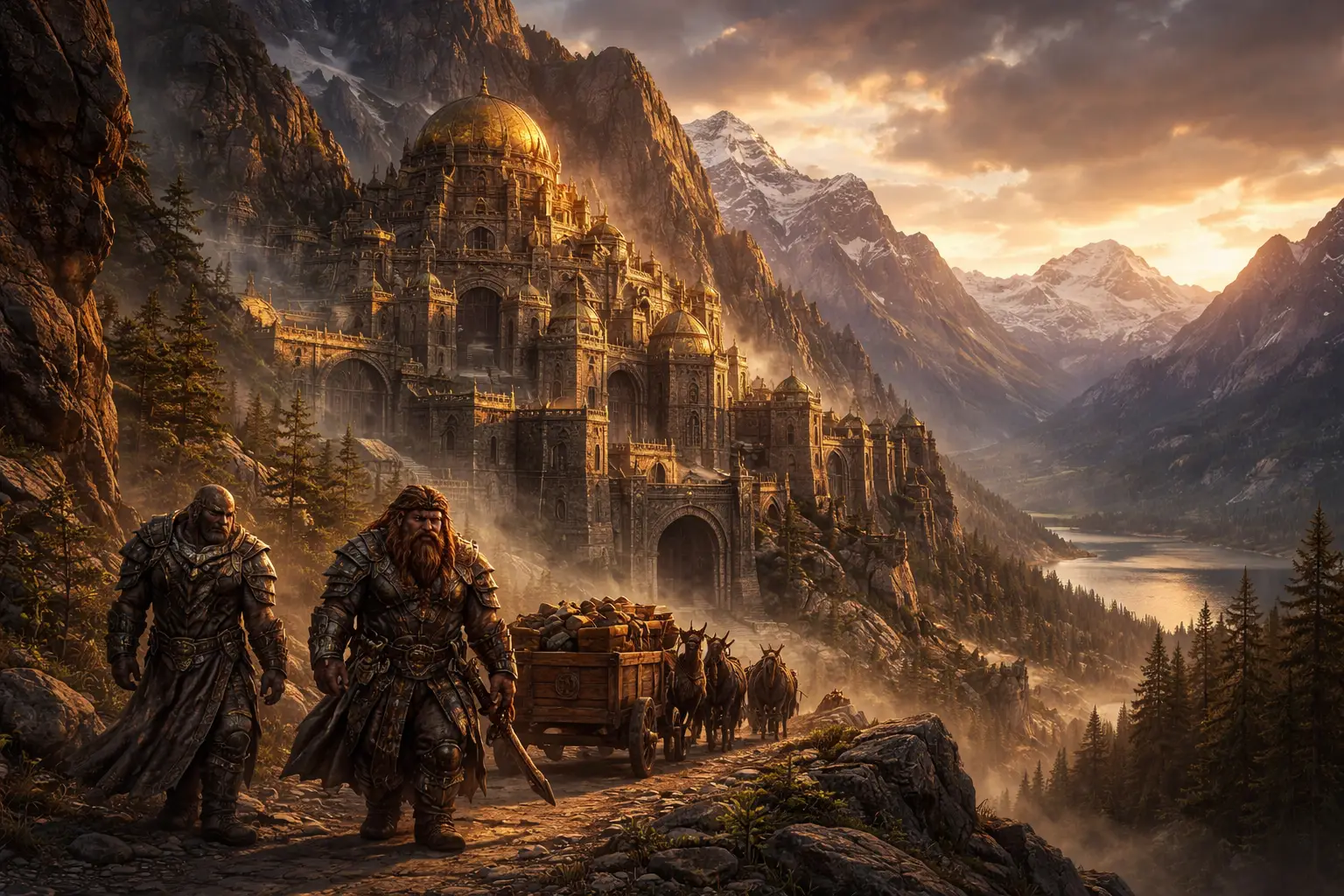
History of the Mror Holds
"Tol kollan! Some say our ancestors came from a place of ice, but we all know that's nonsense. Our ancestors were the mountains themselves. The dragons were jealous of their mighty stature, so they cast a spell that put them all to sleep, and that's where the mountains come from. We dwarves? We're the sweat from their brow. Don't believe me? Go take a look at the Face of Mror! No one could carve something like that, my friend; that's the mountain's original face. As for the others, well, they just went to sleep face down. That's the tale I had from my father, and you wouldn't want to call him a liar!" — Mror origin story, as told by an unnamed Mroranon talespinner
Ancient Origins
The history of the Mror Holds does not begin in the mountains. It begins beneath them — in vast halls deep below the Ironroot range, in a kingdom that was destroyed before humans ever set foot on Khorvaire, and whose ruins the modern dwarves would not rediscover for thousands of years.
No one knows where the dwarves came from. The talespinners of the twelve clans each tell a different origin story, and the talespinners are not particularly interested in which one is true — a fact that drives the scholars of Korranberg to distraction and the dwarves themselves not at all. Most agree that the ancestors came from a land of ice and frost. The most popular scholarly theory holds that the first dwarves arrived from the Frostfell, traveling by way of a demiplane passage through Khyber, and that an undiscovered dwarven civilization — or the ruins of one — may still wait to be found in the frozen north. A second theory suggests they originated in the Tashana Tundra of Sarlona, sailing to Khorvaire and landing in the Lhazaar Principalities millennia before human settlers, though the modern Akiak dwarves of Sarlona have little cultural overlap with the Mror and there is no evidence they ever built ships. The most exotic story holds that the dwarves of both Sarlona and Khorvaire came from Risia, the plane of eternal ice, and that a grand hidden civilization endures somewhere in the glacial deep.
The dwarves themselves, characteristically, do not much care. They are here. The mountains are here. That is enough. The Mror have always preferred a good story to a verified fact, and on this point they are immovable.
Sol Udar: The Realm Below (ancient, pre-Dhakaani contact)
Wherever the dwarves originated, they sank their roots into Khorvaire — literally. Dhakaani records, which are considerably more accurate than dwarven ones, confirm that the Empire of Dhakaan encountered dwarves deep beneath the earth late in the Dhakaani golden age and drove them east, eventually reaching a stalemate below the Ironroot Mountains. The ancient dwarves lacked the numbers or resources to threaten Dhakaan, but they established a defensive line in the deep and held it against countless onslaughts. The dar had no need of the territory, and in time decided the effort of further conquest was not worth the cost.
This was the origin of Sol Udar — the Realm Below — a vast subterranean kingdom whose full extent remains unknown to this day. The ancient dwarves built enormous city-halls lit by continual flame, with environmental enchantments maintaining pure air and comfortable temperatures miles below the surface. Wide tunnels shaped by elemental magic linked the holds. Forges produced work of a quality that modern Mror artificers cannot replicate, using techniques that were lost when the kingdom fell. Some of the deepest mines connected to demiplanes where the laws of nature bent and mineral wealth defied logic — shafts where the rules of reality were strange and the riches seemingly inexhaustible.
It was, by every measure available, a civilization of extraordinary sophistication. It is also a civilization about which the modern dwarves know almost nothing, because the ancient dwarves of Sol Udar were annihilated by the daelkyr — and the kingdom was silent for thousands of years before anyone above thought to look for it.
FRAGMENT — carved in archaic Dwarvish above a sealed forge entrance, Sol Udar, translated by Soranath historians, circa 995 YK
Here the fire shaped. Here the hands built. May they shape and build again.
Mallanok: The Exile (post-Sol Udar, unclear timing)
At some point — whether years or centuries after the founding of Sol Udar is unclear — a group of dwarven warriors was exiled from the Realm Below and found a new home in the mountains above, along with their families and followers. The exiles numbered thirteen clans, each led by a figure whose name would become the name of a ruling dynasty that persists to the present day.
The reason for the Exile depends entirely on who you ask, and the Mror consider this not a deficiency of the historical record but one of its more appealing features.
Mroranon talespinners say that King Mror of Sol Udar could not decide which of his thirteen heirs should inherit his throne, so he pushed them out onto the mountain to prove themselves worthy of his kingdom — a test that has, technically, not yet been resolved. The Soldorak say that King Mror was an iron-handed tyrant, and the thirteen heroes were exiled because they dared to challenge his authority for the good of the common people; in every Soldorak tale, the hero Soldorak is the champion of underdogs against oppressive systems, which may say more about Soldorak self-image than about the actual Exile. Professor Melian Mit Davandi of the Library of Korranberg has advanced the rather less romantic theory that the ancient dwarves may have exiled criminals to the surface instead of maintaining prisons, and that the founders of the Mror Holds were a broad assortment of convicts and undesirables. The Mror find this hypothesis offensive, though the Korranberg academics find it well-supported. The truth is buried under thousands of years of legend and competing talespinner traditions, and unless Sol Uldar is reclaimed, it will probably stay there.
What is not disputed is that the exiles settled in the Ironroot Mountains and never returned to Sol Udar. Whether they could not find their way back, were forbidden from returning, or simply did not want to is yet another question the talespinners disagree about and the historians cannot answer. The Exile — Mallanok — marks the beginning of Mror history as a surface people, and it is the only era on which all twelve clans agree: the story begins with thirteen families on a cold mountain, with nothing but their hands and their grudges, and every dwarf alive today descends from one of them.
Dul Krok: Bloody Stones (post-Exile through Galifar's conquest)
On the surface, the thirteen exiled clans promptly fell into feuds — and stayed in them for a very, very long time.
The era known as Dul Krok, Bloody Stones, covers the centuries during which the Ironroot Mountains were divided among thirteen warlike dwarven clans so consumed by vendettas that they could not unite against external threats, could not advance their own culture, and could not do much of anything except fight each other and forge excellent weapons. When humanity arrived on Khorvaire from Sarlona, the dwarves barely noticed. Humans spread across the lowlands; the dwarves continued killing each other in the mountains. The Ironroot clans were unquestionably fierce warriors who made fine blades, but their deep division prevented any meaningful progress.
Not all dwarves remained in the Ironroots. Some had spread east into what became the Lhazaar Principalities, and it was largely these Lhazaar dwarves who integrated with humanity, spreading west with the new settlers and helping build the foundations of the kingdoms that would become the Five Nations. Dwarf soldiers and engineers fought in the armies that united the Five Nations; dwarf masons laid the foundations, or built atop the old goblin ones, of the greatest cities of Galifar, including Sharn. A few Mror left their feuds behind to join the wider world. But the mountain clans, by and large, stayed in their mountains and kept their grudges.
It was also during Dul Krok that the dwarves and the Jhorash'tar orcs established the pattern of conflict that would define their relationship for millennia. The Jhorash'tar had been in the Ironroots before the dwarves arrived on the surface — how long before is unclear, but their oral traditions suggest they once held most of the range. The exiles pushed them into the least hospitable southwestern regions, and the two peoples have been fighting ever since. Clan Droranath and the vanished Clan Noldrun bore the brunt of the orc wars; the Frosthaven clans of Toldorath and Tordannon sought peace, and claim that an orc shaman taught the healing arts to their founders in the first days of the Exile. Neither approach has ever resolved the conflict.
Sometime during Dul Krok, the thirteenth clan — Noldrun — vanished entirely. Every dwarf in Noldrunhold disappeared. At the time, the dwarves blamed the Jhorash'tar. Modern scholars suspect the Noldrun may have broken through to Sol Udar centuries before anyone else and were the first victims of what lived in the dark. No one knows for certain. Every expedition into the cursed hold has ended in disaster, and the territory remains shunned to this day.
"You want to understand the Mror? Look at Dul Krok. We spent a thousand years killing each other over who owned which rock. Then we spent another thousand years getting rich off those rocks. We have not changed as much as we like to pretend." — overheard at a tavern in Highhold, Sharn
Bal Dulor: The Great Sorrow (-5 YK)
As the Five Nations took form, humanity largely ignored the Ironroot Mountains and left the dwarves to their feuding. This changed with the rise of the united Kingdom of Galifar.
Prince Karrn — Galifar's third child, governor of the nation that bore his name — mounted a concerted campaign to subjugate the mountain dwarves. Through both military force and diplomatic intrigue, Karrn exploited the existing clan feuds with ruthless efficiency, isolating clans and playing them against one another. The soldiers of Galifar were disciplined and well-supplied; the dwarves were brave, skilled, and completely incapable of coordinating a defense. The central fortresses of the holds proved impregnable — no Galifaran army ever took a Mror clan-hold by force — but Galifar controlled the surrounding territory, cutting the holds off from trade and from each other. The compromise that followed left the dwarves as lords of their own holds but subjects of the crown, forced to pay tribute and taxes to Karrnath.
The Mror call this period Bal Dulor — the Great Sorrow — and it is the deepest shame in their history, a wound that has never fully healed. The dwarves were not enslaved — Galifar forbade outright slavery — but they were conquered, and for a proud people who defined themselves by strength and independence, conquest was very nearly worse. The tribute flowed west to Karrnath. Taxes were collected. Karrn appointed a new duke in the border region of Vasfold specifically to manage the flow of dwarven wealth toward the crown, displacing a popular local noble family in the process. And the clans, for the first time in their history, stopped fighting each other — not because they wanted to, but because they could no longer afford to.
What made the Great Sorrow survivable, in the long run, was that it also ended the feuds. Not by choice — by economic necessity. The dwarves needed to raise the funds to pay their tribute, and you cannot mine silver while you are busy killing your neighbors over a disputed border. Warriors became miners. And the Ironroot Mountains, as though rewarding the dwarves for finally learning to put down their weapons, proved to be astonishingly rich in mineral wealth — gold, silver, platinum, iron, mithral, copper, gemstones, and rare ores in quantities that bordered on the geological obscene.
PRIVATE CORRESPONDENCE — recovered from the personal archive of Duchess Forsindh ir'Jaranus of Vasfold, circa 920 YK
The dwarves pay their tribute. They pay it promptly, they pay it in full, and they pay it with a politeness that makes my skin crawl. I have administered this duchy for eleven years and I have never once heard a Mror lord complain about the tax burden. They simply hand over the gold and smile. I do not trust that smile. No one smiles while paying taxes unless they are making considerably more than they are giving away.
Korran Hal: Korran's Blessing (1-913 YK)
The period that followed the Great Sorrow is known as Korran Hal — Korran's Blessing — and it transformed the Mror from feuding mountain warriors into something the rest of Khorvaire had never anticipated: merchant lords.
Mror talespinners say that the Sovereign Onatar had his forge in the mountains and that Kol Korran kept his hoard beneath it, and that the mineral wealth of the Ironroots was a divine gift to the Ironfolk. Whether the mountains' astonishing bounty has a supernatural explanation — some scholars have speculated, quietly, about an overlord tied to greed bound beneath the peaks — or is simply geological fortune, the result was the same. Even with the heavy taxes owed to Galifar, the Mror prospered. They prospered enormously. The forced end of the feuds freed resources for mining, and the mines produced wealth beyond anything the surface world had expected from a backwater mountain territory.
The golden age of Mror commerce was driven by two developments. The first was the rise of Clan Kundarak. The bearers of the Dragonmark of Warding had always been respected among the clans for their expertise in building and protection — Mror talespinners say the mythic founder Kundarak built the first shelter for the exiles during the Mallanok. Working closely with House Sivis, Kundarak parleyed its wealth and the power of its dragonmark to establish the Banking Guild, creating the financial infrastructure that would make the Mror Holds the banking capital of Khorvaire. House Kundarak was formally recognized by the Twelve in 106 YK, and its influence helped drive a further wave of cultural advancement across the Holds.
The second was the Zil-Mror partnership. While humanity had largely ignored the dwarves until after the founding of Galifar, Zil gnome explorers came to the mountains well before the Great Sorrow. The characters of the two peoples complemented each other perfectly: the Zil were fascinated with abstract knowledge and loved keeping records and accounting, while the Mror preferred story and emotion to dull fact. Zil scribes quickly became a standard feature in clan courts, handling the paperwork that the dwarves found tedious and the financial recordkeeping that the expanding mines demanded. As the Mror embraced banking and international business, this partnership deepened. It remains one of the most durable cross-cultural alliances on the continent.
The centuries of Korran Hal were not without conflict. The ancient feuds were never forgotten — they merely shifted from the battlefield to the marketplace. But violence was no longer the first answer, trade routes replaced battle lines, and the dwarves built a thriving society that was wealthy, stable, and increasingly restless under Karrnathi rule. The tribute still flowed west. The dwarves still paid it. And every year, the gap between what the dwarves produced and what the crown extracted grew wider, and the smile with which the Mror lords handed over their taxes grew a little more pointed.
Meanwhile, deep beneath the holds, miners occasionally found tunnels and outposts that seemed to be tied to something older — abandoned structures that appeared to have been empty for thousands of years. The dwarves noted them, explored a few, and kept digging. They were looking for ore. What they found was a kingdom.
Tra Halor: The Revelation (circa 913 YK)
In the early tenth century — during the opening decades of the Last War — miners in multiple holds broke through to something vast. The event is known as tra Halor, the Revelation, and it changed the Mror Holds more profoundly than the Great Sorrow, the feuds, or the founding of the Banking Guild.
What they found was Sol Udar.
Wide tunnels shaped by elemental magic led to grand halls and subterranean cities crafted with techniques far beyond anything the modern Mror could achieve. Avenues were lit by continual flame that had burned for millennia without tending. Environmental enchantments maintained pure air and comfortable climate in chambers miles below the surface. Ancient forges held the promise of forgotten techniques that could yet be reclaimed. And there were treasures — ornaments of gold and silver found simply lying in the avenues for the taking, as though the builders had set them down and walked away.
The ancient halls were entirely empty. No bodies. No blood. No sign of what had happened to the builders. The dwarves, rather than pondering that ominous absence, embraced the discovery as a miraculous stroke of fortune and proof of their collective destiny. It speaks to the Mror character — to their stubborn, magnificent, occasionally suicidal optimism — that they looked at an abandoned underground civilization of unknown fate and saw not a warning but a gift from the Sovereigns.
The Revelation electrified the Holds. Clan leaders proceeded with caution at first, but were lured deeper as greater wonders were discovered. Explorers returned with finely crafted treasures from the depths. Ancient artifacts suggested techniques of artifice that had been lost for millennia. And the mines — the deep mines of Sol Udar, far richer and grander than anything on the surface, some of them connecting to demiplanes where the rules of reality shifted and the wealth seemed literally inexhaustible — made the Ironroot surface mines look like scratching in the dirt.
EXPEDITION LOG — Clan Mroranon deep survey, circa 915 YK
Third gallery breached. The hall beyond is larger than Krona Peak. Continual flames still burning on the pillars — every single one, after Sovereigns know how long. The air is clean. The temperature is comfortable. There is gold leaf on the walls.
I asked Forge-Captain Tharra who she thought had lived here. She looked at me as though I had asked a stupid question and said, "We did."
Mror Solu: The Secession and the Realms of Iron (894-914 YK)
When King Jarot died in 894 YK and the Last War erupted, the Mror Holds were still technically a grand duchy of Karrnath — a subject territory that had paid tribute for over nine hundred years. The dwarves had no stake in the Wynarn succession crisis. They had no candidate for the throne of Galifar. They had no territorial ambitions beyond the Ironroots and no grievance with Aundair, Cyre, Thrane, or Breland. What they had was a Karrnathi crown that immediately began squeezing them harder than ever — raising taxes, demanding troop levies, and expecting the Mror to fund and fight a war that was not theirs over the broken succession of a kingdom that had conquered them by exploiting their own divisions a millennium ago.
The dwarves paid. They had been paying for nine centuries, and the habit was deep. But the resentment was deeper. Karrnath was just a piece of the broken Galifar — the dwarves had been conquered by the whole kingdom, not by one fractious successor state, and the clans saw no reason to bleed for Korth's ambitions. The early years of the war were disastrous for Karrnath: chronic plagues and famine ravaged the nation, the military campaigns against Aundair and Cyre stalled, and King Kaius I's desperate bargain with the Blood of Vol in 896 YK horrified the devoutly Sovereign Mror lords who were expected to send their sons to fight alongside undead soldiers. When Kaius I died under mysterious circumstances in 910 YK and Kaius II took the throne, the new king inherited a nation that was starving, bleeding, and losing grip on its most valuable possession.
Then, in 913 YK, the miners broke through to Sol Udar — and the political calculus changed overnight.
The Revelation gave the clan lords something they had never had before: a shared cause that transcended the old feuds. For centuries, the clans had been too divided to resist Karrnath collectively. Now they had a common inheritance — a wondrous kingdom beneath their feet that belonged to the dwarves and no one else, filled with riches and secrets that Karrnath had no right to tax and no power to seize. The discovery was the spark and the nine centuries of tribute were the fuel.
In 914 YK — just one year after the first major breakthroughs — the lords of the twelve holds convened a council for the first time in Mror history. They called it Mror Aulan, the Iron Council, and they met in Krona Peak, in the shadow of Kol Korran's Throne. The lords declared the sovereignty of Mror Solu — the Realms of Iron — and renounced all obligations to the Karrnathi crown. The tribute stopped. The troop levies stopped. The dwarves informed Korth that they were no longer subjects and would no longer pay.
The timing was brutal and deliberate. Kaius II was four years into a reign defined by inherited catastrophe — famine, plague, the Blood of Vol controversy, and wars on three fronts. The Karrnathi military, stretched to its breaking point, could not spare the forces for a mountain campaign against impregnable clan-holds defended by dwarves who had spent nine centuries getting rich enough to arm themselves to the teeth. Karrnath attempted retaliatory actions — punitive raids, trade blockades, diplomatic pressure — but lacked the power to force the dwarves back into the fold. The first serious Karrnathi campaign to retake the Holds failed badly enough that no subsequent attempt ever came close. The mountains were too defensible, the dwarves too wealthy, and Karrnath too broken.
The secession was a source of immense shame for Karrnath — a humiliation that cut deeper than any battlefield defeat because it was not inflicted by an enemy but by a subject people who simply decided they were done. The loss of Mror tribute devastated the Karrnathi treasury at the worst possible moment. The border duchy of Vasfold, which had existed for nine centuries specifically to manage the flow of dwarven wealth toward the crown, lost its primary economic purpose overnight and spiraled into instability — the loss of Mror tribute triggered yet another failed uprising against Korth, adding to Karrnath's military difficulties by splitting attention between the war and internal suppression. Relations between the Iron Council and Korth ranged from icy to bloody for the remainder of the war, and even today the relationship is defined by two inescapable truths: that geographic proximity and pre-existing infrastructure make the two natural economic partners, and that Karrnath's repeated attempts to annex the Mror Holds have hardened the hearts of the dwarves beyond any easy reconciliation.
The Mror, for their part, were too busy to dwell on Karrnathi feelings. They had a kingdom to build, a Realm Below to explore, and — for the first time in their history — a unified nation that answered to no one but itself. The years immediately following the declaration were called Aul Aur — the Age of Gold — and they were magnificent.
They were also very, very brief.
Dol Udar: The War Below (circa 920s YK–Present)
As the Mror delved deeper into Sol Udar, they learned what had become of the ancient dwarves — and why the kingdom had never reached up to the exiles.
The ancient dwarves of the Realm Below had been annihilated thousands of years ago by the daelkyr. Sol Udar abutted the demiplane prison of Dyrrn the Corruptor, one of the mightiest lords of madness, and when the dwarves dug deep enough, they woke what lived in the dark. The first explorers found curious tools formed from flesh and bone — organic things, slick and warm, that did not belong in a dwarven forge-hall. Then they found the creatures that made them.
Dolgrim hordes erupted from the depths. Entire colonies were overrun. Illithid corruption consumed outposts that had been established only months before. Mind flayers and worse — things without names in any surface language — rose from the lower galleries and tore through dwarven positions with a savagery that the Mror had never faced. While the Five Nations fought the Last War above, the Mror fell into Dol Udar — the War Below — a conflict that has never ended and that defines the modern Holds as profoundly as the Last War defines the Five Nations.
The War Below was not a single battle or a defined campaign. It was a slow, grinding horror that consumed decades. All Mror civilians were pressed into service — combat drills became mandatory, and everyone was expected to contribute to the war effort, whether by fighting in the depths, repairing arms and armor, maintaining fortifications, or producing supplies. The Holds are smaller than the Five Nations, and the impact was intense and personal. Every family lost someone. Every clan carries scars from the deep.
Today, the conflict has settled into a stalemate. Most major clans maintain fortified outposts in the Realm Below, holding established mines and colony positions behind heavy defenses that Kundarak engineers helped build and that Doldarun soldiers help garrison. The line holds — but no one knows what lies beyond it. No one knows the full extent of Dyrrn's power. No one knows whether the current lull is a true stalemate or a trap.
And the War Below brought something else out of the dark — something that would split the Holds more decisively than any feud of Dul Krok. The dwarves recovered symbionts: living tools and weapons crafted by the daelkyr, organic items of flesh, chitin, and bone that bond with their wielders and cannot be casually removed. Some clans saw them as abominations — dularash, foul blood — and burned them with the corpses of the creatures that carried them. Others saw them as trophies, as proof of Mror victory, as a science to be studied and mastered — dolaur, spoils of war.
The argument has never been settled. It has only gotten louder.
KORRANBERG CHRONICLE — Excerpt, Eyre 998 YK
MROR HOLDS: BIRTHPLACE OF ABOMINATION?
"It's been exactly seventy years since the Iron Council declared the Mror Holds' independence from Karrnath. King Kaius II was newly seated on the steel throne and lacked the resolve to bring the dwarf lords to heel. Now we see the harvest we have sown. Witness Lord Malus Soldorak, seen in Korth this week for trade negotiations. His breastplate was forged from chitin and muscle, and it seemed to pulse with its own heartbeat. A guard present at the event said Soldorak's axe moaned when the blade came close to him, as if the weapon hungered for human blood. Who knows what horrors the dwarves are crafting — or breeding — in their mountain halls?"
— editorial reprinted from a Karrnathi broadsheet; the Korranberg Chronicle notes the views expressed are those of the original author
The Treaty of Thronehold (996 YK)
When the Treaty of Thronehold was negotiated, the recognition of the Mror Holds as a sovereign nation was among the least contested provisions. The dwarves had held their independence for over eighty years. Their economic power made them indispensable to every nation at the table — everyone needed Mror metals, Kundarak banking, or both. Their mountain fortifications had never been breached. And Karrnath, the only nation with a legal claim to the territory, was exhausted, depleted, and in no position to fight a mountain war against a wealthy, well-armed, and thoroughly motivated enemy.
The Treaty affirmed the sovereignty of the Mror Holds. No nation seriously challenged it. Even Karrnath, which has never entirely accepted the loss, signed the recognition — though the relationship between the two nations remains defined by the memory of what was taken and what was lost.
The Postwar Holds (996 YK–Present)
To the casual observer, the Mror Holds in the postwar age are a success story — perhaps the only unambiguous success story to emerge from the Last War. The mines produce staggering wealth. Mror artificers make astonishing advances studying the relics of their ancestors. The dwarves are proud, prosperous, and eager to show it. The clan lords build higher, dig deeper, and trade farther than any generation before them.
Those who look deeper see something else entirely.
The War Below has no resolution in sight. The stalemate could break at any time — a renewed daelkyr assault could come as a horde of dolgrim boiling up from below, or as a creeping madness that infects the weak-willed, or as something no one has thought to prepare for. The dwarves maintain their fortified lines and conduct their combat drills and tell themselves the line will hold. No one is certain it will.
The symbiont debate grows more poisonous every year. Clan Soldorak and Clan Narathun have embraced fleshcrafting — the study and creation of daelkyr-derived organic tools — and Soldorak lords now wear living armor in public, carry weapons that moan and pulse, and make no effort to hide their warlock pacts. Clan Soranath's artificers have begun experimenting with the science in their workshops. On the other side, Clan Doldarun draws harder lines every year, refusing entry to anyone carrying symbionts and condemning the practice as an abomination against Onatar and Aureon. Clan Mroranon, the largest and most powerful clan, refuses to use symbionts but has not moved to ban them — a calculated neutrality that satisfies no one. The old Dul Krok feuds were about territory. This new divide is about identity — about what the Mror are becoming — and it cuts deeper.
Noldrunhold remains cursed and unexplored. The vanished thirteenth clan's territory sits empty in the mountains, avoided by everyone, explained by no one. Every few years, someone proposes an expedition. Every few years, the expedition fails.
And in the past three decades, the touch of the depths has manifested in a way no one expected: very rarely, an infant born to ordinary Mror parents arrives different — born with a personal symbiont already bonded to them, along with other mutations and unexpected powers. These ruinbound dwarves are a source of fascination, fear, and fierce argument across the Holds. Are they blessed? Cursed? The next step in dwarven evolution, or the first sign that Dyrrn's corruption has already reached the surface? No one agrees. No one can afford to ignore the question.
Karrnath watches from beyond the mountains, bitter and calculating. A Karrnathi editorial as recently as 998 YK called for military action to "cleanse the horror" of Soldorak symbionts. The dwarves are few in number, but their economic power and mountain fortifications deter any serious aggression — for now. How long "for now" lasts depends on how badly the Holds fracture from within, and how long Karrnath is willing to wait.
The Mror Holds have enemies above and below, ancient feuds that never healed, and a new divide that could shatter the nation. But they also have iron, gold, mithral, and twelve clans worth of stubborn dwarven pride — and the deep, unshakeable conviction that whatever comes out of the dark, whatever crawls up from the depths or marches down from the north, the Ironfolk have endured worse.
Whether that conviction is courage or delusion is the question that defines the Mror Holds in the postwar age.
Carved into the lintel above the Iron Council chamber in Krona Peak, in Dwarvish, in letters that have not been recut since the day they were first struck:
MROR SOLU. AUL DOR.
The Realms of Iron. Age without end.