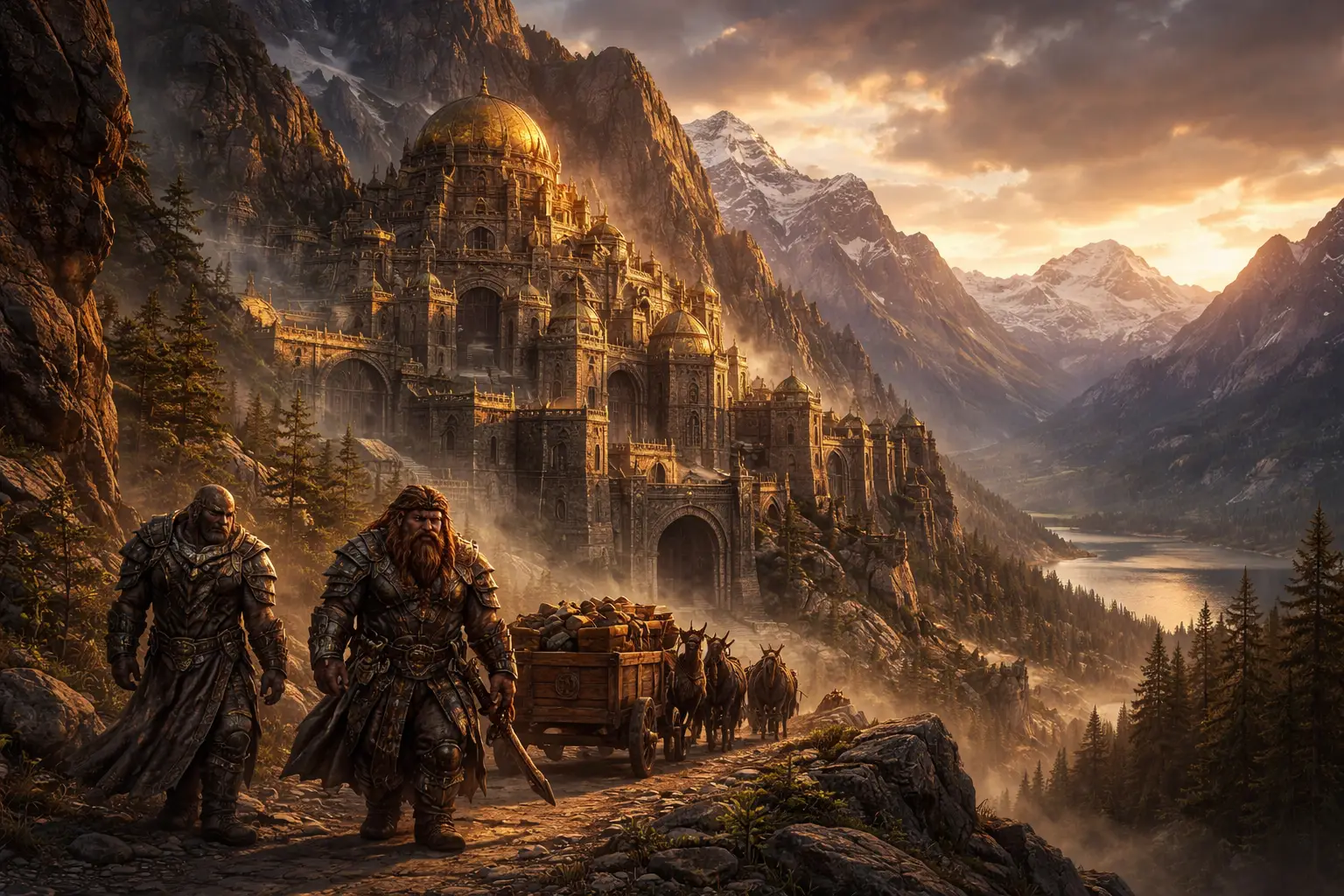
Politics of the Mror Holds
From the travel journal of Kessler d'Sivis, trade liaison to Krona Peak, Sypheros 996 YK:
I have attended six sessions of the Iron Council. In that time I have watched Clan Mroranon and Clan Soldorak argue for three hours over mining rights to a gallery that neither clan has actually explored, Clan Doldarun walk out in protest over a Narathun delegate's symbiont brooch, and the Kolkarun ambassador smile through the entire proceeding while quietly brokering a side deal with both parties.
There is a code of law here — the problem is that it is nine hundred years old, was designed for a nation that did not exist yet, and is interpreted differently by every clan lord in the room. What holds this council together is not the law. It is the understanding that the alternative to arguing in this chamber is arguing with axes, and that the last time they tried that, it took Prince Karrn only six years to conquer them all.
The Governing Structure
The Mror Holds are a feudal confederation — twelve sovereign clan-holds united under an Iron Council that has existed for less than a century and whose authority depends entirely on the willingness of its members to cooperate. There is no king of the Mror Holds. There is no prime minister, no chancellor, no central executive of any kind. The Iron Council — Mror Aulan — sits in Krona Peak and serves as the nation's governing body, but it is a deliberative assembly, not a centralized government. It resolves disputes, coordinates responses to threats that affect the entire nation, and issues proclamations that carry the weight of collective agreement. It does not have the power to compel a clan lord to do anything that the clan lord has not agreed to, and every clan lord in the chamber knows it.
This makes the Mror Holds the opposite of Darguun, where one hobgoblin's personal authority holds the nation together. In the Mror Holds, it is the absence of any single authority that defines the system — twelve proud clans whose cooperation comes grudgingly, whose memories are very long, and whose feuds are never more than one bad council session away from resuming. The system works because the clans have more to gain from unity than division — because the War Below requires coordinated defense, because the international trade that makes the Holds rich depends on stability, and because every clan lord remembers what happened the last time the dwarves were too divided to resist an external threat.
It also works because Clan Mroranon is very large, very wealthy, and very strategically positioned at the center of the Holds, and because no one else wants to find out what happens if Mroranon decides that being first among equals is not enough.
The Iron Council
The Mror Aulan was convened for the first time in 914 YK, when the twelve clan lords gathered in Krona Peak to declare independence from Karrnath. Before that date, there was no unified governing body — the clans had spent the previous five thousand years either feuding or individually paying tribute to Galifar, and the concept of a shared institution was foreign to a people whose primary political unit had always been the family.
The council meets in Krona Peak, in a chamber within the shadow of Kol Korran's Throne — the largest temple to any Sovereign in all of Khorvaire. Each of the twelve ruling clans holds a seat. House Kundarak, the thirteenth clan turned dragonmarked house, does not hold a seat and is not considered a Mror clan for council purposes, though its influence is felt in virtually every decision the council makes. The Jhorash'tar orcs hold no seat either, though the Frosthaven clans of Toldorath and Tordannon have spent the last century promoting the idea of orc representation — a proposal that Clan Droranath opposes with a vehemence that has, on at least one occasion, nearly come to blows on the council floor.
The council operates by consensus, which in practice means that any decision requires enough agreement among enough powerful clans to be enforceable. A resolution backed by Mroranon, Doldarun, and two or three mid-tier clans will generally hold. A resolution opposed by Soldorak, Narathun, and their allies will generally stall. A resolution that splits the council evenly will produce a great deal of shouting, several pointed references to offenses committed centuries ago, and no outcome whatsoever. The council has no mechanism for breaking deadlocks beyond negotiation, bribery, and the occasional creative reinterpretation of ancient precedent by whichever Kolkarun diplomat is working the room that day.
The council's authority covers matters that cross clan boundaries: trade agreements with foreign nations, coordinated defense of the Realm Below, disputes over mining rights in contested territory, and the rare but explosive question of what to do about a clan that has violated a collective agreement. Internal clan affairs — justice, land tenure, family disputes, the treatment of tenant families — are the exclusive domain of each clan lord and are not subject to council oversight. A clan lord could, in theory, do anything they pleased within their own hold, and the council could do nothing about it unless the other clans were willing to intervene by force. This has happened. It is not common. When it happens, it tends to be memorable.
"The Iron Council is the only institution in Khorvaire where twelve people who fundamentally disagree about everything manage to run a country by the simple expedient of being too stubborn to let anyone else do it." — Professor Halden ir'Soras, University of Wynarn, in a lecture on comparative governance
The Feudal Structure: Holds, Spires, and Families
Beneath the council, the Mror Holds are organized into a three-tiered feudal system that has remained essentially unchanged since the Exile.
At the top are the holds — twelve territories, each bearing the name of the ruling clan that governs it. Droranathhold is ruled by Clan Droranath. Mroranonhold is ruled by Clan Mroranon. The ruling clan holds ultimate authority over all land within the hold, both on the surface and — critically — everything that lies below it. This principle became enormously consequential after the Revelation, when the right to claim what lay beneath your territory suddenly meant the right to claim the treasures and horrors of Sol Udar.
Each hold is subdivided into spires — smaller territories governed by lesser clans with ancient ties of kinship and marriage to the ruling line. A spire-clan owes fealty to the ruling clan and provides warriors, tribute, and political support in exchange for the right to govern its territory and exploit its resources. The relationship is feudal in the classical sense: obligations flow in both directions, and a ruling clan that fails to protect its vassal spires will find its vassals looking for better arrangements.
Within each spire, families maintain tenant relationships with the local clan. Land is held by clans and families, and most businesses are family enterprises. Families are long-established and deeply conservative — the creation of a new family is an extraordinarily rare event, treated with the same gravity that a new noble line would receive in the Five Nations. A Mror dwarf's family is not merely their relatives; it is their identity, their reputation, their story. Betraying a family member is like stabbing yourself in the hand. Wronging a member of another family wrongs the entire family — a principle that fuels feuds but also enforces a rough accountability, since everyone knows that their actions reflect on their kin.
Most Mror take the clan name of their ruling house for official purposes, but lesser clan names and family names carry enormous weight within the Holds. A dwarf who introduces themselves by family name is telling you exactly where they stand in the social order, and a Mror who can trace their family's involvement in a famous tale — who can say "my great-grandmother was the Doldarun who faced the troll king" — carries a prestige that no amount of gold can replicate. Gold helps, though. The Mror are very clear on this point.
The Ruling Clans and the Political Landscape
The twelve ruling clans are not equal in power, wealth, or influence. The political landscape of the Iron Council is shaped by a set of alliances, rivalries, and grievances that predate the council itself by centuries and that show no sign of resolving.
Clan Mroranon is the largest, wealthiest, and most industrialized clan, and it dominates the council through sheer weight. Krona Peak is the capital, the seat of the council, and the home of Kol Korran's Throne. Mroranon has the deepest investment in the Realm Below and the strongest ties to House Cannith, and it positions itself as the natural leader of the Holds — a claim that Soldorak resents, Doldarun respects but does not defer to, and everyone else navigates around. Mroranon's political stance on the symbiont debate is calculated neutrality: the clan refuses to use symbionts but has not moved to ban them, a position that preserves its alliances with both sides of the divide while committing to neither.
Clan Soldorak is Mroranon's primary rival — nearly as wealthy, sitting atop vast gold and platinum deposits, and operating the largest mint and treasury in Khorvaire. Soldorak's politics are defined by its founding principle: power must be earned, and the ends justify the means. The clan has embraced symbionts, fleshcrafting, and warlockry openly, and its lords wear living armor in public as a statement of intent. Soldorak is more socially mobile than other clans — talented dwarves can be elevated into the ruling family regardless of birth, and incompetent heirs can be expelled — which gives it a meritocratic energy that the more traditional clans find unsettling. Soldorak has strong ties to Narathun and Kolkarun, and many of the most powerful members of the Aurum — Khorvaire's exclusive society of the ultra-wealthy — are Soldorak or Kolkarun dwarves.
Clan Doldarun is the moral conscience of the Holds, or the self-appointed moral police, depending on whom you ask. Doldarun draws the hardest line against symbionts and fleshcrafting, refuses entry to anyone carrying daelkyr-made items, and has feuded with Soldorak and Narathun over the issue for decades. Its soldiers are the finest in the Holds, its devotion to the Sovereign Host is deep, and its willingness to die for principle is not in question. Doldarun's political influence comes not from wealth — it is not among the richest clans — but from moral authority and military credibility. When Doldarun says something is wrong, the other clans listen, even when they disagree.
Clan Narathun is small, secretive, and powerful in ways that make the other clans uneasy. Its capital at Shadowspire houses the Ebon Library, one of the finest schools of divination in Khorvaire, and its oracles are respected and feared across the Holds. Narathun has embraced fleshcrafting alongside Soldorak and maintains temples to both the Shadow and the Blood of Vol — faiths that the rest of the Holds regard with suspicion at best. Narathun holds long grudges: it has never forgiven Tordannon and Toldorath for thefts committed before Bal Dulor, despises Droranath for a murder that occurred eight centuries ago, and treats Doldarun's condemnation as propaganda to be endured. Soldorak and Narathun are staunch allies, bound by their shared interest in the Realm Below.
Clan Kolkarun is the diplomat's clan — negotiators, merchants, and sailors who have always managed to trick other clans into fighting their battles. Rivals say "Kolkarun's mother was a gnome." The Kolkarun shrug and respond, "Only a fool passes up an opportunity." Kolkarun maintains the strongest ties to foreign nations and serves as the Iron Council's primary diplomatic arm. Most of the council's intelligence operatives are Kolkarun dwarves, a fact that is widely suspected but never officially acknowledged.
Clan Droranath is the warrior's clan — fierce, traditional, poor, and proud of all three. The "Mror Howlers" sell their services as mercenaries through House Deneith and have done so for centuries. Droranath's primary political passion is its hatred of the Jhorash'tar orcs, whom it has fought since the first days of the Exile, and it opposes any proposal to integrate the orcs into Mror society with a fury that makes even the symbiont debate look civilized.
Clans Lanarak and Londurak are the valley clans — farmers, brewers, and fishers who control the food supply that the mountain clans depend on and who wield that leverage with a pragmatism that belies their rustic reputation. Their perpetual, sibling-like rivalry with each other is the closest thing the Holds have to entertainment that does not involve axes.
Clan Soranath is small but influential through the quality of its artisans. Soranath smiths are unmatched, and the clan's dragonshard deposits give it resources disproportionate to its size. Its artificers are fascinated by both ancient Mror relics and daelkyr fleshcrafting, positioning the clan awkwardly between the two sides of the debate.
Clans Toldorath and Tordannon — the Frosthaven clans — share a capital, a reputation for compassion, a talent for healing and hospitality, and the most controversial political position in the Holds: that the Jhorash'tar orcs deserve a seat on the Iron Council. This stance has brought them into bitter conflict with Droranath and earned them the wary respect of the moderate clans. Toldorath has gone further than advocacy, employing Jhorash'tar mercenaries in its Realm Below colony — a practical experiment in integration that the rest of the Holds watches closely.
House Kundarak has no seat on the council but its influence permeates everything. The Banking Guild's financial infrastructure underpins the economy of the Holds and half of Khorvaire. Kundarak engineers built the fortifications that hold the line in the War Below. Kundarak vaults store the treasures that the clans have recovered from Sol Udar. The house maintains a studied neutrality in clan politics — the Korth Edicts require it, and Kundarak's commercial interests are best served by stability — but Soldorak has long accused the house of abandoning traditional Mror values and selling out the dwarves. Kundarak's response, characteristically, has been to continue making money.
PRIVATE NOTE — found in the margins of an Iron Council session transcript, authorship attributed to a Kolkarun delegate, undated
Mroranon wants to lead. Soldorak wants to win. Doldarun wants to be right. Narathun wants to know everything. Droranath wants to fight someone. The valley clans want to be left alone. Soranath wants a better forge. The Frosthaven clans want the orcs at the table. Kundarak wants its percentage.
And Kolkarun? Kolkarun wants to be the one writing the minutes.
Law and Justice
The Mror Holds operate under a legal framework that would make a Brelish parliamentarian weep and a Karrnathi military judge resign in protest. There is no unified code of law. The Galifar Code of Justice does not apply; although the Treaty of Thronehold recognized the Holds as sovereign, but the common laws of the treaty nations are not enforced within the mountains.
Justice in the Mror Holds is clan justice. A dwarf who wrongs a clanmate answers to the clan lord. A dwarf who wrongs a member of another clan has started a feud — a problem that the Iron Council may be asked to adjudicate, but that is just as likely to be settled through direct negotiation between the families involved, compensation in gold or goods, or, if the offense is severe enough, violence. Crimes against outsiders are handled by whichever clan controls the territory where the offense occurred, and the standard of justice applied depends entirely on how the clan lord feels about outsiders. In Krona Peak, foreign merchants can expect a rough but functional legal process. In a remote Droranath spire, a foreigner who gets robbed may find that the local lord considers the robbery to have been the foreigner's fault for being there in the first place.
The critical legal principle of the Holds is territorial sovereignty: a clan holds dominion over its territory and all that lies below it. This means that mining rights, exploration rights, and the disposition of anything recovered from the Realm Below are determined by which clan's territory sits above the relevant gallery. Disputes over subsurface boundaries — where one clan's territory ends and another's begins, miles below the surface — are among the most contentious issues the Iron Council faces, and they are resolved with a combination of precedent, negotiation, and the implicit understanding that any clan willing to fight over a mine had better be prepared to hold it.
Foreign Relations
The Mror Holds maintain trade relationships with virtually every nation in Khorvaire, because virtually every nation needs metal, gemstones, or Kundarak banking. The Holds are not diplomatically active in the way that Breland or Aundair are — they do not seek alliances, do not pursue territorial expansion beyond the Ironroots, and do not involve themselves in the politics of the successor states. What they want is to be left alone to mine, trade, and argue with each other in peace. What they get is a neighborhood that will not stop being complicated.
Karrnath is the closest neighbor, the former overlord, and the most complex relationship. The two nations are natural economic partners — geographic proximity and pre-existing infrastructure make trade inevitable — but Karrnath has never entirely accepted losing the Holds, and the dwarves have never forgiven the centuries of tribute. Relations range from functional to icy depending on which Karrnathi warlord faction is ascendant and how recently a Soldorak lord has worn living armor to a diplomatic function.
Breland is a major trading partner — Mroranon steel and Soldorak coin circulate across the nation — but the relationship is commercial rather than political. The Mror maintain Highhold, a district in Sharn's Upper Dura built by dwarves for dwarves, which serves as their primary point of contact with Breland's largest city.
The Lhazaar Principalities share the eastern face of the Ironroot Mountains, and specific clans — Kolkarun especially — have cultivated trading relationships with specific principalities. Much of the eastern trade passes through Mirror Lake and down to the Lhazaar ports.
Zilargo is the Holds' oldest non-dwarven partner. The Zil-Mror relationship predates Galifar, and Zil scribes, accountants, and scholars remain embedded in clan courts across the Holds.
The Talenta Plains maintain modest trade ties, and Mror cuisine finds surprising admirers among the stout halflings, whose constitutions are robust enough to survive it.
"Every nation in Khorvaire wants something from the Mror Holds. Iron, gold, mithral, banking, gemstones, mercenaries. The Mror want exactly one thing from every nation in Khorvaire: to be paid promptly and left alone. This is the simplest diplomatic relationship on the continent, and somehow everyone still manages to complicate it." — Kolkarun trade envoy, speaking at a reception in Sharn